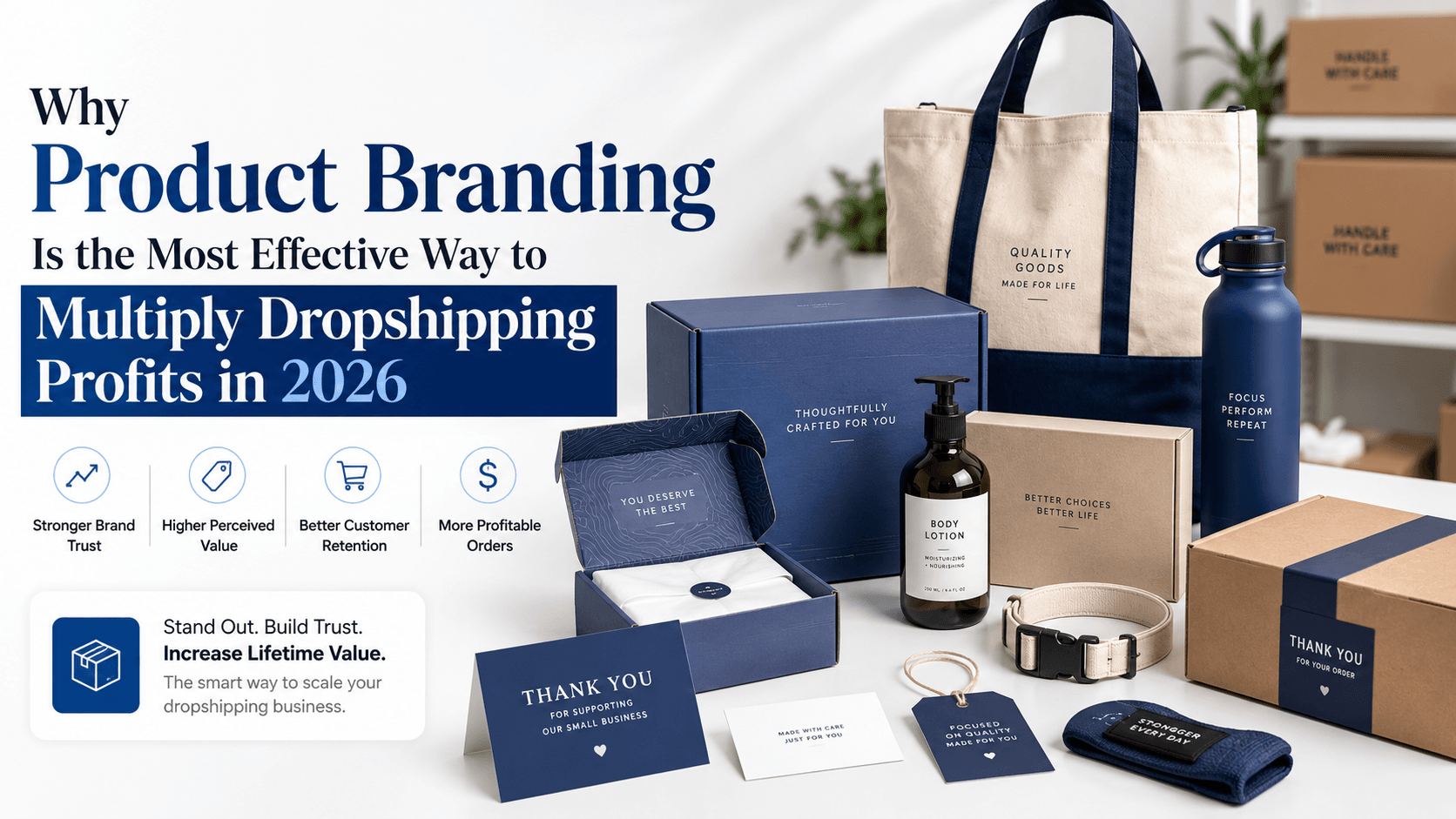
Why Product Branding Is No Longer Optional for Dropshipping in 2026
Dropshipping still offers one of the most flexible ways to test ecommerce products without purchasing large amounts of inventory before customers begin buying. What has changed is the competitive environment around the model.
A seller can still find a product, launch a Shopify store, create advertising, and begin fulfilling orders through an external supplier. The problem is that thousands of other sellers can often access the same product, similar supplier images, comparable advertising ideas, and the same marketplaces.
When products are easy to copy, the store needs another reason to exist.
This is where product branding becomes important. Branding does not mean that a beginner needs custom molds, a large production run, or expensive packaging before the first sale. It means gradually creating an offer customers can recognize and remember instead of permanently selling an anonymous supplier product that can be compared only by price.
For dropshipping sellers in 2026, the real shift is therefore not from dropshipping to traditional ecommerce. It is from generic product selling to branded product selling.
The Main Problem With Generic Dropshipping Is Not the Product
Many generic dropshipping products are perfectly useful.
A storage organizer can solve a real household problem. A pet accessory can make traveling with an animal easier. A beauty tool may save time, while a fitness accessory can make a workout more convenient.
The problem is that usefulness alone rarely creates exclusivity.
If several stores sell almost the same product using the same supplier images and similar descriptions, the customer has very little reason to remember which store provided it.
The product becomes interchangeable.
Once that happens, competition naturally moves toward price, advertising, discounts, and delivery speed. Those can all be legitimate competitive advantages, but they are difficult to defend when competitors can access almost the same supply chain.
Branding creates another layer of differentiation.
The seller begins shaping how the customer perceives the product rather than relying entirely on the physical item supplied by the factory.
Customers Can Compare Products Faster Than Before
The traditional dropshipping model benefited partly from information gaps.
A customer might discover an unusual product through a Facebook advertisement and have limited knowledge of where else it could be purchased.
That environment has changed.
Customers can now search product images, browse Amazon, check TikTok Shop, compare marketplace prices, watch reviews, and find similar products within minutes.
This does not mean every customer will always buy from the cheapest source.
It means sellers need a stronger explanation for why the customer should buy from this particular store.
A brand can provide that explanation through clearer positioning, more consistent presentation, stronger product information, better packaging, original content, useful bundles, and a more professional overall experience.
The physical product may still begin from an existing supplier.
The customer proposition does not have to remain generic.
Branding Is More Than Putting a Logo on a Product
One of the most common misunderstandings is that branding begins and ends with a logo.
A logo is only an identifier.
Real product branding can involve how the product is positioned, which customer it is designed for, how variations are selected, how instructions are written, how the product is photographed, how different products are bundled, and what customers experience after opening the package.
Consider a simple pet grooming brush.
One seller can upload the supplier images, call it a “Pet Grooming Brush,” and compete mainly on price.
Another seller might position the same general product specifically for long-haired indoor cats, provide original grooming instructions, select particular colors, create a travel storage pouch, include a care card, and develop related grooming products around the same customer.
The second store has begun creating a brand even before deep product customization occurs.
Branding is therefore not decoration added at the end.
It is the process of giving an ordinary product a more specific identity.
Product Positioning Is the First Layer of Branding
Before thinking about packaging or logos, sellers should determine who the product is actually for.
A generic product can often serve several types of customers, but marketing it to everyone usually makes the message weaker.
A travel organizer can become part of a minimalist travel brand. A household storage product can be positioned for small apartments. A pet accessory can be designed around owners who travel frequently with their dogs.
The physical product may initially remain similar.
The context changes.
This matters because customers do not usually buy an object in isolation. They buy an expected outcome.
Strong branding makes that outcome clearer and more specific.
It also helps sellers decide which future products belong in the store and which ones do not.
Branding Reduces Dependence on Product Novelty
Generic dropshipping often depends heavily on continuously finding the next interesting product.
A product begins trending, sellers launch advertisements, competition increases, advertising becomes more expensive, and eventually attention moves somewhere else.
The store then searches for another product.
This can work as a testing strategy, but it is difficult to turn into a durable business if customers have no relationship with the store itself.
A branded store has another option.
Instead of abandoning every successful product when growth slows, the seller can build adjacent products around the same customer.
A successful travel accessory can lead to organizers, packing products, travel bags, luggage accessories, and other products serving the same audience.
The original winning product becomes the beginning of a product system rather than an isolated campaign.
Branding Can Make Price Comparisons Less Direct
Branding does not magically allow sellers to charge any price they want.
Customers still evaluate value.
But a well-developed offer is more difficult to compare directly with a generic marketplace listing.
Suppose two sellers source broadly similar cosmetic bags.
One product arrives in a plain transparent bag and uses standard supplier images.
The other has a consistent visual identity, useful interior organization, branded packaging, original lifestyle photography, clearer dimensions, a coordinated travel pouch, and a more professional product page.
Customers are no longer comparing two completely identical offers.
This creates more room for positioning and pricing.
The advantage does not come from the logo itself. It comes from making the overall offer meaningfully different.
A Brand Gives Advertising More to Work With
Advertising a generic product can become repetitive.
The creative usually focuses on the same product demonstration competitors are already using.
Brand identity expands the available marketing material.
Sellers can create content around a customer lifestyle, product philosophy, recurring visual style, problem-solving approach, product series, packaging experience, customer stories, and product education.
This gives advertising more depth than repeating the same “problem → product → discount” structure.
It can also make organic content easier.
A recognizable store has a consistent subject to talk about.
That becomes particularly important when a business wants traffic from TikTok, Instagram, YouTube, Pinterest, email, influencers, or search rather than depending completely on one paid advertising platform.
Branding Helps Customers Remember Where They Bought
A customer may love a generic dropshipping product and still forget the name of the store that sold it.
That creates a serious problem for repeat purchases.
The seller paid to acquire the customer, but the customer remembers only the object.
When they want another product later, they search again and may purchase from a competitor.
Branding changes the memory structure.
A recognizable name, visual identity, packaging experience, product style, useful communication, and consistent customer service make it more likely that the customer remembers the seller as well as the product.
This does not guarantee repeat purchases.
But without brand recognition, repeat purchasing becomes much harder to encourage.
Repeat Purchase Potential Changes the Economics of a Store
A store that must purchase every customer through advertising is structurally different from a store that can generate some revenue from previous buyers.
The first order may require substantial acquisition cost.
A second purchase from an existing customer may require email, organic social content, a product launch, or a smaller promotional incentive instead of the full cost of acquiring a completely new buyer.
This is one reason branding becomes increasingly valuable as stores mature.
It creates the possibility of building customer relationships instead of treating each transaction as an independent event.
Categories with naturally related products can benefit particularly strongly.
Beauty, pets, fitness, fashion accessories, home organization, travel, hobby products, and personal-care products can often support multiple purchases from the same customer when the product range remains coherent.
Branding Also Creates Better Product Expansion Decisions
Without a clear brand, adding products can become random.
The seller sees something trending and uploads it.
A branded store asks a different question:
Does this product make sense for our customer?
That simple question can improve product selection considerably.
A brand targeting small-space organization might add drawer organizers, foldable storage, cable-management products, compact laundry solutions, and modular shelving accessories.
It probably would not add a random automotive gadget simply because the product is trending.
This gives the catalog a stronger internal logic.
The more coherent the catalog becomes, the easier it is to create bundles, cross-sells, content, email campaigns, and product collections.
The Best Time to Start Branding Is Not Before Product Validation
Branding is important, but investing too much too early creates another problem.
A seller who has never sold the product does not know whether customers actually want it.
Ordering thousands of custom boxes, developing expensive molds, or committing to large quantities simply to look like a brand can destroy one of the biggest advantages of dropshipping.
Product validation should still come first.
During early testing, branding can remain light.
The store can have a consistent name, design, product positioning, page style, customer communication, and original content without requiring large physical customization commitments.
If the product begins generating repeatable orders, the next level of branding becomes easier to justify.
This gradual approach is explained more deeply in the practical guide on how to build a brand with dropshipping, where the transition from testing to more structured brand development becomes a separate operational decision.
Light Branding Is Usually Enough at the Beginning
Early branding does not need to be expensive.
A beginner can begin with consistent product-page design, original descriptions, a recognizable visual style, clear instructions, better product photography, branded digital communication, and thoughtful product bundles.
Small physical additions can come later.
A sticker, thank-you card, printed instruction card, simple branded bag, or product label can sometimes be introduced with much less commitment than fully custom manufacturing.
The purpose is not to imitate a multinational brand.
It is to make the customer experience more intentional.
As demand grows, sellers can then decide whether deeper customization produces enough value to justify the additional cost.
Packaging Becomes More Important After the Product Is Proven
Packaging is one of the most visible forms of branding because it is often the first physical contact a customer has with the store.
However, packaging should still serve the product.
A beautiful oversized box that dramatically increases dimensional shipping weight can damage the economics of the order.
A minimal package that looks good but fails to protect the product is equally weak.
Strong ecommerce packaging balances protection, shipping efficiency, presentation, and brand recognition.
A lightweight fashion accessory may need only a branded pouch, custom label, or care card, while a fragile home product may require significantly more protective packaging. As order volume becomes predictable, these elements can gradually become part of a broader product branding strategy, rather than requiring a large customization commitment before the product has been validated.
The packaging strategy should therefore follow the physical characteristics and value of the product, not simply the desire to print a logo somewhere.
Product Customization Becomes More Valuable When Competitors Can Copy the Offer
Eventually, some stores reach a point where packaging alone is not enough.
Competitors can still source the same physical product.
This is where product-level customization becomes more interesting.
A seller might change colors, materials, dimensions, accessories, functions, packaging configuration, or bundle composition.
The goal is not necessarily to invent a completely new product.
Even small changes can make direct comparison harder.
The best customization ideas usually come from customer data.
If reviews repeatedly complain that a bag needs another compartment, a product needs a stronger material, or an accessory needs a different size, those complaints can become product-development opportunities.
At this stage, customization is solving real problems instead of changing the product merely to make it different.
Personalization Is Another Form of Differentiation
Some categories can go beyond general branding into personalization.
Names, initials, custom colors, printed messages, custom combinations, or made-to-order details can create products that are more difficult to compare directly with generic marketplace listings.
Personalization also changes the emotional value of some products.
A standard bag may be a functional purchase. The same type of product with a name or meaningful design can become a gift.
That can open different advertising angles and customer occasions.
The economics and operational complexity still need to be evaluated carefully, but personalized dropshipping products can provide another path for stores that have already moved beyond pure generic-product competition.
Branding Requires More Consistent Product Quality
A generic testing store can sometimes replace one supplier with another relatively quickly.
A brand has less freedom to make uncontrolled changes.
Once customers associate a particular material, color, fit, finish, or product experience with the brand, inconsistency becomes more damaging.
Imagine customers repeatedly purchasing the same storage product.
If one production batch uses thicker material and the next feels noticeably cheaper, customers may interpret the change as a decline in the brand rather than simply a supplier difference.
This means branding gradually creates a need for stronger specification control.
Samples, materials, colors, dimensions, packaging, and acceptable quality standards become more important as sales volume increases.
Branding Turns Supplier Selection Into a Longer-Term Decision
During early dropshipping testing, sellers may prioritize flexibility.
The product needs to be available, reasonably priced, and capable of shipping to the target market.
Once branding becomes deeper, supplier relationships become more strategic.
The supplier may need to reproduce a specific color, maintain packaging standards, support labels, assemble bundles, manage inventory, or follow a defined quality standard.
Changing suppliers then becomes more complicated because the replacement must reproduce the branded specification rather than simply provide a roughly similar generic product.
This is why sellers should avoid investing heavily in branding before confirming that the underlying supply chain can support it consistently.
White Label and Private Label Are Not the Same as Branding
These terms are frequently used as if they mean exactly the same thing.
They do not.
White label generally refers to an existing product that can be sold under the seller's branding with relatively limited physical modification.
Private label can involve deeper control over the product, packaging, materials, specifications, or production arrangement.
Branding is broader than either model.
A store can build brand recognition before it ever moves into private-label manufacturing, and a private-label product can still fail to create a meaningful brand if the positioning and customer experience are weak.
The important point is that manufacturing structure and brand strategy are related but separate decisions.
Some Categories Are Easier to Brand Than Others
Products with strong visual identity, repeat-purchase potential, bundles, accessories, variations, or lifestyle positioning are generally easier to turn into coherent brands.
Beauty accessories, pet products, bags, fitness accessories, home products, fashion accessories, travel products, kitchen tools, and certain hobby categories can provide room for product series and visual differentiation.
The opportunity is particularly clear in white-label categories where customers already expect packaging and presentation to matter. For example, the structure behind a white-label beauty dropshipping business shows how product selection, packaging, positioning, compliance, and customer expectations have to work together instead of treating branding as a logo added to a generic item.
Other categories may be more difficult if customers purchase mainly according to technical specification or commodity pricing.
Brandability should therefore be considered during product selection.
Branding Does Not Fix a Weak Product
There is a dangerous assumption that good packaging can turn any product into a successful business.
It cannot.
If customers do not need the product, branding will not create sustainable demand.
If the product breaks frequently, beautiful packaging will not prevent refunds.
If the economics leave almost no margin, a logo will not solve the cost structure.
If delivery performance is poor, branding may actually make the problem worse because customers expect more from a professional-looking store.
Branding works best when it amplifies a product that already provides value.
The correct sequence is usually:
validate the product, understand the customer, stabilize the basic fulfillment process, and then increase branding investment as evidence grows.
Branding Should Not Be Measured Only by Immediate Conversion Rate
Some branding investments can improve conversion directly.
Better photographs, clearer positioning, stronger packaging presentation, and more professional product pages can make the offer more credible.
Other benefits appear later.
Branding can affect repeat purchases, organic mentions, referrals, customer retention, bundle acceptance, perceived quality, and the ability to launch additional products to an existing audience.
This makes branding harder to evaluate than a single advertising metric.
A seller should not ask only whether adding a branded package increased today's conversion rate.
The broader question is whether the business is gradually becoming less interchangeable.
The Goal Is to Become Harder to Replace
This is one of the simplest ways to think about branding.
A generic store is easy to replace.
If customers can find the same product elsewhere, see the same photographs, receive similar packaging, and get a comparable service experience, switching costs are extremely low.
A brand becomes stronger as substitution becomes less obvious.
The customer may prefer the design, trust the product selection, understand the store's positioning, enjoy the packaging, recognize the content, or know what level of quality to expect.
None of these advantages requires the business to become globally famous.
A small niche brand can be valuable because it is memorable to a relatively small but relevant customer group.
When Should a Dropshipping Seller Start Investing More Seriously in Branding?
The strongest signal is usually repeatable demand.
If a product has moved beyond a few experimental orders and begins generating consistent sales, the seller has more information.
Customer questions reveal what instructions are missing.
Reviews reveal what customers like or dislike.
Advertising data shows which positioning works.
Return reasons reveal product weaknesses.
Sales data shows which colors, sizes, and variations deserve inventory.
At that point, branding investments become less speculative.
The seller can improve the product and presentation using actual customer evidence rather than assumptions.
When Should You Avoid Deep Branding?
Deep branding is usually premature when the product has not been validated, demand is extremely seasonal, supplier quality is unstable, the product changes frequently, or the business is still testing completely different customer groups.
It may also be unwise when customization requires a large minimum order that the store cannot reasonably sell.
The purpose of branding is to reduce long-term business risk.
It should not create unnecessary inventory risk simply because branded products appear more professional.
Light branding preserves flexibility until the product earns deeper investment.
Branding Can Begin Before You Own Inventory
A common misconception is that a business must first become a traditional inventory seller before it can build a brand.
That is not necessary.
Branding can begin at the customer-facing level while fulfillment remains flexible.
The store can establish positioning, visual consistency, product education, customer communication, original content, and a coherent catalog without owning thousands of units.
As the strongest SKUs become predictable, physical brand elements can be introduced gradually.
Some products may later move into small inventory buffers or customized manufacturing, while long-tail products remain more flexible.
The supply-chain model does not need to be identical across the entire brand.
Branded Dropshipping Is a Transition, Not a Separate Business Model
It is tempting to think of generic dropshipping and branded ecommerce as two completely different businesses.
In practice, many successful stores move gradually between them.
A product begins as a low-commitment test.
The seller learns that customers want it.
The store improves its positioning and content.
Packaging becomes more consistent.
The supplier relationship becomes more stable.
Product variations are refined.
Eventually, deeper customization or inventory may be introduced.
The important point is that each additional investment follows evidence.
This retains the flexibility that makes dropshipping attractive while gradually creating advantages that competitors cannot copy as easily.
Frequently Asked Questions
Do dropshipping sellers really need branding?
Not every product test needs deep branding. However, sellers trying to build a long-term store usually benefit from creating a recognizable identity, clearer positioning, consistent presentation, and a more memorable customer experience.
Can I brand a dropshipping product without buying inventory?
Yes. Brand development can begin with positioning, product pages, content, photography, customer communication, bundles, and light packaging. Larger physical customization can be introduced after demand becomes predictable.
Is branded dropshipping the same as private-label dropshipping?
No. Private labeling is a sourcing or manufacturing arrangement. Branding is the broader process of creating a recognizable product and customer experience. A business can build a brand before moving into private-label production.
When should I add custom packaging?
Custom packaging generally makes more sense after a product has demonstrated consistent demand. Early-stage sellers should avoid making large packaging commitments before they know whether the product will continue selling.
Does branding increase dropshipping profit?
It can support stronger pricing, bundles, repeat purchases, and differentiation, but it does not guarantee profit. Product economics, advertising, sourcing, fulfillment, and customer demand still determine whether the business is financially healthy.
What products are easiest to brand?
Products with clear lifestyle positioning, related accessories, bundle potential, repeat purchases, visual differentiation, or customization opportunities tend to provide more room for branding.
Do I need a custom product to build a brand?
No. Many stores begin by improving the positioning and customer experience around an existing product. Product-level customization can come later when sales justify it.
Should beginners focus on branding or finding winning products?
Beginners need both in the correct order. First validate that customers want the product. At the same time, build a coherent store rather than a completely generic one. Deeper branding investment should follow proven demand.
Conclusion
Product branding is becoming more important for dropshipping because generic products are increasingly easy to discover, compare, and copy.
The problem is not that dropshipping has stopped working. The problem is that access to products is no longer a strong competitive advantage by itself.
Branding gives sellers another way to compete.
It can make the product easier to recognize, create a more coherent product range, support stronger presentation, reduce direct price comparison, improve the opportunity for repeat purchases, and make the store itself more memorable.
But branding should grow at the same pace as evidence.
A new product does not need expensive customization before its first sale. Light branding can begin through positioning, content, visual consistency, customer communication, and product presentation.
Once demand becomes stable, sellers can gradually introduce packaging, labels, product modifications, bundles, personalization, and stronger supplier specifications.
The goal is not to make a dropshipping store look like a large company overnight.
The goal is to stop being completely interchangeable.
In 2026, that difference is increasingly what separates a temporary product seller from a business customers can remember and choose again.