How Product Branding Can Improve Dropshipping Profits in 2026
Dropshipping sellers once competed mainly by finding a product early and launching advertisements quickly. That advantage is easier to copy in 2026. Competitors can locate the same supplier, reuse similar images, match a price, and reach the same audience. Branding matters because it changes what the customer compares: not only the item, but also the positioning, evidence, packaging, instructions, support, and experience around it.
Branding does not automatically multiply profit, and adding a logo to an unproven product can waste money. The commercial value appears when a validated product gains clearer positioning, higher perceived value, better conversion, stronger retention, or lower comparison with generic listings. This article explains where that value comes from, how to measure it, and when a seller should invest.
The Core Problem for Dropshipping Sellers in 2026: Ordinary Products Are Becoming Harder to Profit From
The traditional dropshipping model is simple: find a product, list it on a Shopify store, run ads, and let the supplier ship the order directly to the customer. This model has a low entry barrier, but its weaknesses are becoming more obvious.
The first problem is product similarity. Many sellers use the same supplier, the same product images, the same descriptions, and even similar advertising angles. Customers can search on Amazon, Temu, AliExpress, or Google Shopping and often find a cheaper version of the same product.
The second problem is rising advertising costs. Ordinary white-label products have little brand value, so sellers have limited room to increase prices. If a product costs $8 including shipping and sells for $19.99, the margin may look attractive at first. But after advertising costs, payment fees, refunds, customer service, and discounts, the real net profit can become very thin.
The third problem is weak repeat purchase potential. When customers receive a plain package, they may remember the product, but they may not remember the store or brand. Without brand memory, it becomes difficult to build email marketing, membership programs, product bundles, and repeat purchases.
Ecommerce competition increasingly rewards sellers who give customers a reason to choose the store rather than search for the lowest-priced copy. The question is shifting from whether the item is available to whether the offer is more credible, useful, and memorable.
Why Branding Can Increase Profit
The biggest role of branding is that it changes how customers judge product value.
Ordinary dropshipping sells product function. Branded dropshipping sells product value, use cases, trust, and experience. The same pet grooming brush, for example, can be sold as a basic tool by a white-label seller. But a branded seller can package it as part of a pet care kit, adding branded packaging, a usage guide, a pet grooming tips card, and related accessories. The customer is not just buying a brush. They are buying a more complete pet care solution.
This directly affects pricing.
A basic pet grooming brush may only sell for $14.99 as a white-label product. But if it comes with branded packaging, a logo, a care guide, a thank-you card, and a storage pouch, the seller may be able to position it at $24.99 or higher. The product cost may only increase by $1–$3, but the perceived value increases much more.
Branding also creates the basis for personalization. A recognizable store can segment customers by the product they bought, recommend a compatible item, and communicate in a consistent voice. Those retention advantages are difficult to build when every order looks like an unrelated marketplace shipment.
Packaging Is Not Decoration. It Influences Repeat Purchases
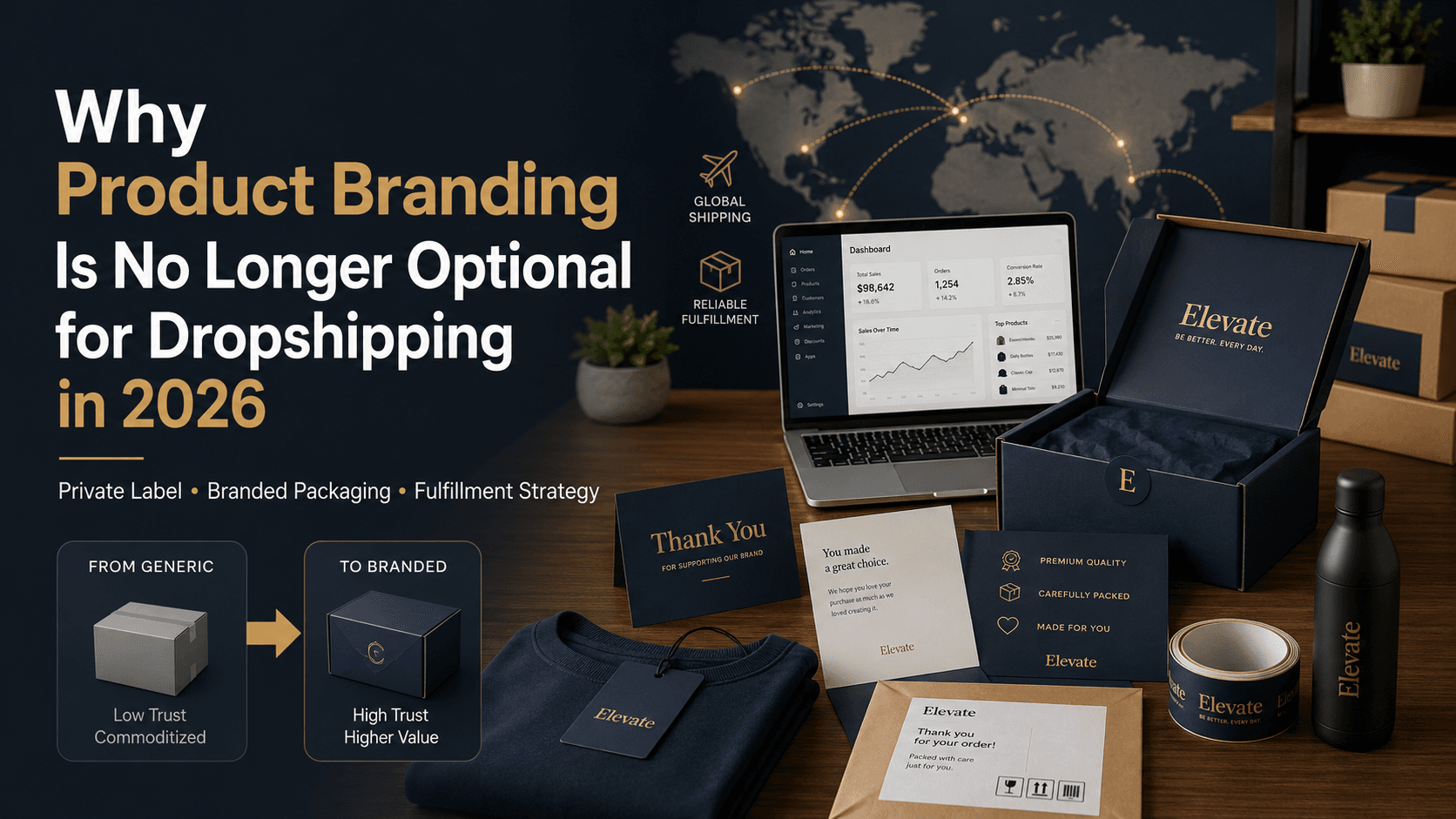
Many new sellers see packaging as an extra cost that should be minimized. But in the 2026 e-commerce environment, packaging has become part of the brand experience.
Packaging affects the customer’s first physical impression, but it should be right-sized and appropriate to the product. Protection, clear instructions, recyclable materials where practical, and an easy-to-recognize sender can matter more than an expensive decorative box.
This is important for dropshipping sellers because the first physical contact between the customer and your brand happens when the package is opened.
A product delivered in a plain plastic bag can easily feel cheap. But a package that includes branded packaging, an instruction card, a thank-you card, an after-sales card, a discount code, and a short brand story can create a much stronger impression.
This is especially important for beauty products, pet products, fitness products, baby products, fashion accessories, bags, gifts, and home goods. In these categories, packaging can directly influence how much value customers feel they are receiving.
Real Case Study: Gymshark Moved From Low-Inventory Testing to Brand Building
Gymshark is a strong example of how a business can move from lightweight product testing to brand building. According to Gymshark’s own brand story, the founder started by selling fitness supplements and later began dropshipping clothing alongside the supplements. After noticing that existing fitness clothing did not fully meet the needs of the target audience, the team began sewing, screen-printing, and shipping their own fitness apparel.
The important lesson is not simply that Gymshark once used dropshipping. The real lesson is the path: test demand with a lighter model, improve the product, build a brand identity, strengthen supply chain control, and eventually create a long-term brand asset.
Shopify’s Gymshark case study reported that Gymshark reached £41 million in sales in 2017 and had millions of social media followers across more than 100 countries. This shows that long-term value does not come from selling ordinary white-label products forever. It comes from turning proven demand into a brand, a community, and a supply chain advantage.
Ordinary dropshipping sellers do not need to copy Gymshark’s scale. But they can learn from the sequence: test demand first, then upgrade the product, build a visual identity, improve the supply chain, and finally create a brand moat.
Real Case Study: Allbirds Shows How Product Value Can Change Pricing Logic
Allbirds is not a traditional dropshipping case, but it is a useful example of how branding can change product value. As a direct-to-consumer footwear brand, Allbirds built recognition through its material story, sustainability positioning, simple design, and customer experience.
Shoes are a highly competitive category. But Allbirds did not compete only on price. It created a clear brand identity around comfort, sustainability, and minimalist design. This helped transform shoes from ordinary functional products into branded consumer products with a stronger emotional and value-based appeal.
This is relevant to dropshipping sellers because many common products are not rare: socks, bags, pet products, yoga products, storage products, beauty tools, and accessories are all easy to find. But if sellers can build a clear brand around a specific customer group, the product no longer has to compete only on price.
Product Categories That Are Suitable for Branded Dropshipping
Not every product is suitable for branding. Products that are too cheap, too standardized, purely functional, difficult to differentiate, or unlikely to create repeat purchases usually have limited branding potential.
Products that are more suitable for branding often have one or more of these qualities: visual appeal, lifestyle value, gifting potential, trust requirements, repeat purchase potential, or room for customization.
Beauty and personal care products are very suitable for branding. Examples include makeup brushes, nail tools, skincare tools, toiletry sets, and beauty device accessories. Customers care about texture, packaging, safety, and trust in this category.
Pet products are also suitable for branding. Examples include pet toys, pet beds, leashes, grooming products, cleaning products, and pet clothing. Pet owners are often willing to pay more for better design, safer materials, and a more thoughtful brand experience.
Fitness and sports products also have strong opportunities. Resistance bands, yoga products, massage balls, sports supports, and fitness storage bags can be upgraded through training guides, product bundles, and branded packaging.
Fashion accessories and bags are another strong category. Socks, hats, tote bags, backpacks, makeup bags, and travel storage bags can be differentiated through embroidery, printing, hang tags, hand-drawn designs, branded boxes, and gift cards.
Print-on-demand products are also a major branding opportunity. Products such as T-shirts, hoodies, hats, mugs, canvas bags, wall art, and personalized gifts can be used to test niche audiences without holding large inventory. The main advantage of POD is that sellers can test designs and customer groups with lower inventory risk.
Validate the Product Before Expanding the Brand Investment
Content test: prove the branded difference visually
The product should support original demonstrations that show the use case, physical details, packaging, instructions, and result without depending on a supplier’s stock footage. If the branded version looks almost identical to a cheaper generic listing, the seller needs a stronger product bundle, presentation, specification, or audience—not merely a larger logo.
Commercial test: measure contribution rather than selling price
Calculate the selling price after normal discounts, then subtract product cost, packaging, payment fees, customer acquisition, shipping, duties or taxes where applicable, refunds, replacements, and support. Compare the generic and branded versions. A higher selling price is useful only when the extra gross profit exceeds the added branding cost and the offer can still convert.
Operational test: make every branded order repeatable
Confirm the approved product, logo file, print position, colour, packaging components, inserts, language, barcode or label requirements, assembly, inspection points, packed dimensions, and replacement responsibility. A brand promise becomes an operational obligation. Inconsistent logo placement, missing cards, damaged boxes, or unapproved substitutions weaken the same trust the branding was meant to build.
How Dropshipping Sellers Can Build Product Branding Step by Step
New sellers should not start with large-scale customization immediately. A safer approach is to test the market with ordinary products first, then upgrade products that already have good sales data.
The first step is to choose products that have already been validated. Sellers should not customize products based only on personal preference. They should look at advertising data, add-to-cart rate, conversion rate, refund rate, customer reviews, and supply chain stability. A product should only be branded after it has shown real demand.
The second step is to start with light branding. This can include logo stickers, thank-you cards, instruction cards, branded packaging bags, hang tags, after-sales cards, and discount code cards. These elements are relatively low-cost and often have lower minimum order quantity requirements, making them suitable for sellers in the testing stage.
The third step is to create product bundles. Single products are easy to compare by price, while bundles can increase average order value and reduce direct comparison. For example, a pet grooming brush can be bundled with cleaning wipes and a storage pouch. Resistance bands can be bundled with a workout guide and a storage bag. Makeup brushes can be bundled with beauty sponges and a brush cleaning pad.
The fourth step is to upgrade the product itself. Once sales are stable, sellers can consider custom colors, upgraded materials, product logos, accessory adjustments, custom packaging boxes, and small-batch inventory.
The fifth step is to build a repeat purchase path. Sellers can include a second-purchase discount code, QR code tutorials, membership offers, after-sales contact information, and new product previews in the package. The final goal of branding is not only to increase first-order profit, but also to improve customer lifetime value.
Choose a Branding Route That Matches the Product Stage
A catalogue platform can be useful while the seller is still testing demand, because it offers product access without an early customization commitment. Once a product proves repeat demand, the seller may need a direct factory, print-on-demand provider, or managed sourcing and fulfillment partner that can control the specification, packaging materials, inspection, inventory, and one-by-one order processing.
The correct route depends on the product rather than the popularity of a platform. Print-led apparel and accessories may suit on-demand production. A stable physical SKU may be better served by a factory plus a controlled packaging workflow. A multi-product store may need a partner that can receive goods from different suppliers, apply stored brand materials, inspect orders, and ship them through one system.
Ask who owns the product specification, which changes require approval, whether packaging has a minimum order quantity, how unused materials are handled, how branded items are separated from other sellers’ stock, and what evidence is provided before dispatch. The supplier label matters less than its ability to reproduce the approved customer experience.
How to Choose the Right Supplier
If you are just starting to test products, CJdropshipping, Zendrop, Printful, or Printify can be practical options because they are easier to start with and have lower operational barriers.
If you already have stable orders and want to improve profit, quality control, branded packaging, and small-batch inventory, you can consider ETdropship or HyperSKU.
If you plan to build a real private-label brand with custom colors, materials, logos, packaging boxes, instruction cards, and product bundles, it is better to work with a supplier that can provide sourcing, quality inspection, warehousing, packaging, and fulfillment in one place. Branding is not just about changing packaging. It requires cooperation between front-end sales and back-end supply chain execution.
Branding Profit Model: Why Higher Costs Can Still Lead to Higher Profits
Many sellers worry that branding will increase costs. This is true, but looking only at costs is not enough. Sellers should focus on whether branding can improve selling price, conversion rate, repeat purchase rate, and refund rate.
For example, a regular white-label product may look like this:
Product cost plus shipping:$8
Selling price:$19.99
Advertising cost:$7
Other costs:$2
Estimated profit per order: about $2.99
After upgrading to a branded product:
Product cost plus shipping and packaging:$10
Selling price:$29.99
Advertising cost:$8
Other costs:$2.50
Estimated profit per order: about $9.49
In this simplified model, the cost increases by only $2, but because the selling price increases by $10, the final profit may become almost three times higher. Of course, this is only a simplified calculation. Real profit depends on the product category, advertising cost, refund rate, logistics cost, and supply chain stability.
But the core logic is clear: branding is not simply an extra cost. It is a way to redesign the product’s perceived value and profit structure.
Protect the Brand Promise With Compliance and Ownership Checks
Before printing a name, logo, claim, or design, confirm that the seller has the right to use it. Check trademarks in the intended market, avoid copyrighted characters and copied packaging, keep source design files, and document supplier permission for any licensed material. Product claims must also match the evidence available for the exact item.
Packaging, labels, warnings, recycling marks, importer details, language, and product documentation can vary by market and category. Ecommerce brand compliance should be reviewed before a branded production run because correcting hundreds of printed boxes costs more than correcting a draft.
Ownership should extend beyond the logo. Retain editable artwork, colour references, packaging dimensions, approved samples, bills of materials where relevant, supplier agreements, and customer-facing instructions. These records make it easier to change factories or fulfillment partners without rebuilding the brand experience from memory.
Frequently Asked Questions
Why do dropshipping sellers need product branding?
Because dropshipping competition in 2026 is no longer only about product selection. The same products are easy to copy, ad creatives are quickly imitated, and customers can easily compare prices on Amazon, Temu, AliExpress, or Google Shopping. Product branding helps sellers build recognition, reduce price comparison, increase perceived value, raise selling prices, and create a foundation for repeat purchases.
Is product branding just about adding a logo?
No. A logo is only one part of branding. Real product branding includes product positioning, packaging design, labels, hang tags, instruction cards, thank-you cards, after-sales cards, brand storytelling, product bundles, custom colors, improved product quality, and a complete customer experience. For dropshipping sellers, branding is not just about making the product look better. It is about making customers feel that the product is more valuable and more trustworthy.
Should new sellers start with branded products immediately?
New sellers should not start with large-scale customization right away. A safer approach is to test the market with regular products first. Once a product has stable orders, controllable refund rates, positive customer feedback, and reliable supply, sellers can begin with light branding. This can include thank-you cards, logo stickers, branded bags, product instructions, and after-sales cards. When sales become stable, they can upgrade to product logos, custom packaging boxes, custom colors, or OEM/ODM production.
What types of dropshipping products are most suitable for branding?
Products that are suitable for branding usually have strong visual appeal, emotional value, trust requirements, gifting potential, or repeat purchase potential. Good examples include beauty tools, pet products, fitness accessories, yoga products, fashion accessories, socks, bags, home organization products, baby products, gift items, and print-on-demand products. These categories can increase perceived value through packaging, design, product bundles, and brand storytelling.
Which products are not suitable for branding?
Products that are too cheap, too standardized, purely functional, difficult to differentiate, or unlikely to generate repeat purchases are usually not ideal for heavy branding investment. For example, very low-cost accessories, basic tools, or fragile products with high after-sales risks may be difficult to brand successfully unless sellers can create a clear point of difference.
Does branding increase costs?
Yes, branding can increase costs. Packaging bags, stickers, hang tags, thank-you cards, instruction cards, custom boxes, and small-batch inventory all create additional expenses. However, the key is not just the cost increase. The real question is whether branding can improve selling price, conversion rate, repeat purchase rate, and customer satisfaction. If branding adds $2 to the cost but allows the seller to increase the selling price by $8–$10, the overall profit can grow significantly.
How does branding help increase product prices?
Branding turns a product from a simple commodity into a product with a clear use case, stronger trust, and a better customer experience. For example, a basic pet grooming brush can only compete on function and price. But if it comes with branded packaging, a pet care guide, a storage pouch, and a thank-you card, it can be positioned as part of a complete pet care kit. Customers are no longer buying only a tool. They are buying a more complete solution.
What types of sellers is ETdropship suitable for?
ETdropship is suitable for Shopify sellers who are already running a store or planning to upgrade from regular dropshipping to branded fulfillment. It is especially suitable for categories such as pet products, beauty tools, bags, fashion accessories, fitness products, and home goods. ETdropship can help sellers with product sourcing, procurement support, quality inspection, branded packaging, warehousing, order fulfillment, global shipping, and tracking number synchronization, allowing sellers to focus more on advertising, brand operation, and customer relationships.
Are branded products always more profitable than regular products?
Not always. Branding can increase profit potential, but only when the product has real market demand, a stable supply chain, healthy ad performance, and a good customer experience. If a product has poor conversion, high return rates, unstable logistics, or bad customer feedback, branding alone will not solve the problem. Branding should be built on top of product validation, not used to cover up product weaknesses.
In 2026, Dropshipping Sellers Should Move From Selling Products to Building Brands
Dropshipping still has opportunities in 2026, but the rules have changed. In the past, sellers could make money through information gaps, low-cost products, and copied advertising angles. Now, customers are more informed, platform prices are more transparent, and ordinary products are easier to copy.
Sellers with long-term value will treat dropshipping as a way to test market demand, not as the final business model. They will first use dropshipping to validate demand, then upgrade proven products into branded products, and finally build a moat through supply chain control, packaging, repeat purchases, and customer experience.
Product branding is the most effective way to multiply dropshipping profits because it solves several core problems at the same time: product similarity, low profit margins, weak repeat purchase potential, low trust, and the lack of long-term brand assets.
New sellers can start with light branding. They do not need to begin with complex customization. They can start with thank-you cards, logo stickers, packaging bags, and instruction cards, then gradually move to custom packaging, product bundles, product logos, material upgrades, and OEM/ODM development. This path may be slower than chasing random winning products, but it is more stable and more likely to create long-term profit.
The future of dropshipping competition will not only be about product selection. It will be about branding, supply chain execution, and customer experience. Sellers who can turn ordinary products into memorable branded products will have a better chance of achieving higher prices, stronger repeat purchases, and more stable profits.