
Branding without compliance is expensive decoration. A logo on packaging means nothing if Amazon suspends your listing, eBay removes it under VeRO, customs holds a shipment, or a trademark owner files an IP complaint. This checklist covers the legal and platform controls serious sellers implement before scaling private label—across Amazon, Shopify, TikTok Shop, eBay, and Temu. Reviewed July 18, 2026.
Sources & further reading
- Amazon — Brand Registry
- Amazon — Intellectual Property Policy
- eBay — VeRO Program
- U.S. USPTO — Trademark search
- GS1 — Barcode ownership
- U.S. FTC — Truth in advertising
Policies and forecasts change. Confirm dates and details on each official page before making business decisions.
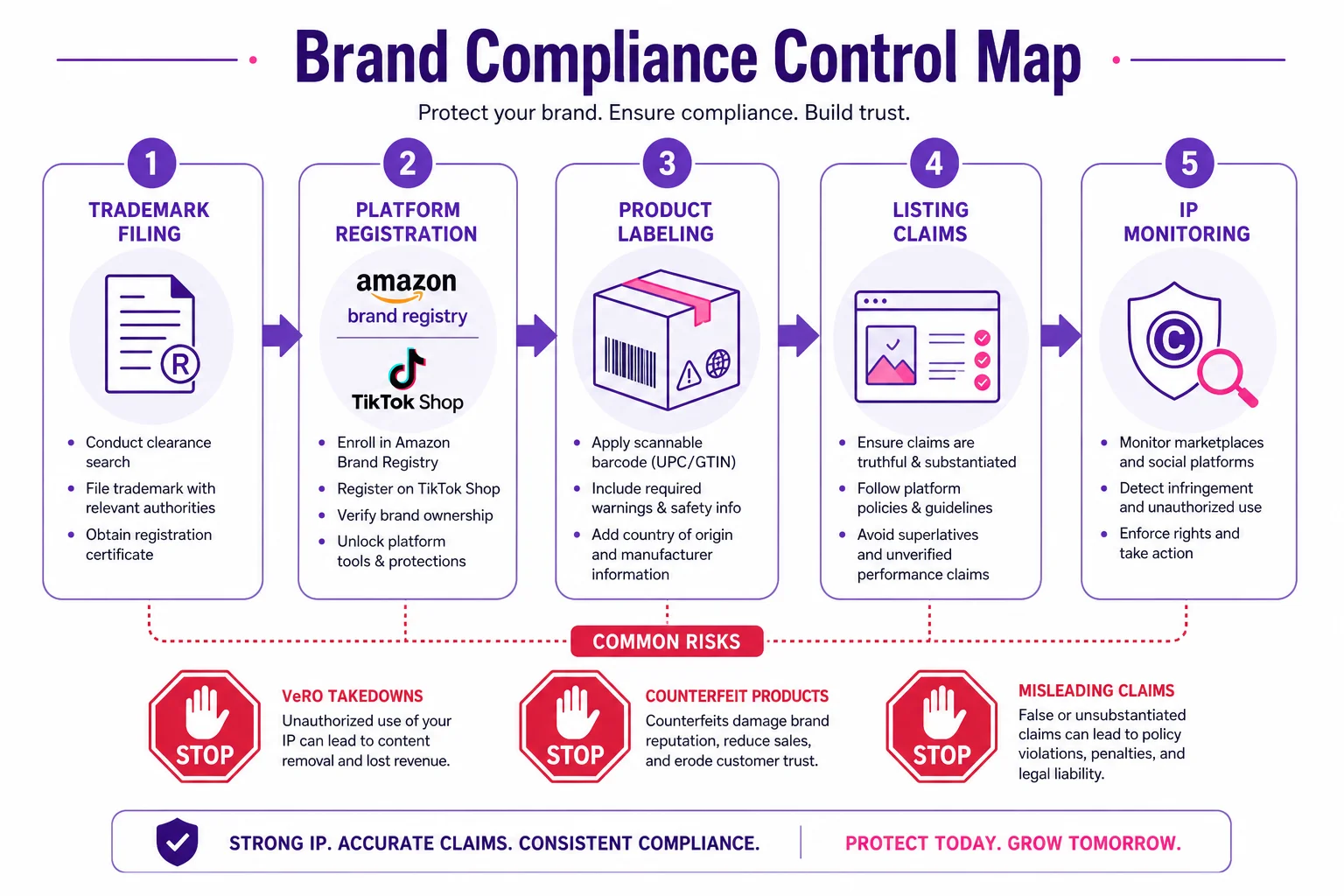
The brand compliance control map
- Clearance: trademark search, design patent check, and category-specific regulations.
- Registration: file trademark; register brand on Amazon, TikTok Shop, and other primary channels.
- Labeling: barcode ownership, origin, materials, warnings, and required certifications.
- Listing claims: align titles, bullets, images, and video with what the product can prove.
- Monitoring: watch for hijackers, counterfeit, VeRO complaints, and recall notices.
1. Trademark clearance and filing
- Search before you design: check USPTO TESS, EUIPO, and WIPO databases for similar names in your class.
- File in your primary market first: U.S. sellers typically need USPTO registration for Amazon Brand Registry.
- Match brand name to domain and handles: inconsistent naming weakens enforcement and confuses customers.
- Avoid descriptive-only names: "UltraSoft Pillow" is hard to protect; coined or distinctive names are stronger.
Dropshipping-specific risk
If your supplier ships another brand's product or uses OEM tooling licensed to a third party, your trademark does not protect you from IP claims on the underlying product design.
2. Amazon: Brand Registry and listing compliance
- Brand Registry: requires active registered trademark; unlocks reporting tools, A+ Content, and brand analytics.
- Listing accuracy: titles, bullets, and images must match the physical product; variant relationships must be correct.
- Restricted claims: avoid medical, environmental, and compatibility claims without substantiation.
- Counterfeit and hijack monitoring: enroll in Project Zero or Brand Registry reporting when eligible; document test buys.
| Violation type | Common trigger | Prevention |
|---|---|---|
| IP complaint | Logo, design, or patent conflict | Clearance search; custom design; supplier indemnity letter |
| Listing policy | Prohibited claims or image violations | Pre-publish checklist; category policy review |
| Product safety | Missing CPC, test report, or warning label | Third-party lab testing before launch |
| Condition mismatch | Sample differs from bulk production | QC inspection and sealed reference sample |
3. TikTok Shop and eBay: authorization and VeRO
- TikTok Shop: brand authorization may be required for branded goods; product attributes in the shop must match shipped items and video content.
- TikTok ads: avoid before/after, absolute claims, and unapproved health statements—creative review failures waste launch momentum.
- eBay VeRO: rights owners can request removal of listings using their trademarks without a court order; do not sell branded goods without authorization.
- Compatibility claims on eBay: phrases like "fits iPhone" or "compatible with Dyson" require substantiation; false compatibility is a policy violation.
4. Product labeling and barcode ownership
- GS1 barcodes: purchase codes registered to your legal entity; do not reuse codes from barcode resellers for long-term brands.
- Country of origin: must be accurate; "Distributed by" does not replace origin marking where required.
- Fiber content and care labels: apparel sold in the U.S. and EU requires specific labeling under FTC and EU Textile Regulation.
- Warnings and age grading: toys, electronics, cosmetics, and food-contact products have category-specific marking requirements.
- Multilingual IFU: EU and many export markets require instructions in the local language.
5. Dropshipping branding mistakes that cause account loss
| Mistake | Why platforms act | Fix |
|---|---|---|
| Using Nike-style logo or luxury font on generic product | Trademark infringement | Original brand identity; clearance search |
| Copying competitor listing text and images | Copyright and misleading representation | Original copy and owned photography |
| Claiming "FDA approved" or "medical grade" without proof | Regulated claim violation | Remove claim or obtain documentation |
| Shipping unbranded item when listing shows custom packaging | Misleading customer experience | Lock packaging spec in fulfillment SOP |
| Selling gated brands without authorization | Brand gating and authenticity enforcement | Sell only cleared or private-label SKUs |
Pre-launch brand compliance checklist
- Trademark search completed; application filed or registered in target market.
- GS1 barcodes purchased in company name (if retail or Amazon scale).
- Supplier agreement covers specification, IP indemnity, and labeling responsibility.
- Label proof reviewed for origin, materials, warnings, and barcode placement.
- Lab tests or certifications obtained for regulated categories.
- Listing copy, images, and video reviewed against platform policy.
- Fulfillment SOP matches approved sample—including packaging and inserts.
- Monitoring process defined for hijackers, reviews mentioning defects, and IP notices.
Frequently asked questions
- Do I need a trademark to do private label dropshipping?
Legally, not always—but practically, yes if you want Amazon Brand Registry, strong enforcement, and investor-grade brand equity. At minimum, run a clearance search before printing anything.
- Can I get Brand Registry with a pending trademark application?
Amazon offers programs for pending marks in some markets. Check current Brand Registry eligibility for your country and filing status.
- What happens if I receive a VeRO complaint on eBay?
The listing is typically removed immediately. Repeated violations can restrict selling privileges. Only list brands you own or are authorized to sell.
- Are cheap GS1 barcode resellers safe?
For a long-term brand on Amazon or in retail, buy directly from GS1 or your national GS1 member organization. Resold codes may already be associated with another company's products.

Author
Simon
Simon is a content strategist at ETdropship with extensive professional experience. He has been working in the industry for 13 years and possesses deep knowledge of the eCommerce sector and logistics systems. Passionate about his work, he creates practical and easy-to-understand content that helps sellers successfully run and grow their dropshipping businesses.
Get in touch
Have a question?
Leave your name, WhatsApp and message. We'll get back to you soon.
Brand with compliance built in
ETdropship helps sellers produce compliant labels, custom packaging, QC-locked specifications, and documentation that supports Amazon, Shopify, and TikTok Shop launches.
