
Most dropshippers treat branding as a logo on a Shopify theme. That works until you expand to Amazon listings, TikTok Shop creatives, eBay store pages, or Temu price wars. A professional multi-platform brand is not one visual—it is a controlled system: fixed identity, flexible execution, and platform-specific proof. This guide was updated on July 18, 2026 against current Shopify, Amazon, TikTok, eBay, and Temu seller guidance.
Sources & further reading
- Shopify — Building a brand
- Amazon — Brand Registry overview
- TikTok Shop — Seller Center
- eBay — Store design and branding
- U.S. USPTO — Trademark basics
Policies and forecasts change. Confirm dates and details on each official page before making business decisions.
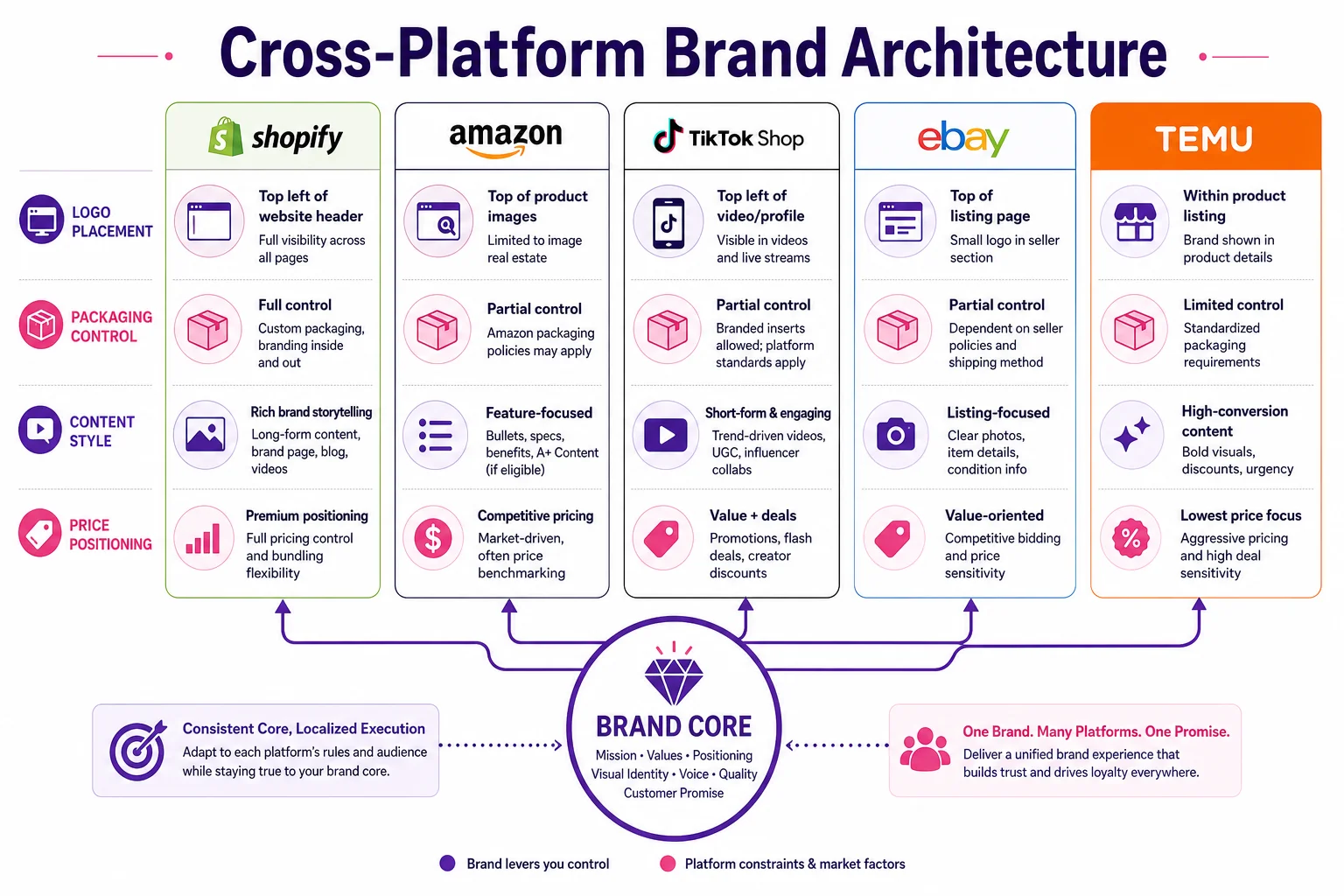
Start with a cross-platform brand architecture
| Layer | What stays fixed | What adapts per platform |
|---|---|---|
| Identity | Brand name, audience, tone, color system, logo usage | Hero image crop, thumbnail style, store banner |
| Promise | Core benefit and proof standard | Headline angle, bullet emphasis, video hook |
| Product | Approved specification and quality bar | Bundle, variant mix, price ladder, warranty wording |
| Experience | Minimum packaging and support standard | Insert depth, delivery promise, returns path |
If the promise changes by platform, you do not have a brand—you have five unrelated offers using the same logo.
Shopify: own the full brand experience
Shopify is the reference channel for DTC branding because you control the storefront, checkout, email, and post-purchase flow.
- Brand depth: custom domain, typography, lifestyle photography, about page, founder story, and editorial content.
- Packaging control: branded mailers, thank-you cards, QR codes to support or reorder, and unboxing sequences for UGC.
- Retention levers: email flows, loyalty, subscriptions, and bundles that are hard to replicate on marketplaces.
- Pricing freedom: you set margin and discount strategy without marketplace fee compression on every lever.
Shopify mistake
Copying a generic theme and one supplier photo set is not branding. Customers compare your store to other DTC brands in the same ad feed—not to raw factory listings.
Amazon: brand inside a search marketplace
On Amazon, the buy box, reviews, and main image do more brand work than your Storefront banner.
- Listing as brand asset: consistent naming convention, A+ Content, brand story module, and comparison charts that reinforce your positioning.
- Visual system: main image compliance plus secondary images that show use case, scale, materials, and packaging—without policy violations.
- Brand Registry: unlock brand protection tools, enhanced content, and reporting—but only after a registered trademark in the target market.
- Review narrative: your brand promise must match what reviewers describe; mismatches destroy conversion faster than weak creative.
| Shopify DTC | Amazon marketplace | |
|---|---|---|
| Primary discovery | Paid social, influencers, SEO | Search, ads, comparison |
| Brand proof | Site design, email, unboxing | Images, bullets, reviews, A+ |
| Packaging role | Retention and UGC | Damage prevention and return rate |
| Price strategy | Bundle and LTV focused | Competitive page position |
TikTok Shop: brand as demonstration
TikTok rewards brands that can show the product solving a problem in seconds—not brands with the most polished logo.
- Hook-first identity: the first three seconds must communicate audience, problem, and outcome; visual branding supports, not replaces, demonstration.
- Creator alignment: brief creators on approved claims, phrases to avoid, and packaging shots that match what ships.
- Shop consistency: product page, live stream, and video captions must show the same variant, color, and bundle.
- Speed vs polish: fast iteration on hooks beats one expensive brand film when you are still finding product-market fit.
eBay: reputation is the brand
- Store branding: logo, banner, about section, and consistent item specifics build recognition in collectibles, parts, and refurbished niches.
- Trust signals: feedback score, return policy clarity, fast message response, and accurate condition grading matter more than lifestyle photography.
- VeRO awareness: do not use brand names, logos, or compatibility claims you cannot substantiate—IP complaints can remove listings instantly.
Temu: brand within a price floor
- Differentiation limits: customers arrive for price; branding must show up in product quality, accurate specs, and reliable delivery—not premium packaging alone.
- Specification control: identical-listing markets punish vague titles and inconsistent variants; lock the exact SKU definition.
- Margin reality: invest in branding elements only when repeat purchase or cross-sell to your owned channels justifies the cost.
A practical 4-stage branding roadmap for dropshippers
- Stage 1 — White label (0–50 orders/week): pick a name, register domain, create logo usage rules, and replace supplier watermarks with your photography.
- Stage 2 — Soft brand (50–200 orders/week): branded thank-you inserts, consistent packaging tape or mailers, and platform-specific listing templates.
- Stage 3 — Private label (200+ orders/week): custom packaging, printed labels, instruction cards, and trademark filing in your primary market.
- Stage 4 — Multi-channel brand (proven SKU): unified creative kit per platform, Brand Registry, creator briefs, and QC-locked specifications.
When to invest
Move to the next stage only when unit economics, fulfillment stability, and repeat purchase signals support it. Branding spend ahead of product-market fit burns cash without building equity.
Frequently asked questions
- Should I use the same brand name on Amazon and Shopify?
Yes, if you can control quality and listing content on both. If Amazon reviews or counterfeit risk threaten the brand, use a distinct sub-brand or delay marketplace expansion until trademark and supply chain controls are in place.
- Does TikTok require a different brand strategy?
The identity stays the same, but the proof format changes. TikTok needs demonstration-first creative; Shopify needs depth and retention; Amazon needs search-optimized listings and review alignment.
- Can I build a premium brand while dropshipping?
Yes, but premium positioning requires locked specifications, approved samples, consistent packaging, reliable delivery, and honest claims. Generic supplier drift destroys premium perception faster than weak logos.
- Which platform should I brand first?
Start on the channel where you have the most control and the best economics—usually Shopify or your primary marketplace—then adapt assets once the offer converts reliably.

Author
Simon
Simon is a content strategist at ETdropship with extensive professional experience. He has been working in the industry for 13 years and possesses deep knowledge of the eCommerce sector and logistics systems. Passionate about his work, he creates practical and easy-to-understand content that helps sellers successfully run and grow their dropshipping businesses.
Get in touch
Have a question?
Leave your name, WhatsApp and message. We'll get back to you soon.
Build a brand system, not just a logo
ETdropship supports private-label packaging, custom inserts, product photography, label printing, and QC-locked specifications so your brand looks the same on every platform.
