Can You Build a Brand With Dropshipping? A Practical 2026 Guide
Yes, you can build a real brand with dropshipping.
But there is an important distinction between using dropshipping to fulfill orders and building a business that behaves like a generic dropshipping store.
The fulfillment model does not determine whether customers perceive a business as a brand. Customers usually do not know whether a store owns a warehouse, uses a third-party logistics provider, purchases products from factories in China, or fulfills individual orders through a supplier.
What customers experience is the product, the positioning, the website, the content, the packaging, the delivery experience and the support they receive after purchasing.
This means dropshipping can be used as the early operational layer of a genuine ecommerce brand.
The mistake is assuming that adding a logo to an ordinary product automatically creates one.
A stronger path is to use dropshipping to reduce inventory risk while demand is uncertain, then gradually increase product and supply-chain control around the SKUs customers prove they actually want.
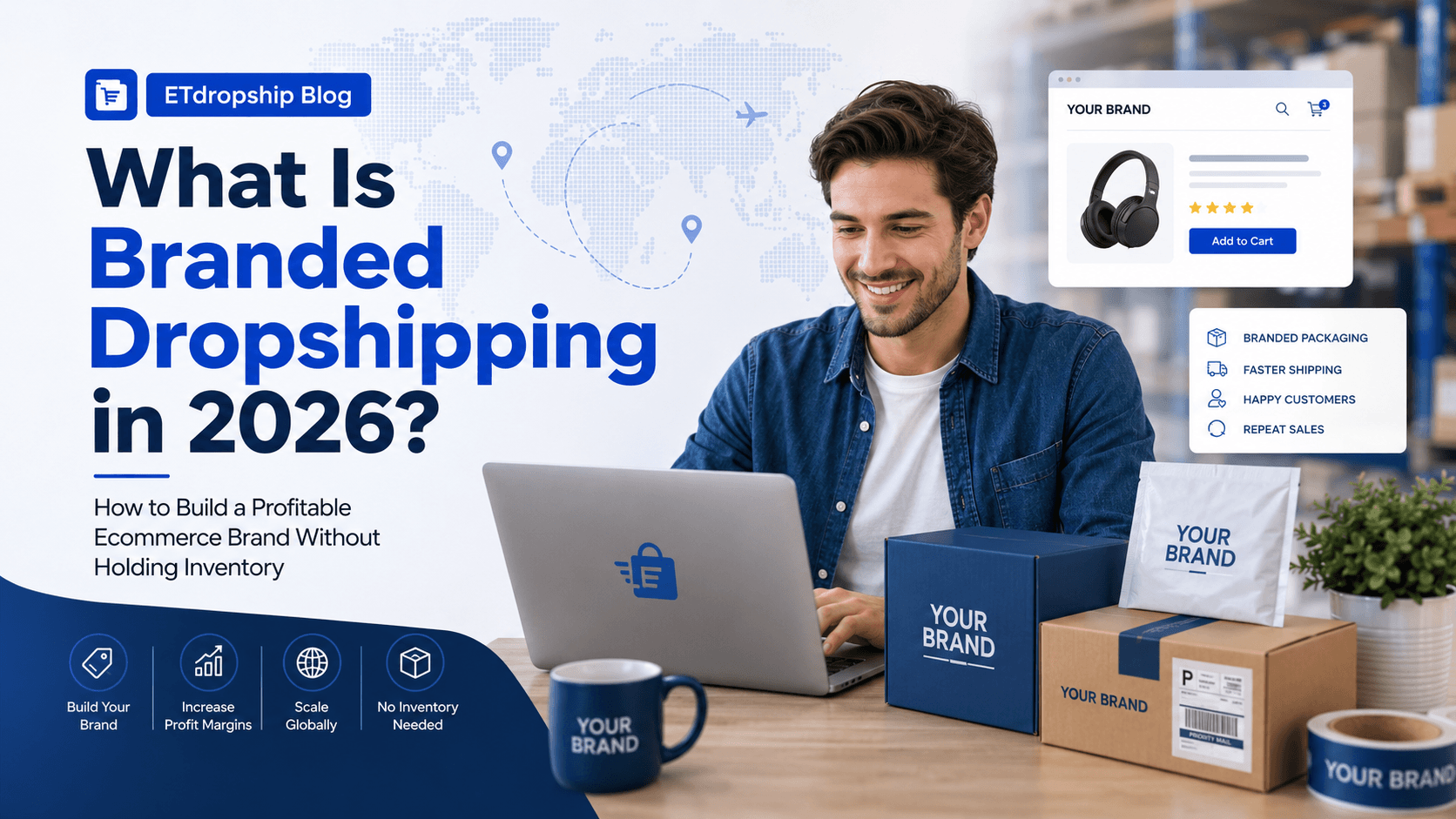
What Is Branded Dropshipping?
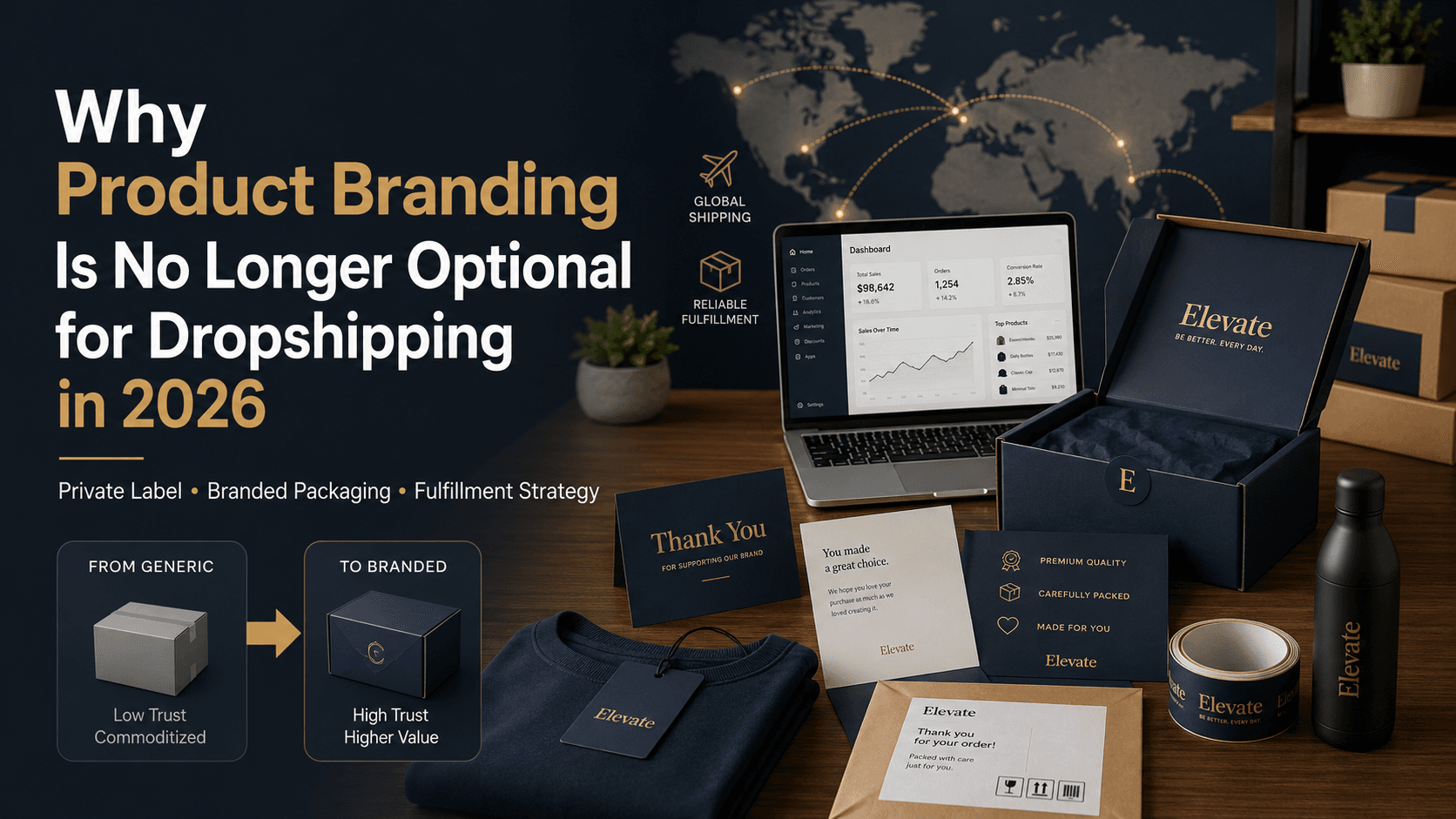
Branded dropshipping is a business model where products are still fulfilled without the seller operating a traditional large inventory system, but the customer experiences a consistent brand rather than an anonymous supplier.
Branding can exist at several levels.
At the simplest level, the store may have a clear audience, recognizable visual identity, original product content and consistent communication.
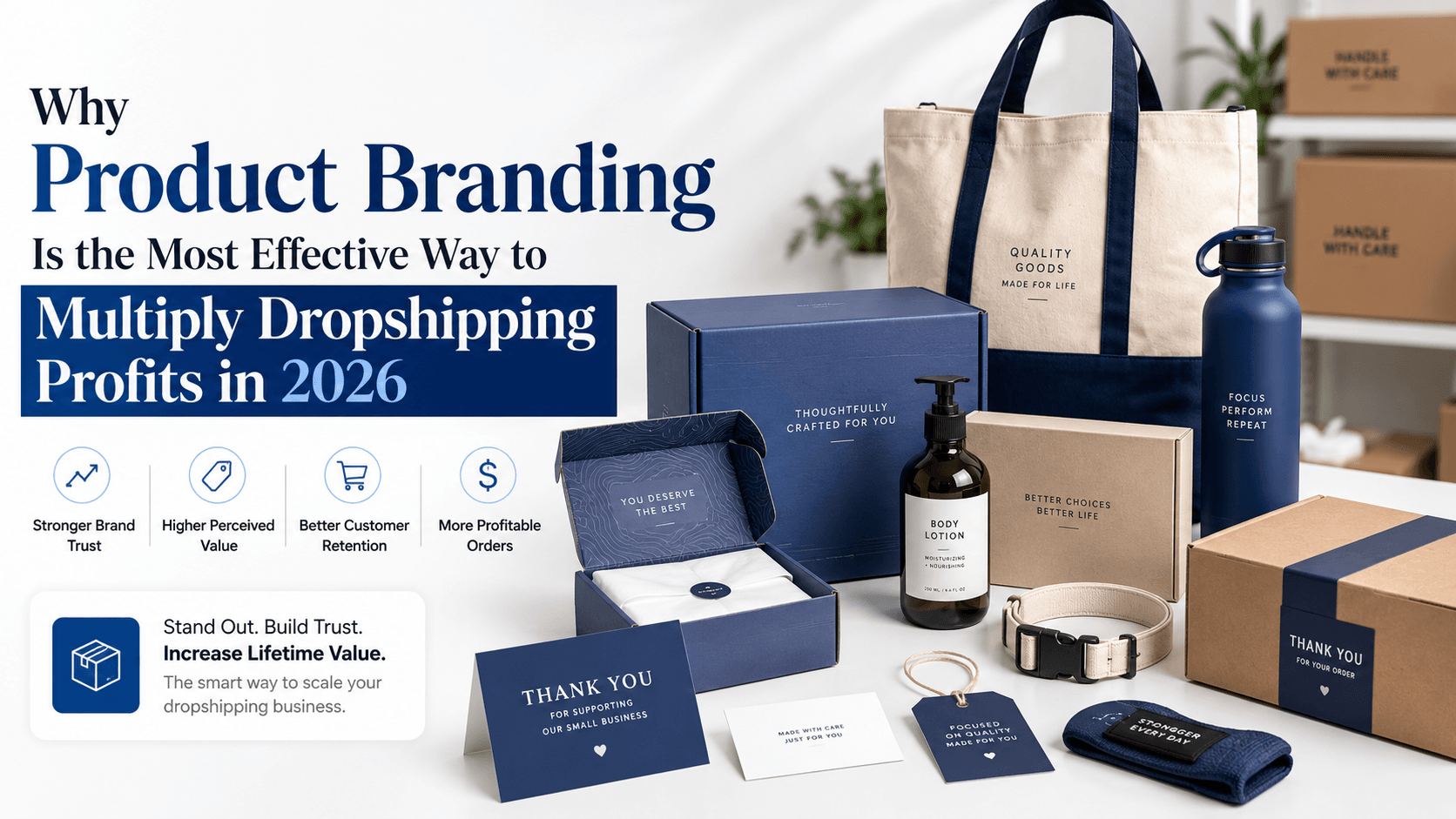
The next stage may introduce branded inserts, stickers, mailers, product labels or packaging.
More mature stores may control product specifications, colors, materials, bundles or private-label versions.
Eventually, some businesses develop completely differentiated products while still using external factories and fulfillment partners.
The important point is that these stages do not need to happen at once.
A store can begin with a relatively generic product and gradually increase differentiation after demand becomes more predictable.
Why Generic Dropshipping Is Becoming Harder
Generic dropshipping works best when the seller has access to a product competitors have not yet discovered.
That advantage is increasingly temporary.
Marketplace products can be found quickly through image search. Viral products spread rapidly across TikTok and Meta advertising. Competitors can reproduce landing pages and creatives within days, while customers can compare prices across Amazon, Temu, AliExpress and other marketplaces.
If ten stores sell the same product using the same supplier photographs and descriptions, price becomes one of the easiest ways for customers to compare them.
That is a difficult position for an independent ecommerce store.
Advertising costs do not necessarily fall simply because competitors are selling cheaper.
Building a brand therefore creates value by making the buying decision less dependent on direct product comparison.
The product still needs to be good.
But the customer begins evaluating the complete offer rather than only the physical SKU.
Branding Starts Before the Logo
One of the biggest misunderstandings is treating branding as visual design.
A logo is part of a brand.
It is not the foundation.
A stronger starting point is defining three things:
Who is the customer?
What problem or desire does the store focus on?
Why should the customer choose this offer rather than another seller offering something similar?
Consider a store selling automotive accessories.
“Car products” is extremely broad.
A store designed specifically around pet owners who travel with dogs immediately has a clearer direction.
Products may include seat covers, travel water bottles, safety belts, trunk protectors, hair-removal tools and storage accessories.
The products are not necessarily unique.
The customer context is.
That context can influence product selection, photography, copywriting, bundles, content and eventually packaging.
This is where branding actually begins.
Start With a Customer, Not a Random Product Collection
General dropshipping stores often struggle to build recognition because each product attracts a completely different customer.
Someone buying a kitchen organizer may have little reason to return for an unrelated phone accessory.
A focused store creates more opportunities for repeat interaction.
A travel brand can continually introduce travel products.
A dog-owner brand can expand across walking, grooming, travel and home accessories.
A home-organization brand can move from kitchens into wardrobes, bathrooms and workspaces without abandoning its audience.
This makes product expansion more coherent.
It also makes advertising and content easier because the brand develops knowledge about one type of customer rather than repeatedly starting from zero.
The First Product Does Not Need to Be Unique
Many beginners believe a brand needs a completely original product before launching.
That can create unnecessary risk.
Developing molds, new electronics, unique formulations or heavily customized products often requires more time, money and minimum quantities.
Before demand exists, that investment may be premature.
A more conservative strategy is to validate the market and offer using an existing product first.
If customers respond, the seller can then investigate how to improve that product.
Maybe the material needs to be stronger.
Perhaps the color range could be better.
Customers may want an accessory that is currently sold separately.
Instructions may be unclear.
Packaging may be unsuitable as a gift.
These observations provide a much stronger basis for product differentiation than attempting to invent something before interacting with customers.
Product Validation Should Come Before Heavy Branding Investment
Suppose you discover a product and immediately order 1,000 custom boxes.
The packaging looks excellent.
But after launching advertising, customers show little interest in the product.
You now own beautifully branded packaging for a product nobody wants.
That is exactly the type of inventory risk dropshipping is supposed to reduce.
A more disciplined sequence is:
Test the product.
Confirm that customers want it.
Understand why they buy it.
Measure refunds and complaints.
Improve the offer.
Then increase branding investment.
This does not mean the early store should look unprofessional.
The website, photography, product information and customer communication should still feel intentional from the beginning.
The difference is between brand identity, which can begin immediately, and physical customization, which becomes more rational after validation.
Use Original Content Before Expensive Packaging
One of the most cost-effective ways to make a dropshipping store feel less generic is to stop relying entirely on supplier content.
Order a sample.
Photograph it yourself.
Film how it works.
Show its actual size.
Demonstrate the problem it solves.
Answer common questions in short videos.
Original content immediately creates separation from competitors using identical marketplace photographs.
It also produces useful product research.
While filming and using the product, the seller may discover weaknesses that were not visible in the supplier listing.
That knowledge can later influence sourcing and customization decisions.
For an early-stage brand, original content often creates more value than expensive packaging.
Customer Experience Is Part of the Brand
Customers experience the brand after checkout as well.
If tracking takes a week to activate, delivery takes much longer than promised, the wrong variation arrives or customer support does not respond, a beautiful website cannot compensate for the experience.
This is why branded dropshipping eventually becomes a supply-chain issue.
The business needs to understand how products are sourced, inspected, packed and delivered.
As order volume grows, customer expectations become increasingly expensive to ignore.
A 2% fulfillment error rate may appear small.
At 50 orders, it affects one customer.
At 5,000 orders, it potentially affects one hundred.
Brand reputation therefore depends partly on operational consistency.
Packaging Should Follow Product Maturity
Physical branding can start gradually.
The first stage may involve only inexpensive elements such as a thank-you card, care card, instruction insert or logo sticker.
The next stage may introduce branded mailer bags, pouches or product labels.
More established products can justify custom boxes, premium inserts or gift-ready presentation.
The correct level depends on product economics.
A $20 commodity accessory does not necessarily benefit from a complex $3 box.
A $100 gift-oriented product may justify significantly more presentation investment.
The objective is not to maximize packaging.
It is to use packaging where it improves protection, recognition, customer experience or perceived value.
A more detailed private label packaging process can help sellers decide when to move from simple stickers and inserts toward mailers, boxes and more complete unboxing systems.
Private Label Is Different From Custom Packaging
These terms are often used interchangeably, but they describe different levels of control.
Custom packaging changes what surrounds the product.
Private labeling puts the seller's identity on the product itself.
Examples include a logo printed on a bottle, woven label inside clothing, engraved mark on an accessory, branded product tag or custom label attached directly to the item.
Private labeling can make the product feel more proprietary.
But it also usually creates greater commitment.
Minimum quantities may increase, samples become more important and switching suppliers may become more complicated.
That is why private labeling generally makes more sense after a product has already demonstrated stable demand.
OEM and ODM Come Later
Some brands eventually need more than a logo.
They want the physical product to change.
This might include new materials, modified dimensions, improved components, custom colors, additional functions or completely new product structures.
This moves the business closer to OEM or ODM development.
The financial risk also increases.
Development may require samples, tooling, larger production quantities and longer lead times.
At this point, the seller is moving away from simple marketplace dropshipping and toward a more traditional brand supply chain.
Dropshipping can still remain useful for testing new categories or fulfilling certain products.
The model does not need to disappear simply because the business becomes more sophisticated.
Branding Should Solve a Commercial Problem
Not every customization is worth paying for.
Suppose a seller spends $1 extra per order on branded packaging.
That investment should ideally contribute to something measurable:
better presentation,
higher customer trust,
more repeat purchases,
better creator content,
lower damage,
gift suitability,
or stronger brand recognition.
If customers throw the packaging away immediately and never notice the difference, that extra dollar may be better invested elsewhere.
Branding should therefore be evaluated like any other business expense.
The question is not:
“Can we customize this?”
It is:
“Will this customization improve the offer enough to justify the cost and commitment?”
A Brand Needs Product Consistency
A customer buying the same product twice expects the same product twice.
This sounds obvious, but it can become difficult when sourcing from marketplace suppliers.
The supplier may change materials.
Colors can vary.
Accessories can change.
Packaging may change without notice.
The seller may even unknowingly receive products from different upstream factories.
This creates a problem once a product becomes associated with a brand.
Branding requires repeatability.
The seller eventually needs clearer specifications for important products, including dimensions, material, color, components, accessories and packaging.
The more recognizable the brand becomes, the less acceptable random supplier variation becomes.
Control the Product Before You Customize It
Before ordering branded packaging or adding a logo, establish which exact product version you intend to sell.
Keep the approved sample.
Record dimensions and materials.
Confirm variations.
Understand packaging size and final shipping weight.
Document the supplier.
Then customize around that specification.
Otherwise, sellers sometimes create branded packaging for a product that later changes dimensions or source.
The packaging no longer fits, and the customization investment becomes a problem rather than an advantage.
Supply-chain control should therefore grow alongside brand control.
When a Dedicated Branding Workflow Becomes Useful
Once a seller has a validated SKU, the work can become surprisingly fragmented.
One factory produces the product.
Another supplier makes the box.
A third prints cards.
Someone else applies labels.
The warehouse stores the materials.
The fulfillment team needs to know which packaging belongs to which SKU.
At low volume, this can be managed manually.
At higher volume, mistakes become more likely.
A coordinated product customization and branded fulfillment workflow becomes useful when product sourcing, samples, packaging, labeling, storage and order fulfillment need to stay connected rather than being managed as isolated purchases.
The goal is not to introduce complexity earlier than necessary.
It is to prevent branding complexity from overwhelming operations once successful products begin scaling.
Do Not Brand Every Product Equally
Most stores eventually discover that a relatively small number of SKUs generate a large percentage of revenue.
Those products deserve more attention.
A product selling twice per month may not justify custom packaging.
A core SKU generating hundreds of monthly orders may justify packaging, private labeling, inventory buffers and product improvements.
This suggests a tiered branding strategy.
Experimental products remain flexible.
Emerging products receive better content and supplier validation.
Core products receive stronger packaging and specification control.
Hero products may eventually receive deeper private-label or OEM development.
Investment follows evidence.
Bundles Can Create Brand Differentiation Without Manufacturing a New Product
Product differentiation does not always require changing the factory product.
Bundles can be powerful.
Suppose several stores sell the same basic travel organizer.
One store sells only the organizer.
Another combines it with packing accessories, a cable pouch and a simple travel checklist designed for a specific type of traveler.
The underlying items may all be available elsewhere.
The offer is different.
Bundles can improve average order value while giving the customer a clearer reason to choose one store over another.
They also provide a useful bridge between generic dropshipping and deeper product development.
Better Instructions Can Be Branding
Instructions are often overlooked.
Supplier manuals may contain poor translations, unclear diagrams or no useful information at all.
A brand can improve the experience simply by producing a clear setup guide, care instructions or troubleshooting page.
This is especially useful for products where incorrect use creates returns.
Better instructions can reduce support requests while making the product feel more professional.
It demonstrates an important principle:
Brand value does not need to come from expensive physical changes.
It can come from reducing customer uncertainty.
Returns and Support Affect Brand Perception
Customers rarely separate fulfillment, support and branding into independent departments.
They experience one company.
If the product arrives damaged, the response becomes part of the brand.
If the wrong size is delivered, the solution becomes part of the brand.
If the customer wants to return an item, the clarity of the process becomes part of the brand.
This means brand building needs operational standards.
Determine how quickly support should respond.
Decide how damaged products are handled.
Understand which problems justify reshipment.
Track why customers return products.
Strong brands learn from those patterns instead of treating each complaint as an isolated incident.
Branding Can Support Higher Prices, but Only When Customers See Value
A recognizable brand can sometimes charge more than a generic seller.
But higher prices are not created by the logo itself.
Customers pay more when they expect something better.
That may include quality, design, convenience, reliability, service, presentation, community or trust.
If the product and experience remain identical to a marketplace listing, changing the logo does little to justify a premium.
Pricing power is therefore an outcome of brand value.
It is not something branding automatically grants.
Repeat Customers Are One of the Strongest Signs a Brand Is Forming
A generic winning-product store often depends heavily on continually acquiring new customers.
A brand has more opportunity to sell again to existing customers.
This is easier when the store targets a coherent audience and offers related products.
If a customer buys a dog travel seat cover, the store may later introduce a portable water bottle, safety belt or grooming accessory.
The products make sense together because the customer problem is related.
Repeat purchasing improves economics because the store does not need to introduce itself from zero every time.
It also creates evidence that the business has value beyond one temporary product trend.
Email, Content and Community Strengthen the Brand After Purchase
A customer relationship should not end when tracking shows “delivered.”
Helpful product-use content, educational emails, care instructions and genuinely relevant product recommendations can create additional value.
Social content can also help customers associate the store with a particular interest or lifestyle rather than one product.
A gardening store can publish seasonal planting content.
A travel brand can share packing advice.
A pet brand can provide practical travel and care tips.
The content does not need to constantly sell.
Its purpose is to give the audience reasons to remember the brand between purchases.
Cross-Platform Expansion Requires a Consistent Brand Core
A successful Shopify store may eventually expand to TikTok Shop, Amazon, eBay, Etsy or other sales channels.
The brand should remain recognizable, but execution cannot always be identical.
Amazon customers interact primarily with listings and reviews.
TikTok customers may discover the product through creator videos.
Shopify gives the brand much more control over the full website experience.
The identity should remain stable while the execution adapts to each platform.
A broader cross-platform brand strategy becomes relevant once a store needs to preserve one brand across several marketplaces without copying the exact same content and merchandising approach everywhere.
A Practical Four-Stage Path From Dropshipping Store to Brand
Stage 1: Validate the Market
Focus on the audience, problem and product.
Use flexible sourcing.
Keep inventory commitment low.
Order samples and create original content.
The main goal is discovering whether customers want the offer.
Stage 2: Standardize the Winner
When a product begins generating repeatable demand, lock the product specification.
Compare suppliers.
Improve photography and instructions.
Track delivery, refunds and customer complaints.
Consider small inventory buffers if they improve processing reliability.
Stage 3: Add Physical Brand Identity
Introduce branding selectively.
Cards, stickers, labels, pouches and mailers are often easier starting points than heavily customized boxes.
Evaluate whether the added cost improves the customer experience.
Store packaging materials so they can be applied consistently to every qualifying order.
Stage 4: Differentiate the Product
Once demand and cash flow justify greater commitment, explore private labeling or product changes.
Use customer feedback to decide what should change.
Develop exclusive bundles, colors, materials, components or other product improvements.
At this stage, the business is increasingly difficult to compare directly with the generic marketplace product it originally tested.
How Much Should You Spend on Branding?
There is no universal percentage.
A business should evaluate branding expenditure against product margin, selling price, order volume and expected customer value.
For a low-ticket product, a small branded insert may make more financial sense than a premium box.
For a higher-value gift product, packaging may be part of the reason customers purchase.
The important calculation is incremental.
What does the branding element cost per order?
What operational commitment does it create?
Does it change shipping weight?
Does it increase minimum quantities?
Does it improve the offer enough to justify those costs?
This keeps branding tied to economics rather than aesthetics alone.
Common Branded Dropshipping Mistakes
The first mistake is investing too heavily before product validation.
The second is believing that a logo automatically creates differentiation.
The third is allowing product quality to remain inconsistent while spending money on packaging.
A fourth mistake is making the packaging larger and heavier without calculating the shipping effect.
Another is branding dozens of weak SKUs instead of concentrating resources on products customers already buy consistently.
The strongest brand-building process is usually gradual.
Each stage should solve the limitations revealed by the previous stage.
Can AliExpress Products Become Branded Products?
Sometimes.
A product can begin as an AliExpress test and later move into a more controlled sourcing arrangement.
The seller may discover the same or similar product closer to the original manufacturer, define a specific version and introduce packaging or labeling.
But this should not be assumed to be possible for every item.
Some marketplace products may have limited customization options, intellectual-property concerns or unstable manufacturing sources.
The product needs to be investigated individually.
The important principle is that the original testing channel does not need to become the permanent supply chain.
Do You Need Inventory to Build a Brand?
Not necessarily at the beginning.
Brand identity, original content, customer positioning and service standards can all exist without substantial inventory.
Physical customization may eventually require minimum quantities.
At that point, limited inventory often becomes practical because branded products or packaging need to be produced in batches.
The transition should be gradual.
Inventory should follow predictable sales rather than be used as proof that the business has become a “real brand.”
Can Dropshipping and Private Label Work Together?
Yes.
Dropshipping describes how orders are fulfilled.
Private label describes how the product is identified and controlled.
A business may store a modest batch of private-label products with a fulfillment provider and still have each customer order processed individually rather than operating its own warehouse.
Likewise, a store may use private-label fulfillment for its core products while continuing to dropship new test products.
Hybrid supply chains are often more practical than forcing every SKU into one model.
Frequently Asked Questions
Can you really build a brand with dropshipping?
Yes. Dropshipping can be used to validate products and fulfill customer orders while the business develops a consistent audience, product experience, content, packaging and customer service. As products mature, greater supply-chain control can be introduced.
What is branded dropshipping?
Branded dropshipping combines dropshipping fulfillment with a consistent brand experience. Depending on the stage of the business, this can include original content, custom packaging, inserts, product labels, private labeling or differentiated product specifications.
Do I need custom packaging to have a brand?
No. Brand positioning, customer experience, content and product consistency can begin before custom packaging. Physical packaging should be introduced when it creates enough value to justify its cost and minimum quantity.
When should I start private labeling a dropshipping product?
Usually after the product has shown repeatable demand and the seller understands its economics, customer feedback and supplier stability. Private labeling too early can create unnecessary inventory and customization risk.
Can I brand products without buying large quantities?
Some simple packaging and labeling options can begin with relatively modest quantities, while deeper customization typically requires higher MOQs. Requirements vary significantly by product and supplier.
Is branded dropshipping more profitable?
It can improve pricing power, average order value, retention and differentiation, but profitability is not guaranteed. Branding adds costs as well, so the investment needs to create enough customer value to justify those costs.
Should beginners start with branding?
Beginners should start with brand positioning and a professional customer experience, but avoid heavy physical customization until products are validated. Original content and a focused audience are often more valuable early investments.
What comes after branded dropshipping?
For some businesses, the next stage is deeper private-label development, OEM/ODM products, larger inventory commitments or regional fulfillment. Other businesses remain successfully hybrid, using branded fulfillment for proven products and flexible dropshipping for testing.
Conclusion
Dropshipping and brand building are not opposites.
Dropshipping is a fulfillment and inventory strategy.
Branding is the process of creating a recognizable, repeatable reason for customers to choose and remember a business.
The strongest path is not to abandon dropshipping immediately or spend heavily on customization before the first sale.
It is to use the flexibility of dropshipping where uncertainty is high and introduce greater control where evidence becomes stronger.
Start with a customer.
Validate the product.
Create original content.
Standardize successful SKUs.
Improve the customer experience.
Add packaging when it makes economic sense.
Introduce private labeling when demand justifies the commitment.
Eventually, use customer feedback to develop products that are increasingly difficult to compare with generic alternatives.
That is how dropshipping can evolve from a low-risk testing model into the supply-chain foundation of a real ecommerce brand.