How to Start a Dropshipping Business With Little to No Upfront Cost in 2026
Dropshipping is attractive to beginners because you do not need to purchase hundreds of products, rent your own warehouse, or build a fulfillment team before testing whether customers actually want what you plan to sell.
That does not mean a real ecommerce business costs absolutely nothing. Domains, ecommerce software, product samples, payment processing, marketing, refunds, and customer service can all create expenses. The real advantage is that you can delay many of the largest commitments until there is evidence that a product deserves further investment.
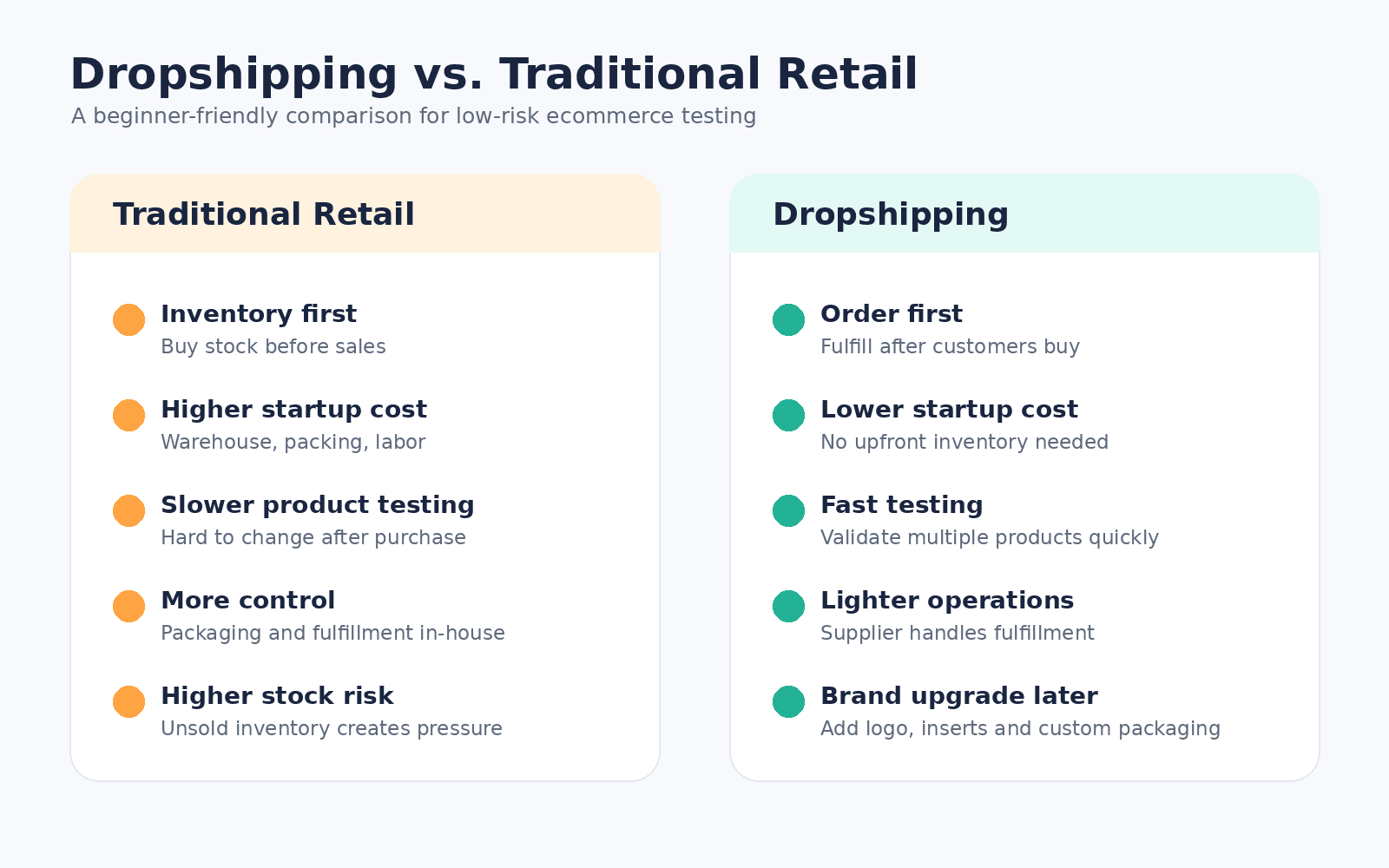
The basic idea of dropshipping is what makes this lean approach possible: products can be sourced and fulfilled after customers place orders rather than purchased in large quantities before the store begins selling.
For someone with limited capital, that changes the most important question. Instead of asking, “How much inventory can I afford to buy?”, you can ask, “What is the cheapest reliable way to find out whether customers will buy this product?”
That is the approach this guide focuses on.
What Does “Zero Upfront Cost” Actually Mean?
“Zero upfront cost” should not be interpreted literally.
You can research markets, study competitors, create social-media accounts, compare suppliers, and validate ideas without spending much money. But once you begin operating a real store, some expenses eventually appear.
The practical goal is therefore not to build a business that never costs anything. It is to avoid committing substantial capital before demand has been validated.
Traditional ecommerce often requires inventory investment before the first customer appears. Dropshipping allows the sequence to be reversed: investigate demand first, test the offer, generate early orders, and then invest more as uncertainty decreases.
If you want a more detailed breakdown of realistic startup budgets, the amount of capital required depends heavily on how you test products, acquire customers, and manage early cash flow. Those costs are covered separately in the guide to how much money you need to start a dropshipping business, rather than repeating the entire budget calculation here.
The principle for this guide is simpler:
Spend as little as possible before you have evidence that spending more makes sense.
Start With a Customer Problem, Not a Huge Product Catalog
A common beginner mistake is opening a general store and importing hundreds of unrelated products.
This feels productive because the store quickly looks full, but it makes product testing much harder. Every category requires different content, customer understanding, advertising angles, and supplier knowledge.
A low-budget seller benefits from doing the opposite.
Start with one customer group or one type of problem. A pet-travel store could focus on products for people who regularly drive or travel with animals. A home-organization store could focus on small products that help customers use limited space more efficiently. A travel-accessories store could concentrate on packing, storage, and convenience.
You do not need to find the perfect niche before starting. You only need enough focus that several products can serve the same type of customer.
That makes your store easier to understand, your content easier to create, and your early data more useful.
Use Free Product Research Before Paying for Expensive Tools
A beginner does not need a large software budget to generate the first product ideas.
Marketplace search results, customer reviews, Google Trends, TikTok search, Instagram Reels, YouTube Shorts, Pinterest, competitor stores, Reddit discussions, and product comments can all reveal useful signals.
The goal is not simply to find products with high views.
Look for recurring customer problems, clear purchasing questions, products that can be demonstrated visually, complaints about existing alternatives, and signs that customers are already spending money to solve the problem.
The same logic should guide your broader product research: demand, competition, selling price, shipping characteristics, supplier availability, and customer use cases matter more than whether a product happens to be trending for a few days.
Negative customer reviews can be especially useful. If buyers repeatedly complain about poor instructions, weak materials, bad packaging, incorrect sizing, or inconvenient design, those complaints reveal what a better offer could improve.
Free research will not guarantee a winning product. Its purpose is to eliminate obviously weak ideas before you spend money testing them.
Choose Products That Are Cheap to Test, Not Merely Cheap to Buy
The cheapest supplier price does not necessarily create the lowest-risk business.
A $3 product can become expensive if it is bulky, fragile, difficult to explain, likely to be returned, or expensive to ship. A $10 product may be easier to operate if it is compact, reliable, easy to demonstrate, and leaves enough room for shipping and customer acquisition.
For low-budget dropshipping, product characteristics matter more than an extremely low unit price.
Products are generally easier to test when customers can understand the benefit quickly, the item is reasonably compact, compatibility issues are limited, the risk of damage is manageable, and there is enough margin between landed cost and selling price.
You should also consider whether the product can support different offers. A single inexpensive item may struggle to absorb advertising costs, while two or three related products packaged as a useful bundle can create a healthier average order value.
The goal is not to find the cheapest object on a wholesale marketplace. It is to find something that can be tested without creating unnecessary financial or operational risk.
Build a Small Product Testing List
After researching a niche, reduce the possibilities to a manageable number.
Five to ten serious candidates are usually more useful than 100 imported products.
For each product, estimate the sourcing price, shipping weight, logistics cost, potential selling price, customer-service risk, likely return reasons, and how easily the benefit can be demonstrated.
Then compare suppliers rather than treating the first marketplace quotation as the true cost.
Once your product requirements become more specific, comparing quotations directly or working with a product sourcing agent can help you evaluate supplier options without assuming that the cheapest public listing represents the best sourcing choice.
This stage is where low-budget sellers should be disciplined. The objective is not to convince yourself that every idea can work. It is to remove weak candidates until only the products worth real testing remain.
Choose a Selling Platform That Matches Your Starting Strategy
Your ecommerce platform should match how you expect to acquire customers and how much technical work you can manage.
Shopify is popular because it simplifies much of the independent-store setup. WooCommerce provides more technical control and can work well for sellers already comfortable with WordPress. TikTok Shop can suit sellers whose advantage is short-form content, while marketplaces may provide access to customers who are already searching for products.
A beginner should not choose a platform only because it is popular.
The more useful question is whether the platform matches your traffic strategy, technical ability, product category, and fulfillment requirements. The differences are covered in more depth in the guide to choosing a dropshipping platform for beginners.
For a low-budget launch, simplicity matters. Avoid paying for several platforms simultaneously before you have made one sales channel work.
Build the Minimum Store Needed to Test Demand
Your first store does not need to look like a multinational brand.
It needs to be understandable and trustworthy.
Customers should quickly understand what the product does, what is included, how much it costs, how long delivery is expected to take, and what happens if something goes wrong.
Clear product images, realistic descriptions, shipping information, basic policies, working payment methods, and mobile-friendly pages matter more than decorative features.
Do not buy several themes, page builders, subscriptions, review apps, upsell tools, email platforms, and automation services before you know which problems actually need solving.
Every recurring cost should have a purpose.
The early store is a testing environment. Once sales show that the offer works, improvements to design, conversion rate, retention, automation, and branding become much easier to justify.
Use Organic Content to Reduce the Cost of Early Validation
Paid advertising can accelerate testing, but it is not the only way to learn whether people care about a product.
For sellers with limited budgets, organic content can provide early demand signals before large advertising commitments.
A cleaning product can be shown through a before-and-after demonstration. A storage product can transform a messy space. A pet accessory can appear in a real travel or walking situation. A kitchen product can solve one specific inconvenience within a few seconds.
The point is not simply to upload promotional videos.
Good testing content lets you observe how people react. Watch whether users stay to the end, save the content, ask questions, visit the profile, click the product, or mention buying intent.
A video with moderate views but many product questions may be more useful than a high-view video that creates no commercial interest.
Organic traffic takes time and does not eliminate the need for future marketing investment, but it can help a low-budget seller decide where that investment has the greatest chance of producing useful data.
Do Not Spend Heavily on Advertising Before the Offer Is Ready
Advertising cannot fix a product that customers do not want.
It also cannot permanently fix a confusing product page, weak pricing, poor margins, unreliable shipping, or disappointing product quality.
Before increasing paid traffic, make sure the product can be explained clearly, the offer makes economic sense, the supplier has been evaluated, and the customer experience has at least been tested once.
A small paid test should be treated as information gathering.
You are trying to determine whether customers click, whether they remain on the product page, whether they add the product to cart, whether they begin checkout, and whether real purchases occur.
If those signals are weak, increasing the budget does not automatically solve the problem.
A low-budget operator needs to become good at stopping weak tests. Protecting capital is just as important as finding successful products.
Always Place a Test Order Before Scaling
One of the best early investments is often a real test order.
The product should go through the same basic process that a customer will experience.
Check how long the supplier takes to process the order, when tracking becomes active, whether packaging protects the product, whether the actual item matches the listing, whether important accessories are included, and how long delivery takes.
If possible, order samples before advertising heavily. The cost of discovering a serious product or fulfillment problem through one sample is much lower than discovering it through 50 unhappy customers.
As orders begin to grow, these tests also help determine whether the supplier can continue handling fulfillment reliably or whether a dedicated dropshipping fulfillment service is needed for quality control, packaging, warehousing, order processing, and international shipping.
The purpose of this step is not to add operational complexity. It is to make sure the simple system works before you send more customers into it.
Understand Cash Flow Before Calling the Business “No-Cost”
Dropshipping removes much of the initial inventory burden, but cash flow still matters.
Customer payments may not always become immediately available for withdrawal. Suppliers and logistics providers still need to be paid. Refunds, chargebacks, failed deliveries, reshipments, and advertising bills can occur before all previous revenue has settled.
This means a store can be profitable on paper and still experience cash-flow pressure.
Beginners should therefore avoid using every available dollar on advertising.
Keep enough operating room to fulfill existing orders, respond to customer problems, and continue testing without depending on tomorrow's sales to pay for yesterday's orders.
This is one reason why starting lean is different from starting recklessly.
A lean business reduces unnecessary commitments while protecting the parts of the operation customers actually depend on.
When Should You Start Spending More?
The point of low-budget dropshipping is not to remain permanently underfunded.
It is to postpone major investment until the business has better information.
When a product begins generating repeatable orders, the priorities change.
Better samples may improve content. More stable sourcing may improve quality. Faster logistics may reduce complaints. A small inventory buffer may shorten processing time. Better product photography may increase conversion. Paid advertising may become more predictable because you already know which messaging attracts customers.
Investment should follow evidence.
A product with inconsistent sales, weak margins, and frequent complaints does not deserve more money merely because you have already spent money on it.
A product with repeatable demand, manageable returns, acceptable margins, and reliable fulfillment gives you a stronger reason to invest.
When Does Small-Batch Inventory Make Sense?
Dropshipping and inventory are not mutually exclusive.
A store can fulfill new products order by order while keeping a small quantity of its strongest products in stock.
This hybrid approach can make sense once demand becomes predictable.
Inventory can reduce supplier stockouts, shorten order processing, make packaging more consistent, and allow several products to be combined before international shipping.
But buying inventory too early defeats one of the main advantages of dropshipping.
The product should earn the right to receive more capital.
Start with flexibility. Introduce inventory only when the expected operational benefit is greater than the risk of unsold stock.
When Should You Add Branding?
Branding should follow a similar progression.
You do not need expensive custom boxes before proving that customers want the product.
During early testing, clean neutral packaging may be sufficient. Once orders become stable, small upgrades such as logo stickers, thank-you cards, instruction cards, labels, or simple branded bags can begin improving the customer experience without requiring a complete packaging system.
Deeper customization makes more sense once the product has enough predictable demand to justify minimum quantities and design costs.
The important distinction is that branding should strengthen a validated offer, not disguise an unvalidated one.
A custom package cannot save a product that customers do not want.
A Practical Low-Budget Dropshipping Roadmap
The safest way to build a low-budget dropshipping business is to increase spending gradually as uncertainty falls.
Begin with research. Understand a customer group and identify several products that solve recognizable problems.
Reduce the list to a few serious candidates. Compare realistic costs and supplier options instead of importing everything you find.
Build the minimum trustworthy store required to test the offer.
Use organic content and limited paid tests to observe real customer behavior.
Place a test order before increasing traffic.
Once sales become repeatable, strengthen sourcing and fulfillment.
Only then should you consider larger advertising budgets, small-batch inventory, custom packaging, or deeper product development.
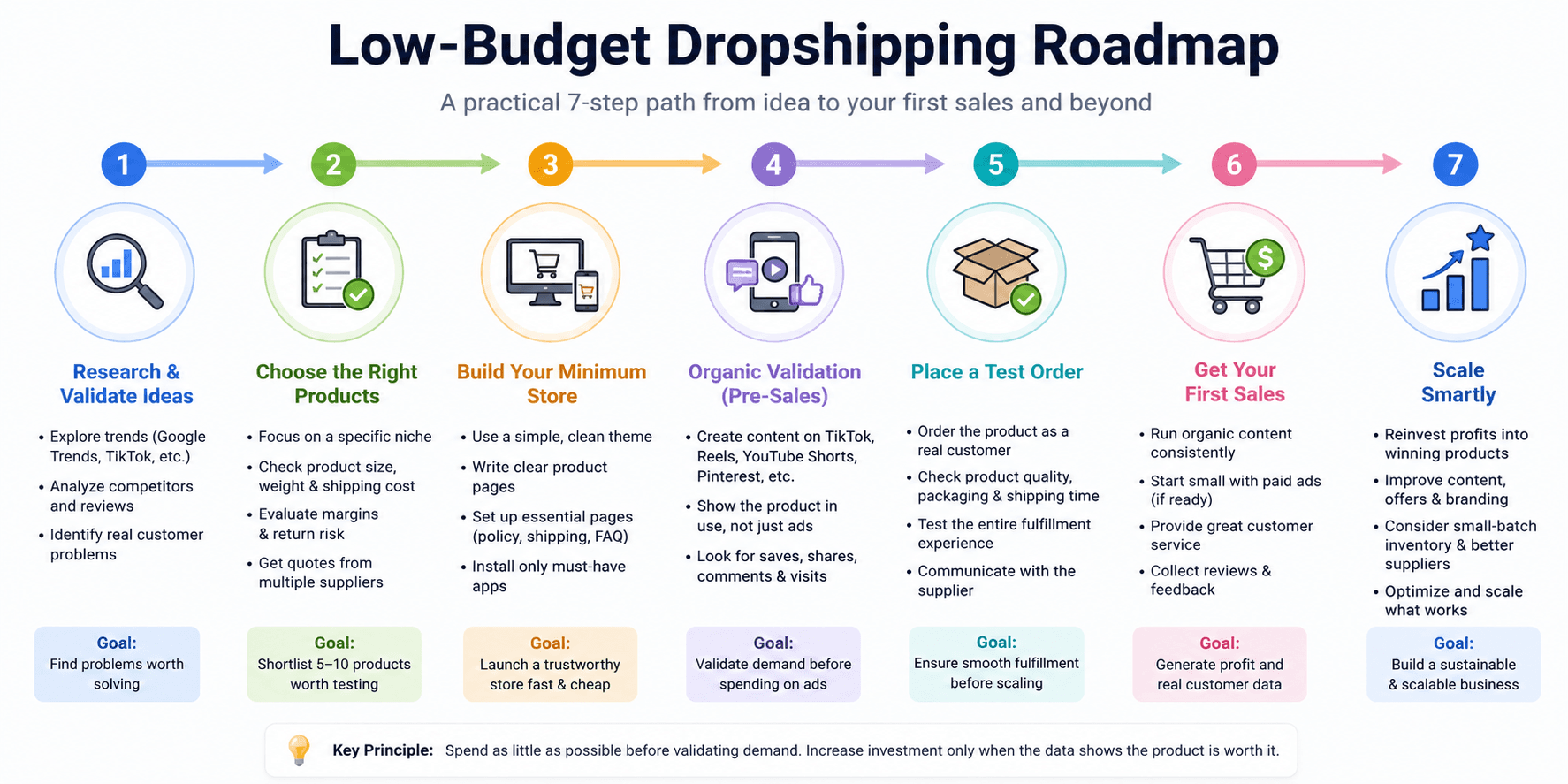
The sequence matters because every stage answers a different question.
Research asks whether the idea is worth testing.
Content asks whether customers care.
The store asks whether interest can become action.
The test order asks whether the supply chain can deliver what was promised.
Early sales ask whether the economics are sustainable.
Scaling asks whether the entire system can continue working at higher volume.
Common Low-Budget Dropshipping Mistakes
The most common mistake is treating “no inventory upfront” as “no money required.” This creates unrealistic expectations and usually leads to poor cash-flow decisions.
Another mistake is choosing products solely because the supplier price is low. Shipping, customer acquisition, returns, quality issues, and support can easily make a cheap product expensive to operate.
Some beginners spend too much on software before they have any sales. Others spend almost nothing on samples or test orders even though product quality and fulfillment create much larger risks.
Another expensive mistake is scaling traffic before understanding the numbers. Revenue can look exciting while advertising, shipping, payment fees, refunds, and after-sales costs quietly remove the profit.
Finally, do not stay attached to a weak product simply because time has already been invested in it. The flexibility to stop, learn, and test another idea is one of the greatest advantages of starting with a low-inventory model.
Frequently Asked Questions
Can I really start dropshipping without buying inventory?
Yes. The standard dropshipping model allows products to be fulfilled after customer orders instead of requiring a large inventory purchase before launch. Running the store can still create expenses such as samples, software, marketing, payment processing, refunds, and customer service.
How much money should I have before starting?
There is no single amount that fits every store. The required budget depends on your platform, traffic strategy, products, samples, advertising approach, and cash-flow needs. The priority is to avoid large commitments before demand has been tested.
Should I use paid advertising immediately?
Not necessarily. Organic content can provide early product signals, especially for products that are easy to demonstrate visually. Paid advertising becomes more useful when the product, offer, store, and fulfillment process are ready for larger-scale testing.
Do I need a warehouse when I start?
Usually not. A supplier or fulfillment partner can process orders without the seller operating a personal warehouse. Small-batch inventory can be introduced later if stable demand makes faster or more controlled fulfillment worthwhile.
Should I buy custom packaging before launching?
Usually not. Early capital is generally better spent on validating the product and the fulfillment experience. Branding can be introduced gradually once sales become more predictable.
What should I spend money on first?
Prioritize expenses that reduce meaningful uncertainty. Product samples, test orders, essential store infrastructure, accurate product content, and reliable fulfillment usually provide more useful information than decorative upgrades.
Conclusion
Starting a dropshipping business with little to no upfront inventory cost is possible because you can test customer demand before making the same inventory commitment required by traditional retail.
But the advantage is not that the business magically becomes free.
The advantage is flexibility.
You can research before purchasing, validate before stocking, test before scaling, and invest more deeply only when the data supports the decision.
For a beginner with limited capital, that discipline matters more than building the largest store, buying the most software, or chasing every trending product.
Start with one clear customer problem. Research a small group of products. Build a simple store. Test real demand. Place a real order. Protect cash flow. Improve the supply chain when the product earns that investment.
Dropshipping works best as test first, invest later—not as “spend nothing and hope for sales.”