
Dropshipping is an ecommerce fulfillment method that allows you to sell products online without purchasing and storing large amounts of inventory in advance. When a customer places an order, the product is supplied and shipped by a third-party supplier or fulfillment partner instead of being packed and dispatched directly by the store owner.
Sources & further reading
Policies and forecasts change. Confirm dates and details on each official page before making business decisions.
This structure makes dropshipping attractive to new ecommerce sellers because it lowers the amount of inventory capital required to test a business idea. Instead of buying hundreds of units before knowing whether customers actually want them, sellers can begin with a smaller financial commitment and learn from real market demand.
However, dropshipping in 2026 is very different from the simple model that became popular years ago. Customers now expect faster delivery, consistent product quality, reliable tracking, professional packaging, responsive customer service, and a trustworthy buying experience.
For beginners, understanding what dropshipping is should therefore come before choosing products or launching advertising. Once you understand the basic concept, it is also useful to understand in more detail how the dropshipping business model works, including how orders, money, suppliers, inventory, and fulfillment move through the system.
What Does Dropshipping Mean?
In a traditional retail business, a seller normally purchases inventory before making a sale. The products may be stored in a shop, warehouse, office, or third-party logistics facility until customers place orders.
Dropshipping changes the timing of that inventory commitment.
Instead of purchasing a large quantity of products first, the seller lists products in an online store and begins generating demand. When an order is placed, the order information is passed to the supplier or fulfillment partner, which prepares the product and ships it to the customer.
The customer still buys from the ecommerce store. From the customer's perspective, the store is responsible for the transaction, communication, product experience, shipping expectations, refunds, and after-sales support.
This distinction is important. Dropshipping reduces the need to hold inventory yourself, but it does not remove the responsibilities of running an ecommerce business.
How Does Dropshipping Work?
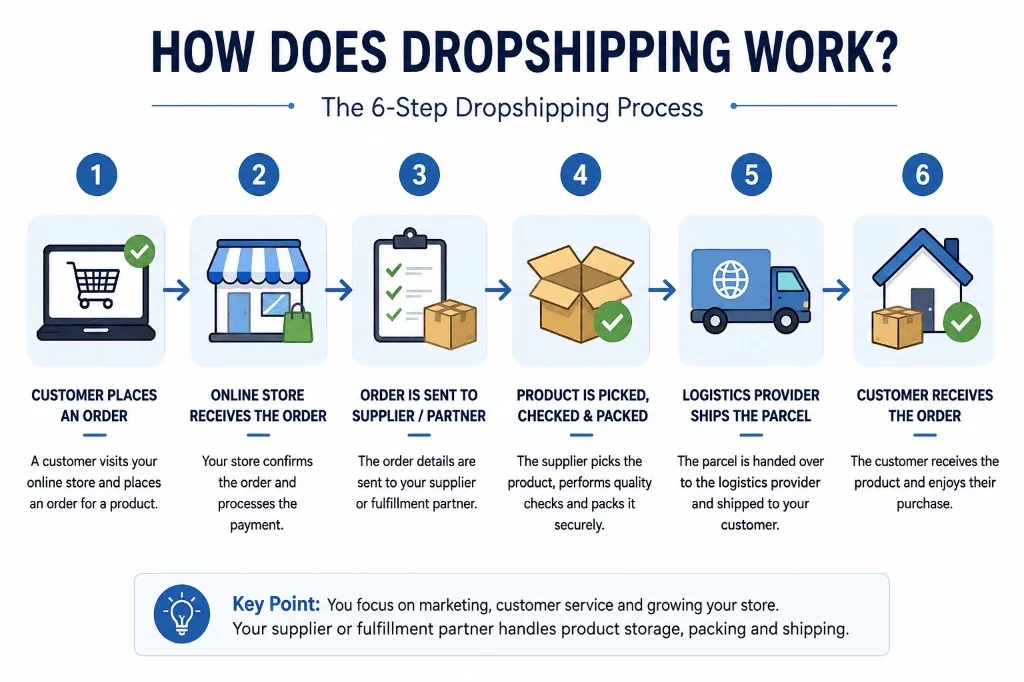
At its simplest, dropshipping connects three main parties: the customer, the seller, and the supplier or fulfillment partner.
The seller builds the storefront, selects products, creates product pages, determines pricing, attracts customers, and manages the customer relationship. The supplier provides or procures the products. A supplier, agent, or fulfillment company may then handle processing, packaging, and delivery depending on the operating model.
Step 1: The Seller Chooses Products
The process begins with product selection.
A seller may find products through manufacturers, wholesale platforms, sourcing agents, dropshipping suppliers, or product sourcing services. The goal should not simply be to find the cheapest possible item. Product quality, shipping weight, competition, customer demand, return risk, available margin, and supplier reliability all matter.
Beginners often test a relatively small number of products before committing more money to inventory or branding.
Step 2: The Product Is Listed in the Store
The seller creates a product listing on Shopify, WooCommerce, TikTok Shop, Amazon, eBay, Etsy, or another ecommerce channel.
The retail price is determined by the seller rather than the supplier. This price needs to leave enough room for product cost, shipping, payment fees, advertising, returns, customer service, and other operating expenses.
Good product pages also do more than copy supplier descriptions. They explain the problem the product solves, show how it is used, set realistic delivery expectations, and give customers enough confidence to purchase.
Step 3: A Customer Places an Order
When a customer purchases the product, payment is collected by the seller's store or selling platform.
The seller then needs to ensure that the corresponding order reaches the supplier or fulfillment system. At a very small scale this can be done manually, while more developed stores often use integrations or automated order synchronization.
Step 4: The Supplier or Fulfillment Partner Processes the Order
Once the order is received, the product is prepared for shipment.
Depending on the supplier arrangement, this may include picking the product, performing basic quality checks, packing the order, attaching a shipping label, and transferring the parcel to the logistics provider.
This part of the process becomes increasingly important as a store grows. Reliable dropshipping fulfillment services can help sellers coordinate warehousing, quality control, packaging, order processing, tracking, and international delivery without building the entire logistics infrastructure themselves.
Step 5: The Product Is Delivered to the Customer
The logistics carrier transports the parcel to the customer.
Tracking information is normally returned to the seller or ecommerce platform so the customer can follow the shipment.
The seller remains responsible for the customer experience even though another company physically ships the product. If the parcel is delayed, damaged, incorrect, or lost, the customer will normally contact the store rather than the original factory.
That is why dropshipping should not be understood simply as "a supplier ships the product for me." It is an ecommerce model in which several businesses work together behind a single customer experience.
Dropshipping vs. Traditional Ecommerce
The biggest difference between dropshipping and traditional ecommerce is when inventory is purchased and where it is stored.
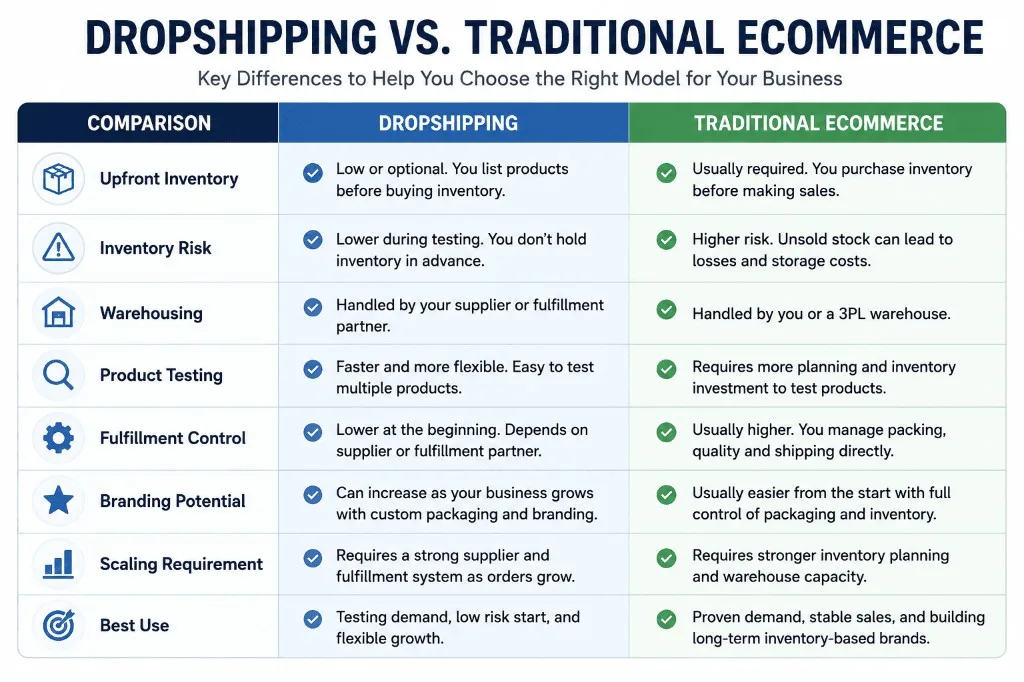
A traditional ecommerce seller may purchase 500 units before launching a product. This can reduce the cost per unit and give the seller more control over inventory, but it also creates financial risk. If the product does not sell, the business may be left with unsold stock.
A dropshipping seller can test demand before making the same inventory commitment. This reduces early inventory risk and makes it easier to experiment with different products.
However, traditional inventory can provide advantages once demand becomes predictable. Bulk purchasing may reduce sourcing costs, stock can be prepared in advance, and orders can often be processed more consistently.
This is why dropshipping and inventory-based ecommerce should not always be treated as opposites. A business can begin with dropshipping, identify products with stable demand, hold small amounts of inventory for those products, and gradually develop a more structured supply chain.
What Are the Main Advantages of Dropshipping?
Dropshipping became popular because it removes several barriers that traditionally made starting a retail business expensive.
Lower Initial Inventory Investment
The most obvious advantage is that sellers do not necessarily need to purchase large amounts of inventory before making their first sale.
This allows beginners to use more of their initial budget for product testing, store development, content creation, advertising, samples, and customer acquisition rather than locking most of their capital into stock.
Lower inventory investment does not mean that dropshipping is free to start. A serious store may still need money for ecommerce software, samples, advertising, payment processing, design, customer service, and other operating expenses.
More Flexibility for Product Testing
Because the seller is not committed to a warehouse full of one product, unsuccessful products can usually be removed more easily.
This is particularly useful in categories where customer preferences change quickly. Sellers can test different products, offers, prices, content angles, and target audiences before deciding where to invest more heavily.
The ability to test is one of the strongest advantages of dropshipping, but testing should still be structured. Uploading hundreds of unrelated products is not the same as understanding what customers actually want.
Access to a Wider Supplier Network
Dropshipping also allows sellers to work with suppliers in different manufacturing regions without building their own sourcing organization from the beginning.
China remains an important sourcing market because of its manufacturing base, supplier variety, packaging capabilities, and international logistics infrastructure. However, supplier selection should be based on more than product price.
When comparing the best dropshipping suppliers in 2026, sellers should consider product quality, processing speed, communication, inventory stability, shipping options, integrations, quality control, packaging support, and the ability to scale.
Easier Geographic Expansion
A store can potentially sell to customers in multiple countries without operating its own warehouses in every market.
This makes dropshipping particularly attractive to ecommerce entrepreneurs who want to test demand in the United States, United Kingdom, Europe, Australia, or other international markets.
International expansion still requires careful logistics planning. Delivery time, tracking quality, taxes, customs procedures, product compliance, and return expectations can differ significantly between countries.
What Are the Disadvantages of Dropshipping?
Dropshipping lowers some types of risk, but it creates other operational challenges.
Understanding these disadvantages before launching is more useful than discovering them after advertising begins.
You Have Less Direct Control Over the Product
If products are shipped directly from a supplier, the seller may not physically inspect every order.
Poor product quality, incorrect variants, packaging damage, missing accessories, or inconsistent batches can therefore become customer-service problems.
Ordering samples and working with suppliers or agents that provide quality inspection can reduce this risk.
Shipping Can Affect Customer Experience
Customers increasingly expect transparent and reasonably fast delivery.
A product may have excellent demand and strong advertising performance, but long or inconsistent shipping can still create complaints, refunds, chargebacks, and poor reviews.
For this reason, sellers should evaluate the entire logistics route rather than choosing a supplier based only on the lowest product price.
Margins Can Be Smaller Than They First Appear
A common beginner mistake is calculating profit as:
Incomplete math
Selling Price − Supplier Price = Profit
Real ecommerce profitability is more complicated.
International shipping, payment processing, advertising, refunds, reshipments, discounts, apps, packaging, taxes, customer service, and other expenses can significantly reduce the amount left after each sale.
This is why a product with a very low sourcing price is not automatically a good dropshipping product.
Supplier Problems Become Your Problems
Customers usually do not know or care which factory supplied their order.
If the supplier runs out of stock, ships the wrong product, delays processing, or changes quality, the customer still holds the store responsible.
Supplier reliability therefore becomes part of the brand experience.
Is Dropshipping Profitable in 2026?
Dropshipping can still be profitable in 2026, but profitability depends much more on execution than on the fulfillment model itself.
The market has become more competitive. Customers can compare products quickly, advertising costs can be significant, and generic products are often available from multiple sellers. Simply finding a cheap product and increasing the retail price is no longer a reliable strategy.
Profitable sellers tend to pay more attention to product positioning, landed cost, average order value, conversion rate, repeat purchases, supplier stability, fulfillment quality, and customer acquisition cost.
Bundling is one way to improve the economics. Instead of selling one inexpensive item, a seller may combine several related products into a more complete solution. This can increase average order value while making direct price comparisons more difficult.
Whether a particular store can make money therefore depends on its actual numbers. Our guide to whether dropshipping is profitable in 2026 examines the cost structure, margins, and operating factors that determine real profitability.
Is Dropshipping Legal?
Dropshipping itself is a legitimate ecommerce fulfillment method.
The fact that a supplier ships an order on behalf of a seller does not make the business illegal. However, sellers still need to comply with the laws and platform rules that apply to the products they sell and the markets they serve.
Product safety, intellectual property, trademarks, taxes, consumer protection, privacy, refunds, labeling, certifications, and import requirements may all apply depending on the product and destination country.
This is especially important for electronics, cosmetics, children's products, health-related products, batteries, and other regulated categories. Sellers should verify compliance requirements before selling rather than assuming that a product is legal simply because a supplier offers it.
Do You Need a Supplier for Dropshipping?
Yes. Every dropshipping business ultimately needs a source for the physical product.
However, the word "supplier" can describe several different relationships.
Some sellers purchase directly from factories. Others work with wholesalers, marketplace suppliers, product sourcing agents, dropshipping platforms, or fulfillment companies.
A beginner testing a small number of orders may only need basic product access and shipping. A growing store may need more advanced services such as supplier negotiation, quality inspection, inventory management, branded packaging, order automation, warehousing, and multiple logistics options.
The right supplier structure therefore depends on the stage of the business rather than on a single universal answer.
Can You Build a Brand With Dropshipping?
Yes. Dropshipping does not prevent brand building.
A store may begin with generic packaging while testing demand and later introduce logo stickers, thank-you cards, custom bags, instruction cards, product inserts, private labeling, and eventually fully customized packaging.
Branding is most valuable after a seller understands which products and customer groups deserve further investment. Spending heavily on custom packaging before validating demand can create unnecessary inventory risk.
The progression is often gradual: test the product first, improve the customer experience when demand becomes more predictable, and invest more deeply in branding as the business becomes stable.
This is one reason modern dropshipping increasingly overlaps with traditional ecommerce. The fulfillment method may remain flexible while the customer-facing business becomes much more professional.
Who Is Dropshipping Best For?
Dropshipping can be suitable for beginners who want to learn ecommerce without making a large initial inventory commitment. It can also work for existing brands that want to test new products before purchasing larger quantities.
It is particularly useful for sellers who are comfortable with product research, marketing, customer service, supplier communication, and continuous testing.
Dropshipping is less suitable for someone expecting completely passive income. Even if the supplier handles physical fulfillment, the seller still needs to manage product selection, store operations, marketing, customer expectations, profitability, and supplier performance.
The model works best when it is treated as a flexible supply-chain structure rather than as a shortcut to easy money.
How Much Money Do You Need to Start Dropshipping?
There is no single amount that every beginner needs.
A basic store can technically be created with a relatively small budget, but launching a store and building a business are different things.
The real budget depends on how products will be tested and how customers will be acquired. Costs may include store software, domain registration, product samples, advertising, content creation, payment fees, apps, branding, and customer-service expenses.
Beginners should therefore think in terms of a testing budget rather than searching for a fixed minimum number.
The goal of the first stage is not necessarily to maximize profit immediately. It is to learn whether customers want the product, whether the offer converts, whether fulfillment works reliably, and whether the economics can eventually support growth.
How Do You Start Dropshipping as a Beginner?
The first step is choosing a market or customer group rather than randomly collecting products.
A focused store usually has an easier time creating consistent product pages, advertising, content, bundles, and branding. A pet travel store, for example, can expand naturally across several related products, while a store selling unrelated gadgets may struggle to develop a clear identity.
Next, shortlist products and order samples whenever practical. Evaluate product quality, packaging, actual dimensions, shipping weight, ease of use, and whether the product matches the supplier's photos and description.
After that, calculate realistic costs before deciding on a retail price. Product cost is only one component. Shipping, advertising, payment processing, returns, packaging, and customer service also need room in the margin.
The store can then be built around a small number of carefully selected products. For sellers using Shopify, learning how to add dropshipping products to a Shopify store is part of turning those product ideas into clear, trustworthy listings with accurate information, images, pricing, and shipping expectations.
Once the store is ready, begin testing traffic and customer response. Early results can help determine whether the product, offer, price, creative, or audience needs improvement.
When a product begins producing consistent orders, the next stage is improving the supply chain rather than simply increasing advertising. Better supplier terms, inventory planning, quality control, faster fulfillment, and eventually branded packaging can turn an experimental store into a more stable ecommerce business.
What Does Successful Dropshipping Look Like in 2026?
Successful dropshipping increasingly looks less like a temporary product-selling tactic and more like a professionally managed ecommerce business.
The strongest sellers understand their customers, select products around specific needs, test offers carefully, calculate real margins, work with reliable suppliers, and improve fulfillment as order volume increases.
They may still avoid purchasing large quantities of inventory at the beginning, but they do not necessarily remain inventory-free forever. Once demand becomes predictable, holding small amounts of stock can improve processing speed, reduce stockouts, and create more consistent packaging.
The same evolution applies to branding. A seller may begin with simple fulfillment and gradually introduce custom packaging, product bundles, private labels, improved inserts, and more consistent customer communication.
In other words, the real advantage of dropshipping in 2026 is not that it eliminates ecommerce operations. It allows those operations to develop gradually as demand becomes clearer, which is also why the dropshipping supply chain is evolving from simple product sourcing toward more coordinated quality control, inventory, packaging, fulfillment, and branding.
Conclusion
Dropshipping in 2026 is best understood as a flexible ecommerce fulfillment model rather than a shortcut to easy income.
It allows sellers to test products without making the same upfront inventory commitment required by traditional retail, but the seller still remains responsible for product selection, pricing, marketing, customer experience, supplier performance, and profitability.
For beginners, the most useful approach is to start small, validate real demand, calculate the complete cost of each order, and improve the supply chain as sales become more predictable.
The businesses most likely to succeed are not simply those that find the cheapest products. They are the ones that turn flexible sourcing and fulfillment into a reliable customer experience and gradually build a stronger ecommerce operation around products that customers genuinely want.
Frequently asked questions
- What is dropshipping in simple terms?
Dropshipping is a way to sell products online without storing large amounts of inventory yourself. When a customer orders from your store, a supplier or fulfillment partner prepares and ships the product to the customer.
- Can beginners start dropshipping?
Yes. Dropshipping can reduce the amount of inventory capital required at the beginning, which makes it accessible to new sellers. Beginners still need to learn product research, pricing, marketing, customer service, supplier management, and basic ecommerce operations.
- Do I need to buy inventory before starting?
Not necessarily. Traditional dropshipping allows sellers to fulfill products after customers order them. However, stores with stable sales may eventually keep small amounts of inventory to improve fulfillment speed and supply stability.
- Can I use Shopify for dropshipping?
Yes. Shopify is widely used for dropshipping because sellers can build independent stores, control product presentation, connect apps and suppliers, and develop their own customer experience.
- Can dropshipping become a real brand?
Yes. Sellers can gradually introduce custom packaging, product bundles, private labels, branded inserts, and other elements after validating demand. Dropshipping describes how products are fulfilled; it does not prevent the customer-facing business from becoming a brand.
- What is the biggest risk in dropshipping?
One of the biggest risks is relying on a supply chain that the seller does not properly control. Product quality problems, inventory shortages, slow processing, poor shipping, and inaccurate tracking can all affect customers even when the seller is not physically handling the product.

Author
Simon
Simon is a content strategist at ETdropship with extensive professional experience. He has been working in the industry for 13 years and possesses deep knowledge of the eCommerce sector and logistics systems. Passionate about his work, he creates practical and easy-to-understand content that helps sellers successfully run and grow their dropshipping businesses.
Get in touch
Have a question?
Leave your name, WhatsApp and message. We'll get back to you soon.
Ready to professionalize your Shopify fulfillment?
Move from ad-hoc supplier links to sourcing, QC, branded packaging, and reliable global shipping—with a team built for independent brands.
