
You can start dropshipping in 2026 without purchasing bulk inventory, renting a warehouse or hiring a fulfillment team before your first sale. That is the useful meaning of "zero upfront cost." It does not mean a functioning ecommerce business will remain completely free. A domain, store plan, product sample, payment fees and occasional refunds still require cash.
The advantage is sequencing: validate a customer problem, test a product and confirm fulfillment before making larger commitments. This guide turns that principle into a practical launch plan for beginners with limited capital.
What "zero upfront cost" really means
Dropshipping shifts inventory ownership and fulfillment until after a customer orders. You avoid the largest traditional retail expense—buying stock before demand is known—but you still operate a real business. The objective is to delay reversible costs, not ignore essential checks.
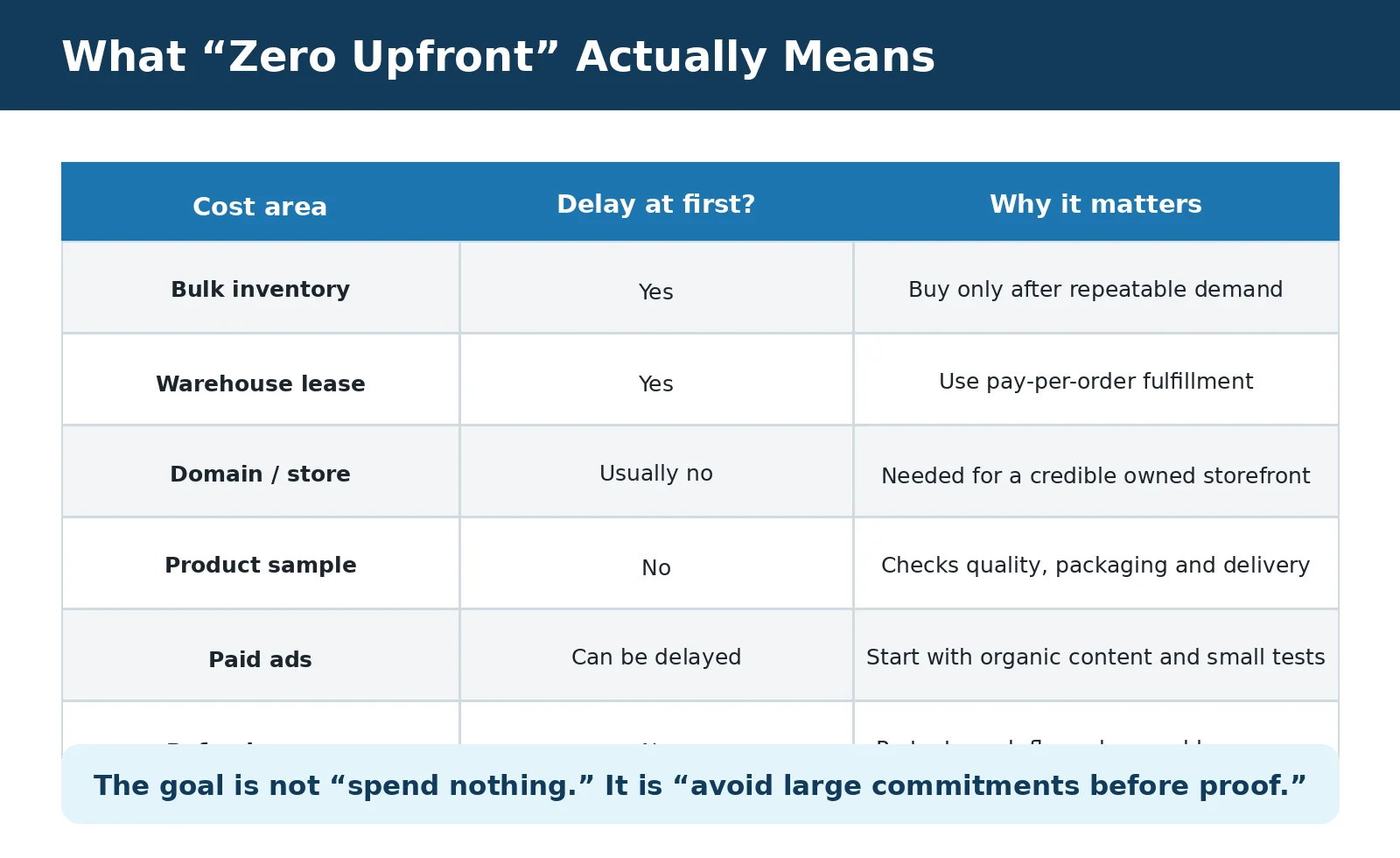
Costs you can delay
- Bulk inventory and long warehouse commitments
- Premium themes and large software stacks
- Custom boxes, tooling and high-MOQ branding
- Large paid-ad campaigns before conversion evidence exists
Costs you should plan for
At minimum, allow for a domain, a simple store, a product sample, payment processing, customer support and a small refund or reshipment reserve. If you need detailed numbers, calculate the complete contribution margin rather than treating the supplier price as your cost.
A five-stage lean launch plan
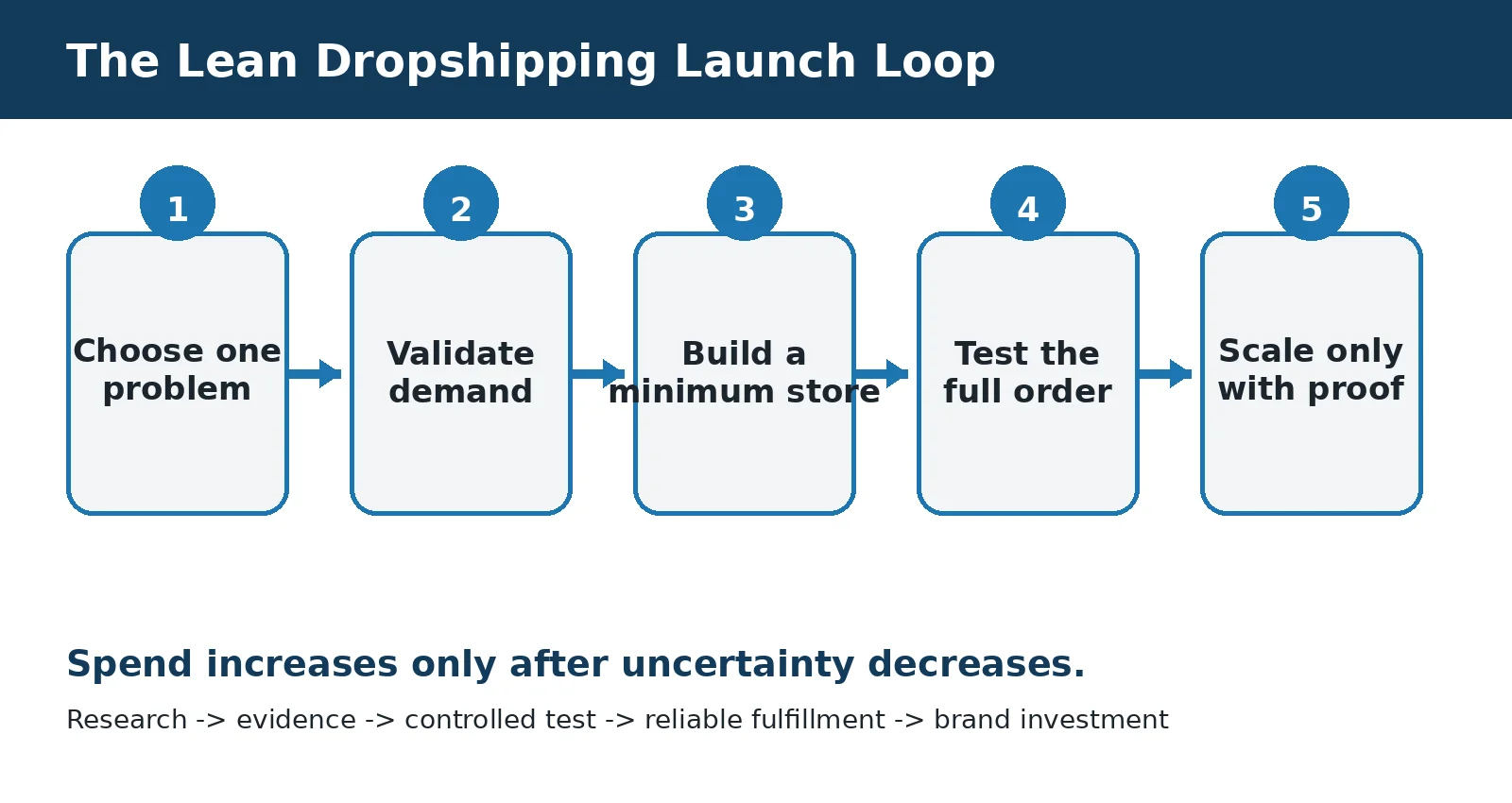
1. Choose one customer problem, not a general store
Start with a narrow situation such as pet travel, small-kitchen organization, desk cable management or compact travel accessories. A focused problem makes product research, content and store messaging more coherent. It also prevents a beginner from uploading dozens of unrelated products that cannot share an audience.
2. Validate demand before building the store
Use at least three independent signals: stable search interest, real marketplace transactions, repeated social content and customer complaints that reveal a better offer. A viral video is discovery evidence, not proof of durable demand. Use the site's cross-platform product validation workflow to score demand, economics, creative fit, supply and compliance consistently.
3. Select a product that survives real costs
A beginner-friendly product is compact, easy to demonstrate, not fragile, not highly regulated and not dependent on risky medical claims. Estimate landed contribution per order: selling price minus product, shipping, duties or tax borne by the seller, platform and payment fees, content or advertising, refunds, reshipments and support.
For discovery channels and the point at which sellers should move beyond a marketplace listing, see the 2026 product sourcing guide. The link belongs here because product discovery and supply-chain selection are related but different decisions.
4. Build the minimum credible store
A minimum store still needs a clear product page, accurate dimensions and materials, honest delivery expectations, returns information, contact details and mobile-friendly checkout. One strong page is more useful than a large catalogue of weak pages. If you are unsure whether Shopify, WooCommerce or a marketplace fits your workflow, compare order routing, inventory synchronization, tracking and scaling needs in the beginner platform selection guide.
5. Test the complete order before promoting it
Place a sample order to the target market. Record supplier response time, processing time, tracking events, delivery time, packaging condition, product match and defect risk. Photograph the received item and use those assets on the product page. A supplier promise is not the same as a verified customer experience.
Use organic content before large ad spend
For products with a visible benefit, organic short-form content is the most capital-efficient first test. Create several angles around the same customer problem: demonstration, before-and-after, objection handling, comparison, setup and common mistakes. Publish enough variations to separate a weak product from a weak creative.
- Track click-through rate to judge the hook
- Track product-page engagement and add-to-cart rate to judge the offer
- Track completed purchases to judge price, trust and checkout
- Track refunds and complaints to judge product and fulfillment quality
Do not scale traffic simply because one video performs well. Promotion amplifies the supply chain you already have; it does not repair unreliable fulfillment.
How to choose a supplier without buying inventory
Ask every potential supplier for the exact product specification, current stock location, processing SLA, chargeable shipping weight, target-country shipping options, tracking method, defect policy, replacement process and packaging choices. Order samples from the shortlisted options and compare them side by side.
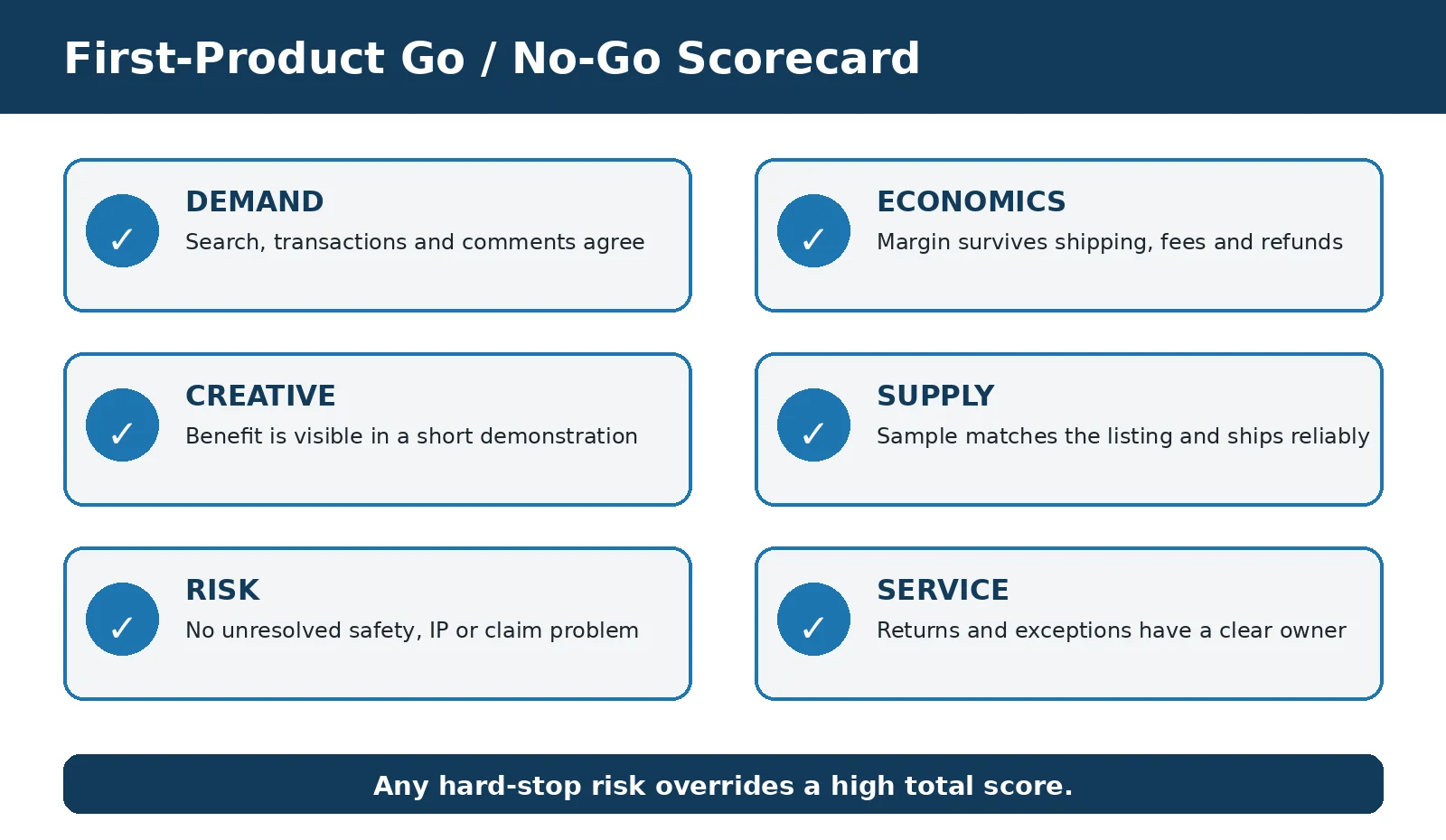
When sourcing from China, written approvals and visible evidence matter more than a broad catalogue. The China sourcing agent checklist explains what to request at the brief, quotation, sample, quality and logistics stages.
When to add inventory, faster shipping or branding
The first upgrade should solve a measured constraint. Consider a small inventory position when repeat orders, stockouts or slow processing are costing more than the commitment. Consider branded packaging when the product has stable contribution, consistent specifications and enough volume to justify packaging inventory.
Begin with low-commitment elements such as a logo sticker, thank-you card or insert. Move to mailers and custom boxes only when order volume and margin support them. The private-label packaging guide provides a staged packaging workflow and explains the costs that must be included per order.
A simple 30-day beginner schedule
| Period | Main work | Evidence required |
|---|---|---|
| Days 1–5 | Choose one audience problem and shortlist five products | Three independent demand signals per candidate |
| Days 6–10 | Estimate landed contribution and contact suppliers | Comparable quotes, specifications and shipping options |
| Days 11–17 | Order a sample and build one minimum product page | Approved sample and credible store policies |
| Days 18–24 | Publish multiple organic content angles | Clicks, page engagement and add-to-cart signals |
| Days 25–30 | Review first orders and fulfillment exceptions | Delivery evidence, customer feedback and revised margin |
Common zero-budget mistakes
- Treating "no inventory" as "no operating cash required"
- Copying supplier images without verifying the received product
- Choosing the cheapest quote without comparing shipping and exception handling
- Adding many apps before a product earns sales
- Scaling ads before delivery, refunds and contribution margin are understood
- Using safety-sensitive products or unverified claims to chase high margins
Conclusion: start lean, then earn the right to scale
Dropshipping can reduce upfront inventory risk in 2026, but a durable business still requires evidence and control. Choose one problem, validate demand, calculate full costs, test the actual order and improve fulfillment before increasing spend. The best beginner plan is not to spend nothing. It is to spend deliberately, in the right order, as uncertainty falls.
Frequently asked questions
- Can I start dropshipping without buying inventory?
Yes. A supplier can fulfill after the customer orders, so bulk inventory is not required at launch. You should still budget for a sample, store basics, fees and customer-service exceptions.
- Can I start with no paid advertising?
Yes, if the product is suitable for demonstrable organic content, search-driven articles or community marketing. Organic traffic reduces cash risk but requires consistent production and testing; it is not instant or guaranteed.
- Should I use a free ecommerce platform?
Use the simplest platform that supports trustworthy checkout, required policies, order routing and tracking. A free plan that blocks essential functions can cost more in lost conversions and manual work than a basic paid plan.
- When should I pay for custom packaging?
After repeatable orders, acceptable margins, a stable specification and reliable fulfillment. Branding should strengthen a proven offer, not compensate for an unvalidated one.
- What is the biggest risk for beginners in 2026?
The biggest risk is scaling an offer before verifying landed economics and delivery performance. Low inventory commitment limits one type of loss; it does not remove refunds, chargebacks, compliance problems or account-health risk.

Author
Simon
Simon is a content strategist at ETdropship with extensive professional experience. He has been working in the industry for 13 years and possesses deep knowledge of the eCommerce sector and logistics systems. Passionate about his work, he creates practical and easy-to-understand content that helps sellers successfully run and grow their dropshipping businesses.
Get in touch
Have a question?
Leave your name, WhatsApp and message. We'll get back to you soon.
Ready to test one product without buying bulk stock?
ETdropship helps Shopify sellers start with pay-per-order fulfillment, then add inspection, packaging and repeat-order control once demand is proven—talk to us about your first SKU and destination market.
