
In 2026, Which Platform Is Best for Beginners in Dropshipping?
Choosing a platform is one of the first decisions a new dropshipping seller makes, but it is easy to give the decision more importance than it deserves. Shopify, TikTok Shop, Amazon, eBay, Etsy and WooCommerce can all support ecommerce businesses, yet they provide very different ways to reach customers and operate orders.
For most beginners, the best platform is not simply the one with the lowest monthly cost or the largest number of products available. It is the platform that matches how you expect to acquire customers, how much technical work you can handle, what type of products you want to sell and how much control you want over the customer relationship.
If you want one simple answer, Shopify is usually the strongest all-around starting point for beginners who want to build an independent store and are prepared to generate their own traffic. TikTok Shop can be a better first choice for sellers who are especially good at short-form content, while eBay and Etsy can make sense when the product and marketplace audience already fit naturally.
Amazon is powerful, but it is not automatically the easiest beginner option. The marketplace provides enormous existing demand, but operational requirements, customer expectations and competition make supplier and fulfillment reliability particularly important.
The Best Platform Depends on Where Your Customers Come From
The biggest difference between ecommerce platforms is not the website builder. It is where demand comes from.
Shopify and WooCommerce are independent-store platforms. They give sellers considerable control over product pages, pricing, branding and customer relationships, but they do not automatically deliver meaningful customer traffic. A seller normally needs advertising, social media, SEO, influencers, email, communities or another acquisition channel.
Amazon, eBay and Etsy operate differently because customers already visit those marketplaces looking for products. TikTok Shop sits somewhere between conventional ecommerce and social discovery because content itself can generate product demand without requiring the customer to begin with a product search.
Understanding this difference makes platform selection much easier. A beginner who enjoys creating videos faces a different decision from someone who understands Google SEO, and both face a different decision from someone who wants to compete for existing marketplace searches.
Quick Comparison for Beginners
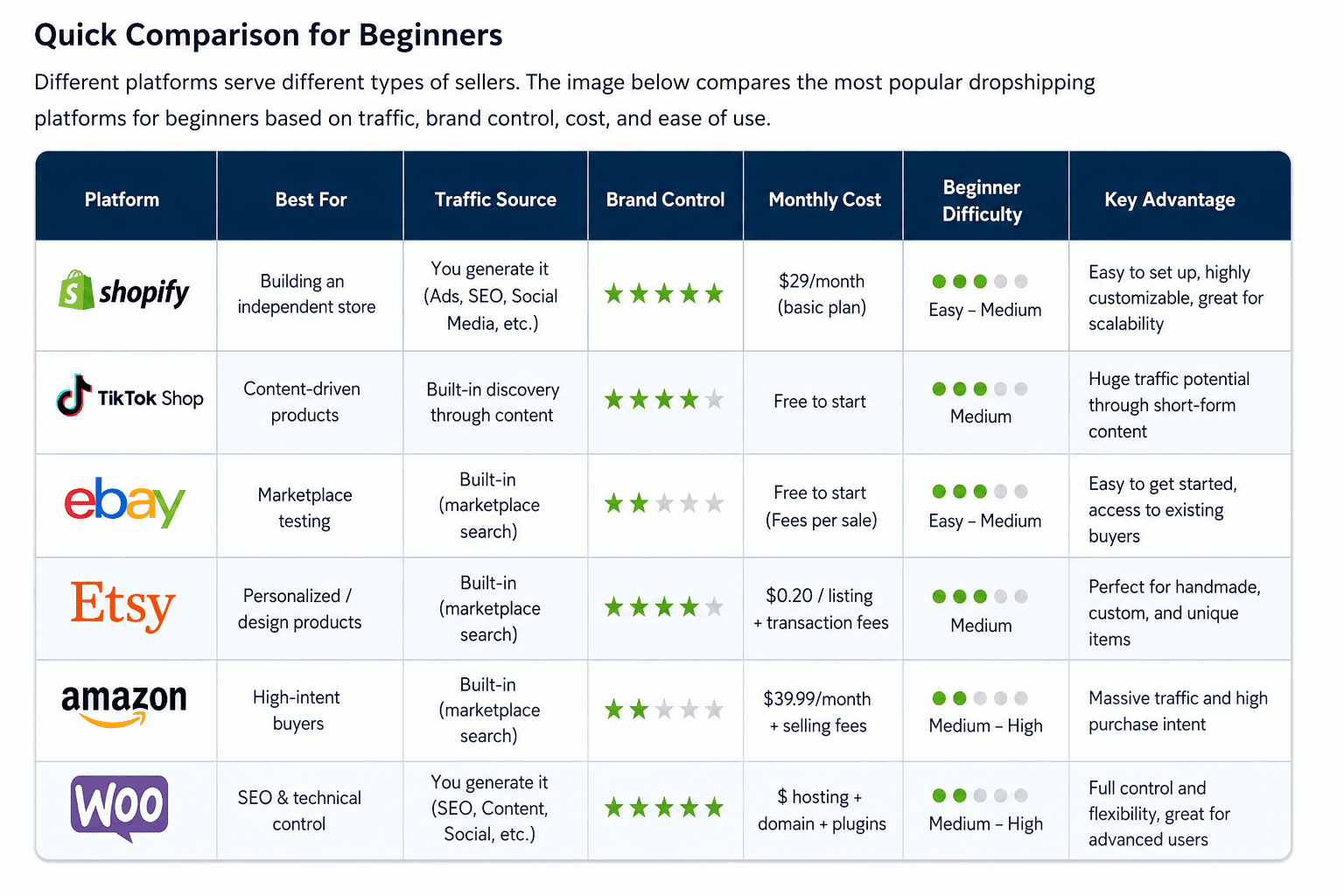
This table is not a ranking from best to worst. A platform becomes easier when its traffic model matches the seller's existing skills.
Shopify: Best Overall for Building an Independent Store
For a beginner who wants to create an independent ecommerce business rather than operate entirely inside a marketplace, Shopify is usually one of the easiest places to start. Hosting, checkout, product management and much of the technical infrastructure are handled inside one ecosystem, allowing the seller to concentrate more heavily on products, marketing and customer experience.
Its biggest weakness is also important: Shopify does not solve customer acquisition. A new store with ten good products can still generate no orders if nobody visits it. Sellers therefore need a realistic plan for TikTok content, Meta advertising, Google, SEO, influencers or another source of traffic.
Shopify becomes particularly attractive for sellers who eventually want to improve branding, build an email list, create bundles and develop repeat customers. The seller controls much more of the shopping experience than they would on a conventional marketplace.
Once Shopify has been chosen, the next decision is often not another ecommerce platform but the operational tools connected to it. The available Shopify dropshipping apps for beginners differ significantly in whether they focus on AliExpress imports, supplier discovery, automation, local products or managed sourcing and fulfillment.
Who should choose Shopify?
Shopify makes the most sense when you want control over the store and are willing to learn customer acquisition. It is particularly suitable when long-term branding matters more than receiving built-in marketplace traffic immediately.
A complete beginner who has no interest in advertising, content, SEO or any other traffic source should not assume Shopify will generate customers simply because the store has been published.
TikTok Shop: Best for Content-First Beginners
TikTok Shop can be attractive when the seller's strongest skill is creating product-focused short-form content. Instead of building a standalone store first and then trying to send people toward it, product discovery and shopping can occur inside the same broader content ecosystem.
This makes visually demonstrable products particularly suitable. Home accessories, beauty tools, organization products, selected pet accessories and other items where the benefit can be understood quickly through video can have a natural content advantage.
The challenge is that content performance can be inconsistent. One successful video does not automatically create a stable business, and sellers still need reliable products, accurate inventory information and fulfillment capable of supporting the orders generated by successful content.
For sellers considering this route seriously, the broader TikTok dropshipping workflow becomes more useful after the initial platform decision because product presentation, creator content and fulfillment all need to work together.
Who should choose TikTok Shop?
TikTok Shop is a stronger beginner option when you already understand short-form content or are willing to produce and test it consistently. It is less attractive if your plan is simply to upload products and wait for TikTok to generate sales automatically.
The platform provides distribution opportunities, but the seller still needs a product and content combination capable of earning attention.
eBay: Useful for Marketplace Product Testing
eBay can be useful for beginners who prefer an existing marketplace rather than building an independent traffic system immediately. Customers already use the platform to search for products, which means the seller can learn about listing quality, pricing and demand without first creating a full standalone brand.
The trade-off is reduced control. The marketplace determines more of the selling environment, and competitors can often appear directly beside your listing. That makes price, seller performance and product availability more visible.
eBay can therefore work well as a learning or testing channel, but sellers who eventually want deeper brand control may later add an independent store rather than expecting a marketplace listing to perform every role.
Etsy: Best When Personalization or Design Is Part of the Product
Etsy should not be treated as a generic replacement for Shopify or eBay. Its strongest fit is with products where design, personalization, craft positioning or another creative element genuinely matters.
Personalized jewelry, custom gifts, selected print-on-demand products, artwork and other design-led offers can fit the marketplace more naturally than generic commodity products. Sellers should still understand Etsy's current seller and production-partner requirements rather than assuming every mass-produced product automatically belongs there.
For the right product, Etsy gives beginners access to customers already searching for distinctive or personalized goods. For a generic electronics or random-product store, another platform is normally a more natural fit.
Amazon: Powerful, but Not My Default Recommendation for a Complete Beginner
Amazon has an enormous advantage: customers visit it with strong purchase intent. Sellers do not need to convince shoppers that online buying is normal or build the marketplace's credibility from scratch.
The difficulty is that Amazon customers also expect a highly structured buying experience. Inventory accuracy, product information, delivery performance and customer service matter considerably, while marketplace rules leave sellers less room to improvise when the upstream supply chain is unreliable.
For that reason, Amazon can be excellent for sellers who already understand their product and operations, but it is not necessarily where I would send a complete beginner whose supplier may change the SKU without notice or whose fulfillment process is still being invented.
A marketplace with strong demand does not compensate for a weak backend.
WooCommerce: Better for Beginners Who Already Understand WordPress
WooCommerce gives sellers substantially more technical control because the ecommerce operation sits inside the broader WordPress environment. This can be valuable for businesses planning large content sites, custom functionality or deep SEO strategies.
The trade-off is responsibility. Hosting, plugins, performance, compatibility and security require more hands-on management than a platform such as Shopify.
For someone who already uses WordPress comfortably, WooCommerce may actually feel easier than learning a completely new ecosystem. For a beginner who wants the least technical friction possible, Shopify is normally the simpler independent-store option.
Should a Beginner Start With a Marketplace or an Independent Store?
The answer depends on which skill you want to develop first.
A marketplace can reduce the first traffic challenge because customers already exist inside the platform. In exchange, sellers accept stronger platform dependence and less control over customer relationships, presentation and sometimes pricing strategy.
An independent store provides more freedom but forces the seller to solve customer acquisition. This can initially make Shopify look harder, yet the skills developed through advertising, SEO, content and customer retention become useful assets if the business grows.
Neither route is inherently more professional. They simply place the difficult work in different parts of the business.
What About the Other Ecommerce Platforms?
There are many more options than the six discussed here. Walmart Marketplace, Wix, Facebook and Instagram commerce tools, regional marketplaces and other platforms can all be relevant in particular situations.
A beginner usually does not benefit from comparing twenty platforms before making the first sale. The purpose of the first platform is to create a workable environment for learning customer acquisition, product economics and order operations.
If you want a broader feature-by-feature comparison rather than only a beginner recommendation, the 10 best ecommerce platforms for dropshipping guide covers a wider set of options and their different use cases.
This keeps the two articles separate: this page answers “Where should a beginner start?”, while the larger comparison page answers “What platforms are available and how do they compare?”
Do Not Choose a Platform Based Only on Monthly Cost
Beginners naturally notice platform subscription fees because they are easy to compare. However, the difference between a $20, $30 or $40 software cost can be much less important than the cost of acquiring customers or fixing poor fulfillment.
A platform with a low monthly fee can still become expensive if the seller needs many paid plugins or spends heavily to attract traffic that does not convert. A marketplace with no conventional store subscription can still charge selling fees and create different advertising costs.
Instead of asking which platform is cheapest, calculate the complete model: platform fees, payment fees, product cost, shipping, acquisition cost, refunds and operational tools.
Do Not Choose Based Only on How Easy Product Import Looks
One-click product importing is convenient, but moving a supplier listing into a store is not the difficult part of ecommerce. The important questions begin after the product has been imported.
Is the product actually good? Is the supplier stable? Can the seller use accurate product information? Is shipping suitable for the target country? Will the exact SKU remain available if advertising works?
An app that imports 100 products in ten minutes can create more problems rather than fewer if none of those products has been evaluated properly.
Your Traffic Skill Should Influence the Decision
A beginner who already creates strong short-form videos has an advantage on a content-driven platform. Someone who understands SEO may benefit more from an independent website where content can become a long-term acquisition asset.
A seller who dislikes marketing but understands marketplace optimization may prefer starting inside a platform where purchase intent already exists. The important point is to choose according to your strongest realistic acquisition method rather than according to which platform another seller happened to succeed on.
Platform choice and traffic strategy should be made together.
Your Product Type Should Influence the Decision Too
Personalized products naturally fit different environments from generic household accessories. Visual impulse products behave differently from products customers search for using precise technical specifications.
This is why the same platform cannot be the best recommendation for every beginner. A custom-name necklace seller and an automotive replacement-parts seller can both be beginners while requiring very different customer discovery and product-page structures.
Choose the platform after understanding how customers naturally look for your type of product.
Do Not Launch on Five Platforms at Once
Multi-channel selling sounds attractive because it appears to multiply the number of places customers can find the product. For a beginner, however, it also multiplies operational complexity before basic problems have been solved.
Orders need to be synchronized, inventory needs to remain accurate and customer-service expectations differ between platforms. A stockout that is manageable on one store can become several oversold orders when the same inventory is listed across multiple channels.
One primary platform is usually enough to learn the business. Additional channels become more useful after the first system is already functioning.
Platform Choice Does Not Solve Fulfillment
A common beginner mistake is spending weeks comparing storefront features while giving much less attention to what happens after an order is paid.
Regardless of whether the order comes from Shopify, TikTok Shop, Etsy or another channel, someone still needs to obtain the correct SKU, confirm availability, pack it, choose the shipping route and return valid tracking information. As volume grows, manually coordinating those steps across separate suppliers becomes increasingly difficult.
This is where a dropshipping fulfillment service becomes relevant: not because every beginner needs a managed warehouse immediately, but because supplier coordination, QC, inventory, packing, shipping and tracking eventually need to operate as one workflow when order volume increases.
The platform gets the order. The fulfillment system determines whether the customer receives what was promised.
Start Simple, Then Let the Backend Become More Sophisticated
A beginner does not need a complex supply chain before proving that anyone wants the product. Small-volume testing can remain flexible while the seller learns which products and channels actually work.
After demand becomes predictable, the priorities change. Supplier consistency, faster processing, inventory planning, QC, packaging and order automation become more valuable because each operational failure now affects a larger number of paying customers.
The platform may remain exactly the same while the business behind it becomes substantially more sophisticated.
My Platform Recommendation by Beginner Type
If you want to build an independent ecommerce business and are willing to learn traffic generation, start with Shopify. It offers a relatively straightforward technical setup and enough flexibility to remain useful as the store grows.
If your strongest ability is short-form video and product demonstrations, consider TikTok Shop. If you want to begin inside an existing marketplace and learn listing-based ecommerce, eBay can be useful. If the offer is genuinely personalized, creative or design-led, Etsy may be a more natural starting environment.
If you already understand WordPress, WooCommerce can be excellent. If you want to sell on Amazon, approach it with stronger operational discipline rather than assuming marketplace traffic makes the supply chain easier.
There is no contradiction in these recommendations. Different beginners have different starting advantages.
A Simple Decision Framework
Ask four questions before choosing.
Where will the customer come from? If you have an external traffic plan, an independent store becomes more attractive. If you need existing marketplace demand, look at marketplaces first.
What kind of product are you selling? Personalized, visual, technical and commodity products naturally behave differently across sales environments.
How much technical control do you want? Shopify prioritizes convenience, WooCommerce offers more technical freedom, while marketplaces provide less storefront control.
What happens after an order arrives? The platform must fit a supplier and fulfillment process capable of meeting its customer expectations.
If one platform gives clear answers to all four questions, it is probably a better starting point than whichever platform currently receives the most attention on social media.
Frequently Asked Questions
What is the best dropshipping platform for beginners in 2026?
For most beginners building an independent store, Shopify is one of the strongest overall choices because setup is relatively straightforward and the platform provides considerable room for future branding and expansion. It still requires the seller to generate traffic.
Is Shopify easier than TikTok Shop?
They are difficult in different ways. Shopify makes store setup relatively easy but requires an external customer-acquisition strategy. TikTok Shop can provide content-driven product discovery, but sellers need the ability to create effective content and maintain platform-compatible operations.
Is Amazon good for beginner dropshipping?
Amazon can work for sellers with reliable supplier and fulfillment processes, but it is not automatically the easiest beginner option. Strong marketplace demand comes with strong operational expectations and competition.
Should beginners use eBay for dropshipping?
eBay can be useful when a seller wants to test marketplace demand without first building a complete independent traffic system. Product availability, shipping performance and account requirements still need to be managed carefully.
Is Etsy good for dropshipping?
Etsy is most suitable when the product genuinely fits its creative, design-led or personalized commerce environment and the seller follows the platform's applicable production and seller requirements.
Is WooCommerce better than Shopify?
WooCommerce provides greater technical flexibility, while Shopify is generally easier to set up and maintain. Sellers already comfortable with WordPress may prefer WooCommerce; complete beginners often find Shopify simpler.
Should I start on several ecommerce platforms?
Usually not. Beginners benefit from making one sales channel work first because adding channels increases inventory, fulfillment and customer-service complexity.
Does the ecommerce platform provide the supplier?
Not necessarily. Shopify and WooCommerce provide ecommerce infrastructure rather than automatically providing the complete supplier and fulfillment system. Marketplaces and integrations work differently, so the seller still needs to understand where the product comes from and how orders are fulfilled.
Conclusion
There is no single platform that is easiest for every dropshipping beginner because the platforms solve different problems. Shopify offers strong control and a relatively accessible way to build an independent store, but the seller needs to generate traffic. TikTok Shop is more attractive for content-driven sellers, while eBay and Etsy can make sense when existing marketplace demand matches the product.
Amazon offers powerful purchase intent but should not be mistaken for a shortcut around supplier reliability and fulfillment. WooCommerce provides substantial freedom for sellers who are comfortable managing more of the technical environment themselves.
For most beginners who want to build a long-term independent ecommerce business, Shopify remains my strongest general starting recommendation in 2026. The recommendation changes when the seller already has a specific strength—such as short-form video, marketplace selling, WordPress or personalized products—that another platform supports more naturally.
The important decision is therefore not which platform has the longest feature list. Choose one platform that fits your current acquisition skills, learn how customers respond and allow the rest of the operation to become more sophisticated only when real orders justify it.
