
Validation means trying to disprove a product idea before committing meaningful budget. Use platform data to test demand, but make the final decision with landed contribution, sample quality, fulfillment, compliance, and differentiation. This workflow was updated on July 18, 2026.
Sources & further reading
- Shopify — Ecommerce product research (2026)
- Amazon — Product Opportunity Explorer
- eBay — Product Research
- TikTok — Creative Center Top Ads
- Google Trends
- U.S. CPSC — Recalls
Policies and forecasts change. Confirm dates and details on each official page before making business decisions.
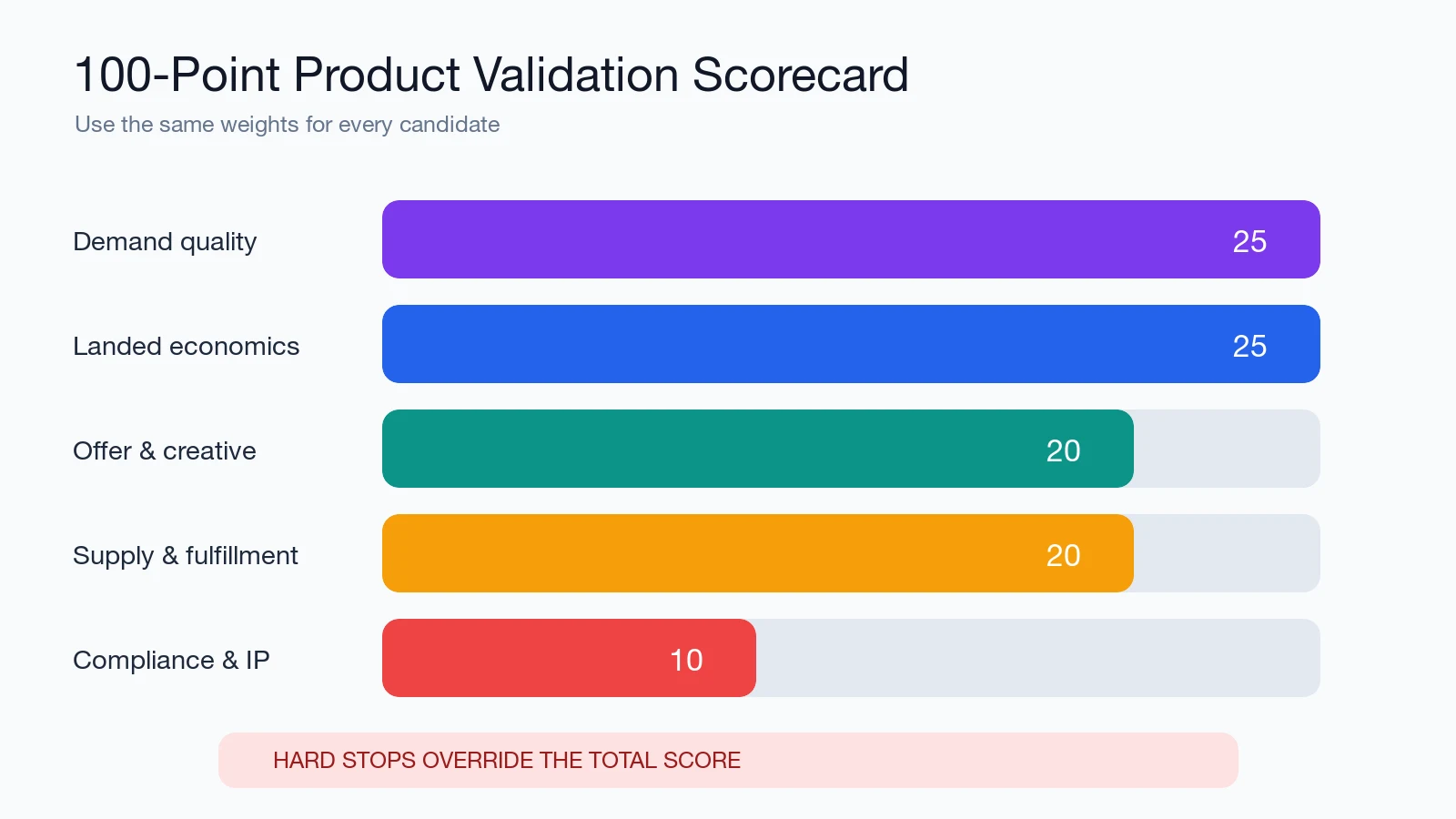
Use a 100-point validation scorecard
| Area | Points | Evidence required |
|---|---|---|
| Demand quality | 25 | Stable search plus repeated transactions or purchase signals |
| Landed economics | 25 | Positive contribution under a conservative cost case |
| Offer and creative fit | 20 | Specific audience, visible benefit, and credible differentiation |
| Supply and fulfillment | 20 | Approved sample, stable specification, backup source, viable shipping |
| Compliance and IP | 10 | Claims, labels, documents, and rights can be verified |
Set the pass score before evaluating candidates. Do not lower it to rescue a favorite idea.
1. Validate demand across independent sources
- Amazon: check BSR direction, Best Sellers, Movers & Shakers, review recency, and Product Opportunity Explorer search and return themes.
- eBay: check actual sold prices, seller count, shipping, sell-through, and 12-month seasonality.
- TikTok: compare 7-day and 30-day Top Products or Top Ads patterns, several advertisers, comments, and repeatable demonstrations.
- Shopify and Google Trends: compare current category reporting with five-year search direction and country-level seasonality.
- Temu: compare identical-listing density, review complaints, specification drift, price floor, and delivery expectations.
Minimum evidence
Require meaningful support from at least two independent demand sources. One viral video, one bestseller badge, or one supplier order count is not enough.
2. Calculate landed contribution
Landed contribution per order = selling price − product − packaging − domestic handling − international shipping − duties or VAT where applicable − platform and payment fees − expected refunds and reships − variable advertising cost.
- Use chargeable weight and destination-specific shipping, not a supplier’s best-case headline rate.
- Model a normal case and a conservative case with higher refunds, ad cost, and shipping.
- Compare the result with actual sold prices on eBay and the competitive range on Amazon, Temu, and independent stores.
3. Test the exact sample and promise
- Create a written specification: materials, dimensions, variants, accessories, packaging, labels, and target market.
- Order samples from the leading supplier and at least one credible alternative.
- Test the customer use case, durability, fit, odor, noise, assembly, cleaning, and package protection.
- Record the demonstrations needed for the product page. Remove any claim the sample cannot prove.
- Confirm that future batches will use the approved specification and QC checklist.
4. Run a controlled offer test
- Define the audience, problem, offer, price, bundle, proof, and objection before buying ads.
- Create several honest hooks based on real sample demonstrations and customer language.
- Set the budget, duration, success metrics, and stop conditions before launch.
- Judge the whole funnel: qualified clicks, product-page engagement, checkout behavior, purchases, support questions, refunds, and delivery.
5. Apply hard stop rules
| Stop condition | Why popularity cannot fix it |
|---|---|
| Unverifiable safety or compliance documents | Creates legal, customs, platform, and customer risk |
| Copied branding, characters, patents, or designs | Creates takedown, seizure, and account risk |
| Margin only works when costs are omitted | More sales can increase losses |
| Supplier cannot hold the approved specification | Reviews and refund rates deteriorate after launch |
| Delivery promise cannot be met repeatedly | Conversion gains are erased by disputes and churn |
Make a go, revise, or stop decision
- Go: demand is supported, the sample passes, economics work conservatively, and no hard-stop risk exists.
- Revise: the problem is real but the SKU, price, bundle, supplier, creative, or shipping plan needs improvement.
- Stop: evidence is weak, the margin is fragile, or compliance, IP, quality, or fulfillment cannot be controlled.
Frequently asked questions
- How many platforms should I use to validate a product?
Use at least two independent demand sources, then verify economics, samples, fulfillment, and compliance. More platforms are useful only when they add different evidence.
- Can high TikTok views validate a product?
No. Views show attention. Validate purchase intent with repeated ad patterns, transaction data, search direction, and a controlled offer test.
- What is the strongest eBay validation metric?
No single metric is strongest. Combine actual sold price, transaction frequency, seller count, shipping cost, sell-through, and seasonality for the exact specification and condition.
- When should I buy inventory or custom packaging?
After the exact product and offer produce repeatable orders, acceptable contribution, stable fulfillment, and manageable customer feedback.

Author
Simon
Simon is a content strategist at ETdropship with extensive professional experience. He has been working in the industry for 13 years and possesses deep knowledge of the eCommerce sector and logistics systems. Passionate about his work, he creates practical and easy-to-understand content that helps sellers successfully run and grow their dropshipping businesses.
Get in touch
Have a question?
Leave your name, WhatsApp and message. We'll get back to you soon.
Validate the product before you scale it
ETdropship can compare supplier specifications, arrange samples, inspect quality, and model shipping and landed cost for your target markets.
