
The best dropshipping supplier is not the platform with the largest catalog or the lowest displayed price. It is the supplier model that fits the seller's current stage, product risk, destination market and required level of control.
A beginner testing one product needs low commitment and clear order visibility. A print-on-demand brand needs artwork consistency and production coverage. A store with repeat demand needs stable specifications, inspection, packaging and replenishment. Comparing every option on one universal ranking hides these differences.
This guide keeps ten widely used supplier routes in the comparison, but evaluates them by operating fit rather than declaring a permanent winner. Availability, pricing, integrations and service levels can change, so sellers should verify current terms and test the exact product workflow before launch.
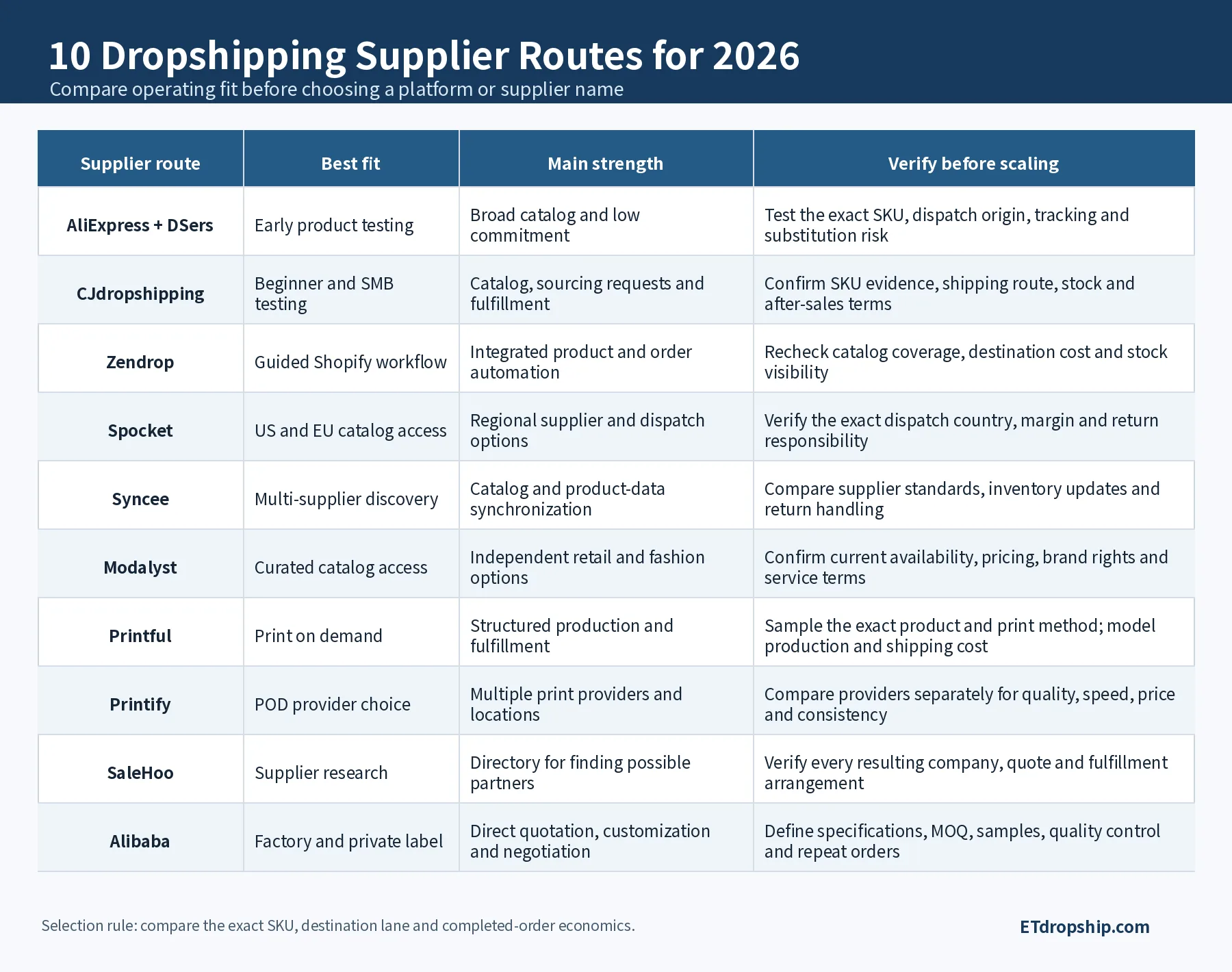
Quick comparison of 10 dropshipping supplier routes
Choose the supplier model before the supplier name
Marketplace sourcing is flexible for discovery and very small tests. Integrated dropshipping platforms reduce catalog import and order-transfer work. Regional networks can shorten delivery for selected products. Print-on-demand providers manufacture customized items after the sale. A private sourcing partner provides more control once demand becomes repeatable.
These models solve different problems. A store that needs one unbranded sample should not evaluate a private supplier by the same criteria as a brand placing repeat customized orders. The first decision is therefore the operating model; the company name comes second.
A separate beginner ecommerce platform comparison can help distinguish the storefront decision from the supplier decision. The selling platform controls checkout and customer data, while the supplier controls the product and order execution.
Supplier routes for fast product testing
AliExpress and DSers
AliExpress offers broad product discovery and supports low-commitment testing, while DSers is commonly used to organize AliExpress product and order workflows. This route can be useful before demand is known, but listing similarity does not guarantee identical materials, packaging or processing speed.
Use it for controlled tests rather than assuming the first listing can support scale. Order the exact variant, confirm the dispatch origin and monitor substitutions, tracking activation and after-sales response.
CJdropshipping
CJdropshipping combines a catalog, sourcing requests, order processing and logistics options. It can reduce the fragmentation of buying from unrelated marketplace listings. The seller still needs to verify the selected SKU, destination quote, processing time and packaging outcome rather than treating platform enrollment as product approval.
Zendrop
Zendrop is designed around integrated product and order workflows for ecommerce sellers. It may suit stores that value a guided interface and simpler automation. Catalog coverage, destination availability, product evidence, total order cost and branding options should be checked for the actual offer.
Supplier routes for regional catalog access
Spocket
Spocket emphasizes supplier discovery that can include products dispatched from the United States or Europe. A regional dispatch point may improve transit time, but it does not automatically prove local manufacturing, broad inventory depth or a lower completed-order cost. Verify the specific supplier and SKU.
Syncee
Syncee connects retailers with supplier catalogs and supports product-data and order workflows. It can help a seller explore multiple markets, although supplier standards vary. Check stock synchronization, return responsibility, shipping coverage and whether product data is complete enough for an accurate listing.
Modalyst
Modalyst provides another catalog and supplier-integration route, including products positioned for independent retail. It may fit sellers who prioritize curated selection or platform convenience. Current catalog access, pricing tiers, destination service and supplier-specific terms require verification.
Supplier routes for customized products
Printful
Printful supports print-on-demand production and fulfillment for customized products. It can reduce inventory commitment and offers a structured artwork-to-order workflow. Sellers should sample the exact product, print method and destination route because base garment, color, placement and production location affect the result.
Printify
Printify connects sellers with multiple print providers. The network creates choice in products, locations and cost, but the selected print provider is operationally important. Two providers offering a similar item may differ in blank product, print quality, packaging, processing and replacement handling.
Supplier routes for research and direct relationships
SaleHoo
SaleHoo is primarily useful as a supplier directory and research resource rather than a single fulfillment operator. It may help sellers discover wholesalers or dropshipping arrangements, but every resulting business relationship must be evaluated independently. Directory inclusion is not a substitute for sample and order testing.
Alibaba
Alibaba is strongest when the seller is ready to negotiate directly with manufacturers or trading companies, compare specifications and discuss customization or inventory. It is less suited to assuming that every supplier will process single direct-to-consumer orders. MOQ, payment, inspection, packaging and shipping responsibilities need explicit agreement.
Use a structured supplier verification process to compare legal identity, quotation scope, samples, production control, payment details and repeat-order consistency. This verification role is different from a platform comparison.
Private sourcing for a validated product
Private sourcing agent or fulfillment partner
A private sourcing route becomes relevant when a product has repeat demand and the seller needs upstream quotations, a stable specification, inspection, customized packaging, inventory coordination or consolidated fulfillment. It offers more control than repeatedly buying from changing retail listings, but it requires a clear product brief and enough order evidence to justify the setup. Before scaling branded orders, document a custom packaging workflow covering inserts, labels, mailers, minimum quantities and final packed dimensions.
Understanding what a product sourcing agent does helps separate supplier discovery from quotation comparison, negotiation, sampling, quality control and repeat-order management. The agent should preserve the validated product rather than silently replace it with the cheapest similar version.
There is no universal daily-order threshold. Move when inconsistency, manual purchasing, stock uncertainty or packaging requirements begin to limit the business and the completed-order economics support a more controlled process.
Compare evidence, not marketing labels
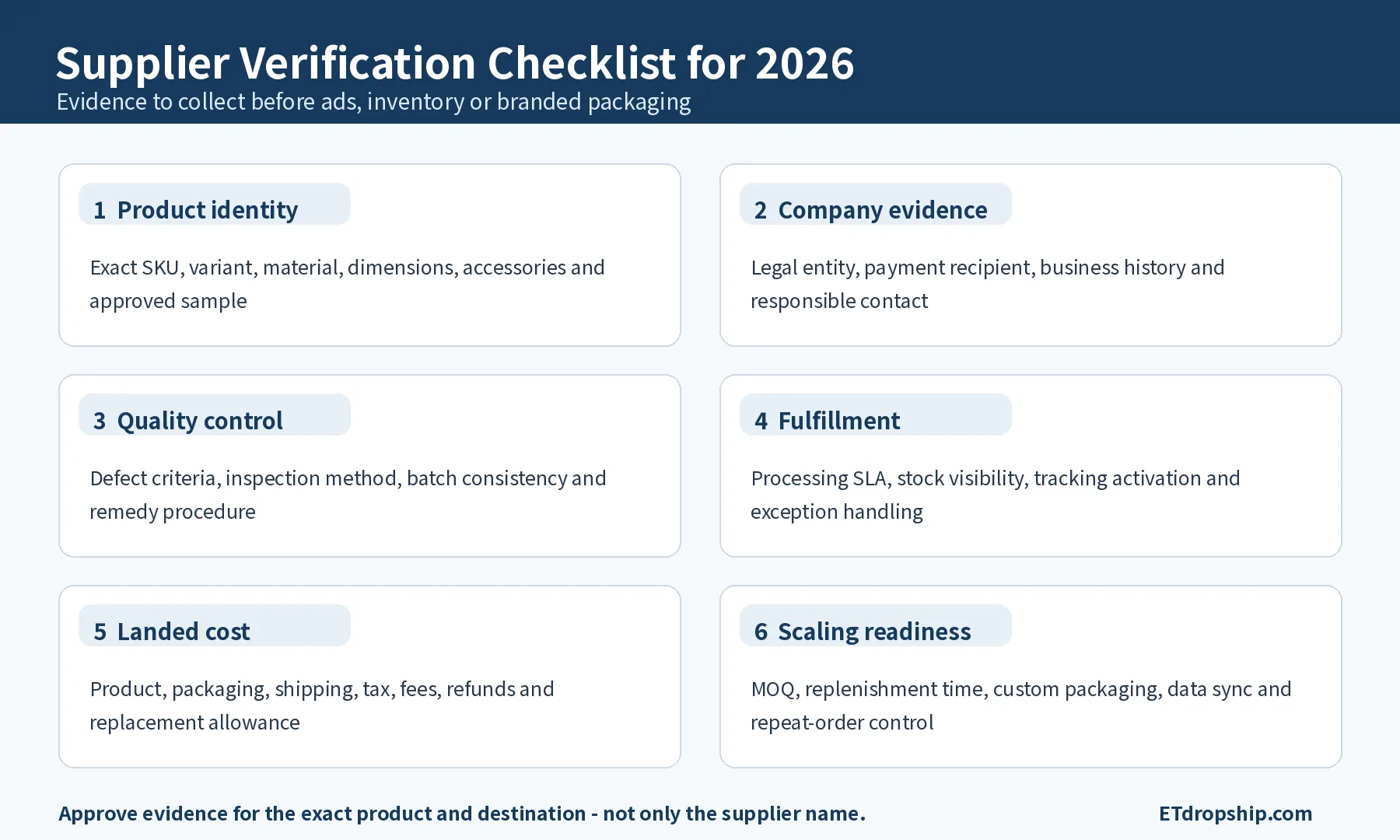
Request the exact SKU, variant, material, dimensions, included accessories, packaging, packed weight, processing time and destination quote. For regulated or higher-risk products, identify the required labels, instructions and documentation before listing.
A supplier described as US, EU, premium, factory direct or verified may still be unsuitable for the order. Ask where the exact SKU is stocked, who receives payment, who controls production, how inventory is synchronized and who handles defects. Test the complete parcel and customer-support path.
Compare completed-order cost rather than unit price. Shipping, volumetric weight, taxes, payment fees, platform fees, refunds, replacements and support determine the contribution left after delivery.
Match the supplier to the store stage
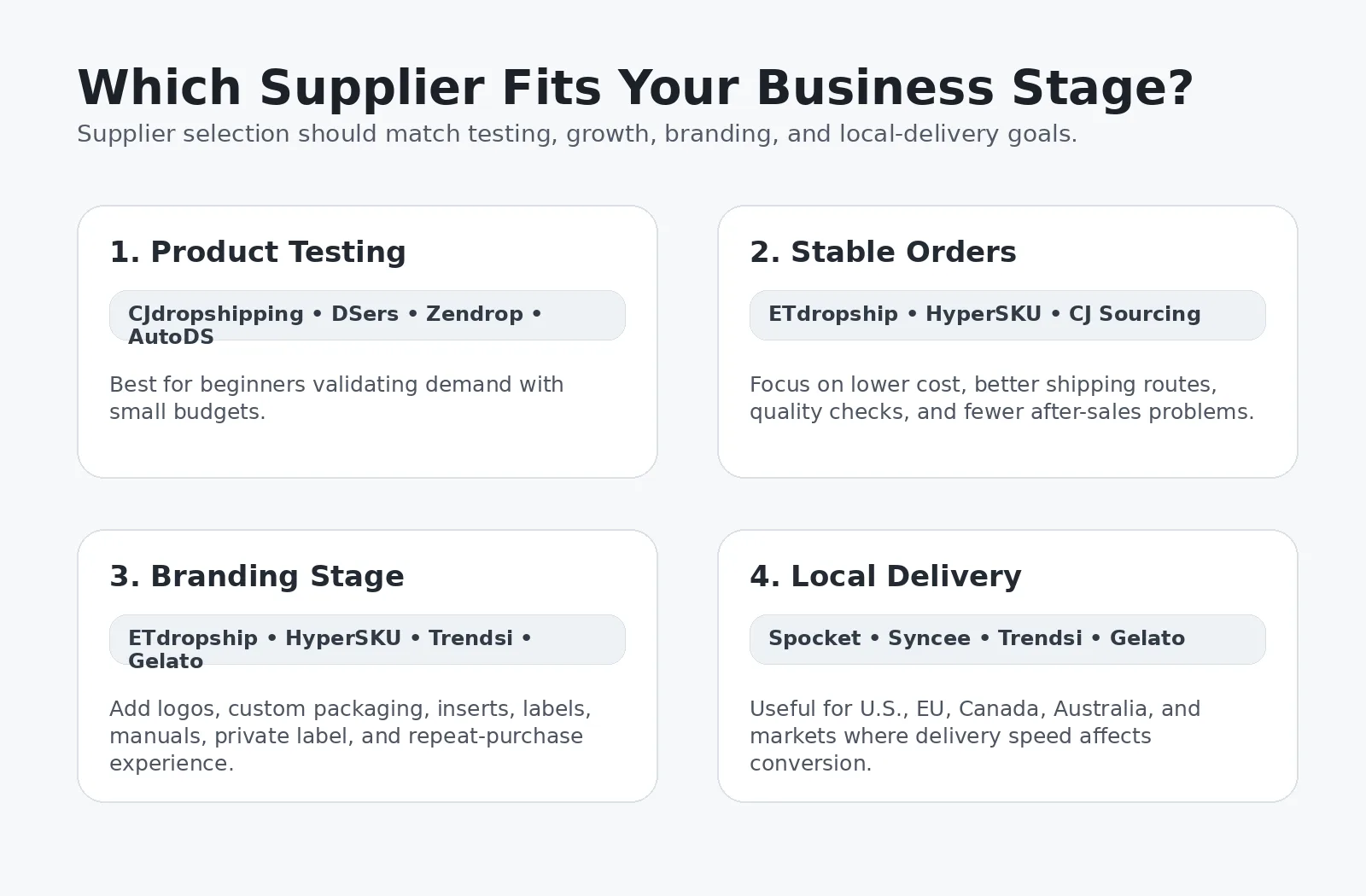
During discovery, prioritize low commitment and fast evidence. During validation, prioritize sample accuracy, trackable delivery and honest cost. During growth, prioritize repeatability, stock visibility, inspection and exception handling. During brand development, prioritize specification ownership, packaging, compliance and replenishment.
When a validated SKU requires comparable factory quotations, sampling, inspection and repeat-order control, product sourcing support is a natural commercial route. It should follow evidence of demand rather than replace early product validation.
The best supplier in 2026 is therefore conditional. Select the route that solves the present constraint, document the approved product and review performance through completed orders. A platform that is excellent for testing can become limiting at scale, while a private supplier that is efficient at scale may be unnecessary at the first-order stage.
Frequently asked questions
- Which dropshipping supplier is best for beginners?
A low-commitment platform with clear product data, trackable shipping and manageable integrations can suit early testing. The exact SKU and destination workflow still need a sample and order test.
- Should I choose the cheapest supplier?
No. Compare the complete order, including packed shipping, fees, defects, replacements and support. A lower unit price can create a higher completed-order cost.
- When should I use a private sourcing agent?
Consider one after a product shows repeat demand and the store needs stable specifications, quotation comparison, inspection, packaging, inventory or coordinated fulfillment.
- Can I use more than one supplier?
Yes, but approve each source against the same specification. Similar listing images do not prove that materials, variants, packaging or performance are interchangeable.

Author
Simon
Simon is a content strategist at ETdropship with extensive professional experience. He has been working in the industry for 13 years and possesses deep knowledge of the eCommerce sector and logistics systems. Passionate about his work, he creates practical and easy-to-understand content that helps sellers successfully run and grow their dropshipping businesses.
Get in touch
Have a question?
Leave your name, WhatsApp and message. We'll get back to you soon.
Ready to move from testing to controlled sourcing?
ETdropship helps Shopify sellers lock specifications, inspect orders, and add branded packaging once a product has repeat demand—talk to us about your SKUs and destination markets.
