Luxembourg Dropshipping 2026: Products, Fulfillment and Profit Strategy
Luxembourg is easy to overlook when choosing European dropshipping markets. Its population is much smaller than Germany, France, Italy or Spain, so sellers looking only at potential order volume may assume that there is little reason to target it separately.
That conclusion is too simple. Luxembourg is a highly connected European market where consumers are accustomed to buying online and interacting with businesses across national borders. At the same time, its small size means it should not usually be approached with the same volume-driven strategy that a seller might use for France or Germany.
For dropshipping sellers, the opportunity is therefore less about finding a huge untapped audience and more about building an offer that works well in a small, multilingual and cross-border-oriented market. Product quality, delivery clarity, pricing, VAT treatment and customer trust matter more than simply offering the lowest possible price.
This makes Luxembourg particularly suitable for sellers who already understand their product economics and want to expand into additional European markets without building a completely separate supply chain for every country.
Is Luxembourg a Good Market for Dropshipping in 2026?
Luxembourg can be a useful dropshipping market, but it should be evaluated realistically. A small population naturally limits the maximum scale available to a narrowly targeted store, while the country's location and consumer familiarity with neighboring European markets create considerable cross-border competition.
The advantage is that online purchasing is already deeply established across the European Union. Eurostat's 2026 digitalisation report shows that 78% of people in the EU bought or ordered goods or services online in 2025, while delivery speed remained one of the most common problems reported by ecommerce customers. Luxembourg was among the countries where online shoppers most frequently reported some type of ecommerce problem, reinforcing the importance of reliable delivery and accurate customer communication rather than relying on broad “fast shipping” promises.
A Luxembourg store therefore needs to compete on the complete buying experience. A product may attract attention through advertising, but unclear delivery estimates, unexpected import charges or weak after-sales support can quickly remove the advantage.
Do Not Treat Luxembourg as a Miniature Version of Germany or France
Luxembourg sits between several much larger ecommerce markets, but that does not mean a German or French campaign should simply be copied and given a Luxembourg location target.
The first difference is scale. A narrow niche can reach audience saturation more quickly, which makes excessively aggressive advertising harder to sustain. The second is language: consumers may interact with French, German, Luxembourgish and English depending on context, so the store should not assume that one localization strategy works for every customer.
The third difference is purchasing context. Luxembourg consumers can easily compare offers from neighboring countries, which means an independent store needs to provide a clear reason for choosing its offer instead of a better-known European retailer.
A seller should therefore think of Luxembourg as part of a wider cross-border European strategy rather than an isolated ecommerce island.
Luxembourg Works Better as Part of a Regional Strategy
For many sellers, it makes little sense to build an entire supply chain exclusively for Luxembourg. The more practical approach is to use the same product, warehouse and logistics infrastructure that already supports countries such as France, Belgium, Germany or the Netherlands.
The customer-facing side can still be localized. Pricing, shipping policies, language and advertising can be adjusted for Luxembourg while the physical inventory remains part of a broader European fulfillment system.
This produces better operational economics because the seller is not maintaining separate stock for a relatively small market before demand has been demonstrated.
Luxembourg can therefore work particularly well as an expansion market for a store that already has validated products and a functioning European supply chain.
What Products Are Better Suited to Luxembourg Dropshipping?
There is no special list of products that only works in Luxembourg. Product selection should instead reflect the economics and expectations of a small, mature European ecommerce market.
Compact products with clear practical value are generally easier to manage than bulky or difficult-to-explain items. Home organization products, pet accessories, travel products, selected automotive accessories, hobby products and lightweight lifestyle items can all be reasonable areas to research when the underlying demand exists.
The product should also have enough perceived value to support the complete European cost structure. Extremely cheap items can become difficult once VAT, shipping, customer acquisition, payment processing, refunds and customs-related costs are included.
The strongest product is therefore not necessarily the cheapest product available from China. It is one that leaves enough economic room to deliver a reliable customer experience.
Avoid Building the Store Around Random Viral Products
A small market can expose the weaknesses of a random-product strategy quickly. If the store repeatedly changes between unrelated viral products, it becomes difficult to build repeat customers or enough audience depth around one category.
A more focused store can continue selling related products to the same type of customer. A pet travel store, for example, can add seat protection, portable water products, travel accessories and grooming items without completely changing its audience.
This matters in Luxembourg because customer acquisition opportunities are not infinite. Extracting more value from a relevant audience can be more sustainable than repeatedly trying to find an entirely new audience for every SKU.
Niche focus also makes localization easier because the same terminology, customer problems and content themes can be reused across several products.
Low-Ticket Products Need Careful Economics
A product that costs €4 or €5 from a supplier may appear attractive because the seller can apply a substantial markup. However, European order economics cannot be calculated from supplier price alone.
International freight, VAT, payment fees, advertising, refunds, packaging and customs-related costs all reduce the amount remaining from the selling price. A product with a retail price of €15 may therefore have less room for customer acquisition and operational mistakes than the supplier markup initially suggests.
For Luxembourg, where building a professional cross-border buying experience matters, extremely low-ticket products can be especially difficult if the store needs paid traffic to acquire customers.
Bundles and multipacks can sometimes improve the economics by increasing the value of one transaction without increasing customer-acquisition cost proportionally.
A Higher Price Can Work if the Offer Supports It
Luxembourg should not automatically be approached as a discount-only market. The stronger question is whether the customer understands why the product and buying experience justify the price.
Clear product photography, useful descriptions, bundles, reliable shipping and strong customer communication can all contribute to perceived value. A generic product using the same supplier photographs found across several marketplaces provides far less pricing power.
The seller should therefore avoid assuming that price competition is the only way to enter a small market.
A product with a slightly higher selling price and better economics may be easier to operate than a cheap item where every additional logistics or advertising cost damages profitability.
Multilingual Ecommerce Requires Practical Decisions
Luxembourg's linguistic environment can make localization look more complicated than it needs to be. A seller does not necessarily need to build four completely independent stores before testing the market.
The correct language approach depends on the audience and traffic source. A French-language campaign should normally lead to a page that feels consistent with that campaign, while German-language traffic should not be sent to an unrelated language experience without a clear option to switch.
English can also be useful for certain products and audiences, but it should not be assumed to replace localization universally.
The most important objective is consistency between advertisement, landing page, checkout information, shipping policy and customer support.
Do Not Auto-Translate Critical Product Information Blindly
Automatic translation can accelerate localization, but product specifications, safety information, dimensions and return policies deserve manual review.
A mistranslated lifestyle sentence may be awkward. A mistranslated size, material specification or return condition can create customer disputes.
This is especially important when a store sells regulated products or products with technical characteristics.
Machine translation should therefore be treated as a first draft rather than a substitute for checking customer-facing information that affects purchasing decisions.
EUR Pricing Makes Comparison Easy for Customers
Luxembourg uses the euro, which simplifies pricing for sellers already operating in eurozone markets. The disadvantage is that customers can also compare prices with French, Belgian, German and other European stores without mentally converting currencies.
This makes artificial markups easier to notice.
Pricing should be built from landed economics and customer value rather than simply multiplying the supplier price by an arbitrary factor.
If the store charges significantly more than comparable alternatives, the additional value should be visible through the product, bundle, presentation, service or delivery experience.
VAT Needs to Be Included in the Profit Model
Luxembourg's standard VAT rate is currently 17%, although reduced rates can apply to certain categories. EU VAT treatment depends on the nature of the transaction and the seller's structure, so sellers should not assume that every product simply uses one identical tax workflow.
The important business point is that VAT affects the amount of sales revenue the seller actually keeps. A €49.99 customer-facing selling price should not automatically be treated as €49.99 of operating revenue before product and advertising costs.
This is particularly important when expanding a product from the United States into Europe. Copying the same margin spreadsheet while ignoring European VAT can make a profitable-looking product much weaker than expected.
VAT therefore needs to be considered before scaling advertising rather than reconciled only after the month is over.
IOSS Can Matter for Low-Value Imports
For qualifying imported consignments not exceeding €150, the EU's Import One Stop Shop can be relevant to how VAT is collected and declared. The practical objective is to make the customer's tax experience predictable rather than allowing unexpected charges to appear at delivery.
The exact setup depends on the seller, marketplace and fulfillment structure. Sellers should therefore confirm how VAT is being collected and declared for the route they actually use.
A logistics line being capable of delivering to Luxembourg does not by itself answer the tax question.
The store, checkout, customs declaration and fulfillment process need to operate consistently.
2026 Makes EU Customs Economics More Important
European low-value ecommerce imports are undergoing significant customs changes, which means sellers should be increasingly cautious about business models built on ultra-cheap parcels and incomplete declarations.
Product descriptions, declared values, HS classification and country-of-origin information need to match the actual goods being shipped. Sellers should also understand how new duties or customs charges affect products that previously appeared inexpensive to send into Europe.
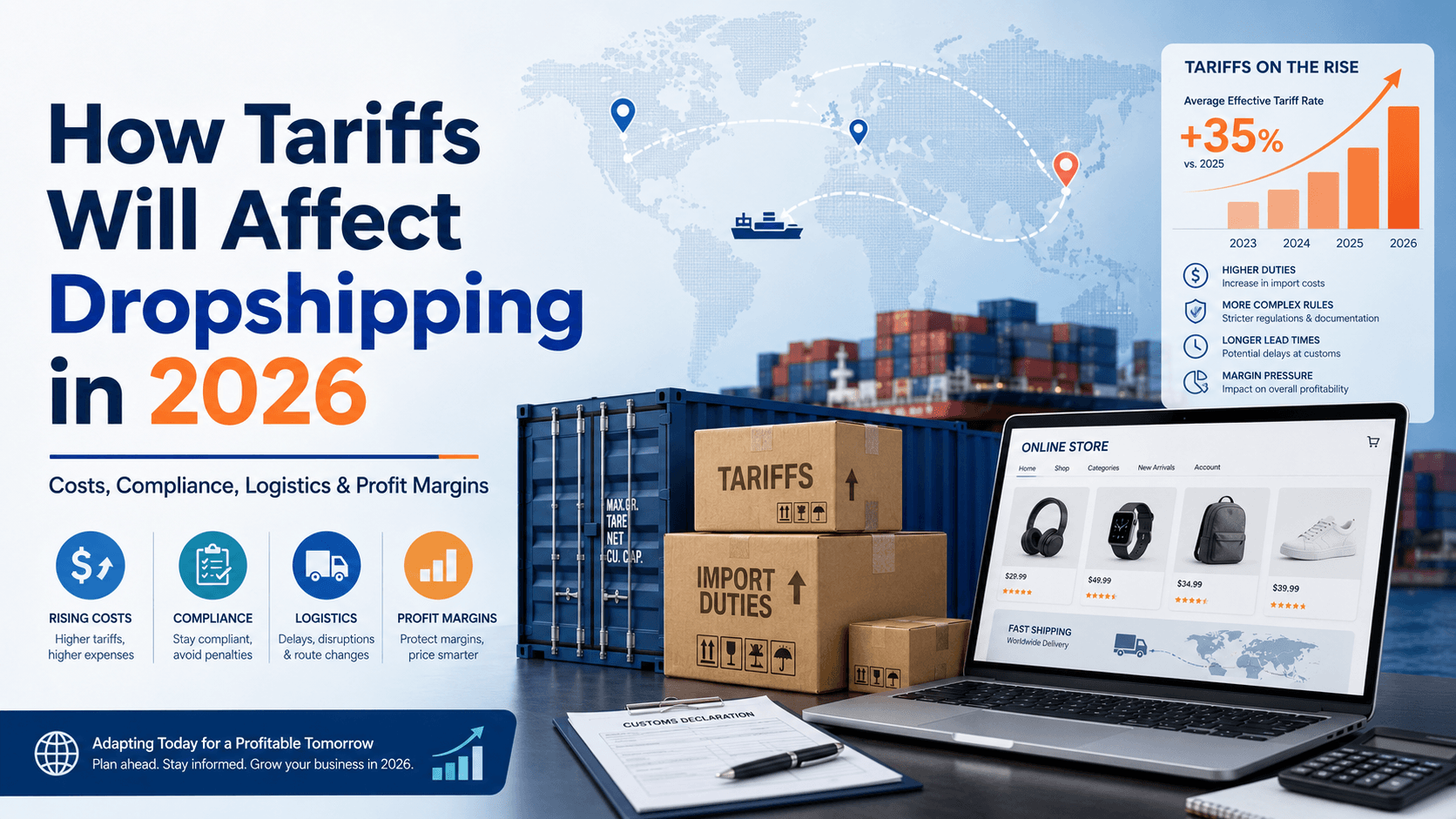
The broader 2026 tariff changes affecting dropshipping become relevant here because EU low-value parcel reform changes the economics of individual cross-border orders, particularly for stores relying on low-ticket products and direct shipping from China.
That does not mean China-to-Luxembourg dropshipping stops working. It means the complete landed cost needs to be known before advertising is scaled.
Avoid Under-Declaration as a Business Model
A sustainable Luxembourg operation should not depend on artificially low customs values or vague product descriptions.
Customs enforcement can change, logistics companies can request additional documentation and the seller remains responsible for the customer experience when a parcel is delayed or assessed differently from expectation.
Accurate declarations also make product economics more transparent.
If a product only appears profitable when its real value or nature is hidden from the customs process, the product does not have a strong long-term margin structure.
The goal should be predictable landed economics rather than temporary savings created through weak declarations.
China-to-Luxembourg Fulfillment Should Be Viewed as a System
A successful China-to-Luxembourg order involves more than international transportation. The correct SKU needs to be sourced or available, checked where necessary, packed, labeled, dispatched, cleared through customs, transferred to a European last-mile network and eventually delivered to the customer.
Each stage can affect the promised delivery window.
For sellers using China as the supply base, the broader China-to-Europe dropshipping workflow is a more useful operating framework than treating Luxembourg as a completely separate logistics system. The same supplier, QC and warehouse infrastructure can often support several EU markets while shipping routes and customer-facing promises are adjusted by destination.
This is one of the main advantages of treating Luxembourg as part of a regional European strategy.
Processing Time and Transit Time Should Be Separated
A logistics provider may advertise a delivery range based only on transportation after dispatch. The customer, however, starts counting from the moment the order is placed.
If the supplier needs three days to purchase or prepare the item before the parcel enters international transit, that time needs to be reflected in the customer-facing promise.
Sellers should therefore measure order-to-dispatch time separately from dispatch-to-delivery time.
This distinction becomes especially important for marketplace-sourced products, because an apparently fast international line cannot compensate for several days of supplier processing before the warehouse receives the product.
Real Test Orders Matter More Than Advertised Shipping Times
Before scaling Luxembourg traffic, place actual orders using the route customers will receive.
Monitor how long the warehouse takes to dispatch, when tracking becomes visible, how customs events appear and which carrier completes final delivery.
The test should also evaluate the parcel itself. Packaging quality, labels, product condition and any supplier promotional materials all become part of the customer experience.
A shipping estimate on a rate sheet can help shortlist routes, but it cannot replace observing the full end-to-end process.
Tracking Clarity Is Especially Important in Cross-Border Orders
Customers should not need to contact support simply to understand whether the parcel has left the origin country.
Tracking should ideally show meaningful movement and eventually identify the local delivery process clearly enough that the customer understands what is happening.
Long gaps between tracking events increase uncertainty even when the parcel is physically moving normally.
The shipping policy should also explain that tracking events can change as parcels pass between international and local carriers.
Clear expectations reduce unnecessary disputes without making unrealistic delivery promises.
When Does Managed Fulfillment Become Useful?
Direct supplier shipping can remain perfectly reasonable while order volume is low and products are still being tested. The operational requirements change when several suppliers, product variants, QC requirements or small inventory buffers need to be coordinated before parcels leave China.
At that point, sourcing and international transportation are no longer independent tasks. Products may need to arrive from different suppliers, be checked against the correct SKU, stored temporarily and packed consistently before the Luxembourg order enters the shipping network.
A dropshipping fulfillment service becomes relevant when receiving, QC, inventory, picking, packing, shipping and tracking need to operate as one workflow rather than as a series of manual supplier conversations. The current ETdropship fulfillment page specifically includes Luxembourg among its tracked European delivery markets.
That infrastructure should follow actual demand. A seller testing ten Luxembourg orders does not need the same backend as a store processing several hundred European orders every day.
Do Not Build Luxembourg-Specific Inventory Too Early
Luxembourg's small size makes premature local inventory particularly risky.
A seller may correctly identify a promising product but still overestimate how many units the Luxembourg market alone can absorb. Sending a large quantity of inventory specifically for one small country removes much of the flexibility that made dropshipping attractive in the first place.
A better approach is usually regional.
Inventory for a proven SKU can support several European destinations, while the seller monitors which countries generate enough order volume to justify deeper local positioning later.
The physical inventory decision should follow sales data rather than geographic enthusiasm.
When Could European Inventory Make Sense?
A European warehouse can become useful once a product has predictable regional demand and the improvement in delivery time or economics justifies the additional inventory commitment.
The keyword is regional.
For many sellers, the stronger question is not whether to place stock inside Luxembourg itself but whether a European inventory node can efficiently serve Luxembourg alongside neighboring markets.
That can reduce the amount of stock fragmented across individual countries while providing a more local delivery experience for validated products.
New and uncertain products can still remain direct-from-China until the demand pattern becomes clearer.
Returns Need a European Strategy
Returns are often ignored during market-entry planning because sellers focus on the outbound parcel. The problem becomes visible after the first customer decides that the product is unsuitable.
For inexpensive products, sending every return internationally back to China may cost more than the value of the item. Higher-value products can justify a different process, while a growing European operation may eventually benefit from regional return handling.
The store's policy should reflect the actual supply-chain capability.
Customers should not be promised a simple local return process if the business has no way to execute it.
The expected cost of refunds and non-resellable returns should also be included in product economics.
Customer Support Should Match the Market Positioning
A premium-looking Luxembourg store with unclear support creates an immediate contradiction.
Customers need to know how to contact the business, what happens when delivery is delayed and how refunds or damaged products are handled.
A very small store does not need a large customer-service team, but it does need a reliable process.
Common questions can be answered through clear shipping and return pages, while unusual cases should have a defined escalation path.
Good customer service is particularly valuable in a small market because reputation is harder to separate from repeated customer experiences.
Shopify Can Work Well, but the Platform Is Not the Strategy
Shopify is a practical option for Luxembourg because it supports independent ecommerce, multiple languages, local pricing configurations and a broad app ecosystem. WooCommerce and other platforms can work as well.
The platform itself does not determine whether the store succeeds.
A beautiful Shopify theme cannot solve poor product economics, unreliable suppliers or an inaccurate delivery promise.
The better sequence is to identify a viable offer and operational model first, then use the platform to present and process that offer effectively.
The technology should support the strategy rather than become the strategy.
Paid Advertising Needs a Smaller-Market Mindset
Luxembourg's limited audience means campaigns can saturate more quickly than campaigns targeting a much larger country.
This does not automatically make paid advertising unattractive. It means sellers need to monitor frequency, audience overlap and incremental acquisition performance carefully.
A broad product with a large potential customer base may still support substantial advertising. A very narrow niche can exhaust the most responsive audience much faster.
Creative variation and regional expansion can help once the Luxembourg audience begins reaching saturation.
This is another reason the country often works better as part of a multi-country European strategy than as the sole destination for a large-scale store.
Organic Search Can Capture High-Intent Customers
SEO can be useful for Luxembourg when products solve problems people actively search for rather than relying entirely on impulse discovery.
Search volume will naturally be smaller than in Germany or France, but lower total volume does not make high-intent traffic worthless.
Product pages should use the language customers actually use rather than simply translating awkward supplier titles.
Category pages can also target understandable use cases instead of generic phrases such as “best innovative products.”
For a focused niche, a smaller number of qualified visitors can be more valuable than a large amount of poorly targeted traffic.
Social Content Can Support Regional Expansion
Content created for Luxembourg does not always need to remain exclusive to Luxembourg.
A product demonstration can often be adapted for neighboring European markets, with language, captions and pricing changed according to the target audience.
This improves the economics of original content production.
Instead of creating entirely new creatives for every small European country, sellers can build a reusable creative system around the product while still localizing the customer-facing details that matter.
The product should remain the same even if the messaging changes between markets.
Bundles Can Improve Small-Market Economics
When customer acquisition opportunities are limited, increasing the value generated by each customer becomes more important.
A home organization store can offer related storage products together. A pet store can combine travel accessories, while an automotive store can create a practical interior-care bundle.
Bundles work best when the products naturally solve a larger version of the same problem.
Adding an unrelated inexpensive item purely to increase order value can reduce trust.
The objective is to increase customer utility and average order value at the same time.
Repeat Customers Matter More Than Constantly Finding New Ones
Luxembourg's small market makes customer retention strategically valuable.
A general store selling unrelated viral items has little reason for a customer to return after the first purchase. A focused niche can introduce additional products that make sense to the same buyer.
Reliable product quality and fulfillment also become important here. A customer who had to chase tracking information or request a refund is much less likely to purchase again regardless of how good the next advertisement looks.
Retention therefore begins before email marketing.
It begins with the first product and delivery experience.
Product Safety Should Be Considered Before Advertising
EU market access involves more than VAT and customs.
Product category determines which safety, labeling, traceability or documentation requirements may apply. Electronics, children's products, cosmetics and other higher-risk categories generally require more diligence than simple low-risk accessories.
For a small market such as Luxembourg, there is little reason for a beginner to choose unnecessary compliance complexity unless the potential economics justify it.
The safest product strategy is not necessarily to avoid every regulated category forever, but to understand the obligations before spending money acquiring customers.
A product should be operationally sellable before it is aggressively advertised.
Do Not Assume a Supplier's “EU Certificate” Solves Everything
Suppliers sometimes respond to compliance questions by sending a document described broadly as an EU certificate.
The seller still needs to know what the document is, which product or model it covers and whether it addresses the actual requirement in the target market.
Documents can become outdated or apply only to a different variant.
Compliance therefore needs to be connected to the exact SKU being sold.
A reliable supplier should be able to provide specific product information rather than simply repeating that the product “can ship to Europe.”
How to Test Luxembourg Without Overcommitting
A practical Luxembourg test begins with an already promising product rather than building a complete country-specific infrastructure before any demand exists.
Use a functioning store, localize the customer-facing essentials and place a real test order through the intended fulfillment route. Calculate the complete order economics using realistic VAT, logistics and customer-acquisition assumptions.
Then run a controlled demand test.
Observe not only conversion but also customer questions, delivery performance, refunds and whether the audience can support continued acquisition.
If Luxembourg performs well, investment can increase. If not, the same product and infrastructure may still be useful in neighboring European markets.
What Metrics Matter Most?
Revenue alone is not enough to decide whether Luxembourg is working.
Track customer-acquisition cost, average order value, contribution profit, refund rate and delivery performance. For logistics, useful measures include order-to-dispatch time, first tracking update and final delivery time.
Also monitor how quickly advertising audiences saturate.
A campaign may begin profitably and deteriorate once the most responsive segment has already seen the creative repeatedly.
The objective is to determine whether the market produces repeatable economics rather than one short period of sales.
When Should You Expand Beyond Luxembourg?
If the supply chain already supports nearby European markets, expansion can happen before Luxembourg reaches its theoretical maximum size.
A successful French-language offer may provide insights useful in Belgium or France. German-language creative may help identify opportunities in Germany or Austria.
The product should still be evaluated separately in each market because acquisition cost, competition and customer behavior differ.
The operational advantage is that the seller does not need to rebuild everything.
The same sourcing and fulfillment infrastructure can support several destinations while marketing is localized.
When Is Luxembourg Not a Good Market?
Luxembourg may not be the best first market for a seller whose strategy depends on extremely large audience volume.
It can also be difficult for products that need very low customer-acquisition costs to remain profitable, particularly when the retail price leaves little room after European taxes and logistics.
Bulky or difficult-to-ship products deserve careful analysis, as do products with significant regulatory complexity.
A market can have strong consumers and still be wrong for a particular SKU.
The decision should therefore be based on unit economics and addressable demand rather than a general statement that Luxembourg is either “good” or “bad” for dropshipping.
A Practical Luxembourg Dropshipping Strategy for 2026
A sensible starting point is to choose a product that already has evidence of demand and enough margin to support European fulfillment. The product should be easy to explain, relatively manageable to ship and not unnecessarily difficult from a compliance perspective.
The store should then provide clear euro pricing, useful product information, realistic delivery expectations and customer policies that can actually be executed. Language should match the audience being targeted rather than relying entirely on generic automatic translation.
On the supply-chain side, the seller should verify the real packed weight, shipping route, tracking and tax treatment through an actual order before scaling paid traffic.
If demand becomes stable, the next step is not necessarily building a Luxembourg warehouse. It is strengthening the regional European supply chain, holding limited inventory where justified and expanding into additional markets where the same product can produce viable economics.
Frequently Asked Questions
Is dropshipping legal in Luxembourg?
Dropshipping itself is a fulfillment model rather than a special legal category. Sellers still need to comply with the normal business, consumer, tax, customs and product requirements that apply to their specific structure and goods.
Is Luxembourg a good country for Shopify dropshipping?
It can be, particularly as part of a wider European strategy. The market is relatively small, so products and advertising should be evaluated according to realistic audience size and customer-acquisition economics.
What products are suitable for Luxembourg dropshipping?
Compact products with clear utility, adequate perceived value and manageable compliance requirements are generally easier to operate. Product decisions should still be based on actual demand and complete landed economics rather than generic “winning product” lists.
What is the VAT rate in Luxembourg?
Luxembourg's standard VAT rate is currently 17%, with reduced rates applying to certain categories. The VAT treatment of a particular ecommerce transaction depends on the product and selling structure.
Can I dropship from China to Luxembourg?
Yes, provided the product can legally enter the market and the seller has an appropriate VAT, customs and fulfillment process. The complete customer experience should be tested before scaling.
Should I use IOSS for Luxembourg dropshipping?
IOSS may be relevant to qualifying imported consignments not exceeding €150, but the appropriate setup depends on the seller and transaction structure. Sellers should confirm how VAT is collected and declared for the specific route they use.
Do I need a warehouse in Luxembourg?
Usually not when the business is still testing demand. Small-market sellers can often use cross-border fulfillment or regional European inventory before considering country-specific warehousing.
How important is delivery speed in Luxembourg?
Delivery reliability is very important. Eurostat data shows delivery delays remain one of the most common problems European online shoppers experience, so sellers should use real route data rather than exaggerated shipping promises.
Can I target Luxembourg together with France, Belgium and Germany?
Operationally, this can be efficient when the same product and fulfillment infrastructure support several European markets. Advertising, language, pricing and customer expectations should still be evaluated separately by market.
Conclusion
Luxembourg is unlikely to become the highest-volume market in a European dropshipping portfolio, but volume is not the only reason to enter a market.
Its value lies in being part of a highly connected European ecommerce region where a well-designed supply chain can serve several countries without requiring completely separate infrastructure for each one.
The strongest strategy is therefore not to build a large Luxembourg-specific operation before demand exists. Start with a validated product, understand the complete European cost structure, localize the customer-facing experience and test the real China-to-Luxembourg fulfillment route.
VAT, customs treatment and delivery expectations need to be included in the economics from the beginning. A cheap supplier price does not create a profitable product if taxes, shipping, acquisition and after-sales costs consume the remaining margin.
If the product demonstrates stable demand, operational control can increase gradually. Limited regional inventory, more consistent QC and better fulfillment can support Luxembourg alongside France, Belgium, Germany and other nearby markets.
That makes Luxembourg most useful not as an isolated dropshipping opportunity, but as one part of a disciplined European ecommerce strategy.