ETdropship vs USAdrop in 2026: Which Fulfillment Partner Fits Your Store?
ETdropship and USAdrop both combine product sourcing, store integration, branding support, warehousing, quality control, and international fulfillment. That makes this comparison more difficult than comparing a product-research tool with a fulfillment agent. The two providers overlap substantially, and neither should be reduced to a beginner app or a manual sourcing service.
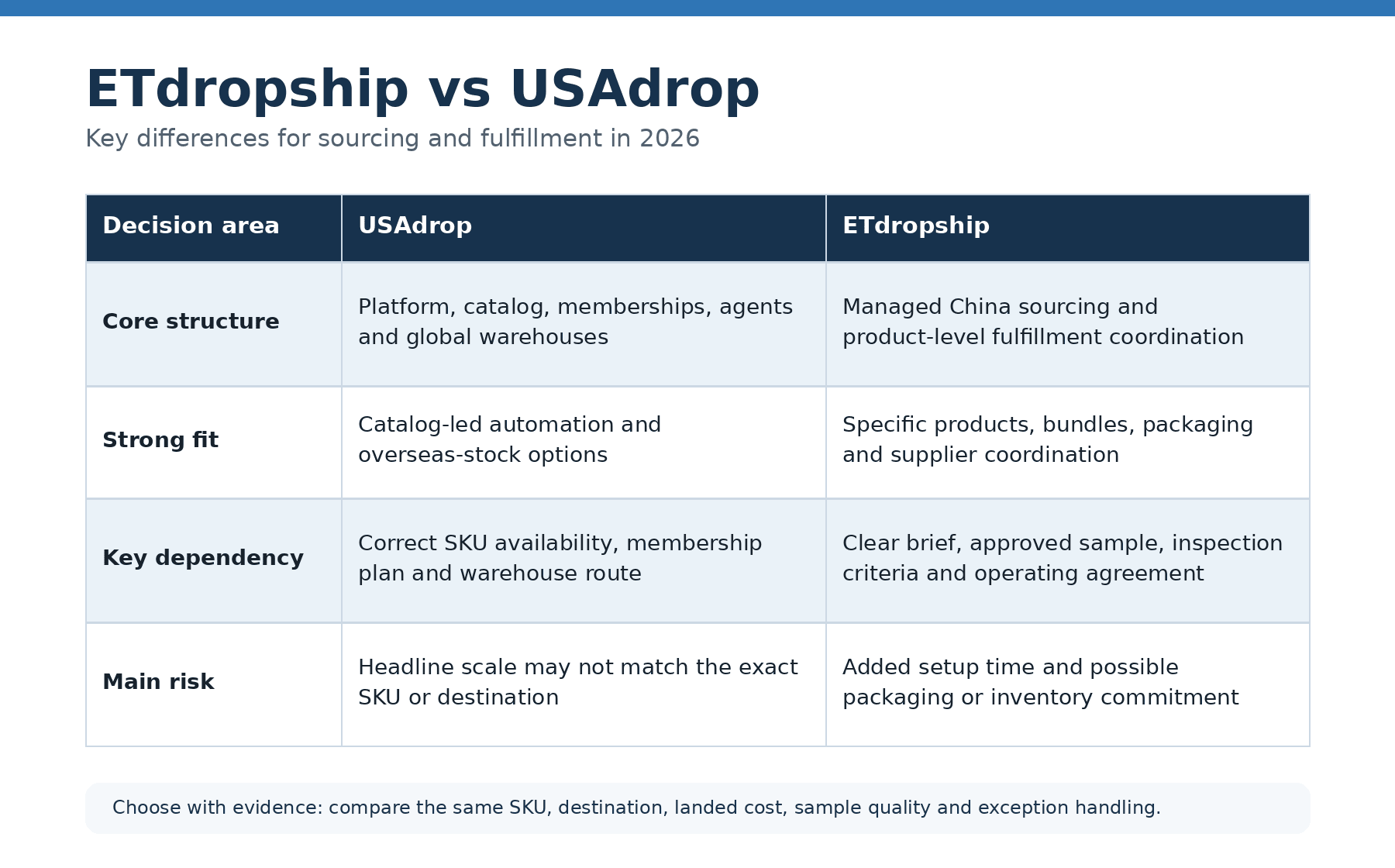
The useful question is which operating structure fits a seller’s products, markets, order volume, and need for control. USAdrop presents a broad platform, membership plans, a large product catalog, automated fulfillment, dedicated agents, and a global warehouse network. ETdropship emphasizes China-based supplier access, product-specific quotations, inspection instructions, small-batch branding, packaging coordination, inventory handling, and direct order support.
This article compares the models without declaring an automatic winner. Sellers should verify claims with samples, written quotations, destination-specific shipping tests, and clear responsibility for exceptions before moving live orders.
Why the Original Comparison Needs a Positioning Update
The original article correctly argued that supply-chain execution matters more as a store grows, but it portrayed USAdrop too narrowly and repeated general statements about branding, automation, and long-term growth. USAdrop’s current official pages describe automatic fulfillment, China and overseas warehouses, custom packaging, strict quality inspection, store connections, product sourcing, tracking, and personal sales agents. Those are meaningful operational capabilities, not merely entry-level conveniences.
ETdropship therefore should not compete by denying that overlap. A more credible comparison explains the differences in workflow, evidence, cost, and fit. USAdrop may suit sellers who value a larger self-service ecosystem and overseas-stock options. ETdropship may suit sellers who want closer coordination around a specific product, Chinese suppliers, samples, packaging materials, consolidated inventory, and route selection.
The comparison also needs a neutral test. Marketing numbers, warehouse counts, catalog size, and delivery headlines can be useful context, but they do not prove performance for the seller’s exact SKU and destination. The decision should be based on the cost and outcome of representative orders.
What USAdrop Offers in 2026
USAdrop operates as an all-in-one dropshipping platform and fulfillment company. Its current service pages describe store integration, catalog product imports, custom sourcing, automated order flow, quality checks, global shipping, branded tracking, custom packaging, and access to a dedicated agent. Membership tiers affect product discounts, sourcing limits, order limits, quotes, thank-you cards, and other benefits, so sellers should check the current plan rather than rely on an old comparison.
Its warehouse network is a central strength. USAdrop promotes a large China warehouse and overseas facilities serving markets including the United States, Europe, Australia, and Latin America. When the correct product is stocked in the correct region, local fulfillment can reduce delivery time. The important limitation is availability: an overseas warehouse claim is useful only when the required variant is actually stocked there and replenishment can keep pace with sales.
USAdrop also provides published shipping ranges. Its policy separates order processing from delivery and notes that timing varies by warehouse, destination, product availability, and external events. Sellers should treat those ranges as planning estimates and test real orders, especially for remote areas, peak seasons, batteries, liquids, oversized goods, or destinations with limited routes.
For merchants who want catalog browsing, Shopify product import, automated order handling, and a wider platform relationship, this structure can reduce setup friction. It can also support growing brands when the available products, warehouse locations, agent service, and branding options match the business.
Where USAdrop Requires Careful Verification
A broad catalog does not remove product-level risk. The seller still needs to confirm material, dimensions, weight, included accessories, color tolerance, packaging, processing time, and approved substitutions. A product imported quickly into Shopify can create customer-service problems just as quickly if the listing does not match the delivered item.
Membership benefits should be evaluated against actual volume. Product discounts and additional sourcing or quote allowances may justify a paid plan, but the calculation should include subscription allocation, product cost, shipping, packaging, taxes or duties where applicable, platform fees, refunds, replacements, and advertising. A percentage discount does not guarantee the lowest landed cost.
Overseas inventory creates another decision. Local stock may improve delivery, yet it requires the correct SKU, variant mix, replenishment timing, and responsibility for slow-moving units. Sellers should ask whether stock is dedicated or shared, how frequently inventory syncs, what happens during a stockout, and whether a China-shipped replacement changes the promised delivery time.
Dedicated-agent service should also be tested through response quality rather than the existence of an assigned contact. A useful agent clarifies missing specifications, separates product and freight costs, documents decisions, reports exceptions, and does not substitute a product or route without approval.
What ETdropship Offers
ETdropship is also a sourcing and fulfillment partner, but its operating emphasis is on building a product-specific China supply-chain workflow. Sellers can submit a product link, image, or specification; compare available suppliers; confirm samples; define quality checks; arrange packaging; store products or branding materials; and ship customer orders through connected or managed workflows.
This can be useful for sellers who already know the product they want and need more than a catalog import. A clear China sourcing agent brief should identify the exact variant, materials, dimensions, target cost, destination markets, expected order volume, branding, compliance needs, and unacceptable substitutions. Better instructions create quotations that can actually be compared.
ETdropship can also coordinate components from more than one supplier. A product, box, label, instruction card, accessory, and insert may arrive separately and be assembled during fulfillment. That flexibility supports bundles and brand consistency, but it also introduces inbound lead time, inventory records, assembly instructions, and packaging-weight decisions.
Its dropshipping fulfillment service is commercially relevant when a seller wants one partner to connect sourcing, quality checks, packaging, warehousing, shipping, tracking synchronization, and after-sales coordination. It is less necessary for a beginner who only wants instant access to a large ready-to-import catalog.
ETdropship Has Trade-Offs Too
A managed and product-specific workflow can require more communication than choosing a product from a structured platform catalog. Samples, supplier comparisons, packaging prototypes, inspection criteria, and special assembly do not happen instantly. Sellers should allow enough time for confirmation instead of treating every request as a same-day import.
Customization may require advance production. Individual customer orders can be shipped one by one, but logo labels, cards, pouches, or boxes may have minimum quantities. That inventory commitment is reasonable only after demand, unit economics, and packaging dimensions have been tested.
ETdropship’s closer coordination does not guarantee that every supplier, route, or batch will perform perfectly. The value comes from defining controls and responding to exceptions. The seller should still approve samples, retain specifications, monitor delivery data, and document responsibility for defects, delays, loss, and unauthorized changes.
The Differences That Matter in Practice
Compare Product Sourcing With the Same Written Brief
Send both providers the same product specification and destination scenario. Include reference links or images, exact variants, materials, dimensions, required certification or labeling, monthly quantity, target countries, packaging, acceptable processing time, and whether substitutions are allowed. Without a shared brief, two quotes may describe different products.
Ask each provider to separate product price, China domestic freight, packaging, inspection, handling, international shipping, duties or taxes where applicable, service or membership costs, and any minimum commitment. Then order samples from the intended fulfillment route. A supplier comparison should measure delivered reality, not only the first quoted number.
The broader guide to China dropshipping service providers can help sellers compare catalog platforms, managed agents, sourcing specialists, and fulfillment providers without assuming they all perform the same role.
Treat Quality Control as a Specification
“Strict quality inspection” and “professional QC” are not measurable promises by themselves. The seller should define what will be checked and what evidence is required. For apparel this may include size label, measurements, color, stitching, print position, stains, and packaging. For electronics it may include model, plug, voltage, included accessories, visible damage, and a functional test.
Inspection depth should match risk. A simple visual check may be enough for stable low-risk products, while high-return or branded items may require sampling rules, photos, functional testing, or batch records. Confirm whether the inspection occurs at the supplier, inbound warehouse, or packing stage and who pays when a defect is found.
The same standard should apply after a supplier, material, factory, or warehouse changes. Otherwise a winning listing can quietly begin shipping a materially different product.
Compare Shipping by Lane and Stock Location
USAdrop’s global warehouse model can be advantageous when the right inventory is available near customers. ETdropship’s China-based coordination can be advantageous when a seller needs flexible sourcing and several international lines from one consolidation point. The better structure varies by product and geography.
Test processing time, first carrier scan, delivered time, tracking continuity, customs behavior, and failed-delivery handling for each important market. Separate local-stock performance from China-direct performance. Do not average a two-to-five-day local shipment with a longer cross-border shipment and present the result as one universal delivery promise.
Shipping cost should use chargeable weight after final packaging. Custom boxes, bundles, protective material, and included accessories can increase dimensional weight. A route that looks cheaper before packaging may become more expensive after the final parcel is measured.
Automation Is Only Valuable When Exceptions Stay Visible
Both providers promote automation, but automatic order import is only the beginning. The operating system must also show product mapping, inventory status, payment state, fulfillment status, tracking, partial shipments, cancellations, address problems, and exceptions. A successful sync should reduce manual work without hiding errors.
Before launch, test what happens when a variant is unavailable, an address is incomplete, a customer requests cancellation after payment, a parcel receives no carrier scan, or a supplier proposes a substitution. The platform and agent should make the decision visible before the wrong item ships.
As fulfillment competition increases, sellers gain less from a large feature list than from a workflow that reliably turns paid orders into correct deliveries and creates evidence when something fails.
Compare Total Cost Per Successful Delivery
Do not compare one product price or one membership fee. Build a destination-weighted model that includes product, inbound freight, packaging, inspection, handling, storage, subscription or service charges, international shipping, taxes or duties, payment fees, replacements, refunds, and customer support. Add advertising only after the fulfillment cost is clear.
Then compare the cost of orders customers successfully keep. A lower factory quote can be offset by slower processing, poor tracking, wrong variants, damage, or repeated reshipments. A slightly higher cost may be rational if it reduces support and protects conversion, reviews, and repeat purchases.
Run the calculation for representative SKUs rather than assuming one provider wins across the entire store. Light accessories, apparel, fragile goods, batteries, liquids, and bulky home products can require different suppliers and routes.
Which Partner Fits Different Seller Needs?
USAdrop may fit sellers who value a broad platform, catalog import, membership benefits, automated fulfillment, overseas-stock options, and an established global warehouse narrative. It can serve beginners and scaling stores when the actual SKU, warehouse, agent support, and shipping performance meet the requirement.
ETdropship may fit sellers who begin with a specific product brief and want closer coordination across Chinese suppliers, samples, product-level QC, branded materials, bundles, inventory, and shipping lines. It is particularly relevant when the product cannot be managed as a simple catalog listing.
Some sellers can use both. A store might use local USAdrop stock for selected fast-moving products while using ETdropship for custom bundles or China-sourced lines. The store then needs clear SKU ownership, inventory rules, delivery promises, and after-sales responsibility so customers do not experience inconsistent fulfillment.
A Low-Risk Provider Test
Choose one or two representative products and send the same written brief to both providers. Compare clarification quality and written quote structure before ordering samples. Then inspect the exact products and packaging customers would receive.
Place trial orders to the store’s main markets. Record processing, carrier scan, delivery, tracking, parcel condition, product accuracy, and response to any exception. Repeat the test if a route or warehouse changes.
Only after the evidence is comparable should the seller move live volume. Keep the existing workflow available during a limited cohort, update customer-facing delivery information if necessary, and avoid transferring every SKU from one attractive quotation.
Frequently Asked Questions
Is USAdrop only for beginners?
No. Its current platform, membership plans, sourcing, automation, branding, warehouse network, and agent support can serve operating and scaling stores. Fit depends on the exact product and service outcome, not a beginner label.
What is the main difference between ETdropship and USAdrop?
USAdrop emphasizes a broad platform ecosystem, catalog, membership structure, automation, and global warehouse network. ETdropship emphasizes product-specific China sourcing, inspection, packaging, consolidation, inventory, and managed fulfillment coordination.
Which provider has faster shipping?
Neither has one universal speed. Delivery depends on stock location, destination, processing, product type, route, customs, and last mile. Compare tested lanes for the same SKU and country.
Which provider is cheaper?
There is no universal answer. Compare product, packaging, handling, membership or service fees, chargeable shipping weight, taxes, refunds, replacements, and support cost per successful delivery.
Do both providers support branding?
Yes, both advertise branding or customization capabilities. Confirm the exact product, packaging option, minimum quantity, production time, application fee, storage requirement, and fulfillment process before committing.
Can both connect with Shopify?
Both describe Shopify integration and automated order workflows. Test product mapping, order import, tracking updates, cancellations, inventory status, and exception handling before relying on automation.
Should I move all products to one provider?
Not necessarily. Different products or markets may need different workflows. If more than one provider is used, assign each SKU clearly and keep customer-facing delivery and return rules accurate.
What should I test before choosing?
Use the same written brief, compare itemized quotations, approve samples, place destination-specific trial orders, and document processing, delivery, tracking, quality, packaging, cost, and exception response.
Conclusion
ETdropship and USAdrop are genuine competitors in sourcing and fulfillment, so the comparison should not manufacture a false app-versus-agent divide. USAdrop offers a broad platform, membership benefits, automated fulfillment, branding, dedicated agents, and global warehouses. ETdropship offers a more product-specific route through China sourcing, supplier coordination, inspection, packaging, consolidation, inventory, and international fulfillment.
The best choice depends on evidence from the seller’s real SKU and markets. Compare identical specifications, itemized landed cost, sample quality, inventory availability, processing, tracking, delivery, and after-sales responsibility. Marketing scale is useful context, but the successful delivered order is the unit that matters.
Choose USAdrop when its platform and warehouse network provide the required speed and simplicity. Choose ETdropship when deeper product and supply-chain coordination creates measurable value. Use both when the product portfolio genuinely benefits from separate routes and the store can manage them clearly.