ETdropship vs Printify in 2026: Which Fulfillment Model Fits Your Brand?
Printify and ETdropship can both help ecommerce sellers deliver customized products, but they are not interchangeable print-on-demand platforms. Printify is a technology-led POD network: a seller selects a catalog item, adds artwork, chooses or accepts a print provider, connects a store, and routes eligible orders into production. ETdropship is a managed sourcing and fulfillment partner whose wider role can include finding products, confirming samples, inspecting goods, coordinating packaging, storing inventory, assembling mixed-product orders, and shipping internationally.
That difference changes the comparison. A seller launching graphic T-shirts does not have the same operational problem as a lifestyle brand combining printed apparel, sourced accessories, gift packaging, and bundles. The better option depends on the product architecture, destination markets, acceptable production variation, branding requirements, inventory tolerance, and the amount of operational control the seller wants.
This ETdropship vs Printify fulfillment comparison therefore avoids declaring one universal winner. It explains where each model is structurally strong, where its limits can appear, and when a seller may reasonably use both rather than forcing an immediate migration.
The Comparison Starts With Two Different Operating Models
Printify is built around on-demand production. The product is normally manufactured or printed only after an order is approved, which lowers the need to buy finished inventory before demand is known. Its catalog, mockup tools, integrations, order routing, and provider network make it useful for quickly publishing design-led products across supported channels.
ETdropship begins from a different question: what physical product and delivery process does the seller need? The answer may involve a standard sourced product, a lightly customized item, a private-label version, pre-produced packaging, or a combination of POD and non-POD products. Production can still be demand-led, but some packaging, components, or stable inventory may need to be prepared in advance.
The practical distinction is standardization versus coordination. Printify standardizes a large portion of the POD workflow inside a platform. ETdropship coordinates a wider range of product and supply-chain decisions through a managed service. Neither structure is automatically more advanced; each removes a different kind of friction.
What Printify Does Well in 2026
Printify remains attractive when speed and range matter. A seller can compare many catalog products, upload a design, generate mockups, connect channels such as Shopify or Etsy, and test several variations without ordering a warehouse quantity. This creates a low-commitment route for learning which audience, message, product type, and price can generate real orders.
Its provider network also gives sellers options across product categories and production locations. That can support localized production when a suitable provider and destination combination exists. The workflow is especially efficient for recognizable POD formats such as T-shirts, hoodies, mugs, posters, tote bags, phone cases, and selected home products.
Printify's current branding capabilities should not be understated. Eligible products and providers may support packaging inserts, gift messages, custom neck labels, sleeve prints, or other branded print areas. Availability is not universal, however, so the seller must check the exact product and print provider rather than assuming every order can carry the same brand treatment.
Pricing also follows a familiar platform model. A free plan supports initial use, while paid plans can offer product discounts and additional account features. The relevant cost is not the subscription alone. Sellers should compare the base item, print charges, shipping, taxes where applicable, platform fees, refunds, reprints, and customer acquisition cost for the exact products they intend to sell.
Where a Printify Workflow Can Become More Complex
A network of independent print providers creates choice, but it can also create variation. Two products that look consistent in a storefront may use different blanks, facilities, production times, packaging, and shipping methods. If a multi-item order is fulfilled by different providers, customers may receive separate parcels. That is not necessarily a service failure, but the store should disclose the possibility and prepare customer support for split tracking.
Quality must also be judged at product-provider level. A strong sample from one provider does not prove that another provider, replacement route, or color variant will produce the same result. Sellers should record the blank, print method, artwork dimensions, color profile, placement, provider, and packaging that passed approval. A provider change should trigger a new sample instead of an assumption.
Branding options are provider-dependent. Printify supports meaningful brand features on eligible orders, yet it does not generally operate like a warehouse where a merchant can freely send unrelated accessories and ask for a custom mixed bundle. Its own support documentation distinguishes packaging inserts from adding arbitrary extra items to a parcel. This matters when the product promise depends on a sourced accessory, instruction booklet, refill, or gift set rather than a printed item alone.
International delivery also needs route-level checking. Production time comes before carrier transit, and delivery estimates differ by provider, product, destination, and shipping method. A broad claim such as 'fast global shipping' is less useful than measuring approval-to-production time, first carrier scan, delivered time, split-shipment frequency, and remake resolution for representative orders.
What ETdropship Adds Beyond Standard POD
ETdropship is most relevant when the seller's requirement extends beyond printing artwork on a catalog product. A store may want a printed garment together with a sourced cap, a care card, a reusable pouch, or a complementary accessory. It may also need one party to coordinate samples, packaging dimensions, quality checks, stock, assembly, and international shipping.
This is common when a print-on-demand brand store develops into a broader lifestyle offer. The winning design may remain important, but future growth can come from related products that are not native POD items. A fitness brand, for example, might combine printed apparel with resistance bands, bottles, towels, bags, or recovery accessories. A pet brand might combine portrait products with collars, bowls, keepsake boxes, or grooming items.
The managed model can also support more specific inspection instructions. Instead of treating quality as a general promise, the seller can define what should be checked: artwork position, print clarity, color, size label, material, accessory count, packaging, barcode, or visible damage. Whether every unit or a sample is inspected should be agreed before launch because deeper inspection adds handling time and cost.
ETdropship's branding support is more useful when the seller needs coordinated materials across POD and sourced products. Logo labels, cards, pouches, boxes, instructions, and bundle components may come from different factories but can be received and assembled through one fulfillment workflow. This flexibility usually requires more setup than selecting a catalog product, so it should solve a real commercial need rather than add complexity for appearance alone.
ETdropship Also Has Trade-Offs
A managed supply-chain relationship is not the simplest choice for every seller. Product sourcing, sample approval, packaging development, stock decisions, and inspection standards require communication and lead time. A seller who only wants to publish several T-shirt designs this week may gain little from that additional coordination.
Some branding materials must be produced in batches. Although customer orders can still be fulfilled individually, custom bags, labels, cards, or boxes may have minimum quantities and need storage. This introduces inventory exposure that pure POD avoids. The seller must decide whether proven demand justifies the packaging commitment and whether outdated materials can be reused if a product changes.
Catalog breadth and instant self-service are also different. Printify lets users browse a large structured POD catalog and generate products directly. ETdropship typically works from a product request, reference link, image, specification, or sourcing brief. The second approach offers flexibility, but it is less suitable for a seller who values immediate catalog exploration above product-specific coordination.
Service quality depends on a clearly defined operating agreement. Processing targets, inspection scope, approved substitutions, packaging rules, shipping options, billing, and responsibility for defects or lost parcels should be documented. A managed partner does not remove the need for operational discipline; it makes those decisions more customizable.
A Fair Feature Comparison
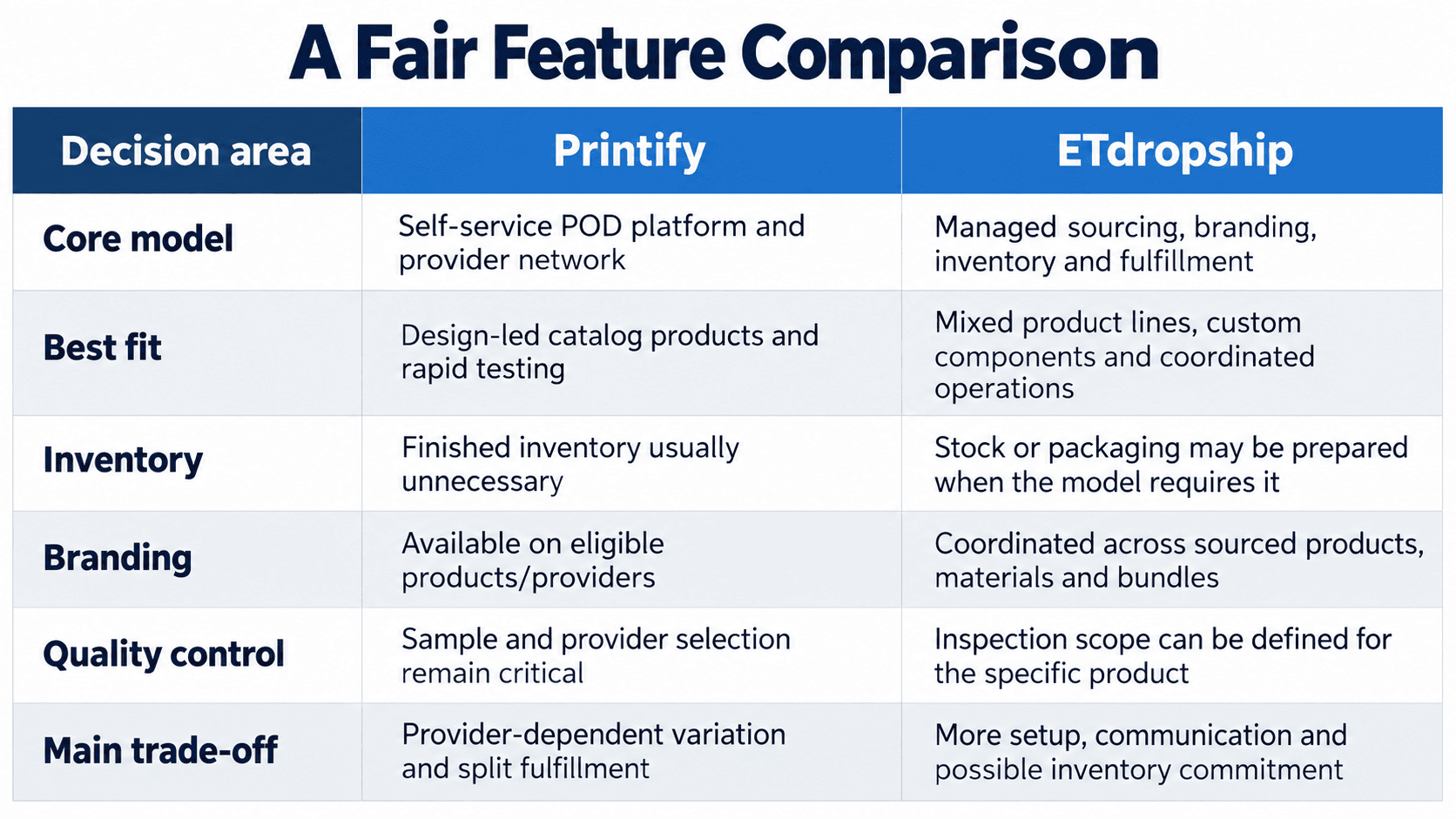
Choose Printify When the Product Is Primarily the Design
Printify is usually the cleaner fit when the commercial value comes mainly from artwork or personalization applied to established POD products. The seller wants to publish quickly, carry no finished inventory, automate supported store orders, and test several creative ideas without developing a custom supply chain.
This does not mean the business must remain small. A focused POD company can grow on a platform workflow if the available products, providers, quality, delivery, and branding options continue to meet its promise. The correct test is whether customers receive a consistent product at an acceptable contribution margin—not whether the seller has reached an arbitrary order volume.
Sellers should still reduce provider risk. Order samples from the facility that will fulfill the target market, avoid publishing untested variants, keep artwork specifications, and calculate profit using production and shipping for the actual destination mix. If multiple providers are used, product pages and support templates should explain split delivery clearly.
Choose ETdropship When the Offer Extends Beyond POD
ETdropship becomes more relevant when the store needs sourced products, proprietary bundles, coordinated packaging, centralized quality checks, or inventory prepared for stable demand. The product may include printing, but the operational requirement is broader than a POD catalog can conveniently support.
This situation often appears with personalized dropshipping products that require customer data, accessory selection, proofing rules, or manual assembly. Errors can be expensive because an item made for one customer may not be resold. The workflow should specify how customization data enters production, who checks it, when the customer can still make changes, and who pays for a remake caused by seller, supplier, or customer error.
A managed workflow is also useful when the brand wants several product categories to arrive in one coordinated experience. Consolidation is not always the cheapest choice, but it may reduce split shipments, support bundles, and make packaging more consistent. The landed-cost calculation must include inbound movement, storage, assembly, dimensional weight, international freight, and expected after-sales cost.
Use Both When the Business Has Two Product Speeds
The decision does not have to be exclusive. A seller can use Printify for low-risk design testing and keep proven POD products there while using ETdropship for sourced accessories, packaging, or bundles. Another seller may validate demand through Printify and later reproduce a stable product through a controlled production route, provided artwork rights, specifications, customer expectations, and transition risks are handled carefully.
A hybrid model works only when ownership is clear. The store needs one source of truth for SKUs, processing times, inventory status, tracking, refunds, and customer communication. If the same product can route to two suppliers without a documented rule, customers may receive different blanks, packaging, or quality under one listing.
The safest structure separates experimental and stable products. New designs can remain on demand, while repeatable winners receive deeper sampling, cost analysis, and brand investment. This lets the seller preserve flexibility without forcing every SKU into the same fulfillment model.
Compare Cost Per Successful Order, Not the Cheapest Base Price
A useful comparison begins with the order the customer successfully keeps. For Printify, include the base product, print areas, shipping, plan cost allocation, store and payment fees, taxes, reprints, refunds, and customer support. For ETdropship, include sourcing, customization, packaging, inspection, inbound handling where applicable, storage, pick and pack, international shipping, duties or tax arrangements, service fees, replacements, and support.
The calculation should use weighted destination and variant data rather than one attractive sample quote. Apparel sizes, extra print areas, mugs, heavy accessories, and remote destinations can change the economics. Dimensional packaging can also raise shipping cost even when the materials themselves are inexpensive.
Profit should be tested after advertising. A product with a large gross markup can still be weak if conversion, remake, return, or acquisition costs consume the difference. Measure contribution profit, delivery reliability, complaint rate, and repeat purchase together. A cheaper order that creates more support and refunds may be the more expensive fulfillment model.
Branding Should Follow Evidence, Not Precede It
Brand investment is valuable when it reinforces a product customers already want. Early-stage sellers can begin with accurate mockups, a consistent visual identity, clear size or care information, and provider-supported inserts or labels. They do not need a complex box before understanding which design and audience convert.
Once demand becomes repeatable, custom packaging dropshipping can support a more distinctive unboxing experience, bundles, instructions, and gift positioning. The packaging still has to protect the item and remain economical to ship. A beautiful structure that increases damage, assembly time, or dimensional weight can reduce rather than increase brand value.
The practical sequence is evidence-led: validate the audience and design, confirm the physical product, understand order economics, then deepen branding where customers can notice and value it. That sequence applies whether production remains with Printify, moves to a managed supply chain, or uses both.
How to Test a Change Without Disrupting Customers
Do not move every SKU because one sample or quotation looks better. Select one stable product and document its current baseline: conversion rate, production time, delivered time, gross margin, refund reasons, print complaints, sizing issues, split shipments, and customer support volume.
Then request the alternative sample using the same artwork and specification. Compare the blank, print method, placement, color, wash behavior, packaging, tracking, and delivery to the target market. If packaging or sourced accessories are added, test the complete packed dimensions and assembly instructions rather than reviewing each component separately.
Run a limited order cohort before changing the main listing. Keep the original route available until the new process produces enough successful deliveries to support a decision. Update product photos, size information, material claims, delivery estimates, and return rules if the customer-facing product changes. A quiet backend migration is unsafe when the new item is not materially identical.
Finally, compare the result with the original baseline. A migration is justified when the new process improves contribution profit, consistency, customer experience, or strategic flexibility enough to compensate for added coordination and inventory risk.
Decision Framework
Choose Printify when rapid self-service publishing, a broad standard POD catalog, no finished inventory, and platform automation match the store's needs. Choose ETdropship when the product requires broader sourcing, defined inspection, custom components, mixed bundles, inventory preparation, or coordinated fulfillment beyond standard POD.
Use both when experimental designs and stable branded products genuinely need different operating systems. Avoid switching merely because one provider sounds more advanced. The right model is the one that protects the customer promise at a sustainable total cost.
Frequently Asked Questions
Is Printify only suitable for beginners?
No. Printify can support established POD sellers when its products, providers, integrations, pricing, and service levels fit the business. Store maturity alone is not a reason to leave a platform that is producing consistent customer outcomes.
Does Printify offer branding options?
Yes. Eligible products or providers may support inserts, gift messages, neck labels, sleeve prints, and other branded elements. Availability varies, so confirm the exact product-provider combination before promising a uniform unboxing experience.
Can ETdropship fulfill print-on-demand products?
ETdropship can coordinate customized and printed products, but its main distinction is the wider managed workflow around sourcing, quality checks, packaging, warehousing, assembly, and international fulfillment. Product feasibility, production method, quantity, and timing should be confirmed for each request.
Which option is better for Etsy POD sellers?
Printify is often the simpler starting point for standard Etsy POD products because of its catalog and integration workflow. ETdropship may become relevant when the Etsy offer requires sourced components, special packaging, assembly, or customization that a standard POD route cannot support.
Can Printify and ETdropship be used together?
Yes. Keep clear SKU ownership and fulfillment rules. Printify can handle eligible POD lines while ETdropship manages sourced products, bundles, packaging, or inventory-based lines. Customer-facing delivery and return information should reflect the route used by each item.
When should a POD seller consider custom packaging?
After a product shows repeatable demand and acceptable quality. Begin with lighter brand elements, then test custom packaging against material cost, minimum quantities, assembly time, protection, dimensional weight, and customer response before committing to a large batch.
Which platform has lower costs?
There is no universal answer. Printify costs vary by product, provider, plan, print areas, destination, and shipping. ETdropship costs depend on sourcing, customization, inspection, packaging, inventory, handling, and route. Compare the total cost per successful order for the same customer promise.
Should a successful Printify product be moved immediately?
No. First document performance, sample the alternative, test a limited cohort, and confirm that product specifications and customer-facing claims remain accurate. Migration should solve a measured limitation rather than create unnecessary operational risk.
Conclusion
Printify and ETdropship solve overlapping but different problems. Printify offers an efficient platform-led route for publishing and fulfilling design-led POD products without finished inventory. ETdropship offers a more managed route when the seller needs sourcing, product-level inspection, custom components, packaging, storage, assembly, or mixed-product fulfillment.
The original comparison was directionally useful but too absolute. Printify is not limited to beginners, and its branding capabilities are more developed than a simple generic-packaging description suggests. ETdropship is not automatically the better choice for every growing store; its additional flexibility creates value only when the product and customer promise require it.
Choose from evidence: the exact product, provider, sample, destination, order economics, quality data, and after-sales outcomes. A focused POD business may stay with Printify, a broader brand may use ETdropship, and a hybrid store may use both. The best fulfillment model is the one customers experience as accurate, consistent, and worth buying again.