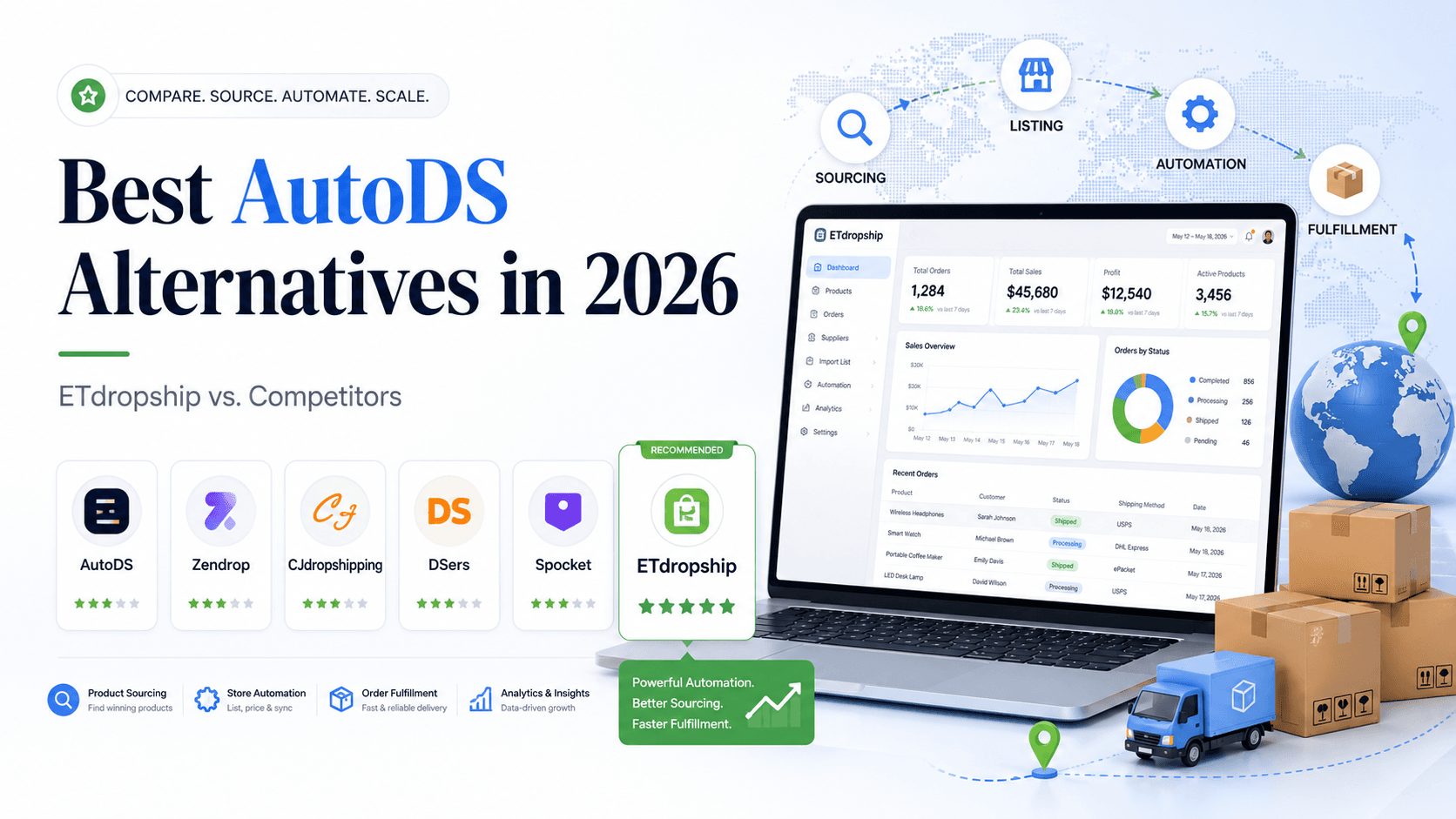
DSers vs ETdropship for Shopify Sellers in 2026
DSers and ETdropship Solve Different Parts of the Workflow
A Shopify seller can use DSers or ETdropship to reduce manual work, but the two services are not direct substitutes. DSers is primarily an ecommerce automation layer for connecting stores with marketplace suppliers, mapping products, processing orders, and synchronizing tracking. ETdropship is a sourcing and fulfillment partner that coordinates suppliers, purchasing, inspection, packaging, inventory, shipping, and after-sales exceptions.
The correct choice depends on the bottleneck. A new store may need a fast way to import and test products. A store with a validated SKU may need a more controlled product specification, approved sample, packaging process, inventory plan, and shipping route. Comparing only the number of features hides this difference.
This article compares the two operating models across product testing, supplier responsibility, order automation, quality control, branding, logistics, total cost, and the transition from marketplace fulfillment to a managed supply chain.
DSers generally fits sellers whose workflow still centers on AliExpress or other supported marketplace connections. ETdropship generally fits sellers who want a team to execute defined sourcing and fulfillment requirements. Neither option removes the merchant’s responsibility to verify products, set accurate delivery expectations, and monitor customer outcomes.
What DSers Does in a Shopify Workflow
DSers is a dropshipping automation application used with Shopify and other supported ecommerce platforms. Its best-known workflow connects merchants with AliExpress, while current DSers materials also describe additional supported supplier and platform connections. Merchants should confirm the exact integration and plan features they need before relying on them.
DSers can be useful during controlled product testing. A seller can import a focused group of products, map variants to suppliers, receive store orders, place orders in batches, and return tracking data without creating a custom procurement process for every unproven item.
Its role is mainly coordination and automation. The software can move order data and simplify repetitive actions, but the underlying supplier still affects stock, processing, product consistency, packaging, shipping, and remedies. Automation makes a workflow faster; it does not automatically make every supplier dependable.
What ETdropship Does After Product Requirements Become Specific
ETdropship is a China-based sourcing and order fulfillment service for independent ecommerce sellers. Its model begins with the merchant’s product and operating requirements rather than only with a marketplace listing.
The service scope includes sourcing, purchasing coordination, quality inspection, branded packaging, warehousing, consolidation, global shipping, order fulfillment, and after-sales support. The practical result depends on the quality of the product brief, sample approval, inspection standard, inventory plan, and shipping assumptions agreed with the merchant.
This makes ETdropship relevant when the seller needs more than data synchronization. A validated product may require a consistent material, accessory set, finish, label, bundle, insert, parcel configuration, or destination-specific shipping route. Those requirements need to be recorded and followed across suppliers and batches.
A managed process is not automatically appropriate for every beginner. If the product has no demand evidence, customization and inventory can create unnecessary risk. The strongest fit appears when a seller has enough data to identify which operational problem is limiting margin or customer experience.
The Operational Bottleneck Often Appears After the Sale
Many sellers treat advertising as the difficult part of dropshipping. Once orders arrive, however, stockouts, variant mistakes, slow processing, unclear tracking, inconsistent batches, damaged parcels, and weak exception handling can become the more expensive problems.
These issues are connected. A supplier change can alter product quality or packaging. A delayed dispatch can create support tickets and cancellation requests. Incorrect variant mapping can send the wrong item even when the order automation works exactly as configured.
Backend failures eventually affect front-end performance because customers judge the store, not the supplier tool. Refunds, reshipments, payment disputes, negative reviews, and wasted advertising spend all reduce completed-order margin.
The comparison should therefore ask which party owns each step after checkout. DSers helps transmit and organize data between the store and supplier workflow. ETdropship can take a more active role in sourcing, inspection, packing, shipping, and resolving operational exceptions.
Where DSers Is Strongest: Structured Product Testing
DSers is strongest when the merchant needs to start a focused test quickly and manage marketplace-based ordering with less repetitive work.
During the testing stage, the goal is to learn whether the audience, offer, creative, price, and delivery promise work together. Building a customized supply chain too early can consume time and money before demand is proven.
Product import, supplier mapping, bulk order placement, order synchronization, and tracking updates can shorten routine work. These capabilities are particularly useful when a seller is testing a small product family rather than manually copying orders one by one.
The value is faster learning. A tool should help the merchant reach reliable evidence sooner, including conversion, completed-order margin, delivery performance, complaint reasons, and refund rate.
DSers can also support multiple stores and supported sales channels, depending on the plan and integration. Sellers should test the full flow with sample orders, edited variants, address changes, partial fulfillment, and failed synchronization before increasing volume.
Where DSers Stops: Supplier and Fulfillment Responsibility
DSers can help a seller identify and map suppliers, but software cannot guarantee supplier stock, product consistency, dispatch speed, packaging execution, or the outcome of every dispute. Those responsibilities remain distributed among the merchant, marketplace supplier, carrier, and application workflow.
At low order volume, a seller may resolve exceptions manually. At higher volume, even a small stock or variant error rate can create significant support work and customer dissatisfaction.
A merchant should monitor changes in supplier listing, price, shipping method, warehouse location, variant mapping, and processing time. When the preferred supplier becomes unavailable, switching sources without a new sample can introduce material or packaging differences.
DSers can remain useful for mature stores when the marketplace workflow continues to meet requirements. The important point is not that every seller must leave the tool, but that automation should be paired with supplier controls appropriate to the product risk.
Supplier Selection Still Requires Merchant Control
Supplier discovery and supplier management are different tasks. A marketplace tool can make it easier to compare listings or map a replacement source, but the seller still needs evidence that the product, variant, parcel, and shipping method match the promise made to customers.
Before approving a supplier, compare the exact variant, material, dimensions, included accessories, packaging, processing history, shipping coverage, and return terms. Product photographs and marketplace ratings are useful screening signals, but they are not substitutes for ordering a sample.
The sample should be purchased through the intended order and shipping workflow. This exposes the real processing sequence, tracking events, parcel condition, product match, and delivery variation. A faster sample sent through a different route does not validate the customer experience.
Supplier mapping also needs change control. If an original listing disappears or a variant becomes unavailable, the replacement should not be activated solely because the image looks similar. The seller should compare specifications, order a new sample when the risk is material, and update the product page if the replacement changes what the customer receives.
With DSers, the merchant manages these decisions around marketplace suppliers and product mappings. With ETdropship, the same controls can be expressed through a sourcing brief, approved sample, purchasing instruction, and inspection checklist. The operating model changes, but the need for a defined product does not.
Run an Operational Test Before Choosing or Migrating
A platform demonstration shows the normal path. A useful operating test also includes the cases that create manual work: an unavailable SKU, an address correction, a split order, a delayed supplier, a parcel without tracking movement, a damaged unit, and a customer requesting cancellation after the order has entered processing.
Start by testing one product and one representative destination. Record the time from store order to supplier action, supplier action to dispatch, first tracking event, delivery, and any support response. Compare the product and parcel with the approved information rather than relying only on delivery speed.
Check data ownership at the same time. Product titles can be edited for marketing, but SKU and variant mappings must remain unambiguous. Tracking should return to the correct order. Inventory or supplier changes should not silently replace a variant with a product the merchant has not approved.
For DSers, test how the store, DSers account, marketplace supplier, payment step, and carrier status connect. For ETdropship, test how the sourcing brief, purchase, inspection, packing instruction, warehouse action, shipping channel, and after-sales escalation are recorded and communicated.
After the trial, compare completed-order margin, error rate, delivery variation, support time, and customer feedback. A workflow that requires slightly more setup may still be more efficient if it prevents repeated exceptions. A highly automated workflow may be the better choice when the product is simple and the supplier performance is already stable.
Where ETdropship Adds Control
ETdropship’s value is the coordination of physical operations around a defined product. Instead of only sending an order to a marketplace supplier, the workflow can include supplier communication, procurement, approved samples, inspection instructions, packaging assembly, inventory, and shipping-route selection.
This model becomes useful when the store knows what must remain consistent. The product specification should state the accepted variant, material, dimensions, accessories, finish, labeling, packaging, and any functional checks. Delivery targets and destination markets should also be clear.
The service relationship works best when responsibilities are explicit. The seller approves products and commercial decisions; the fulfillment team executes documented requirements, reports exceptions, and supplies evidence needed for resolution.
A growing store may also need inventory buffering for a stable SKU instead of purchasing every unit only after an order arrives. A limited reserve can reduce repeated procurement delay, but it should be based on sales velocity, supplier lead time, seasonality, and the financial risk of unsold stock.
For branded shipping, packaging and inserts must be treated as operational materials. Their minimum quantity, print approval, storage, assembly, weight, replenishment, and disposal risk belong in the cost model.
The managed model is most valuable when these controls improve completed-order economics or customer experience. It should not be added merely to make a simple test look more sophisticated.
Compare Completed-Order Cost, Not Subscription Price
A software subscription is easy to see, but it is not the main cost of a fulfilled order. The larger financial differences often come from product price, shipping, processing, packaging, inspection, storage, defects, refunds, reshipments, duties or tax arrangements, and customer-support work.
For each provider, calculate total cost using the same SKU, parcel dimensions, weight, destination, packaging, processing expectation, and shipping service. A quote cannot be compared fairly if one assumes plain packaging and economy shipping while another includes inspection, branded materials, or a faster route.
Then measure the cost per successfully completed order. A low purchasing price may be offset by a higher defect rate, poor tracking, long delivery variation, or more refunds. A more controlled service may also be uneconomic if the product margin cannot support the added work.
DSers can be cost-efficient when marketplace suppliers and standardized automation meet the store’s needs. ETdropship can create value when targeted sourcing, inspection, packaging, inventory, or route planning removes a costly bottleneck. The decision requires the seller’s own order data.
Branding: Separate Visual Identity From Operational Consistency
Public marketplace products are easy for competitors to find. The same images, descriptions, and packaging can make a store difficult to distinguish, but adding a logo is not enough to create a defensible brand.
A stronger brand promise begins with a consistent product, accurate page, honest delivery expectation, protective parcel, and dependable support. Visual packaging becomes useful when it reinforces that experience and the product has already shown repeatable demand.
DSers can automate marketplace product and order workflows, while branding arrangements depend on the supplier options and additional coordination available to the merchant. Any customized product or packaging requirement should be confirmed directly and sampled.
ETdropship is designed to coordinate custom packaging, labels, inserts, bundles, and related fulfillment instructions around a defined product. The merchant still needs to approve artwork, materials, quantities, final parcel dimensions, and how unused packaging inventory will be handled.
Sellers should introduce branding in stages. Validate the ordinary product, approve the product specification, test the final parcel, and add materials in controlled quantities. This reduces the chance of owning packaging for a product that does not retain demand.
Logistics and After-Sales Exceptions
Shipping performance includes processing time, carrier handoff, tracking events, delivery variation, customs handling where relevant, and the response when a parcel stalls or fails. An advertised estimate is not enough; sellers should test representative destinations and monitor actual order cohorts.
As volume rises, delayed or unclear tracking can create a wave of where-is-my-order messages. A useful provider workflow should identify abnormal parcels, define when an investigation begins, and state which evidence is needed for refund, reshipment, or claim handling.
DSers can synchronize orders and tracking within supported workflows, while the marketplace supplier and carrier still influence the physical outcome. ETdropship can coordinate shipping and after-sales escalation more directly as part of its fulfillment role.
The seller should compare exception handling, not only normal orders. Test address problems, unavailable variants, delayed dispatch, damaged products, lost parcels, and customer-requested changes. These cases reveal whether responsibilities and response times are clear.
When DSers Is the Better Fit
DSers is usually the better fit when the store is still testing products, relies on AliExpress or another supported marketplace workflow, and values product import, supplier mapping, batch ordering, and tracking synchronization.
It suits merchants who can work within available product and supplier options and who are prepared to monitor listings, variants, inventory, shipping methods, and exceptions. A low-friction tool is valuable when it keeps a disciplined test moving.
DSers may also remain suitable after validation if the chosen supplier is stable, the product requires little customization, shipping performance is acceptable, and the marketplace workflow continues to produce healthy completed-order margin.
The trigger for change is not a fixed daily order number. It is evidence that supplier inconsistency, packaging limits, stock risk, shipping variation, or fragmented support is preventing the store from meeting its commercial goals.
When ETdropship Is the Better Fit
ETdropship is usually the better fit when the merchant has a defined product and needs a team to coordinate sourcing, purchasing, inspection, packaging, inventory, or international fulfillment.
Typical signals include repeat orders, a supplier that no longer meets the required specification, frequent quality complaints, a need for branded materials, or delivery performance that cannot support the store’s promise.
It can also fit stores building bundles, private-label variations, or a controlled product line. These projects require clear briefs, approved samples, realistic forecasts, and a process for managing packaging and stock.
The advantage is not simply “more service.” It is useful ownership of physical operations. If the merchant cannot define the required product or has not validated demand, the extra coordination may not yet improve the business.
A Practical Transition From DSers to Managed Fulfillment
DSers and ETdropship do not have to be an all-or-nothing choice. A merchant can test through DSers, keep unproven products in the marketplace workflow, and move only a validated SKU when deeper control is justified.
Before moving, document the exact supplier link, approved sample, variant names, SKUs, current orders, refund issues, destination mix, processing performance, shipping methods, and completed-order margin.
Run the managed workflow on samples and a limited group of real orders. Confirm product match, packaging, processing, tracking, delivery, and exception handling before changing the product-page promise or increasing advertising.
A staged transition protects the customer experience. Tools can accelerate market learning, while a managed supply chain can stabilize a product that has earned further investment.
The Core Difference: Data Automation Versus Physical Execution
DSers is primarily an order and supplier-workflow tool. Its value is organizing product import, mapping, batch order placement, status handling, and tracking synchronization across supported connections.
ETdropship is primarily a sourcing and fulfillment operator. Its value is coordinating purchasing, supplier requirements, inspection, packaging, inventory, shipping, and operational exceptions.
The distinction is simple but important: DSers helps move commerce data and marketplace orders efficiently; ETdropship helps manage the physical supply chain around a defined product.
A seller may need one model, the other, or a staged combination. The correct choice follows the work that must be controlled.
The decision should be based on product maturity, operational risk, and the seller’s ability to manage suppliers—not on the assumption that one solution is universally more advanced.
Choose With a Store-Specific Scorecard
Score both options against the real order flow. Relevant criteria include product match, supplier continuity, sample quality, mapping accuracy, processing time, inventory visibility, shipping coverage, tracking reliability, inspection scope, packaging capability, support response, and completed-order cost.
Weight the criteria according to risk. A simple accessory may prioritize automation and price. A fitted, fragile, electronic, or highly branded product may place more weight on specifications, inspection, packaging, and exception handling.
Place sample orders and keep the assumptions identical. The better choice is the workflow that achieves acceptable customer outcomes and margin with the least unnecessary complexity.
FAQ: DSers vs ETdropship
What is the biggest difference between DSers and ETdropship?
DSers is mainly an ecommerce automation tool for product, supplier, order, and tracking workflows. ETdropship is a sourcing and fulfillment partner that coordinates the physical supply chain, including purchasing, inspection, packaging, inventory, shipping, and exceptions.
Which option is better for a beginner?
DSers is generally the simpler choice for a beginner testing marketplace products. ETdropship can fit a beginner who already has a defined product and needs assisted sourcing, but customized operations usually become more valuable after demand is validated.
Can DSers support a long-term brand?
Yes, if the marketplace suppliers and workflow continue to meet the product, delivery, and margin requirements. However, branding that requires consistent specifications, inspection, custom materials, inventory, or coordinated shipping may need additional supplier management or a fulfillment partner.
Does ETdropship support branded packaging?
Yes. ETdropship supports branded packaging workflows such as boxes, labels, logos, inserts, and related packing instructions. Sellers should confirm minimum quantities, print approval, storage, assembly cost, and final parcel dimensions before ordering materials.
When should a seller move from DSers to ETdropship?
Consider a move when a validated product is limited by supplier inconsistency, quality problems, packaging requirements, stock risk, shipping variation, or fragmented exception handling. Test the new workflow on one SKU before migrating the catalog.
Can a store use DSers and ETdropship at the same time?
Yes. A store can keep early product tests in DSers and use ETdropship for selected validated products. SKU mapping, inventory ownership, tracking, and customer promises must be kept clear so the two workflows do not conflict.