Cross-Border Dropshipping Inventory Synchronization in 2026
A cross-border store can generate orders faster than its supply chain can confirm stock. The storefront may show an item as available while the supplier has sold the last units, the warehouse is waiting for replenishment, or another marketplace has already consumed the same variant. When several channels depend on one physical inventory pool, a small data delay can become overselling, cancellations, late dispatch, and customer disputes.
Inventory synchronization is therefore more than copying a number between systems. The seller needs one definition of available-to-sell stock, reliable SKU and variant mapping, rules for reserving units when an order is placed, and a process for reconciling system records with physical stock. Shipping performance belongs in the same workflow because stock is not commercially useful if it cannot be processed and delivered through the promised route.
This guide focuses on the operational long-tail problem: how Shopify and multi-channel dropshipping sellers can keep inventory, orders, replenishment, and fulfillment aligned while expanding across markets. It does not replace a general automation or software guide. The objective is to define the decisions and controls that the connected systems must execute.
Why Inventory Errors Become More Expensive as Orders Grow
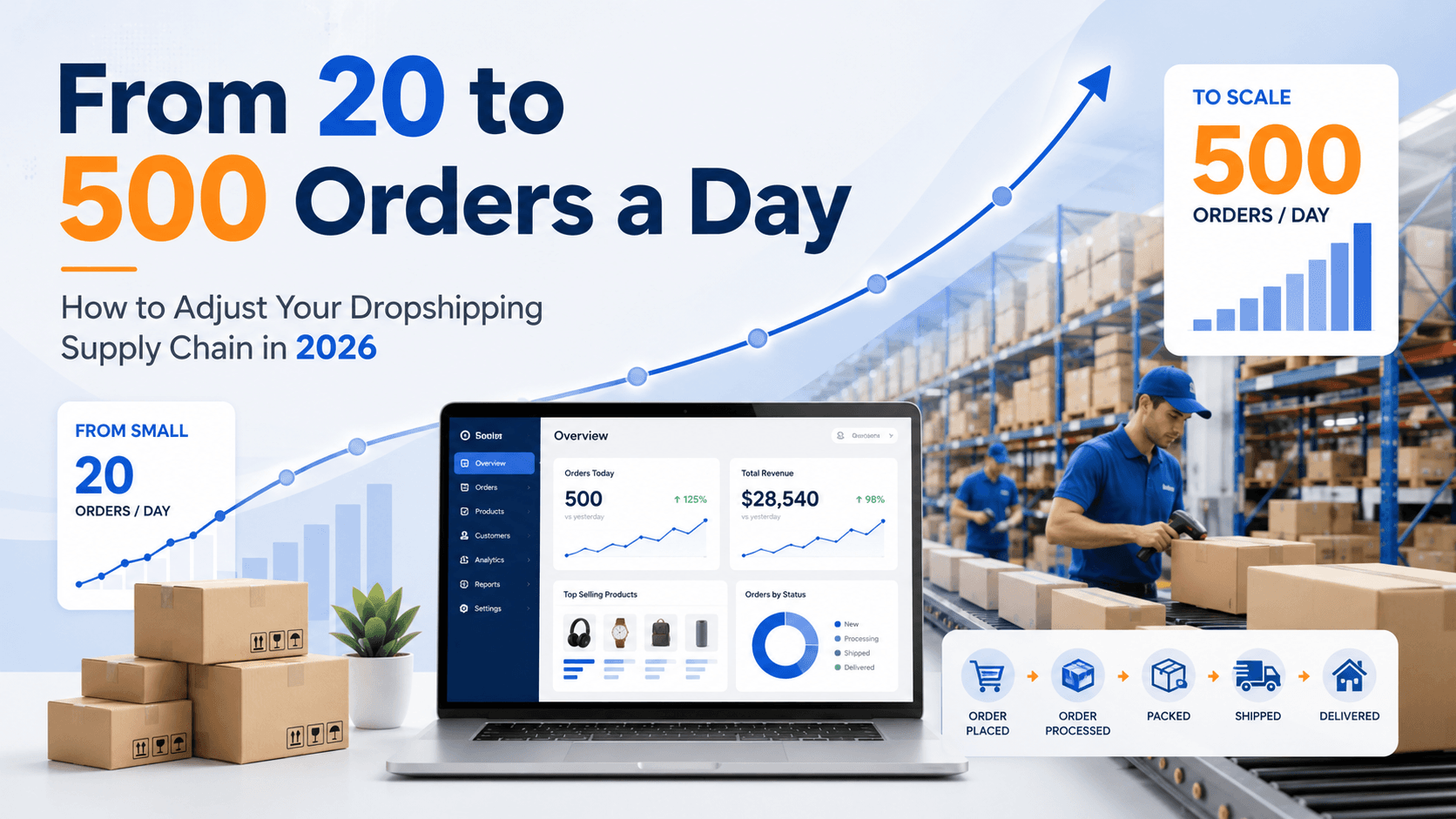
One thing cross-border sellers often underestimate is how quickly inventory errors are amplified as orders increase. When a store only receives 10 or 20 orders a day, inaccurate inventory may only require a few extra messages, a temporary supplier change, or a simple explanation to the customer. But when a product starts scaling, inventory mismatches become a systematic business risk.
For example, imagine an independent store selling a home support product through Shopify, Facebook ad landing pages, and TikTok Shop at the same time. In the beginning, the store receives only about 30 orders per day, and the supplier manually reports stock levels. Everything seems manageable. Then a short-form video ad starts performing well, and the store receives 800 orders within three days. The backend still shows enough inventory, but the supplier only has 350 units in stock. The remaining units need to be repurchased or produced. If the seller continues accepting orders, overselling happens. If the seller stops the ads, the traffic window is lost. If the seller refunds customers, ad spend and customer trust are both damaged.
This type of problem is very common in cross-border dropshipping. Sellers may think they are simply dealing with “supplier stock shortages,” but the real problem is the lack of a real-time inventory synchronization mechanism, the lack of safety stock for winning SKUs, and the lack of fulfillment capacity planning before scaling a product.
For cross-border sellers, the losses caused by inventory distortion are even more complex. Cross-border orders involve sourcing, quality inspection, packaging, international logistics, last-mile delivery, payment risk control, and after-sales disputes. A simple inventory mistake can quickly turn into a chain of business losses.
Delivery Promises Affect Conversion and Customer Trust
Many sellers believe that if the customer eventually receives the product, a few extra days of waiting should not matter too much. But consumers in 2026 are far less tolerant than before. In mature e-commerce markets such as the United States and Europe, buyers care not only about price, but also about estimated delivery time, logistics tracking transparency, and after-sales response speed.
This is especially important for independent store dropshipping sellers. Many sellers spend heavily on ads to bring customers to their websites. But if the product page and checkout page fail to provide a reliable delivery expectation, the conversion rate will fall. Even if the ad creative performs well and the click-through rate looks strong, orders may still be lost because the delivery promise is not convincing enough.
The more serious problem appears after the order is placed. If the store promises delivery within 7 to 10 days, but the actual delivery time becomes 15 or even 20 days, the customer experience quickly deteriorates. Customers begin sending emails, requesting refunds, opening PayPal disputes, leaving negative reviews, or complaining in social media comment sections. Shipping delays are never just a single-order issue. They affect the trust asset of the entire store.
Why Dropshipping Inventory Records Drift
The advantages of dropshipping are clear. Sellers do not need to hold large amounts of inventory upfront, they can test products with lower risk, and they can expand into more product categories faster. But the biggest challenge of dropshipping lies in the same place: sellers do not directly control the warehouse or production side. Inventory information often comes from suppliers, factories, or third-party fulfillment providers.
If the dropshipping supplier does not have a real-time inventory system, the inventory number seen by the seller may only be an estimate. When a supplier says a product is “in stock,” it may only mean that raw materials are available. When the supplier says an item “can be shipped,” it may still require two or three days of picking and preparation. When the supplier says inventory is “sufficient,” it may not be separated by color, size, or bundle option.
The area where cross-border e-commerce inventory synchronization most often fails is not total stock, but variant stock. Apparel, support products, pet supplies, beauty tools, home goods, and accessories often include different colors, sizes, specifications, and bundle combinations. For example, a pair of compression socks may show a total inventory of 2,000 units, but the best-selling black size M may already be out of stock. If the seller only looks at total inventory, the store continues accepting orders until customers have already paid and the team discovers that the exact variant cannot be shipped.
Multi-channel inventory management also adds difficulty. A seller may operate Shopify, Amazon, eBay, TikTok Shop, Etsy, and localized independent stores at the same time. If these channels do not share one unified inventory logic, the same SKU may be sold repeatedly across different channels. The final batch of stock may be sold out on the U.S. site, while the U.K. and French sites continue accepting orders, resulting in cross-market overselling.
Before scaling, sellers need confirmed ready-to-ship units, daily processing capacity, variant-level stock, replenishment time, the effect of custom packaging on dispatch, and the place of quality inspection in the fulfillment timeline. These details show whether the supplier can deliver orders consistently; a general statement that stock is available does not.
Inventory Confidence Sets the Limit for Ad Scaling
Cross-border sellers often experience the same pattern: a product looks profitable during testing, but once it scales, operations begin to fall apart. On the surface, it may seem like ad costs are rising. In reality, inventory and fulfillment systems are often dragging down frontend sales.
When inventory synchronization is inaccurate, sellers cannot confidently increase ad budgets. Every time ads scale, overselling may occur. If the ad team does not know the real inventory level, it cannot judge which SKUs should continue being promoted and which SKUs need reduced budgets. If suppliers do not know the advertising plan, they cannot prepare stock in advance. The result is a disconnect between frontend traffic and backend fulfillment.
For example, a seller is promoting a pet water bottle. Ad data shows that the U.S. market has the best conversion, the U.K. market has a higher average order value, and the German market has a lower refund rate. Under normal circumstances, the seller should gradually shift more budget toward the better-performing markets. But because inventory is not allocated by country or channel, all markets share the same inventory pool. The U.S. market suddenly sells out the stock, and orders from the U.K. and Germany are also affected. The seller has to pause ads, reconfirm supplier inventory, and loses the best scaling window.
This type of problem cannot be solved by ad optimization alone. Advertising brings orders, but inventory synchronization and dropshipping fulfillment determine whether the seller can actually handle those orders. In 2026, mature cross-border sellers will look at inventory data and advertising decisions together instead of letting the advertising team and supply chain team operate separately.
Shipping Delays Create Support, Refund, and Payment Risk
The cost of shipping delays goes far beyond higher logistics expenses. For independent store sellers, delays affect customer service workload, refund rates, chargeback risk, reviews, and payment account stability at the same time.
When an order exceeds the expected delivery time, customers begin asking about logistics updates more frequently. Customer service teams need to respond one by one, explaining customs clearance, transit status, last-mile delivery, and tracking updates. If tracking information does not move for a long time, customers are more likely to request refunds or open disputes. For sellers using PayPal, credit cards, or other payment channels, a high dispute rate can increase account risk.
More importantly, shipping delays hurt repurchase. Many cross-border products naturally have repeat-purchase potential, such as pet supplies, beauty tools, apparel accessories, health care products, and home consumables. But if customers have a poor first purchase experience, they are unlikely to buy again. The seller spends money acquiring the customer, but loses long-term value because the fulfillment experience is unstable.
That is why solving cross-border e-commerce shipping delays should not only be viewed from the angle of logistics price. Sellers need to consider sourcing time, quality inspection time, packaging time, outbound processing time, international shipping time, and last-mile delivery time together. What truly affects the customer experience is the full cycle from order placement to final delivery, not just one section of the shipping journey.
Inventory Synchronization Requires Shared Operational Rules
Many sellers immediately think of ERP systems, plugins, or automation tools when they hear the term inventory synchronization. Systems are important, but inventory synchronization is not only a technical problem. Truly effective inventory management requires system data, supplier execution, and manual review to work together.
If the supplier’s inventory is inaccurate, the system will only synchronize incorrect data faster. If the warehouse does not complete timely stock checks, backend inventory will drift away from real inventory. If the sourcing team does not confirm replenishment cycles, the seller cannot know whether advertising can continue scaling.
A healthy cross-border e-commerce inventory synchronization process should include several key actions. Sellers need to separate testing inventory, winning-product inventory, and safety stock. Test products can be run in small batches, but products with stable daily orders must be prepared in advance. Sellers need to set inventory alerts for winning SKUs instead of discovering stockouts only after the product has sold out. For products with many variants, sellers must monitor specific colors, sizes, and bundle combinations instead of only checking total inventory.
Sellers also need to connect inventory planning with target markets. The United States, the United Kingdom, Europe, Canada, and Australia have different logistics timelines, shipping cost structures, and customer expectations. Sellers cannot simply use one inventory number for every market. Before entering multiple countries, sellers should test different shipping routes and confirm whether fulfillment can remain stable after order volume increases.
Define One Source of Truth for Every SKU
Separate supplier availability from warehouse stock
Supplier availability, purchased inventory, warehouse on-hand inventory, and available-to-sell inventory are different values. A supplier may have raw material or units that can be produced, but that stock is not ready for immediate customer fulfillment. Purchased inventory may still be in transit to the warehouse. Warehouse on-hand stock may include damaged, quarantined, or already reserved units. The storefront should publish only the quantity that the operation can actually promise.
Choose one system as the operational source of truth. Other storefronts and marketplaces should receive inventory from that record rather than maintaining independent estimates. If a supplier feed is the only source during testing, define its update interval and add a conservative buffer. When stable products move into stocked fulfillment, the warehouse record should usually become more important than the supplier catalogue.
Map variants and bundles to physical components
Every sellable variant needs a stable SKU that maps to the exact colour, size, specification, packaging version, and warehouse item. Names such as “black / medium” are not sufficient when different channels format variants differently. A mapping error can reserve the wrong item even when the total inventory number appears correct.
Bundles require component-level logic. If one cleaning kit contains a brush, cloth, and storage bag, the available bundle quantity is limited by the component with the lowest usable stock. Selling the kit must reserve all three components. Otherwise, the system can show bundle inventory after one component has already run out.
Reserve stock when the order becomes actionable
Define the event that reserves inventory: order creation, payment authorization, successful payment, or fulfillment acceptance. Reserving too late permits two channels to sell the last unit. Reserving too early can lock stock behind failed or unpaid orders. The correct rule depends on the payment and fraud workflow, but it must be consistent and include a timed release for cancelled or expired orders.
Keep a small channel or operational buffer for volatile SKUs. The buffer is not extra physical stock; it is stock deliberately withheld from storefront availability to absorb synchronization delay, inspection failures, and normal count differences. Review the buffer against sales velocity, replenishment time, and inventory accuracy rather than setting the same number for every product.
Use Three Tests Before Scaling an Inventory-Dependent SKU
Content test: match promotion to available variants
Advertising and content should promote variants that can actually be fulfilled. A video may create demand for one colour or bundle even when the campaign links to a page with several options. Track the variant selected after each creative and avoid scaling a winning angle until the exact SKU has sufficient available stock and a confirmed replenishment path.
Commercial test: model the cost of stock errors
Calculate contribution after product cost, inbound purchasing, packaging, pick and pack, international shipping, duties or taxes where applicable, payment fees, customer acquisition, refunds, replacements, and support. Then model a stockout scenario. Lost ad spend, cancellation fees, reshipping, discounts, and chargeback exposure can erase the apparent saving from running with no buffer stock.
Operational test: reconcile orders and physical units
Run a controlled test across every connected channel. Place orders for representative variants, confirm that each order reserves the correct stock, reaches the fulfillment queue once, and returns tracking to the correct storefront. Cancel one order, fail one payment, and create a bundle order to test release and component logic. The operation is ready to scale only when exceptions are visible and recoverable.
Reconcile Inventory and Handle Exceptions Early
A synchronized system still needs reconciliation. Compare system on-hand inventory with physical counts on a defined schedule, more frequently for fast-moving or high-value SKUs. Record receipts, inspection failures, damaged units, returns, replacements, manual adjustments, and lost parcels with reason codes. Unexplained adjustments should be investigated rather than repeatedly used to force the numbers to match.
Create alerts from sales velocity and replenishment lead time. A useful reorder point considers demand during supplier processing, inbound transport, receiving and inspection, plus a safety allowance for variability. Advertising plans should be shared with the sourcing and fulfillment team before a promotion, influencer post, or new-country launch creates an unusual demand spike.
Stock shortages, tracking inactivity, route suspension, customs holds, and failed delivery should be detected before the customer asks. Define who pauses listings or ads, who contacts the supplier, which substitutions require seller approval, when the customer is notified, and when refund or reshipment decisions are made. Fast, accurate communication reduces the damage even when the original exception cannot be avoided.
Connect Inventory Data to Fulfillment Execution
For cross-border sellers, a valuable dropshipping partner should not simply ship orders after they are received. It should help sellers judge whether a product is suitable for scaling, whether supply is stable, whether inventory is real, whether packaging can be customized, and whether the logistics route fits the target market before the orders come in.
ETdropship is a branded dropshipping fulfillment service provider for e-commerce sellers. It helps sellers handle product sourcing, factory-cost support, custom packaging, quality inspection, order fulfillment, and global shipping. For sellers preparing to expand, the value of this type of service is not only reducing sourcing communication costs, but also lowering business risks caused by inventory mismatches, shipping delays, and after-sales disputes.
For example, when a seller prepares to promote a support product, pet product, apparel accessory, beauty tool, or home product, ETdropship can help confirm supplier capacity, real inventory, best-selling variants, packaging requirements, and destination-country logistics solutions. The seller focuses on sales and marketing, while the fulfillment team handles sourcing, inspection, packaging, order processing, shipping, and after-sales support. This allows the seller to understand whether the product can handle scaled orders before increasing ad spend, instead of discovering inventory shortages only after orders explode.
For cross-border sellers who want to build a brand, inventory synchronization and shipping stability are especially important. A brand is not built through one transaction. It is built through repeated and stable delivery experiences. Whether the customer receives consistent product quality, unified packaging, realistic delivery timing, and timely after-sales support will all influence repurchase and word of mouth.
Make Fulfillment Capacity Part of Global Expansion
In 2026, cross-border e-commerce competition has moved beyond pure traffic competition. It has become a competition between frontend sales and backend fulfillment working together. Sellers still need good products, strong ads, and high-converting pages, but if inventory synchronization is inaccurate, order processing is slow, and logistics timing is unstable, backend problems will eventually hold back growth.
Inventory mismatches lead to overselling. Overselling leads to shipping delays. Shipping delays lead to refunds and complaints. Refunds and complaints affect payment accounts, advertising performance, and brand trust. In the end, a store that could have expanded may not fail because of weak market demand, but because of poor supply chain execution.
Global expansion in cross-border e-commerce is not simply about selling products to more countries. It is about giving customers in different countries a stable experience. Customers in the United States, the United Kingdom, France, Germany, Canada, and Australia each have their own expectations for delivery speed, logistics transparency, and after-sales response. Without a reliable inventory synchronization system and a stable dropshipping fulfillment team, it becomes very difficult to manage multiple markets over the long term.
Mature sellers prepare inventory plans before a product becomes a winner. They confirm supply capacity before scaling ads. They test logistics routes before entering new markets. They detect abnormal orders before customers complain. These sellers may not always grow the fastest, but they are more likely to grow steadily.
In 2026, the core question for cross-border e-commerce sellers is no longer simply whether they can sell the product. The real question is whether they can deliver the product consistently after it is sold. The sellers who can connect inventory, sourcing, quality inspection, packaging, logistics, and after-sales support into one stable system will have a stronger chance of expanding globally for the long term.
Frequently Asked Questions
Is the zero-inventory model still suitable for dropshipping sellers in 2026?
The zero-inventory model is suitable for early product testing, but not for long-term scaling. During the testing stage, it can reduce risk. But once a product starts generating stable orders, sellers need to build safety stock. This is especially important for products with many variants, such as apparel, support products, pet supplies, and beauty tools. Best-selling colors and sizes should be prepared in advance.
Where does Shopify inventory synchronization for dropshipping most often go wrong?
The most common problems are multi-channel inventory and variant inventory. Many sellers only look at total stock while ignoring colors, sizes, bundle combinations, and inventory consumption across different platforms. If Shopify, TikTok Shop, and Amazon sell the same SKU at the same time without unified inventory, overselling can happen very easily.
What hidden costs do cross-border e-commerce shipping delays create?
Shipping delays increase customer service workload, refund rates, chargeback risk, and negative reviews. They also reduce repeat purchases. For independent store sellers, delays may also affect payment channel stability and advertising conversion. The real cost is not only shipping expense, but also customer trust and brand reputation.
Can inventory synchronization software completely solve inventory mismatches?
Not completely. Software can improve synchronization efficiency, but only if suppliers, warehouses, and sourcing teams provide accurate data. If the real inventory is inaccurate, the system will still synchronize wrong information. Sellers need software, suppliers, and fulfillment teams to work together.
What type of sellers is ETdropship suitable for?
ETdropship is more suitable for cross-border sellers who have already started receiving orders, are preparing to scale ads, or want to move from ordinary dropshipping to branded operations. Sellers can focus on sales and marketing, while ETdropship handles sourcing, brand customization, quality inspection, order fulfillment, global shipping, and after-sales support.
Conclusion
Cross-border dropshipping inventory synchronization is an operating discipline supported by software, not a feature that one plugin can solve alone. Accurate supplier and warehouse records, stable SKU mapping, reservation rules, component-level bundle logic, reconciliation, replenishment planning, and visible exceptions must work together.
A zero-inventory approach can remain useful for early testing. Once a product develops repeatable demand, the seller needs more reliable availability data and may need a small stock buffer for the variants driving sales. Connect advertising decisions to inventory depth, test delivery routes before promising them, and expand to new channels or countries only when the fulfillment operation can reproduce the expected experience.