Best Fashion Jewelry Dropshipping Suppliers in 2026: Build a Jewelry Brand Without Holding Inventory
Why Fashion Jewelry Is Still a Strong Dropshipping Category in 2026
Fashion jewelry has always been one of the most suitable categories for dropshipping. Unlike furniture or home appliances, jewelry does not take up much storage space. Unlike clothing, it usually has fewer sizing problems and lower return pressure. Earrings, necklaces, rings, bracelets, hair clips, anklets, and small accessories are lightweight, easy to ship, and highly visual, making them ideal for Shopify stores, TikTok, Facebook, Instagram, and Pinterest.
For many new ecommerce sellers, the biggest advantage of jewelry dropshipping is simple: you do not need to buy inventory in advance. You do not need to purchase hundreds of pieces before testing the market. You do not need to rent a warehouse, pack parcels, or ship orders by yourself. Once a customer places an order, your supplier can handle sourcing, quality inspection, packaging, fulfillment, and shipping.
Market data also shows that jewelry is still a long-term growth category. According to Fortune Business Insights, the global jewelry market is expected to grow from about USD 254.13 billion in 2026 to USD 387.36 billion by 2034, with a projected compound annual growth rate of 5.41%. Grand View Research also estimates that the global jewelry market will continue expanding through 2033. Although different research firms may use different calculation methods, the overall direction is clear: jewelry is not a short-term trend. It is a stable consumer market with strong potential for long-term brand building.
However, jewelry dropshipping in 2026 is no longer about simply finding cheap products and listing them on a Shopify store with a markup. Consumers compare prices more easily now. Similar products appear everywhere. Advertising costs are also higher than before. If a store only copies supplier images, uses basic packaging, and has no brand story, customers will not easily trust it.
The real opportunity in 2026 is not just “no inventory.” The real opportunity is using the no-inventory model to test products with lower risk, then gradually turning winning products into a real jewelry brand.
Why Fashion Jewelry Works Well With the No-Inventory Model
Fashion jewelry has a special advantage: the gap between product cost and perceived value can be very large. The same necklace may feel cheap if it arrives in a plain plastic bag. But if it comes in a branded jewelry box with a thank-you card, care instructions, a gift bag, and professional product photography, it feels more like a thoughtful gift or a branded product.
That is why jewelry works well for independent ecommerce stores. Marketplace shoppers often compare prices quickly, but independent store customers are more likely to be influenced by brand visuals, storytelling, packaging, and emotional context.
For example, a pearl necklace may look ordinary if it is listed as just another accessory. But if it is positioned as a Mother’s Day gift, a bridesmaid jewelry set, or an elegant everyday piece for work, its perceived value changes immediately.
Jewelry is also highly suitable for content marketing. A simple TikTok try-on video, an Instagram styling post, or a Pinterest gift guide image can influence a customer’s purchase decision. Many people do not buy jewelry because they urgently need another necklace. They buy because a style, scene, story, or emotional message creates desire.
Shopify has reported that global ecommerce sales are expected to continue growing into the trillions of dollars in 2026. For jewelry sellers, this means online shopping is still expanding, but competition will also become more demanding. Product images, social content, packaging, fulfillment, and customer experience will all matter more.
Social commerce is another important factor. According to eMarketer, TikTok Shop has become a major part of the U.S. social commerce market. This shows that visually driven products like jewelry can no longer rely only on static product photos. Short videos, gift scenes, styling clips, and emotional content will become increasingly important for conversion.
The Competition Has Changed: Jewelry Dropshipping Is No Longer Just About Low Prices
In the early days of dropshipping, many sellers focused mainly on finding winning products. They watched TikTok, Facebook ads, AliExpress, and other platforms to see what was trending, then quickly listed similar products in their stores.
This method can still work to some extent, but when everyone follows the same strategy, the result is predictable: too many similar products, lower prices, higher ad costs, and weaker profit margins.
In 2026, the sellers who succeed in fashion jewelry dropshipping are usually not the ones selling the cheapest products. They are the ones who place products inside a stronger brand system.
A good jewelry brand needs a clear store style, consistent product photography, real wearing images, attractive packaging, reliable fulfillment, and content that connects with the target customer. These details affect conversion rates, repeat purchases, and customer trust.
Some sellers list hundreds of jewelry products at once: earrings, rings, necklaces, bracelets, hair clips, anklets, and random gift items. The store looks full, but it has no clear identity. When customers visit the site, they cannot tell whether the brand is minimalist, luxury-inspired, cute, romantic, gift-focused, or everyday casual.
On the other hand, some sellers start with fewer products but a much clearer direction. For example, they may focus only on pearl gift jewelry, minimalist gold accessories, zodiac necklaces, waterproof stainless steel jewelry, or romantic couple jewelry. Their product images, packaging colors, ad copy, and social media content all support the same style.
This is why jewelry dropshipping should not be seen as simply selling accessories. It is about selling a style, a gifting moment, and an emotional experience.
Choosing a Jewelry Dropshipping Supplier: Product Quantity Is Not Enough
Many suppliers will tell you they have thousands or even tens of thousands of jewelry products. But for Shopify sellers, a large product catalog does not always mean the supplier is suitable for long-term cooperation.
The real question is whether the supplier has strong service capability.
A good jewelry supplier should do more than give you product links. They should help solve real operational problems. Are the products in stock? Is the quality stable? Can the packaging be upgraded? Is one-piece dropshipping supported? Can they handle order issues? Do they provide tracking numbers? Can they respond quickly when customers complain?
Jewelry products may look simple, but the details matter. A necklace chain may break easily. Earring posts may feel rough. Ring sizes may be inaccurate. Poor plating may cause discoloration. Weak packaging may be damaged during shipping. If these problems are not checked before shipping, they become customer service problems for the seller.
Return risk is also important. According to the National Retail Federation and Happy Returns, U.S. retail returns reached a very high level in 2025, and online return rates remained significantly higher than many sellers expect. For jewelry sellers, this means product pages, size information, material descriptions, packaging photos, and pre-shipment quality checks directly affect profit.
New sellers should not only ask,“How much does this product cost?” They should also ask: Is the quality stable? Can I order samples first? Can you support branded packaging? What is the processing time? How long does shipping take to the U.S. or Europe? What happens if the customer receives a damaged item? Can you support Shopify order fulfillment?
Price is only one part of the supply chain. Service quality is what determines whether a supplier can support long-term growth.
Best Fashion Jewelry Dropshipping Suppliers to Watch in 2026
ETdropship: Best for Shopify Sellers Who Want Brand-Focused Jewelry Fulfillment
For sellers who want to build a long-term Shopify jewelry brand, ETdropship is better suited as a backend supply chain partner rather than just a product source.
As a jewelry store grows, the seller’s needs usually go beyond simply finding a product and shipping it. They may need product sourcing, purchasing coordination, quality inspection, branded packaging, warehousing, order fulfillment, global shipping, tracking updates, and after-sales support.
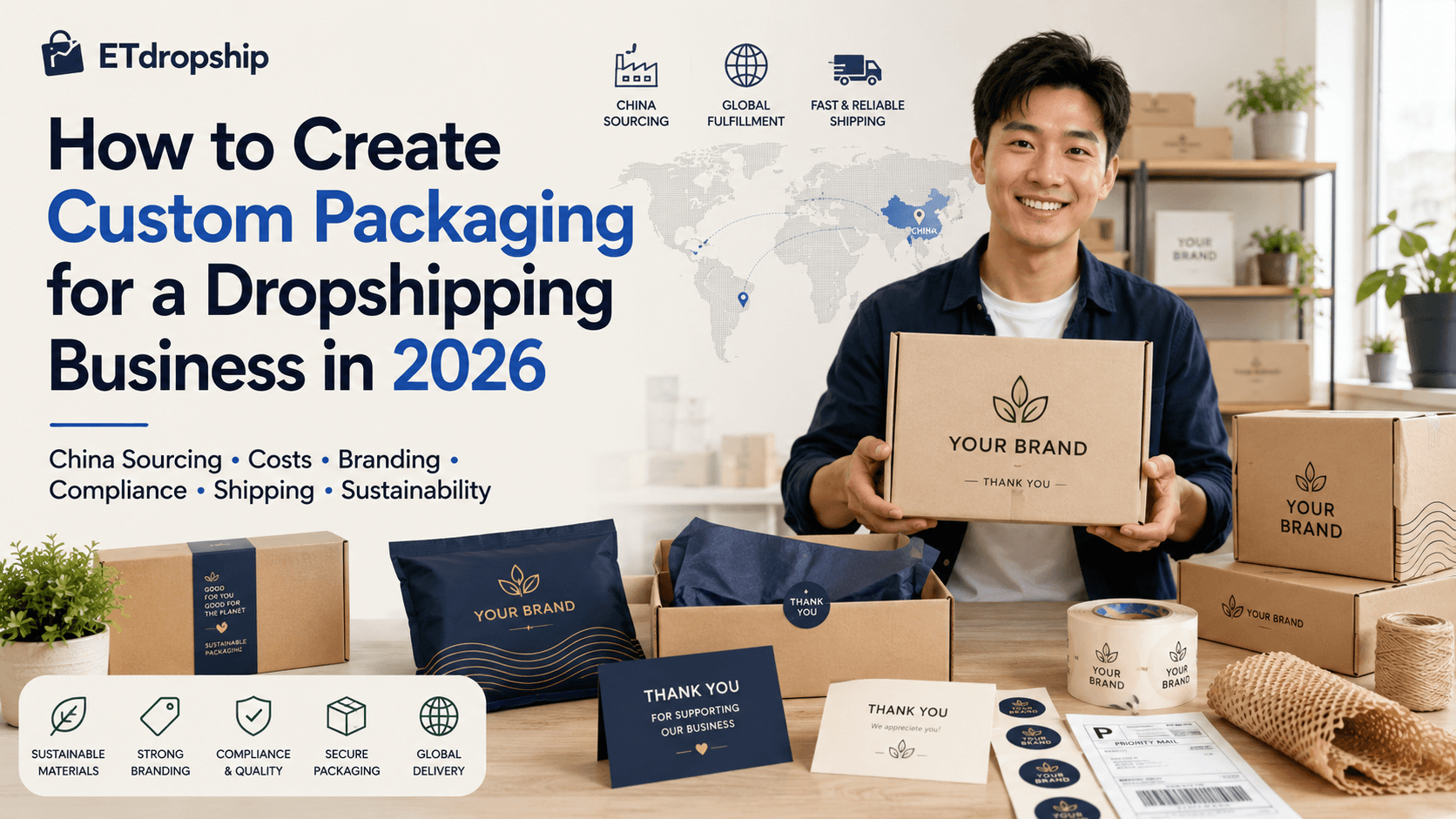
At the beginning, a seller can use the no-inventory model to test earrings, necklaces, rings, bracelets, and other accessories. Once certain products start generating stable sales, they can be upgraded into branded products with logo jewelry boxes, thank-you cards, care cards, gift bags, and even small-batch stock.
This is how a seller can move from basic dropshipping to brand-focused fulfillment.
Jewelry depends heavily on first impressions. If customers receive a product in plain packaging, they may see it as a cheap accessory. But if they receive a complete branded package with a jewelry box, care card, brand card, and gift bag, the product feels more trustworthy and valuable.
CJdropshipping: Good for Product Testing and Multi-Category Stores
CJdropshipping is a broad dropshipping platform with many product categories. It is useful for beginners who want to test multiple styles quickly. Sellers can test earrings, necklaces, rings, bracelets, and other jewelry products while also exploring other categories.
Its advantage is convenience and product variety. However, jewelry sellers should be careful with sample quality because product standards can vary. A product may look good in photos but feel very different in real life. Before scaling ads, it is better to check material, weight, color, plating, and packaging.
Nihao Jewelry: Good for Low-Cost Fashion Jewelry Testing
Nihao Jewelry is suitable for sellers who want to test trendy accessories at a lower cost. It offers many styles, including earrings, hair clips, necklaces, rings, bracelets, and fashion accessories.
If a certain bow hair clip, pearl earring, vintage ring, or zodiac necklace becomes popular on TikTok or Instagram, this type of supplier can help sellers quickly find similar products for testing.
However, low-cost platforms are better for testing than long-term brand building. Some products look attractive in supplier photos but may not have enough quality or packaging value to support a higher selling price.
Trendsi: Good for Fashion Stores That Want Jewelry as Add-On Products
Trendsi is more suitable for sellers in fashion, women’s clothing, boutique accessories, or lifestyle categories. If your Shopify store is not a pure jewelry brand, jewelry can still work well as an add-on product.
For example, a dress product page can recommend matching earrings. A swimwear page can recommend anklets or shell necklaces. A sweater page can recommend minimalist gold necklaces.
Jewelry is small and lightweight, so adding it to fashion orders usually does not create major shipping pressure, but it can help increase average order value. For women’s fashion stores, jewelry accessories are often a smart upsell category.
Spocket and Syncee: Good for Finding U.S., European, or Global Suppliers
Spocket and Syncee are useful for sellers who want to find suppliers in the U.S., Europe, or other regions. If your target market is sensitive to shipping speed, or if you do not want to rely only on one supply region, these platforms can be helpful.
However, local suppliers often have higher product costs. This makes them more suitable for mid-range or higher-priced jewelry brands rather than low-price accessory stores. If your brand positioning is stronger and customers care about delivery speed, these platforms are worth considering.
ShineOn: Good for Personalized Gift Jewelry
ShineOn is worth studying if you want to sell personalized gift jewelry. Its strength is not ordinary jewelry. Its strength is combining necklaces, pendants, message cards, and emotional copywriting.
Examples include necklaces for mothers, birthday gifts for daughters, anniversary gifts for wives, memorial jewelry, and pet remembrance pendants. These products do not compete mainly on the lowest price. They compete on emotional value and gifting context.
When customers buy this type of product, they are not comparing the metal cost. They are looking for a way to express love, appreciation, memory, or encouragement. That is why personalized jewelry is often suitable for holiday campaigns, gift advertising, and emotional storytelling.
Building a Jewelry Brand Through Dropshipping Does Not Require Perfection at the Start
Many beginners think that building a brand requires a large upfront investment. This is not always true. A jewelry brand can start with dropshipping, but it cannot stay forever at the stage of copying supplier images.
A more practical path is to start with no-inventory testing. Choose one clear niche first, such as pearl gift jewelry, minimalist gold accessories, zodiac necklaces, waterproof stainless steel jewelry, or couple jewelry. Then select 10 to 20 products around that direction.
Do not sell every style at the beginning.
After a period of testing, you may find that only a few products show real potential. At that point, do not keep adding random new products. Instead, focus on improving the winning styles.
You can improve product images, add wearing photos, rewrite product descriptions, explain materials and sizes more clearly, design gift packaging, create bundles, and increase average order value.
From an operational point of view, this is much more practical than endlessly uploading new products. The global ecommerce market is growing, but traffic is not free. Sellers need to find high-converting products with a smaller test range, then use packaging, content, and customer experience to improve profit.
In many cases, the product itself is not the problem. The problem is that the seller has not packaged or presented it well. A pearl earring on a plain white background may look ordinary. But when positioned for weddings, dates, Mother’s Day, birthdays, or gift boxes, it becomes more valuable.
Dropshipping is not the final goal. It is a lower-risk way to find products worth building into a brand.
Real Brand Examples and Lessons for Jewelry Sellers
Pura Vida: A Simple Bracelet Can Become a Lifestyle Brand
Pura Vida is a valuable case study for jewelry sellers. It is not a traditional dropshipping brand, but its growth logic is useful for anyone selling jewelry online.
The brand started with handmade bracelets and built a story around travel, beaches, freedom, and artisan craftsmanship. A simple bracelet became part of a lifestyle identity.
The lesson is clear: jewelry does not always need to be technically complex. What matters is brand story, visual identity, and emotional connection. Many sellers look at a bracelet and only ask about cost and selling price. Strong brands ask different questions: What lifestyle does this product represent? Who is it for? Why would customers share it? Can it create a community feeling?
For dropshipping sellers, even if the supplier handles fulfillment, brand positioning must still come from the seller. A supplier can ship your product, but it cannot define your brand personality.
ShineOn: Jewelry Profit Often Comes From Emotional Value
ShineOn shows another important direction: jewelry can increase profit through emotional storytelling.
It combines necklaces with message cards, holiday copy, family relationships, romantic relationships, and gift occasions. A simple necklace becomes a gift for a mother, a daughter, a wife, a partner, or someone meaningful.
The customer is not just buying metal. The customer is buying a way to express emotion.
This is an important lesson for Shopify sellers. You do not need to create a complicated product from the beginning. You can increase product value through scenes, messages, and packaging.
For example, a zodiac necklace described only as “zodiac necklace” may not feel very compelling. But if it is positioned as “a personalized birthday gift for her birth month,” with a gift box and card, the conversion angle becomes much stronger.
From Basic Dropshipping to Branded Packaging
Many jewelry sellers start with basic dropshipping. They test earrings, necklaces, rings, and bracelets using supplier images. Once certain products show stable ad performance, they upgrade the best-selling styles with branded gift boxes.
After packaging improves, sellers often find it easier to increase selling prices. Customer complaints may also decrease because the product feels more like a complete brand experience rather than a random small item.
This is one of the biggest advantages of jewelry dropshipping. Sellers can test products with lower risk first, then upgrade supply chain, packaging, and brand presentation based on real sales data.
Common Mistakes New Jewelry Dropshippers Should Avoid
Looking Only at Product Cost
Many beginners see a cheap earring or necklace and immediately assume the profit margin is high. But real profit includes product cost, shipping cost, packaging cost, advertising cost, refund rate, customer service time, and payment fees.
A cheap product with poor quality can become expensive if it creates refunds, complaints, chargebacks, or bad reviews.
Running Ads Without Ordering Samples
Jewelry depends heavily on real-life quality. Supplier photos can look beautiful, but the actual product may be too light, too small, off-color, poorly plated, or poorly packaged.
Before spending money on ads, sellers should check samples whenever possible. Details like plating, chain strength, earring posts, clasps, ring sizing, and packaging should be reviewed before scaling.
Overstating Materials
Do not describe ordinary alloy as sterling silver. Do not describe gold-plated jewelry as solid gold. Do not claim a product is waterproof if it is not designed for long-term water exposure.
These claims may increase short-term conversion, but they can damage trust and create refunds later. For long-term jewelry branding, material descriptions must be clear and honest.
For Western markets, information such as stainless steel, nickel-free, hypoallergenic,925silver, gold-plated, care instructions, and packaging details should be explained carefully when accurate.
Selling Too Many Unrelated Styles
Jewelry is not about listing as many products as possible. It is about creating a clear style.
If a store sells Y2K earrings today, mother-daughter necklaces tomorrow, men’s rings the next day, and children’s hair accessories after that, the brand will feel confusing.
A clear direction makes ads, product photography, packaging, social content, and customer retention much easier.
A Practical Suggestion: Start With a Small but Clear Jewelry Model
For beginners, it is better to start with a focused product model instead of a large general jewelry store.
If you choose pearl gift jewelry, build around pearl earrings, pearl necklaces, pearl bracelets, and gift sets. The product count does not need to be large, but the style should be consistent. Product images, ad creatives, packaging colors, and social media content should all support the same message: elegance, gifting, femininity, and special occasions.
If you choose zodiac birthday jewelry, focus on zodiac necklaces, birthstone rings, initial pendants, and gift cards. This direction works well for birthday gifts, best friend gifts, and personalized marketing.
If you choose waterproof stainless steel jewelry, focus on daily wear, travel, durability, and low-maintenance styling. This direction is better for long-term everyday products.
New sellers do not fail because they have too few products. They often fail because the store direction is too messy. The clearer the direction, the easier it is to test ads, create content, design packaging, and communicate with suppliers.
Conclusion: No Inventory Is Only the Beginning
Fashion jewelry will remain a strong dropshipping category in 2026. It is lightweight, easy to ship, rich in styles, suitable for gifting, and highly responsive to packaging and content marketing.
But the market is no longer suitable for simple product copying. The sellers who build long-term success will not rely only on cheap sourcing. They will gradually build their own style, packaging, supply chain, and customer experience.
At the beginning, no-inventory dropshipping helps reduce risk and test products quickly. In the middle stage, sellers need to use real sales data to identify promising products, then improve product photos, videos, descriptions, packaging, and bundles. In the later stage, winning products should become branded items supported by custom packaging, small-batch stock, and private-label elements.
If you want to test products quickly, suppliers such as CJdropshipping, Nihao Jewelry, Trendsi, Spocket, and Syncee can be useful. If you want to sell personalized gift jewelry, ShineOn is worth studying. If you want to turn ordinary jewelry products into a stronger Shopify brand, ETdropship can support product sourcing, quality inspection, branded packaging, global shipping, and order fulfillment.
No-inventory dropshipping can help you start. But long-term profit depends on whether you can turn products into a brand. Jewelry does not have to compete only on low prices. With the right style, packaging, story, and gifting angle, it can become a profitable, repeatable, and brandable ecommerce category.
FAQ:
1. Is fashion jewelry still good for dropshipping in 2026?
Yes. Fashion jewelry remains a strong dropshipping category because it is lightweight, easy to ship, visually attractive, and suitable for gifting. It also works well with Shopify stores, TikTok content, Instagram styling posts, and Pinterest gift guides.
2. Do I need to buy inventory before selling jewelry online?
No. With jewelry dropshipping, you can list products in your store first. When a customer places an order, your supplier handles sourcing, packing, fulfillment, and shipping. This helps beginners test the market with lower risk.
3. What type of jewelry is best for dropshipping?
Good product directions include pearl jewelry, minimalist gold accessories, stainless steel jewelry, zodiac necklaces, birthstone rings, personalized gift jewelry, couple bracelets, and jewelry gift sets.
4. Which supplier is best for building a jewelry brand?
It depends on your business model. CJdropshipping and Nihao Jewelry are useful for testing products. Trendsi works well for fashion stores. Spocket and Syncee can help sellers find U.S., European, or global suppliers. ShineOn is suitable for personalized gift jewelry. ETdropship is better for Shopify sellers who want sourcing, quality inspection, branded packaging, fulfillment, and long-term supply chain support.
5. Why is packaging important for jewelry dropshipping?
Packaging directly affects perceived value. A necklace in a plain bag may feel cheap, while the same necklace in a branded box with a thank-you card and care instructions can feel like a premium gift. Good packaging can support higher pricing and improve customer satisfaction.
6. Should beginners order samples before selling jewelry?
Yes. Jewelry quality is difficult to judge only from photos. Sellers should check samples for color, material, plating, weight, size, clasps, chain strength, earring posts, and packaging before spending money on ads.
7. What is the biggest mistake new jewelry dropshippers make?
The biggest mistake is focusing only on low product cost while ignoring quality, packaging, shipping time, refunds, and customer experience. A cheap product can become unprofitable if it causes complaints or returns.
8. Can jewelry dropshipping become a real brand?
Yes. Many sellers start with dropshipping to test products, then upgrade winning items with branded packaging, better product photography, improved descriptions, bundles, and eventually small-batch inventory. Dropshipping can be the starting point for building a real jewelry brand.
9. Is personalized jewelry better than regular jewelry?
Personalized jewelry can often support higher perceived value because it is connected to emotions, names, birthdays, relationships, and gift occasions. However, sellers must manage production time, customization accuracy, and return policies carefully.
10. How can I increase profit when selling jewelry online?
You can increase profit by improving product presentation, using branded packaging, creating gift sets, offering bundles, targeting clear niches, using emotional copywriting, improving product videos, and working with a supplier that can support stable fulfillment and quality control.