
The most reliable product ideas do not come from a single “winning products” list. They appear when multiple independent signals agree: buyers search for the problem, products sell at workable prices, social content can demonstrate the value, and suppliers can fulfill the item consistently. This guide was researched and reviewed on July 18, 2026 using current official platform resources.
Sources & further reading
- Amazon — Product ideas in 2026 (Jan. 5, 2026)
- Amazon — Product Opportunity Explorer
- eBay — Product Research
- TikTok — Creative Center Top Products
- Temu — Seller Center and Seller Academy
- Shopify — How to do ecommerce product research (2026)
Policies and forecasts change. Confirm dates and details on each official page before making business decisions.
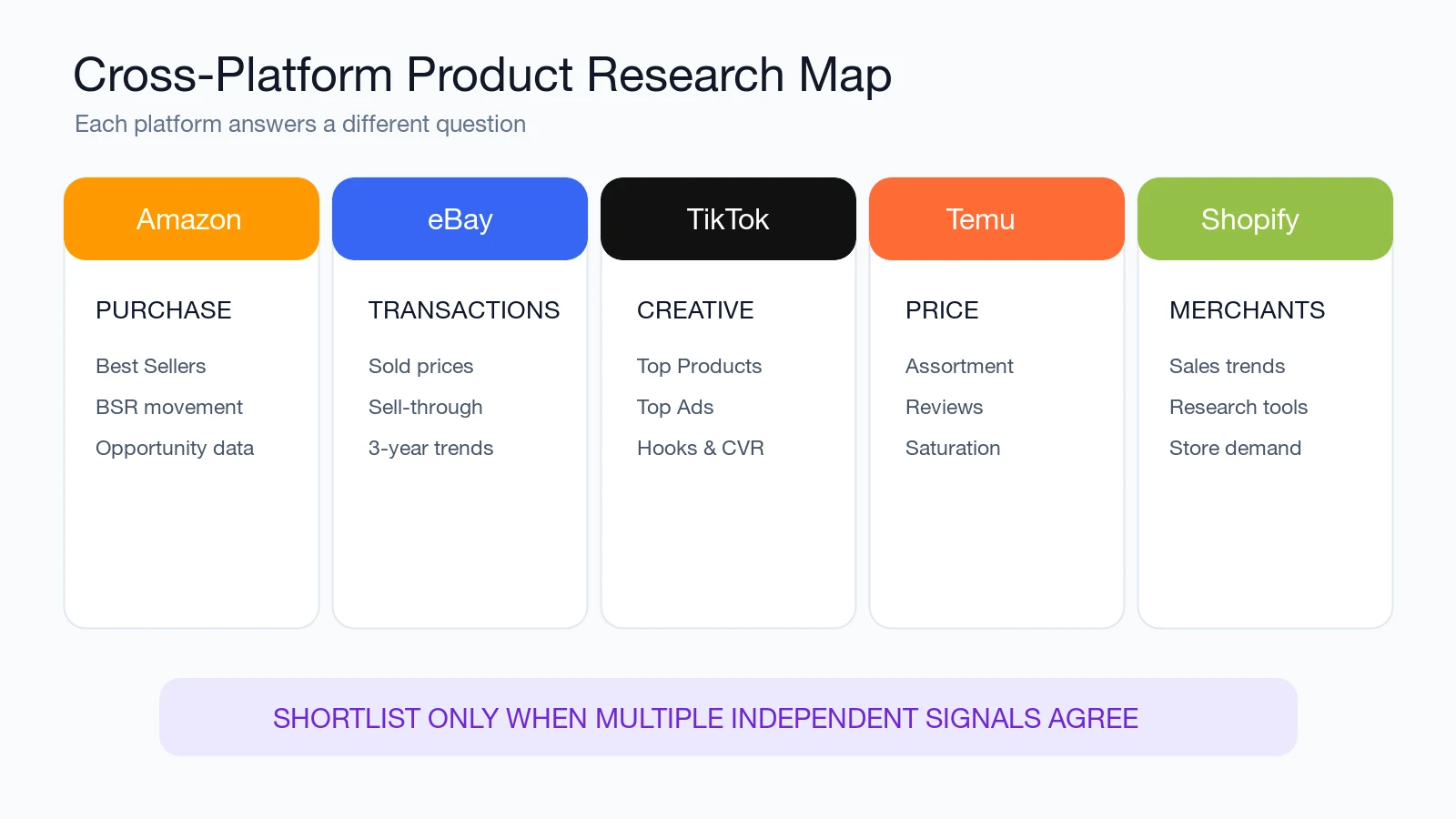
What each platform can actually tell you
| Platform | Best evidence | What not to assume |
|---|---|---|
| Amazon | Best Sellers, BSR, Movers & Shakers, Product Opportunity Explorer | A high rank does not prove your margin or ability to compete |
| eBay | Actual sold prices, sales trends, seller count, shipping, sell-through | A sale in one condition or country may not transfer to your offer |
| TikTok | Top Products, Top Ads, CTR/CVR context, hooks and demonstrations | Views and likes do not equal durable purchase demand |
| Temu | Price, assortment, reviews, Seller Center recommendations | Public browsing does not expose market-wide sales data |
| Shopify | Merchant trend reports and cross-channel research methods | A category growth rate is not a product-level forecast |
A repeatable 45-minute research workflow
- Start with a customer problem. Write the audience, recurring problem, and desired outcome before searching products.
- Check Amazon demand. Review the relevant Best Sellers category, Movers & Shakers, BSR, review dates, and repeated complaints.
- Check eBay transactions. In Product Research, compare 90-day and 12-month sold prices, seller count, shipping cost, and seasonality.
- Check TikTok creative fit. Filter Top Products and Top Ads by target country and 7- or 30-day period. Save recurring hooks, not just viral videos.
- Check Temu saturation and price pressure. Compare the same specification, review depth, delivery promise, and how many near-identical listings exist.
- Check Shopify and Google Trends. Confirm whether the category appears in current merchant data and whether five-year search interest is stable, rising, or seasonal.
- Run the dropshipping filter. Reject ideas with weak landed margin, fragile shipping, unclear compliance, IP risk, or no useful differentiation.
Use Amazon and eBay for different demand questions
Amazon’s January 2026 guide says Best Sellers lists are updated frequently, while Movers & Shakers is updated hourly and tracks the biggest sales-rank gainers over the previous 24 hours. That makes Amazon useful for detecting current purchase momentum.
eBay Product Research is better for historical transaction context. eBay states that sellers can review up to three years of sales data, including actual sold prices, accepted Best Offers, average shipping, seller count, sales trends, and recent sell-through rate. Use it to test whether demand survives beyond one short spike.
Strong signal
A candidate is more credible when Amazon shows active demand and eBay shows repeated sold transactions at a price that can support your landed cost.
Use TikTok and Temu without misreading them
- TikTok: evaluate whether the benefit is visible in the first seconds, whether several advertisers use different hooks, and whether 30-day interest persists beyond a 7-day burst.
- Temu: use public listings to compare specification, price floor, review complaints, and delivery expectations.
- Temu limitation: its public site does not provide an equivalent to eBay’s open historical sold-data report. Detailed product-selection guidance and listing recommendations are primarily offered inside Seller Center.
Only shortlist products that pass all five tests
| Test | Pass condition |
|---|---|
| Demand | Repeated purchase evidence across at least two independent sources |
| Margin | Positive contribution after product, shipping, fees, refunds, and ads |
| Fulfillment | Compact, durable, traceable, and available from more than one source |
| Compliance | Claims, labels, materials, and target-market rules can be verified |
| Differentiation | A useful bundle, niche, design, content, service, or branding angle |
Frequently asked questions
- Which platform is best for product research?
No single platform is best. Amazon is useful for purchase momentum, eBay for historical sold data, TikTok for creative momentum, Temu for assortment and price pressure, and Shopify for broader ecommerce research methods.
- Can I use Amazon Best Sellers for dropshipping ideas?
Yes, as an idea source. You still need to validate supplier availability, landed margin, IP, compliance, delivery, and whether your offer can compete.
- Does Temu publish reliable bestseller sales data?
Temu provides product and listing guidance inside Seller Center, but its public browsing experience does not provide the same transparent historical sold metrics as eBay Product Research.
- How often should I repeat product research?
Review fast-moving TikTok and Amazon signals weekly, transaction and search trends monthly, and the full landed-cost and supplier model whenever specifications or shipping rates change.

Author
Simon
Simon is a content strategist at ETdropship with extensive professional experience. He has been working in the industry for 13 years and possesses deep knowledge of the eCommerce sector and logistics systems. Passionate about his work, he creates practical and easy-to-understand content that helps sellers successfully run and grow their dropshipping businesses.
Get in touch
Have a question?
Leave your name, WhatsApp and message. We'll get back to you soon.
Turn a shortlist into supplier evidence
Send ETdropship your candidate links. We can match specifications, compare suppliers, order samples, and estimate landed fulfillment cost.
