Custom Apparel Dropshipping Profitability in 2026: Costs, Fit and Growth
Custom apparel dropshipping can be profitable, but customization alone does not create profit. A design may earn attention on TikTok or Instagram and still lose money after blank garment cost, printing, shipping, advertising, replacements and returns. The useful question is not whether custom clothing works as a category. It is whether one defined product, audience and production model can retain contribution after the complete order experience is paid for.
The category has a real advantage: clothing can express identity, membership, humor, taste or affiliation. That emotional value can support a better selling price than an undifferentiated garment. It also has structural risks. Fit is subjective, print quality varies, colors behave differently across screens, and customers may return an item that is technically correct but does not match the photograph or expected feel.
This guide focuses on custom apparel dropshipping profitability rather than broad keywords such as custom apparel or print on demand. It explains how to select an operating model, build realistic unit economics, approve samples, control sizing and returns, and move from rapid testing to a more defensible clothing brand.
Profitability Starts With Contribution, Not Revenue
A store dashboard reports sales, but sales do not show what remains. Calculate contribution for each product and destination: selling price minus garment and decoration cost, packaging, processing, chargeable shipping, payment and platform fees, advertising, discounts, refunds, replacements and customer support. If duties or taxes are absorbed by the seller, include them as well.
Suppose a hoodie sells for $54. The blank garment and print cost $20, packaging and processing cost $2, shipping costs $9, payment fees are $2, customer acquisition averages $13, and a $3 allowance covers expected refunds or remakes. The contribution is $5, not the $34 difference between selling price and production cost. A discount or expensive delivery zone can remove it entirely. The figures are illustrative; actual quotes and store data must replace them.
Model at least a normal case and a conservative case. The conservative version should include a higher acquisition cost, a more distant shipping zone and realistic remake exposure. A product that remains workable under modest pressure is safer to scale than one that looks excellent only when every assumption is favorable.
Choose the Operating Model That Matches the Stage
Custom apparel is not one supply model. Print-on-demand, light customization and small-batch production solve different problems. Choosing too much infrastructure before demand is proven traps cash; staying with an expensive test model after sales stabilize can cap margin and brand control.
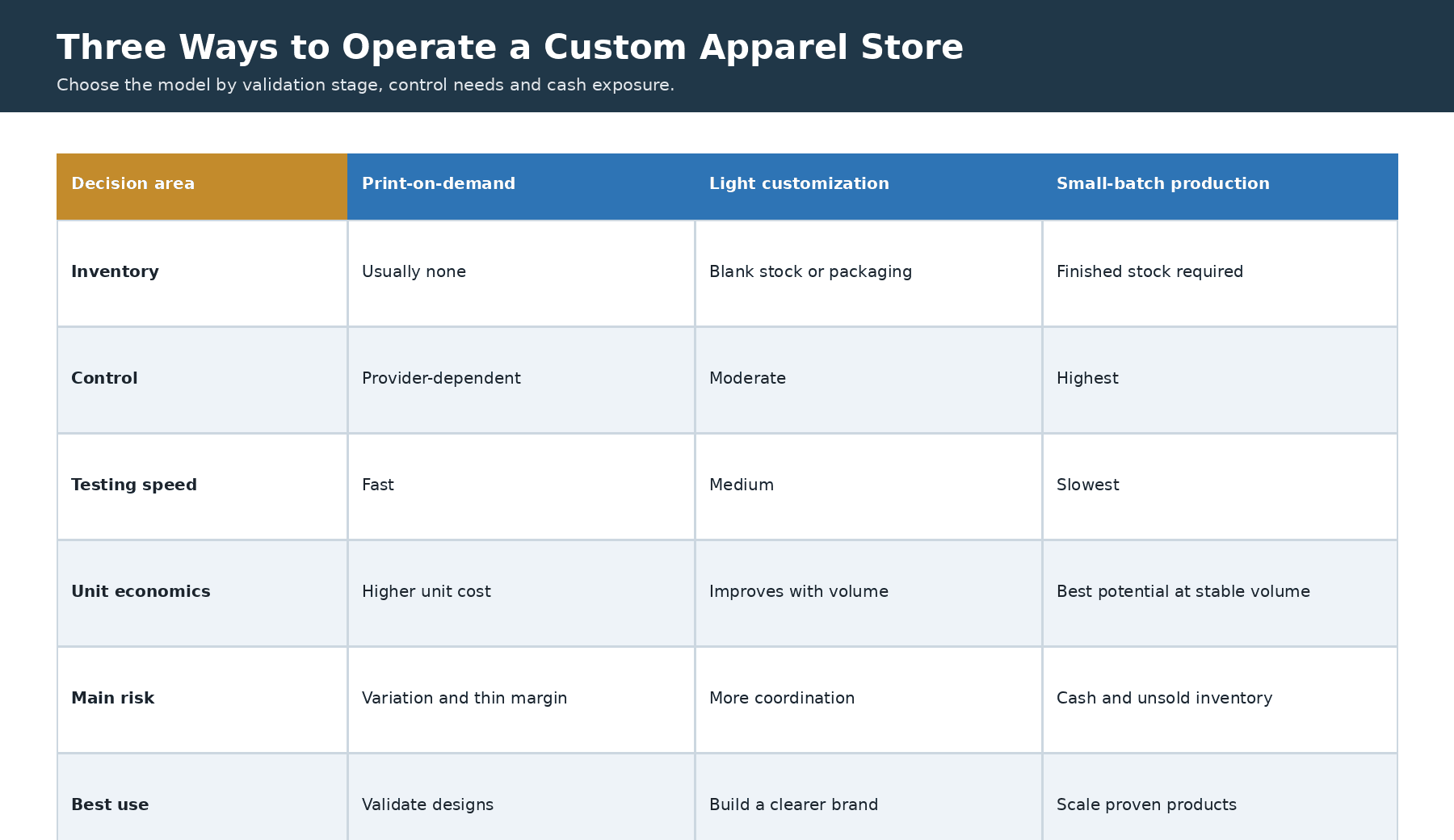
Operating-model comparison for custom apparel dropshipping
Print-on-demand for design validation
Print-on-demand is useful when the main uncertainty is whether a design and audience match. Finished inventory is usually unnecessary, and a seller can test multiple ideas without funding a production run. The trade-off is a relatively high unit cost and dependence on the provider’s blank garments, print methods, locations and quality controls. Provider or routing changes can also make consistency harder to manage.
Use this stage to learn which message, garment and content angle earn completed orders. Do not treat a fast mockup as sample approval. Order the exact garment and decoration configuration, because fabric weight, cut, ink coverage and color are difficult to judge from a digital preview.
Light customization for a clearer brand
Once one or two designs show repeat demand, the store may keep blank stock, use more controlled decoration, add neck labels, size stickers or branded packaging, and coordinate production in smaller runs. This creates more setup work but can improve consistency and the unboxing experience without requiring a large finished-goods commitment.
The shift should solve a measured problem. If customer feedback shows that generic packaging weakens gifting, branded inserts or mailers may help. If customers complain about garment feel, changing the blank matters more than adding a decorative box. The private label packaging guide is most relevant after the product specification is stable and packaging has a defined operational purpose.
Small-batch production for proven demand
Small-batch manufacturing gives more control over fabric, construction, labels, measurements, decoration and packaging. It can improve unit economics at repeat volume, but it introduces minimum quantities, production lead time, inspection needs and inventory risk. A popular graphic does not prove that every size and color will sell at the same rate.
Commit only after demand can be forecast at variant level. A batch should be based on paid order history, size distribution, return reasons and a realistic replenishment window. A cautious first run is often worth a slightly higher unit cost because it buys better information and reduces markdown risk.
A Narrow Audience Is More Valuable Than a Large Catalog
The strongest apparel offers usually give a specific person a reason to identify with the design. That could be a hobby community, local culture, profession, creator audience, event, shared joke or distinctive aesthetic. “Clothes for everyone” gives the product no useful creative direction and pushes the store toward the most competitive generic terms.
Start with one hero garment and a coherent message. A heavyweight T-shirt, relaxed hoodie, embroidered cap or performance top can each work, but the store should understand why that format fits the audience. The hero product concentrates sampling, reviews, content and purchasing data. Complementary items can follow once customers show what they want next.
Avoid building the opening catalog by copying every design onto every blank. Too many combinations dilute sales signals and create inconsistent product pages. A small, deliberately edited range also makes it easier to photograph real samples rather than relying on repetitive mockups.
Select Products by Use Case, Not a Ranking
Heavyweight T-shirts and hoodies
Substantial tees and hoodies can support a premium position when fabric weight, hand feel, fit and decoration are visible in the content. They are not automatically premium. Check shrinkage, pilling, seam stability, rib recovery, hood construction and print behavior after washing. Heavy garments may also increase chargeable shipping weight, especially in multi-item orders.
These products suit design-led communities and creator merchandise because the surface area supports graphics and the garment itself can become part of the value proposition. Publish the actual fabric composition and garment measurements rather than relying on words such as luxury or oversized without evidence.
Embroidery and community merchandise
Embroidery can look durable and distinctive on caps, sweatshirts, workwear-inspired pieces and uniforms. The digitized artwork, stitch density, backing, thread color and placement affect the result. Fine lettering that looks sharp on screen may close up or distort in production. Approve a stitched sample, not only the embroidery file.
Community merchandise has an additional intellectual-property risk. A seller should have the right to use names, logos, characters and artwork. A supplier’s willingness to produce an image does not grant permission to sell it.
Performance and activewear
Performance garments can support a strong niche, but customers are more sensitive to opacity, stretch recovery, moisture behavior, seam comfort and size. Compression or shaping claims can also create unrealistic expectations. The existing activewear dropshipping profitability analysis is a useful downstream reference when the proposed collection depends on leggings, sports bras or technical fabrics rather than ordinary printed garments.
Test movement, not just appearance. Squat, stretch, wash and dry the approved sample according to the care instructions. Record whether seams twist, color transfers, waistbands roll or printed areas crack. These observations should inform both the listing and the decision to reject a product.
Sampling Is the First Profitability Test
A sample is not merely a content prop. It is evidence about whether the promised product can be delivered. Order the exact color, size, blank, decoration method and packaging intended for customers. If several fulfillment locations may be used, sample the important route or provider combinations because results can differ.
Create an approval sheet with garment code, supplier, fabric composition, weight, color, measurements, decoration dimensions, placement, label details, packaging and date. Photograph the measurement points and keep an approved reference. Any substitution should trigger review rather than silently becoming the new standard.
Wash testing is essential. Follow the care label, then check dimensional change, twisting, pilling, color loss, cracking, peeling and embroidery distortion. One cycle may reveal an obvious failure; several cycles give a better picture of customer use. Also examine the package on arrival, since a good garment can still disappoint when it is creased, damp, stained or mislabeled.
Fit and Returns Must Be Designed Into the Offer
Apparel returns are often expectation failures rather than manufacturing defects. A customer chooses a familiar size label, but the garment follows a different measurement system or silhouette. Calling an item oversized, slim or unisex without measurements does not solve the problem.
Publish garment measurements and explain how they were taken. Distinguish body measurements from finished-garment measurements, show the model’s size and relevant dimensions, and note stretch where it matters. If production tolerance exists, disclose it carefully. A fit note should help the customer choose; it should not shift all responsibility to them.
Analyze returns by reason, SKU, size and destination. “Too small” may signal an inaccurate chart, a narrow cut, shrinkage or a misleading model image. “Not as expected” may point to color, fabric or print scale. Fixing the underlying page or specification improves both margin and customer trust.
Custom-made or personalized products may have different return rules in some markets, but a seller should not assume that customization removes all consumer obligations. Defective, incorrect or misdescribed goods still require a remedy. Check the current rules for the target market and write a policy customers can understand before checkout.
Content Should Demonstrate the Garment, Not Hide It
Short-form video can accelerate apparel discovery, but virality is not a business model. A high-view post may attract the wrong audience or produce sales that disappear when paid amplification, returns and fulfillment are included. Content should reveal the product clearly enough that engagement can turn into satisfied orders.
Show fabric movement, texture, print detail, front and back views, fit on more than one body where possible, and the package as delivered. Compare styling situations or explain the design story. Avoid edits that materially change color or conceal construction. Real samples usually provide more useful creative variation than an unlimited set of mockups.
Each channel may require a different opening, pace and format, but the product promise should remain consistent. A cross-platform dropshipping brand strategy helps connect short-form discovery, product-page proof and post-purchase communication without forcing identical content everywhere.
Control Production Before Increasing Ad Spend
A custom apparel supplier should be evaluated at the SKU and process level. Ask which blank or fabric is used, who performs decoration, what file requirements apply, how colors are managed, whether substitutions can occur, which locations may fulfill the order and what remedy applies to a verified production error.
Define visual acceptance criteria. Include placement tolerance, maximum skew, print or embroidery dimensions, thread or ink reference, label position, stain limits, stitching expectations and correct variant packaging. Some variation is inherent in textile production, but an undefined standard leaves every complaint open to argument.
When the product needs live-model fit, fabric detail and consistent campaign assets, a managed product photography service can become a natural commercial step after samples are approved. Photography cannot rescue a weak garment; its job is to represent the approved item accurately and give customers better evidence before purchase.
Fulfillment Decisions Affect Both Margin and Trust
Print-on-demand may route different products or variants to different providers. That can produce split shipments, inconsistent packaging and separate tracking. If a cart contains multiple items, model the real fulfillment pattern rather than assuming one parcel and one charge.
For stocked or small-batch products, storage, pick-and-pack accuracy and inventory synchronization become part of the model. Size and color variants multiply quickly. A simple shirt in five sizes and four colors creates twenty stock positions before designs are counted. Limit variants until demand data justifies the operational complexity.
Test complete orders to priority destinations. Measure production time, tracking activation, transit, packaging condition and communication. A quoted carrier transit time does not include artwork approval, printing, quality checks or handoff delays. Promise the end-to-end experience that the system can repeatedly achieve.
Scale Only What Has Survived Real Orders
A design deserves more spend when completed deliveries retain contribution, customers understand the fit, quality complaints are controlled and production can repeat the approved result. Click-through rate alone is not enough. Track contribution by design and variant, return reason, remake rate, delivery performance, support contacts and repeat purchase behavior.
Move from POD to light customization or small-batch production only when the change has a measurable purpose: lower landed cost, better garment quality, faster processing, consistent decoration or a stronger branded experience. Calculate the break-even volume and include inventory carrying cost, inspection and markdown exposure.
Expansion should follow adjacent demand. If hoodie customers repeatedly request a matching cap, that signal is more useful than a generic trend list. New products should share the same audience and brand logic while introducing only a manageable amount of new sourcing and fit risk.
Price the Offer Without Training Customers to Wait for Discounts
Custom apparel needs enough price room to absorb creative testing and the occasional remake, but the price still has to make sense beside the product evidence. A higher price is easier to defend when the garment weight, construction, decoration, fit and design relevance are visible. Simply adding the word premium to a standard blank does not create that value.
Test the offer before relying on permanent discounts. Free shipping, a bundle, a limited edition, a gift-ready package and a percentage discount affect contribution differently. Calculate each promotion as a separate order model. A two-item bundle can improve acquisition efficiency, yet it may increase production complexity, split-shipment risk or chargeable weight. The profitable option is the one that retains contribution after its real fulfillment pattern is included.
Use price tests carefully enough that product changes do not contaminate the result. If the creative, garment and audience all change at the same time, the store cannot tell whether price caused the difference. Run controlled comparisons and measure completed-order contribution, not only conversion rate. A lower price can improve checkout conversion while producing less cash to fund support, replacements and the next production cycle.
Manage Colors, Sizes and Designs as Inventory Decisions
Every additional color, size and design increases choice, but it also divides demand. Under print-on-demand, the cost may appear mainly as catalog and quality-control complexity. Under stocked production, the same choice becomes working capital and potential dead inventory. A large-looking collection can therefore be less useful than a smaller range with reliable availability and better product evidence.
Use early order data to identify the variants that deserve permanence. Track views, purchases, cancellations, returns and stockouts separately. A size that sells slowly may still be important to the audience, while a color that attracts clicks but produces few completed orders may not deserve inventory. Decisions should combine commercial performance with the inclusive fit promise the brand intends to make.
When a new design is added, decide whether it strengthens the same customer identity or starts a different store inside the catalog. Too many unrelated slogans make repeat purchase and organic topical relevance harder to build. Collections work best when product names, imagery and copy make the relationship clear without repeating the same keyword on every page.
Protect Artwork and Customer Personalization Data
Original artwork, licensed collaborations and customer-supplied personalization require different controls. Keep records showing who created the design and what rights were granted. For a collaboration, define products, territories, sales channels, duration and approval rights. Do not assume that an image found online is available for commercial printing, and do not rely on a factory to decide whether a design infringes another party’s rights.
Personalized names, photographs or messages also create order-data risk. The production instruction must remain connected to the correct order, variant and preview. Limit access to the information needed for production, set a retention policy, and prevent personal data from appearing on an external package label or shared production sheet unnecessarily. A spelling error caused by the customer and an error introduced during production may require different remedies, so the approval flow should be explicit.
For personalized products, provide a clear preview or confirmation when the workflow permits it. State character limits, accepted file quality, placement rules and production cutoff. Once production begins, cancellation may be difficult, but the policy still needs to comply with the destination’s consumer rules and address defective or incorrect goods fairly.
Use Support Data to Improve the Product
Customer-service messages are a source of product research. Group questions and complaints into fit, material, color, decoration, personalization, delivery and care. A repeated pre-sale question indicates missing page information; a repeated post-delivery complaint may indicate a specification or production problem. Both should trigger a concrete owner and corrective action.
Reviews should be read for patterns rather than selected only for advertising. If customers consistently praise softness but complain about length, the next content and sourcing decisions are obvious. If the supplier’s remedy rate rises after a production change, stop scaling until the approved standard is restored. Keeping dated sample and inspection records makes that conversation evidence-based.
Support data also reveals whether the store has earned the right to expand. Requests for another color, youth sizing or a coordinating accessory are useful only when they come from the intended audience and the original product is performing reliably. Expansion should solve an observed customer need, not hide weak retention behind more launches.
A Practical Ninety-Day Launch
During the discovery phase, define one audience, review intellectual-property rights, select a hero garment and compare operating models. Obtain detailed specifications and landed-cost estimates before building a large storefront. Reject ideas that require an unrealistic selling price or cannot be described without exaggerated claims.
During the validation phase, order exact samples, run wash and fit checks, approve the specification and create original content. Publish a focused offer with accurate measurements and delivery expectations. Use a controlled budget and write stop conditions in advance, including unacceptable remake, refund or acquisition costs.
During the improvement phase, study completed orders rather than early excitement. Correct the size guide, creative, packaging or production standard where evidence points. Expand spend or commit to inventory only when the product remains profitable after exceptions and the supplier can repeat the approved result.
Warning Signs That the Model Is Not Ready
Pause when the supplier cannot identify the exact blank or fabric, refuses an exact sample, changes fulfillment locations without notice, or offers only edited mockups. The same applies when decoration quality varies widely, measurement charts conflict, or remediation for defects is undefined.
The economics are also a stop signal. If profit depends on excluding advertising, returns or split shipping, the product is not yet viable. If the required selling price cannot be supported by garment quality, audience relevance and proof, a dramatic discount will not create a durable brand.
Finally, do not scale a design whose sales depend on unlicensed artwork, confusing scarcity or a misleading fit presentation. The short-term revenue is not worth the platform, legal and trust exposure.
Final Recommendation
Custom apparel dropshipping is most attractive when it is treated as a staged operating system. Use print-on-demand to validate an audience and design, strengthen samples and product pages before increasing traffic, and adopt light customization or small-batch production only after repeat demand justifies more control.
Profit comes from the relationship between product, promise and delivery. A narrow audience, approved garment, accurate fit guidance, disciplined contribution model and repeatable fulfillment process matter more than a viral sales screenshot. Build those elements around one hero product, then let real order data determine the next step.
Frequently Asked Questions
Is custom apparel dropshipping profitable in 2026?
It can be profitable when the selling price covers the full landed order, acquisition, fees, returns and remakes. Profitability must be calculated for the exact product, destination and operating model.
What is the best margin for custom apparel?
There is no universal target. Use contribution after all variable costs, then test whether it remains positive under conservative acquisition, shipping and return assumptions.
Should a beginner use print-on-demand or buy inventory?
Print-on-demand usually reduces initial inventory risk and is useful for validating designs. Inventory can improve control and unit economics only after demand and variant distribution become predictable.
Which custom garment should I launch first?
Choose one hero garment that fits a defined audience and can be sampled thoroughly. A smaller range produces clearer data and more consistent content.
How can I reduce apparel returns?
Publish accurate garment measurements, explain fit, show real samples, include model details and analyze return reasons by SKU and size. Then fix the page or product specification causing the mismatch.
Are supplier mockups enough to start advertising?
No. Mockups cannot confirm fabric, construction, color, print quality, fit or packaging. Approve and photograph the exact sample customers will receive.
When should I add custom labels and packaging?
Add them when the product is stable and they support a defined brand or customer-experience goal. Do not let packaging consume cash that should first improve the garment.
When should I move to small-batch production?
Move after repeat orders show stable design, size and color demand, and when better control or unit economics outweigh inventory, lead-time and markdown risk.