Wellness Accessories Dropshipping in 2026: Product Selection, Claims and Profitability
Wellness can be a useful ecommerce direction, but it is not one simple product category. A yoga strap, posture cushion, heated eye mask, massage device and dietary supplement may appear beside one another in a marketplace while carrying very different safety, documentation, shipping and advertising risks. Treating them as interchangeable “high-margin health products” is a fast way to create returns, payment disputes or compliance problems.
For most new dropshipping stores, the practical entry point is a non-ingestible accessory with a clear everyday use, modest shipping weight and benefits that can be demonstrated without promising to diagnose, prevent or treat a condition. Profitability then depends on the exact SKU, landed cost, customer expectation and return rate—not a category-wide percentage.
This guide focuses on lower-risk wellness accessories and a process for deciding whether an item deserves a test. It is not medical or legal advice. Requirements vary by product and destination, so sellers should verify current rules and obtain specialist help where the intended use or claim could make an item regulated.
Start With Product Risk, Not a Trend List
A trending keyword can show attention, but it does not reveal whether the product is safe, whether its advertising can be supported or whether the seller can deliver the exact version shown. Before estimating demand, define what the item physically does, who will use it, how it contacts the body and what could happen if it fails.
The most manageable candidates usually have a simple mechanical function, no ingestible ingredients, no invasive contact, no essential medical purpose and no need for dramatic outcome claims. Complexity rises when a product uses batteries, heat, strong compression, adhesives, skin-contact materials, measurements or instructions that customers may interpret medically.
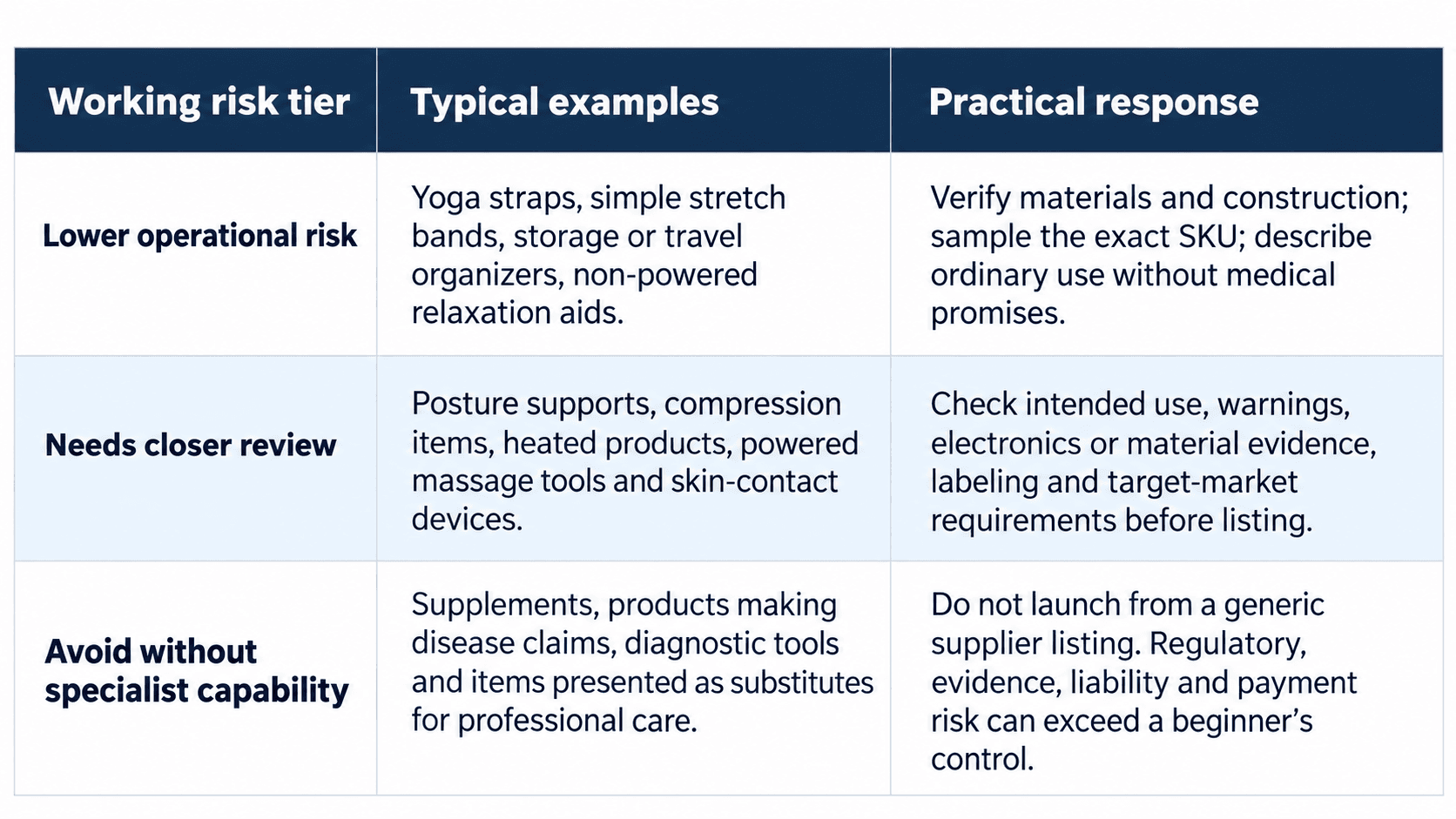
This is a screening framework, not a legal classification. In the United States, the FDA explains that intended use and indications for use help determine whether a product meets the definition of a medical device. In the EU, the General Product Safety Regulation creates safety and supply-chain obligations for covered consumer products sold online as well as offline. The wording of the listing cannot be separated from the product decision.
Choose a Narrow Customer Situation
“People interested in health” is too broad to support a useful store. A clearer opportunity begins with a repeatable situation: commuters carrying compact recovery accessories, home-workout customers needing simple mobility tools, desk workers organizing comfort products, or travelers building a sleep routine. The situation guides the product range, content and bundle without forcing medical claims.
Narrow positioning also prevents the page from competing for oversized keywords such as health products or beauty products. A store can build pages around terms like compact mobility accessories for home workouts, travel sleep accessories or desk comfort products. These phrases describe shopper intent more precisely and give the seller a realistic path to useful organic content.
Keep the catalog coherent. A store that mixes supplements, electronics, orthopedic-looking supports and generic beauty tools creates more compliance work while giving customers little reason to trust its expertise. Begin with one use case and a small set of compatible products, then expand only when customer questions and order data reveal the next logical need.
Product Families Worth Evaluating
Mobility and light fitness accessories
Resistance bands, yoga straps, sliders, jump ropes, grip trainers and compact balance accessories can communicate their purpose visually. They are not equally easy to ship or control. Bands require consistent resistance and durable attachment points; ropes need reliable bearings and length adjustment; balance products need material and load considerations. Sellers entering this area can use the fitness equipment supplier evaluation guide to separate lightweight textile products from powered or heavy equipment before comparing suppliers.
Avoid unsupported claims that a simple accessory will cure pain, correct a medical condition or produce guaranteed body changes. Demonstrate dimensions, setup, resistance options and ordinary movements instead. Clear use instructions and limitations build more durable trust than an exaggerated transformation promise.
Relaxation and routine accessories
Eye masks, simple acupressure-style mats, non-medicated hot or cold packs, breathing reminder tools and quiet travel accessories can fit a relaxation routine. The safest content describes comfort, routine and product features. Claims about anxiety, insomnia or treatment outcomes require a different level of evidence and review.
Sampling should reproduce the customer experience: smell the material after opening, check skin-contact seams, examine closures, measure heat retention where relevant and follow the cleaning instructions. A product that looks attractive in supplier images may still create complaints because it feels rough, leaks, is difficult to wash or arrives with a strong odor.
Desk and everyday comfort products
Footrests, seat cushions, wrist supports and simple posture reminders can serve desk workers, gamers and students. These products often create expectation risk. One cushion will not fit every body or chair, and a “posture correction” promise may imply more than the product can deliver. Publish exact dimensions, firmness, materials, cover care and compatibility instead of universal results.
Bulky foam products may also appear cheap until volumetric weight is included. Ask for final packed dimensions rather than the uncompressed product dimensions. Vacuum packing can reduce shipping cost, but the sample must show that the item recovers its intended shape and does not arrive damaged.
Personal-care tools with limited claims
Non-invasive grooming and self-care accessories may fit a wellness-adjacent store when their ordinary cosmetic use is clear. Risk increases with electrical functions, skin penetration, intense heat, light-based treatment or promises to alter a disease or body function. Do not infer export readiness from a marketplace label or certificate thumbnail.
If a product sits near the boundary between a lifestyle accessory, cosmetic tool and medical device, pause the launch until its intended use, documentation and target-market requirements are clear. Choosing a simpler alternative is often a better commercial decision than trying to explain away ambiguity after advertising starts.
Write Claims the Product Can Actually Support
The product page, ad, packaging, influencer script and customer testimonial all contribute to the marketing message. The U.S. Federal Trade Commission’s health-products guidance states that objective health claims should be truthful, not misleading and supported by competent and reliable scientific evidence. A testimonial does not become proof simply because a customer said it.
Translate this into an editorial rule: describe observable features and ordinary use before outcomes. “Three resistance levels with labeled bands” is verifiable. “Fixes back pain in seven days” is a treatment claim and a guaranteed outcome. “Soft blackout eye mask with adjustable strap” describes the product; “cures insomnia” does not.
Create a claims sheet for every SKU. Record each phrase used in ads or listings, the evidence supporting it, any required qualifier and the countries where it will appear. The global ecommerce tax and compliance guide provides a broader framework for treating product documents, labels and market responsibilities as part of selection rather than a repair after ads scale.
Validate the Exact Product, Not the Supplier Photo
Order the exact color, size, material, plug type and accessory configuration that customers will receive. Keep a written specification and compare the sample against it. For textiles and supports, inspect stitching, elasticity, fasteners, odor, color transfer, measurements and care instructions. For powered products, confirm battery details, charger or cable, heat behavior, controls, noise, markings and transport documents.
Use the product as the customer would, but do not improvise medical tests. Record setup time, confusing instructions, fit limits, packaging condition and realistic demonstrations. Ask a second person who has not seen the listing to unpack the sample; their mistakes often reveal instructions or expectations that the seller has overlooked.
A sample approval must be traceable to the future production version. Photograph key measurements and components, assign a version date and require supplier approval before substitutions. A lower-priced motor, fabric or adhesive can change the customer experience even if the product silhouette remains the same.
Calculate Profitability at SKU Level
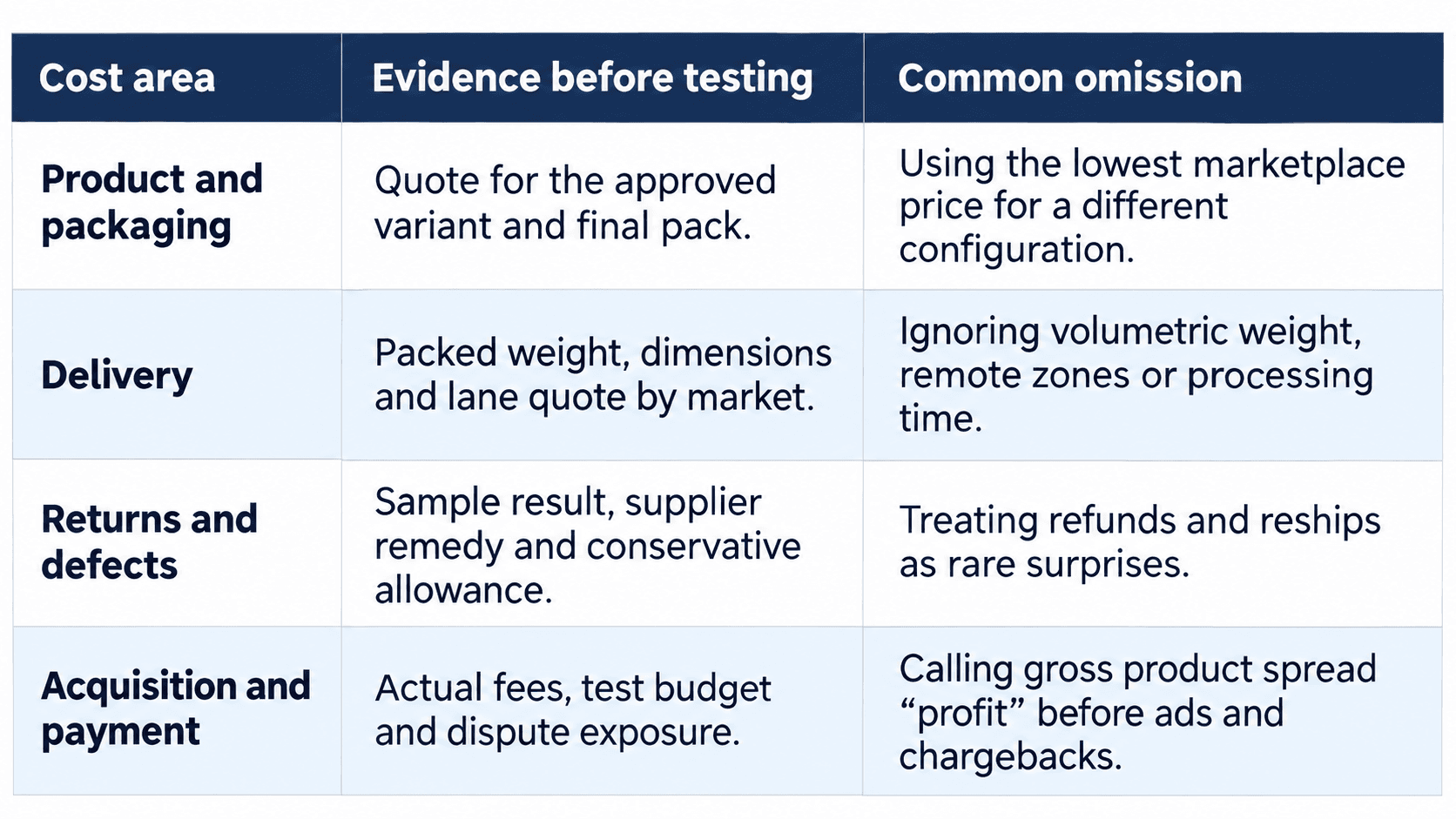
No responsible analysis can promise one gross-margin range for all wellness products. A light strap and a powered massage tool have different shipping, defect and return exposure. Calculate contribution for the exact destination and offer: selling price minus product, packaging, processing, chargeable shipping, duties or taxes borne by the seller, payment and platform fees, advertising, expected refunds, reshipments and customer support.
Run a normal case and a conservative case. The conservative model should include a higher return rate, more expensive shipping zone and a realistic replacement allowance. If the offer becomes unprofitable when only one assumption worsens, it is fragile. This is why the end of low-cost product dropshipping matters: a cheap unit price cannot compensate for weak differentiation, unclear claims and expensive exceptions.
Build an Honest Product Page
A wellness listing should reduce ambiguity. Include dimensions, materials, package contents, who the product is designed for, ordinary use, cleaning or storage, warnings, warranty or return conditions and a realistic delivery promise. Show the scale of the item in use and disclose variations that matter. Do not hide a plug adapter, battery limitation or fit restriction below promotional copy.
Product photography should demonstrate only what the approved sample can do. If hands, body placement or movement appear in the image, make the setup accurate. Before scaling content, a managed dropshipping fulfillment workflow can be relevant when the store needs the approved SKU, packaging, quality checks and tracking kept together; the service relationship does not replace the seller’s responsibility for claims or target-market compliance.
Control Suppliers and Repeat Orders
Request the supplier’s legal identity, role, product specification, production or dispatch lead time, quality process and available documents for the exact model. Compare at least two credible sources when possible. A long marketplace history can support investigation, but it does not prove that the current product version matches the sample or the documents.
Write acceptance criteria around likely customer complaints. For a band set, check quantity, resistance identification, length, seams and included accessories. For an eye mask, check fabric, light blocking, closure, odor and stitching. For an electronic massager, add functional, charging, battery, noise and packaging checks appropriate to the product and destination.
When orders become stable, decide whether small buffer inventory improves consistency. Inventory can lock the approved batch and shorten processing, but it creates cash and obsolescence risk. Move gradually: confirm demand, approve the specification, test a pilot batch, measure completed deliveries and then increase commitment.
Fulfillment Can Change the Product Decision
Estimate shipping before choosing the offer. Dense or bulky products, magnets, liquids, batteries and heat components may restrict routes or increase cost. A bundle can raise perceived value while also crossing a chargeable-weight threshold. Use final retail packaging in the quote rather than an optimistic sample envelope.
Test one complete order to each priority market. Measure processing, tracking activation, transit, package condition and customer-facing communication. A seller should not advertise a five-day experience based only on carrier transit if sourcing and processing require several additional days.
Returns require a written policy. Low-value international returns may be uneconomic, but automatic refunds without evidence can invite abuse. Decide when to refund, replace, request photos, accept a local return or ask the supplier for a remedy. Feed the actual cost back into SKU profitability.
A Practical Launch Sequence
Begin with a narrow customer situation and remove products that depend on medical or guaranteed-outcome claims. Shortlist a few operationally simple accessories, obtain specifications and route estimates, then order exact samples. Build the listing from the sample rather than from supplier copy.
Launch a controlled offer with a fixed budget and clear stop conditions. Watch not only clicks and purchases but also pre-sale questions, delivery, complaints, refunds and repeat interest. A product with a lower click-through rate may still be the better business if customers understand it and completed orders retain more contribution.
Expand only after the product, promise and fulfillment work together. Add a complementary SKU because customer behavior supports it, not because a supplier catalog labels it “hot.” Sustainable wellness dropshipping is less about chasing a broad health trend and more about controlling a specific product that customers can understand and use safely.
Products to Decline
Decline a product when the supplier cannot identify the responsible manufacturer, the sample differs materially from the listing, essential documents cannot be tied to the exact model, or the sales angle requires an unsupported health outcome. Copied branding, concealed ingredients, missing warnings and unclear battery information are additional stop signals.
Also decline offers whose economics depend on an unrealistic selling price or zero returns. Popularity does not repair a fragile product. Removing one risky SKU before launch is cheaper than rebuilding store trust after complaints, chargebacks or platform action.
Final Recommendation
Keep the opportunity narrow: non-ingestible wellness accessories with a clear ordinary use, controllable quality and honest demonstrations. Evaluate products by risk first, then by demand and unit economics. Treat claims, documentation, packaging and delivery as parts of the same offer.
The strongest candidate is not the product with the largest advertised margin. It is the SKU whose approved specification can be repeated, whose customer promise can be supported and whose contribution remains positive after delivery and returns. That foundation gives the store room to build useful content and a recognizable niche without competing for the broadest health-product terms.
Frequently Asked Questions
Are wellness accessories suitable for beginner dropshippers?
Some simple, non-ingestible accessories can be manageable, but beginners should still verify materials, intended use, claims, shipping and target-market requirements before listing.
Should I dropship supplements?
Supplements create ingredient, labeling, claims, manufacturing and market-entry obligations. They are generally unsuitable for a beginner relying on an unverified marketplace listing.
Can I advertise a product as relieving pain?
Health-related outcome claims may require strong evidence and can affect regulatory treatment. Use specialist review rather than copying supplier or customer language.
What is a safer wellness product angle?
Focus on an ordinary routine or use case, such as compact mobility, travel comfort or home-workout organization, and describe observable product features accurately.
How many products should a wellness store test?
A small coherent set is easier to sample, document and explain than a large mixed catalog. Test only as many SKUs as the team can control properly.
How should I calculate profit?
Use destination-specific contribution after product, packaging, processing, shipping, duties or taxes, platform and payment fees, advertising, refunds, reships and support.
Do supplier certificates prove that a product is compliant?
Not by themselves. Documents must be authentic, current, relevant to the exact model and manufacturer, and appropriate for the product and target market.
When should I hold inventory?
Consider a small buffer only after demand is repeatable, the approved specification is stable and faster processing or batch consistency justifies the cash commitment.