
Dropshipping sourcing is not finished when an agent finds a lower unit price. A workable product needs a stable specification, approved sample, realistic landed contribution, repeatable quality checks, stock visibility, and a shipping route that fits the destination. This guide was reviewed on July 18, 2026 using current Shopify, Amazon, Alibaba.com, and product-safety resources.
Források és további olvasnivaló
- Shopify — Product Sourcing Guide (2026)
- Shopify — Dropshipping Fulfillment Guide (2026)
- Shopify — Branded Dropshipping Guide (2026)
- Amazon — Reselling guidelines and sourcing controls
- U.S. CPSC — Recalls
A szabályok és előrejelzések változhatnak. Döntés előtt mindig ellenőrizze a dátumokat és a hivatalos oldalakon a részleteket.
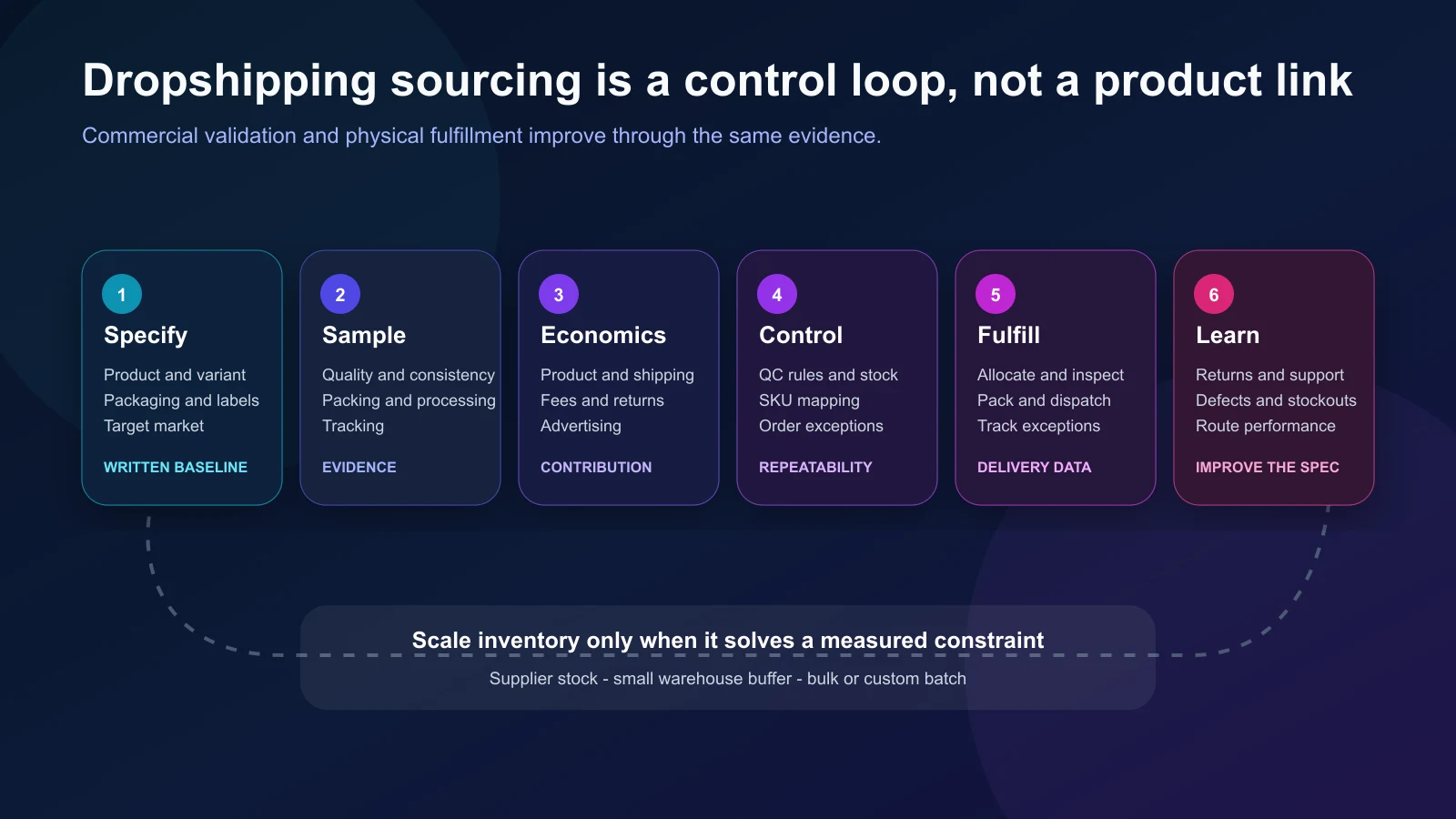
The controlled dropshipping sourcing workflow
- Define the offer. Record audience, problem, claims, target price, destinations, and expected order pattern.
- Create the specification. Define model, dimensions, materials, variants, accessories, packaging, and labels.
- Shortlist suppliers. Compare manufacturing role, stock, MOQ, quote basis, lead time, and substitutions.
- Order samples. Test the exact item and packaging; record differences against the written specification.
- Calculate landed contribution. Include product, packing, handling, freight, tax or duty where applicable, fees, returns, reships, and ads.
- Approve QC rules. Define visible defects, function checks, quantity, packaging, barcode, and evidence.
- Choose inventory mode. Use supplier stock, a small warehouse buffer, or a custom production batch according to validated demand.
- Connect orders and exceptions. Map SKUs, addresses, inventory, tracking, stockouts, cancellations, and claims.
Sample the product and the fulfillment experience
Shopify recommends sample orders to evaluate communication, quality control, processing, packaging, delivery information, and consistency. Its 2026 sourcing guide specifically suggests testing multiple sample orders under different names when vetting consistency.
| Test | What to record |
|---|---|
| Product | Dimensions, material, finish, function, accessories, instructions |
| Packaging | Protection, odor, labels, barcode, presentation, unnecessary factory material |
| Processing | Order acknowledgement, stock confirmation, dispatch time |
| Tracking | First scan, usable events, destination carrier, exception visibility |
| Consistency | Differences between samples, variants, or repeated orders |
Calculate landed contribution before scaling
Contribution per order = selling price − product − packaging − handling − international shipping − taxes or duties where applicable − payment/platform fees − expected refunds and reships − variable advertising cost.
- Use packed dimensions and chargeable weight, not the bare product weight.
- Calculate destination-specific rates for the countries you plan to advertise in.
- Model normal and conservative refund, reship, and acquisition-cost cases.
- Reject offers that work only when customer-service and exception costs are ignored.
Choose the right inventory stage
| Stage | Best use | Main trade-off |
|---|---|---|
| Supplier stock / no buffer | Early test with minimal commitment | Slower handling and weaker stock control |
| Small warehouse buffer | Validated SKU needing faster dispatch | Cash tied in limited inventory |
| Bulk or custom batch | Stable demand, branding, or specification control | Forecast, MOQ, and obsolescence risk |
Practical rule
Inventory should solve a measured constraint—dispatch speed, stockouts, QC, or customization. It should not be purchased only because the unit price is lower.
Define order and exception controls
- Use one SKU definition across store, supplier, warehouse, and packaging.
- Confirm stock before accepting delivery promises.
- Generate tracking only for an allocated and packed order.
- Define evidence required for wrong item, damage, loss, delay, and address problems.
- Review returns and support messages for specification or packaging defects.
- Keep an approved replacement supplier for proven products where practical.
Gyakran ismételt kérdések
- Can I source a dropshipping product from a marketplace link?
Yes, as a starting reference. The link must be converted into a written specification because listings can change suppliers, materials, accessories, and packaging.
- Do I need inventory for dropshipping sourcing?
Not necessarily for an early test. A small buffer can become useful after validation when stock visibility, dispatch speed, packaging, or consistent QC matters.
- How many samples should I order?
Order enough to test the exact variants, suppliers, and fulfillment consistency that matter to the offer. One perfect sample does not prove repeatability.
- What is the biggest sourcing mistake in dropshipping?
Treating a supplier listing and low unit price as proof while ignoring specifications, packed shipping cost, quality variation, stockouts, compliance, and returns.

Szerző
Simon
Simon is a content strategist at ETdropship with extensive professional experience. He has been working in the industry for 13 years and possesses deep knowledge of the eCommerce sector and logistics systems. Passionate about his work, he creates practical and easy-to-understand content that helps sellers successfully run and grow their dropshipping businesses.
Kapcsolat
Kérdése van?
Hagyja meg nevét, WhatsApp-számát és üzenetét. Hamarosan jelentkezünk.
Source the product and the fulfillment system together
Send ETdropship your product link, target market, selling price, and order expectations. We can compare specifications, samples, QC, packaging, and shipping options.
