Amazon FBA vs Shopify Dropshipping in 2026: Which Model Is Better for New Sellers?
Amazon FBA and Shopify dropshipping can both be used to build an ecommerce business, but they operate very differently.
Amazon FBA is primarily an inventory-based marketplace model. Sellers purchase products, send inventory to Amazon fulfillment centers, and rely on Amazon to store, pick, pack, and ship orders. Shopify dropshipping gives sellers their own storefront while allowing products to be fulfilled by suppliers or fulfillment partners after customers place orders.
The difference affects much more than shipping. It changes how much money you need before launching, where customers come from, who controls the customer relationship, how inventory risk is managed, and how easily products can be tested.
For new sellers in 2026, the better question is therefore not simply:
“Is Amazon or Shopify better?”
It is:
“Which model fits my capital, product stage, traffic strategy, and long-term business goals?”
Amazon FBA vs Shopify Dropshipping: The Core Difference
With Amazon FBA, sellers generally commit to inventory before customer demand is fully realized. Products are manufactured or purchased, prepared according to Amazon requirements, and shipped to Amazon fulfillment centers.
Once the inventory arrives, Amazon handles much of the fulfillment process.
Shopify dropshipping reverses much of this sequence.
The seller can create a storefront, list products, generate traffic, and receive customer orders without necessarily purchasing large quantities of inventory beforehand. A supplier or fulfillment partner can then process individual orders.
This creates a fundamental difference in risk.
Amazon FBA: Buy inventory → Send to Amazon → Generate sales.
Shopify dropshipping: Generate demand → Fulfill orders → Stock proven products later if needed.
Neither sequence is automatically better. They are suitable for different stages of an ecommerce business.
Quick Comparison: Amazon FBA vs Shopify Dropshipping
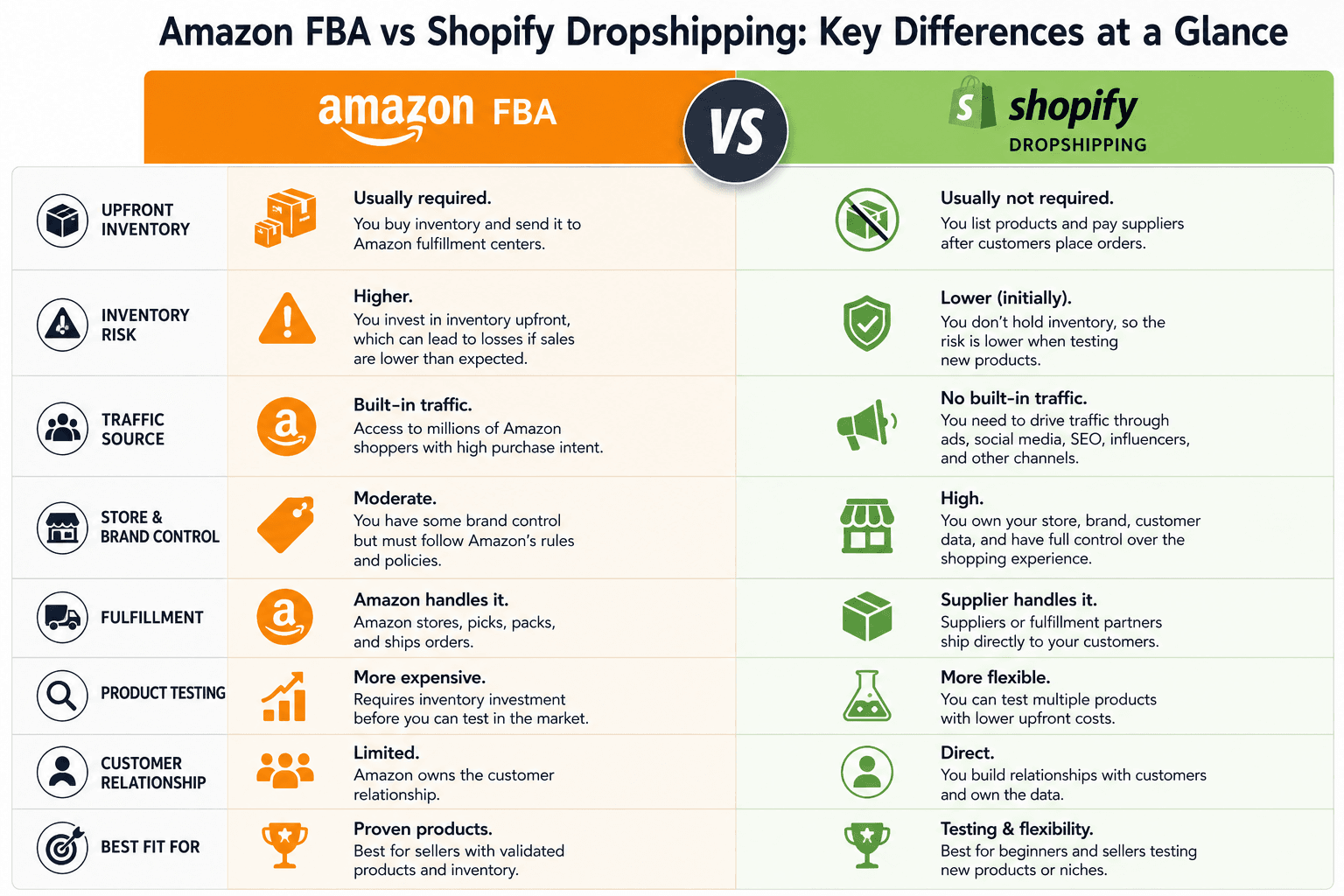
This comparison also explains why choosing between them is partly a platform-strategy decision, not simply a fulfillment decision. Sellers still deciding between independent stores and marketplace channels should evaluate traffic, operations, and supply-chain requirements when choosing a dropshipping platform, rather than selecting one only because it is popular.
Which Requires More Money to Start?
Amazon FBA generally requires more capital before meaningful sales begin.
The seller may need to pay for samples, inventory, production, freight, duties, product preparation, labeling, Amazon fees, advertising, and enough working capital to reorder inventory.
The biggest risk is not simply spending money.
It is spending money on inventory before knowing how quickly that inventory will sell.
If demand is weaker than expected, capital can remain tied up in stock. Storage costs, discounting, liquidation, or slow inventory turnover can then reduce profitability further.
Shopify dropshipping lowers this particular barrier because sellers can test products without buying hundreds of units first.
However, Shopify dropshipping is not free. Store software, domains, samples, content, advertising, payment fees, refunds, and customer service can still create significant costs.
The financial advantage is flexibility, not zero cost.
Where Do Customers Come From?
This is one of the biggest differences between the two models.
Amazon already has customers searching for products.
An FBA seller competes inside an established marketplace where buyers already have purchase intent. Product rankings, reviews, pricing, listing quality, Prime eligibility, and advertising can all affect visibility.
Shopify does not automatically provide an audience.
A Shopify seller must attract customers through channels such as TikTok, Instagram, Facebook, Google, influencers, SEO, email, Pinterest, or other marketing sources.
This gives Shopify more freedom but also more responsibility.
Amazon sellers compete for existing demand.
Shopify sellers often need to create or capture demand themselves.
For sellers who are good at creative content, paid advertising, brand storytelling, or community building, that independence can be valuable. For products with strong existing marketplace search demand, Amazon can offer a different advantage.
Which Model Is Better for Testing New Products?
Shopify dropshipping usually provides greater flexibility during the testing stage.
A seller can test several carefully selected products, change offers, adjust prices, experiment with content, and stop promoting products that fail to generate demand.
A failed test still costs money, especially if advertising is involved, but the seller does not necessarily end up holding hundreds of unsold units.
Amazon FBA becomes riskier when inventory is purchased before the product has been properly validated.
For example, ordering 500 units because a product appears popular does not prove that the listing will rank, advertising will convert, or customers will prefer that particular offer.
This is why Shopify dropshipping can work as a product-validation stage, even for sellers who may eventually use Amazon.
When Does Amazon FBA Become More Attractive?
The FBA model becomes more attractive when uncertainty decreases.
Suppose a product has already demonstrated consistent demand, manageable return rates, stable manufacturing, healthy margins, and predictable replenishment.
Buying inventory is now based on evidence rather than speculation.
The seller can potentially benefit from faster delivery, Amazon's marketplace traffic, Prime eligibility, and a fulfillment system designed to process large numbers of standardized orders.
The question therefore changes from:
“Should I risk buying this product?”
to:
“How much inventory should I hold for a product that is already selling?”
That is a much stronger position from which to use FBA.
Inventory Risk Is the Biggest Structural Difference
Inventory is not inherently bad.
The problem is uncertainty.
Amazon FBA sellers need to forecast how much inventory to purchase and when to replenish it. Buying too little can create stockouts. Buying too much can tie up working capital and increase storage pressure.
Shopify dropshipping reduces this risk during product testing because inventory can remain with the supplier or be purchased after orders are generated.
But that advantage can eventually become a limitation.
Once a product is producing predictable daily orders, relying entirely on order-by-order purchasing may create supplier stockouts, inconsistent processing times, or unstable packaging.
The strongest supply-chain structure can therefore change as the product matures.
Which Gives You More Brand Control?
Shopify generally provides more control over the complete customer experience.
Sellers control their domain, storefront design, landing pages, bundles, product presentation, email collection, promotions, content, and much of the post-purchase experience.
Amazon brands operate inside a marketplace environment.
A strong Amazon brand can still use professional listings, Brand Registry tools, A+ Content, Storefronts, packaging, reviews, and advertising. But the customer experience remains more standardized.
This difference becomes particularly important when the same business begins selling across multiple channels. A consistent brand does not mean presenting the product identically everywhere; a cross-platform brand strategy keeps the core identity stable while adapting listings, content, proof, and presentation to Shopify, Amazon, TikTok, eBay, or other channels.
That link is deliberately here—not in a random branding paragraph—because this is exactly the stage where the reader begins thinking beyond a single sales channel.
How Fulfillment Differs Between Amazon FBA and Shopify Dropshipping
Amazon FBA requires inventory to be prepared before it enters Amazon's network.
Products may need FNSKU labels, compliant packaging, poly bags, carton preparation, quality inspection, and shipment to the correct Amazon fulfillment destination.
For sellers sourcing from China, this preparation can take place before the inventory leaves the origin country.
Shopify dropshipping works differently. Individual customer orders can be processed after the sale and shipped directly to different customer addresses.
That difference means an Amazon seller needs a reliable inbound inventory workflow, while a Shopify dropshipper needs a reliable direct-to-customer order workflow.
If inventory is being sourced in China specifically for Amazon, services such as Amazon FBA preparation and forwarding become relevant because labeling, inspection, packaging, carton preparation, and inbound shipping have to happen before Amazon takes over fulfillment.
Notice the commercial link is not inserted in the introduction. It appears exactly when the reader has reached the operational problem the service solves.
Which Model Has Better Profit Margins?
Neither model automatically produces higher margins.
Amazon FBA sellers need to consider product cost, inbound freight, duties, preparation, marketplace fees, fulfillment charges, storage, advertising, returns, and inventory losses.
Shopify dropshippers need to consider sourcing, international shipping, payment processing, advertising, apps, refunds, customer service, and reshipments.
A lower visible fulfillment cost does not necessarily produce a higher net profit.
For example, Shopify may provide greater pricing freedom but require expensive customer acquisition.
Amazon may provide built-in purchase intent but charge marketplace and fulfillment fees.
The useful comparison is therefore not:
“Which platform charges less?”
It is:
“Which model leaves more contribution margin after all costs required to acquire and successfully fulfill an order?”
Amazon FBA Is Not Automatically Easier
Once inventory reaches Amazon, FBA removes much of the daily picking, packing, and delivery work.
But the business is not passive.
Sellers still need to manage listings, advertising, account health, inventory forecasting, replenishment, product reviews, competition, returns, and marketplace compliance.
Shopify creates a different workload.
The seller has more responsibility for traffic, conversion, customer communication, supplier coordination, and the overall customer journey.
The complexity has not disappeared.
It has moved to different parts of the business.
Shopify Dropshipping Is Not Automatically Lower Risk
Dropshipping reduces inventory risk.
It does not remove ecommerce risk.
A Shopify seller can still lose money through advertising, weak conversion rates, poor products, supplier problems, refunds, chargebacks, shipping delays, or inconsistent quality.
Amazon FBA concentrates more risk in inventory and marketplace execution.
Shopify dropshipping concentrates more risk in customer acquisition and supply-chain execution.
Understanding which risks you are better equipped to manage is more useful than assuming one model is simply safer.
Can You Test on Shopify and Later Move to Amazon FBA?
Yes, and this can be a logical progression for some products.
A seller might begin by testing a product through Shopify without making a large inventory commitment.
If demand becomes consistent, the seller can improve sourcing, negotiate better pricing, standardize product specifications, and introduce small-batch inventory.
Once demand becomes sufficiently predictable, inventory can be prepared for Amazon FBA.
The sequence becomes:
Test → Validate → Improve → Stock → Expand
This does not mean every successful Shopify product belongs on Amazon.
Some products depend heavily on creative advertising or brand storytelling and perform better in an independent-store environment.
Others have strong search demand and standardized customer expectations, making them better candidates for Amazon.
The product should determine the channel—not the other way around.
What About Amazon FBM Instead of FBA?
FBA is not the only way to sell on Amazon.
With Fulfilled by Merchant (FBM), the seller remains responsible for fulfillment rather than sending all inventory into Amazon's FBA network.
This changes inventory placement, operational control, and shipping responsibility.
For sellers specifically considering Amazon but unsure whether FBA is the right fulfillment structure, the comparison between Amazon dropshipping and FBM deserves separate consideration because the operational question is different from Shopify versus Amazon.
This is a good example of the kind of internal link we want across your site: the reader naturally reaches a narrower question, and another article answers that narrower question.
When Does a Shopify + Amazon Strategy Make Sense?
The decision does not always have to be Amazon or Shopify.
A mature ecommerce business can use the two channels for different purposes.
Shopify can provide direct customer relationships, brand storytelling, bundles, email retention, flexible offers, and rapid testing.
Amazon can provide marketplace discovery, strong purchase intent, and efficient fulfillment for selected stocked products.
A new SKU might remain on Shopify while being validated.
A proven standardized product might later be added to Amazon.
A premium bundle might stay on Shopify because the seller has more control over presentation.
The important point is that expanding to multiple channels creates a new operational challenge: inventory and orders must remain synchronized.
Once that actually becomes necessary, multi-platform integration can connect order and inventory workflows rather than forcing the seller to manage each sales channel as an isolated operation.
Which Products Are Better Suited to Amazon FBA?
Amazon FBA tends to become more attractive when products have relatively predictable demand, manageable dimensions, stable manufacturing, acceptable return rates, and enough margin to support marketplace costs.
Search-driven products can also benefit from Amazon because customers already know what they are looking for.
Inventory planning still matters.
Products with rapidly changing demand, very short trend cycles, or uncertain customer acceptance can be much more dangerous when large quantities are purchased in advance.
Before sending hundreds of units into FBA, sellers should understand how long replenishment takes and what happens financially if sales are slower than expected.
Which Products Are Better Suited to Shopify Dropshipping?
Shopify dropshipping is particularly useful when a product is still being validated.
Products that benefit from visual demonstrations, storytelling, bundles, creative advertising, niche audiences, or distinctive positioning can also fit independent stores well.
The seller can change offers quickly without restructuring a marketplace listing or committing immediately to large inventory quantities.
If the product fails, the seller can move on.
If it succeeds, the supply chain can gradually become more structured.
That flexibility is one of the strongest reasons Shopify dropshipping remains useful even for businesses that may eventually hold inventory.
Which Model Should a Beginner Choose?
For someone with limited capital and no validated product, Shopify dropshipping generally offers more flexibility.
It allows the seller to learn product selection, marketing, pricing, supplier communication, fulfillment, and customer service without immediately purchasing substantial inventory.
For someone who already has a validated product, sufficient working capital, and clear evidence of Amazon demand, FBA may make sense earlier.
The important factor is the stage of the product.
A beginner does not need to make a permanent philosophical choice between dropshipping and FBA.
The business model can evolve as uncertainty decreases.
Common Mistakes When Comparing Amazon FBA and Shopify Dropshipping
One mistake is comparing only startup costs.
Lower upfront costs do not guarantee easier profitability.
Another is assuming Amazon's existing traffic makes customer acquisition effortless. Sellers still compete through listings, reviews, rankings, pricing, and advertising.
A third mistake is buying substantial FBA inventory before validating demand.
The opposite mistake also occurs: successful Shopify sellers sometimes remain dependent on unstable order-by-order sourcing even after predictable demand makes a more structured inventory system worthwhile.
Finally, sellers often assume they need to choose one model forever.
In reality, the right model can change as the product moves from testing to stable sales and eventually to multi-channel expansion.
FAQ: Amazon FBA vs Shopify Dropshipping
Is Amazon FBA better than Shopify dropshipping for beginners?
Not universally. Shopify dropshipping generally provides more flexibility for testing products without a large upfront inventory commitment. Amazon FBA becomes more attractive when a product has validated demand and the seller has enough capital to manage inventory.
Does Amazon FBA require inventory?
Yes. Sellers send inventory to Amazon fulfillment centers before Amazon fulfills customer orders from that stock.
Does Shopify dropshipping require inventory?
Not necessarily. Individual orders can be fulfilled through suppliers or fulfillment partners without the seller purchasing large quantities of stock in advance.
Which model gives more control over branding?
Shopify generally gives sellers more control over the storefront, product presentation, offers, customer data, content, and post-purchase experience. Amazon brands can still become very strong, but they operate inside Amazon's marketplace structure.
Can I sell on Shopify and use Amazon FBA at the same time?
Yes. Businesses can operate both channels and decide which products belong on each. However, multi-channel inventory and order management become increasingly important as volume grows.
Should I test a product before sending inventory to Amazon?
For new products, validation can reduce inventory risk. Evidence can come from marketplace research, samples, small production runs, independent-store sales, or other reliable demand signals.
Conclusion
Amazon FBA and Shopify dropshipping are not simply two competing ecommerce platforms.
They represent different ways of managing inventory, traffic, fulfillment, customer relationships, and financial risk.
Amazon FBA becomes powerful when demand is sufficiently predictable to justify inventory and the seller wants access to Amazon's marketplace and fulfillment infrastructure.
Shopify dropshipping becomes powerful when flexibility matters more—particularly during product testing and independent brand development.
For many businesses, the best strategy can change over time.
Test while uncertainty is high.
Invest more when demand becomes clearer.
Use inventory when its operational benefits justify the financial commitment.
And expand to additional channels when the product—not enthusiasm for another platform—gives you a reason to do so.