How to Promote a Dropshipping Business in 2026: Google vs. Facebook
In 2026, promoting a dropshipping business is no longer as simple as advertising “low-cost sourcing,” “one-piece dropshipping,” or “worldwide shipping.” Shopify sellers, independent store owners, and DTC brands have become much more cautious when choosing suppliers. They do not only compare prices. They also care about shipping stability, packaging capabilities, order processing efficiency, after-sales response, and long-term cooperation reliability.
The market is still growing. According to the U.S. Census Bureau, U.S. e-commerce sales reached about $1.2337 trillion in 2025, up 5.4% year over year, accounting for 16.4% of total U.S. retail sales. This shows that online retail remains a large market, but competition has become more mature, and sellers now expect stronger supply chain and fulfillment support.
Digital advertising is also still expanding. According to the IAB and PwC Internet Advertising Revenue Report, U.S. digital advertising revenue reached $294.6 billion in 2025, up 13.9% year over year. This means advertising is still an important customer acquisition channel, but success depends more on targeting, content quality, tracking, and conversion efficiency.
For dropshipping service providers, both Google and Facebook are worth using, but they serve different purposes. Google is better for capturing customers who already have clear demand. Facebook is better for building trust through content, case studies, and visual proof. A good promotion strategy is not about choosing only one platform. It is about understanding how customers make decisions at different stages.
The Core of Dropshipping Promotion Is Trust, Not Exposure
Dropshipping services are different from ordinary e-commerce products. A consumer may buy a product after looking at images, price, and reviews. But dropshipping is a B2B service. Before working with a supplier, sellers consider many more details.
For a Shopify seller who already has orders, the real concern is not whether a supplier can ship products. The concern is whether the supplier can process orders consistently. Shipping delays, tracking issues, unstable product quality, poor packaging, and slow after-sales support can all affect store reviews, ad performance, payment accounts, and repeat purchases.
DHL eCommerce’s 2025 delivery and returns trend data also shows how important delivery trust has become. The report states that 73% of global online shoppers will not buy from an online retailer if they do not trust the delivery provider. This is especially important for dropshipping sellers because consumers usually do not know who the backend supplier is. They judge the delivery experience as part of the seller’s own brand.
That is why dropshipping service providers should not only say, “We can source, pack, and ship.” These services matter, but customers want to know whether the provider can make fulfillment more stable, reduce after-sales issues, help ordinary products look more like branded products, and keep up when order volume grows.
This is also why many service providers feel their ads do not convert well. Ads may bring clicks, but customers may not inquire immediately. Some customers ask for prices but do not place orders right away. Some seem interested but do not move forward. On the surface, it looks like an advertising issue. In reality, the problem is often that trust has not been built yet, or the ad content does not address what customers truly care about.
Google Is Better for Capturing Active Search Demand
Google’s biggest advantage is search intent. When customers search on Google for dropshipping suppliers, fulfillment services, branded packaging, or sourcing agents, they usually already have a clear need.
According to StatCounter, Google held about 90.02% of the global search engine market share in April 2026. This means Google is still one of the most important channels for users to find business information, suppliers, and solutions worldwide.
For dropshipping service providers, Google’s value is not about being seen by everyone. Its value is appearing when customers are actively searching. For example, when someone searches “Shopify dropshipping fulfillment service,” they are likely looking for fulfillment support for a Shopify store. When someone searches “private label dropshipping supplier,” they may already be considering brand building. When someone searches “China sourcing agent for Shopify,” they may already have product links or orders and need a better sourcing and shipping solution.
These customers are usually more valuable than general browsing users because they are not passively seeing an ad. They are actively looking for a solution.
Google Keywords Should Not Be Too Broad at the Beginning
Many service providers start Google Ads with keywords such as “dropshipping,” “dropshipping supplier,” or “best dropshipping supplier.” These keywords look attractive because they have large search volume, but the traffic is often mixed. Some users are only learning about the dropshipping model. Some do not have a store yet. Some are looking for free tutorials or supplier directories.
For dropshipping services, it is usually better to start with long-tail keywords, especially keywords with clear commercial intent.
Examples include:
Shopify dropshipping fulfillment service
Private label dropshipping supplier
Branded packaging dropshipping supplier
China sourcing agent for Shopify
Product sourcing agent for ecommerce
Custom packaging dropshipping service
These keywords may not bring the largest volume, but the intent is clearer. People searching these terms are usually not simply learning about dropshipping. They are looking for an actual service.
From a real advertising perspective, high traffic does not always mean good leads. Some broad keywords bring many clicks but poor inquiry quality. More specific long-tail keywords may bring fewer clicks, but they are more likely to lead to quotations, sample testing, and real cooperation.
Search Term Reports Need to Be Checked Regularly
One detail that is often ignored in Google Ads is the search term report. Many advertisers only look at clicks, impressions, and spend, but they do not carefully check which actual search terms triggered their ads.
In real campaigns, ad budget can easily be spent on learning-stage searches such as “free dropshipping course,” “how to start dropshipping with no money,” or “AliExpress dropshipping tutorial.” Most users behind these searches are not ready to work with a fulfillment provider.
If irrelevant search terms are not excluded, the campaign may appear to have clicks, but real inquiries will remain low. For B2B dropshipping services, every irrelevant click reduces overall advertising efficiency.
At the early stage, it is usually safer not to rely completely on broad automated matching. A more controlled approach is to begin with exact match and phrase match keywords, review search terms regularly, and exclude clearly irrelevant searches. This may scale more slowly, but lead quality is usually more stable.
Landing Pages Should Not Only Be the Homepage
Many dropshipping service providers send all Google Ads traffic to their homepage. The homepage is important, but it is usually too general to handle every type of customer demand.
A customer searching for Shopify fulfillment cares more about order syncing, shipping workflow, tracking number updates, and after-sales support. A customer searching for branded packaging cares more about logos, labels, hang tags, thank-you cards, packaging bags, boxes, and MOQ. A customer considering switching suppliers cares more about whether the transition process is stable and whether samples and logistics can be tested first.
If all visitors see the same homepage, the message may feel too broad. A better approach is to create different pages for different needs.
A Shopify fulfillment page can focus on order processing, sourcing, quality checks, packing, shipping, and after-sales support. A branded packaging page can showcase packaging examples, small-batch testing options, and the branding process. A supplier-switching page can explain how to test products and shipping first, then gradually transfer orders.
When customers enter a page and quickly see content related to their needs, they are more likely to stay and inquire.
Facebook Is Better for Case Studies and Brand Awareness
Facebook and Instagram work differently from Google. Google captures people who are actively searching. Facebook places content in front of potential customers before they actively search. For that reason, Facebook leads may not be ready to cooperate immediately, but the platform is very useful for showing service capability and building early trust.
According to DataReportal, the number of global social media user identities reached 5.79 billion in April 2026, equal to about 69.9% of the global population. This shows that social media remains an important channel for brands, sellers, and service providers to reach potential customers.
Meta’s advertising influence is also growing. Reuters, citing eMarketer, reported that Meta’s global digital ad revenue is expected to reach $243.46 billion in 2026, potentially surpassing Google’s $239.54 billion for the first time. This shows that the advertising ecosystem across Facebook, Instagram, Reels, WhatsApp, and Threads has become a major destination for global ad budgets.
For dropshipping service providers, Facebook’s value is not only about generating leads. It is about showing sellers the real service process. How ordinary products become branded packages, how products are checked before shipping, how parcels are packed, and how orders are fulfilled are all suitable for images and short videos.
Facebook Creatives Should Focus on Real Scenarios
Many dropshipping ads look professional but do not convert well. A common approach is to show a warehouse photo, an airplane logistics image, or a carton box, then add a line like “We provide dropshipping fulfillment service.” This is not wrong, but it is too common to create strong interest.
More effective Facebook content usually shows a specific transformation.
For example, a product packed in a plain transparent bag can be shown next to the same product upgraded with a logo, hang tag, thank-you card, and custom packaging bag. A short video can show the process from sourcing and inspection to weighing, labeling, and shipping. A case study can show how a seller reduced communication problems by moving from multiple suppliers to one fulfillment partner.
On Facebook, the content should not only show what services are available. It should show how the seller’s business becomes more stable or more professional after using those services.
Branded Packaging Works Well on Social Media
Branded packaging is one of the best content angles for dropshipping services. Many Shopify sellers focus on product selection and advertising at the beginning. Once orders become more stable, they start to care more about customer experience and brand recognition.
Plain, unbranded packaging can complete delivery, but it does not help consumers remember the store. Products with logos, thank-you cards, hang tags, labels, and custom packaging bags make the store feel more like a real brand rather than a simple reseller.
This type of content is very easy to understand on Facebook and Instagram. Customers do not need to read a long explanation. A simple before-and-after packaging comparison can quickly show the value of branding.
For dropshipping service providers, branded packaging can become a strong promotion angle. Ads do not need to exaggerate. Real examples of logo customization, paper card packaging, thank-you cards, packaging bags, boxes, and small-batch packaging tests are enough to show practical service capability.
Cheap Facebook Leads Do Not Always Mean Good Leads
Facebook ads sometimes bring low-cost leads, but not all of them are high quality. Some people fill out forms casually. Some do not have a store yet. Some have not chosen products. Some only want the lowest price.
That is why Facebook campaigns should not be judged only by cost per lead. For dropshipping services, the quality after the lead is more important. A valuable lead is more likely to send product links, have a Shopify store, have order volume, accept sample testing, and care about logistics, packaging, and after-sales support instead of only price.
If the lead form is too simple, it may bring many low-quality leads. Adding a few filtering questions can improve follow-up efficiency. For example, the form can ask what products the customer sells, which target market they serve, whether they already have orders, and whether their main problem is sourcing cost, shipping time, branded packaging, or after-sales support.
These questions are not too heavy, but they help identify which customers are worth serious follow-up.
Fulfillment Capability Also Affects Advertising Results
Many sellers see advertising only as a traffic issue, but for dropshipping businesses, fulfillment capability also affects advertising performance.
Baymard Institute’s 2026 cart abandonment statistics show that the average online shopping cart abandonment rate is about 70.22%. There are many reasons for cart abandonment, but this data shows that e-commerce conversion is already fragile. Any additional uncertainty can affect whether consumers complete a purchase.
If shipping time is unclear, returns are difficult, or delivery feels unreliable, customers are more likely to hesitate. DHL’s data also shows that 73% of global consumers will not buy from an online retailer if they do not trust the delivery provider.
This matters directly to dropshipping service providers. Promotion should not only emphasize “cheap shipping.” It should also emphasize stable fulfillment. Sellers eventually face the consumer directly. If the supply chain is unstable, more ad spend may simply create more after-sales pressure.
In Google and Facebook ads, shipping stability, quality inspection, abnormal order handling, tracking number updates, and after-sales support should all become important selling points. Mature sellers are often willing to pay for certainty, not just the lowest price.
Some Advertising Mistakes I Have Seen in Real Operation
When I first promoted dropshipping services, I also thought that as long as the service was explained clearly and supported by Google or Facebook ads, customers would come in fairly quickly. After running campaigns, I realized that conversion in this industry is slower than expected.
Customers do not cooperate immediately after seeing an ad. They usually check the website and case studies first, then ask for prices, then compare the new supplier with their current supplier. Some customers talk for a long time but do not move forward. Some seem cold during the first conversation but come back later with product links. The decision cycle for dropshipping services is longer than ordinary product sales, so campaigns cannot be judged only by same-day conversions.
One of the first mistakes I made was trusting broad keywords too much. At the beginning, “dropshipping supplier” looked attractive because the traffic seemed large. In reality, many visitors were not mature sellers. Some were only learning. Some had no store. Some had no purchasing budget. The campaign spent money, but inquiry quality was not good.
Later, I gradually shifted toward more specific keywords. Searches that include Shopify, fulfillment, private label, branded packaging, and sourcing agent usually bring users closer to real cooperation demand. After launching ads, it is not enough to look at traffic volume. It is more important to check whether that traffic comes from people with a real business foundation.
Another lesson from Google Ads is that the search term report must be checked regularly. Much of the budget may not be spent on the keywords you intended to target, but on related searches matched by the system. If searches such as “free course,” “tutorial,” or “how to start with no money” are not excluded, the budget can slowly disappear into learning-stage traffic.
The main issues with Facebook are creatives and lead quality. At the beginning, it is easy to make creatives look like company brochures. Warehouses, airplanes, cartons, and logistics lines all look professional, but customers may not feel much. Later, I found that more specific content gets better reactions. Packaging before-and-after comparisons, product labeling, how a product link is quoted, and how a parcel moves from inspection to shipment all feel more relevant to what customers actually care about.
Another practical lesson is not to make “lowest price” the main advertising message. Low prices can attract attention, but they often bring customers who constantly bargain and switch suppliers easily. For dropshipping services, price matters, but long-term customers care more about stability, clarity, response speed, and control.
It is better to emphasize clear quotations, stable logistics, quality checks, packaging options, and after-sales handling. Customers can still compare prices, but they should also understand the time and risk of each shipping option, the MOQ and production time for branded packaging, and who follows up when abnormal orders happen. These customers may not be the cheapest leads, but the communication quality is much better.
Retargeting is another area that deserves more attention. Many customers only browse the first time they see an ad. They do not contact immediately. If there is no follow-up exposure, that traffic is mostly wasted. A better approach is to retarget people who visited the website, viewed the packaging page, or clicked an ad but did not inquire. The first touch tells them what the business does. The second touch shows case studies. The third touch can guide them to send product links for a quote. Dropshipping services are not impulse purchases. Customers often need to see a provider several times before trust builds.
Response speed also matters. Ads bring customers in, but conversion depends heavily on follow-up. If a customer sends a product link and the reply is too slow, they may already be talking to another supplier. Even if a full quotation is not ready, it is better to respond quickly, confirm the product, target market, order volume, and packaging needs, then explain the next step for calculating sourcing and shipping options.
Many customers continue the conversation not because they receive the lowest price immediately, but because they feel the provider understands their business and is willing to help solve problems clearly.
How Google and Facebook Should Work Together
If the budget is limited, there is no need to launch on every platform at the beginning. Dropshipping service providers should test one or two main channels first, understand the data, and then scale gradually.
If the website and landing pages are already complete, with real case studies, packaging images, service workflows, and inquiry forms, Google can be tested first. Google users have stronger search intent, so lead quality is often better when keywords and landing pages match well.
If there are many packaging examples, shipping videos, warehouse materials, and product inspection photos, but the website still needs improvement, Facebook and Instagram can be used first for content exposure. At this stage, the goal is not immediate conversion. The goal is to let more sellers see the provider’s capability and prepare for retargeting and future inquiries.
A more mature approach is to let the two platforms handle different tasks. Facebook helps customers recognize the service provider and builds the first layer of trust through content and case studies. Google captures active search demand and sends customers to specific pages. Retargeting brings back people who visited the website or interacted with ads but did not take action.
The customer journey is rarely completed in one step. A seller may first see a packaging case on Facebook, later search for the brand or related service on Google, then visit the website to check the process, and finally send product links through WhatsApp, email, or a form. This multi-touch journey is more realistic for dropshipping services.
Shopify’s growth also shows that the independent store market remains active. Shopify reported in its Q1 2026 financial results that revenue grew 34% year over year and merchant GMV exceeded $100 billion. This means there is still room for services around Shopify sellers, but service providers need more professional content to attract mature sellers instead of only targeting beginners.
Dropshipping Suppliers Worth Considering in 2026
When promoting a dropshipping business, it is useful to mention different types of suppliers instead of recommending only one company. Sellers at different stages need different solutions. Beginners may need product catalogs and automatic listing tools. Sellers with stable orders care more about sourcing cost, shipping time, and after-sales handling. Sellers building brands care more about packaging customization, product labels, MOQ, and communication efficiency.
CJdropshipping
CJdropshipping is suitable for sellers who want product sourcing, order fulfillment, and branded packaging in one place. Its official pages mention custom packaging and different packaging options, including eco-friendly materials and customized packaging sizes. For sellers who want to move from basic dropshipping to branded packaging, CJdropshipping can be a useful option.
HyperSKU
HyperSKU is more suitable for e-commerce sellers who already have some order volume and want to improve fulfillment efficiency. It positions itself as a sourcing, custom branding, and global fulfillment platform for online sellers. It is a common option for sellers who do not want to manage many suppliers separately and prefer to centralize sourcing and fulfillment.
Spocket
Spocket’s advantage is its U.S. and European supplier network. Its Shopify App Store page emphasizes U.S. and European products, no minimum order, branded invoicing, and automation features. For sellers mainly targeting the U.S. and European markets, Spocket can be useful for product testing and regional fulfillment.
Zendrop
Zendrop is suitable for sellers who want an all-in-one platform for product discovery, fulfillment, print-on-demand, and automation. Its official positioning highlights product sourcing, reliable fulfillment, custom branding, U.S. and China warehouses, and a POD product catalog. For beginners or sellers moving away from a basic AliExpress model, Zendrop can be considered.
Syncee
Syncee works more like a dropshipping and wholesale marketplace. It connects online stores with suppliers across multiple e-commerce platforms and allows sellers to sell products without holding inventory. Its Shopify App Store page mentions suppliers from the U.S., Canada, the U.K., the EU, Australia, and worldwide, along with product import, automatic updates, and order synchronization. It is suitable for sellers who want more supplier variety or local brand options.
Printful
Printful is more suitable for print-on-demand products such as T-shirts, hats, bags, mugs, home décor, and accessories. Its official pages emphasize print-on-demand dropshipping, allowing sellers to sell customized products without inventory. Its Shopify App Store page also mentions that Printful handles printing, packaging, and shipping. For content brands, apparel brands, gift stores, and creator brands, Printful is often more suitable than a general dropshipping platform.
DSers
DSers is more suitable for sellers who still use the AliExpress ecosystem. It positions itself as an AliExpress dropshipping tool that helps sellers optimize supplier selection, process orders, and improve supply chain efficiency. For beginners, DSers is more of an automation tool than a complete branded supply chain service provider.
AutoDS
AutoDS is more focused on dropshipping automation. It is suitable for sellers who need product importing, price monitoring, order automation, and tracking updates. Its Shopify-related pages mention supplier order monitoring and updating tracking details to Shopify when available. For sellers testing products across multiple suppliers and platforms, AutoDS can reduce manual work.
SourcinBox, Sup Dropshipping, and Supply Chain Service Providers
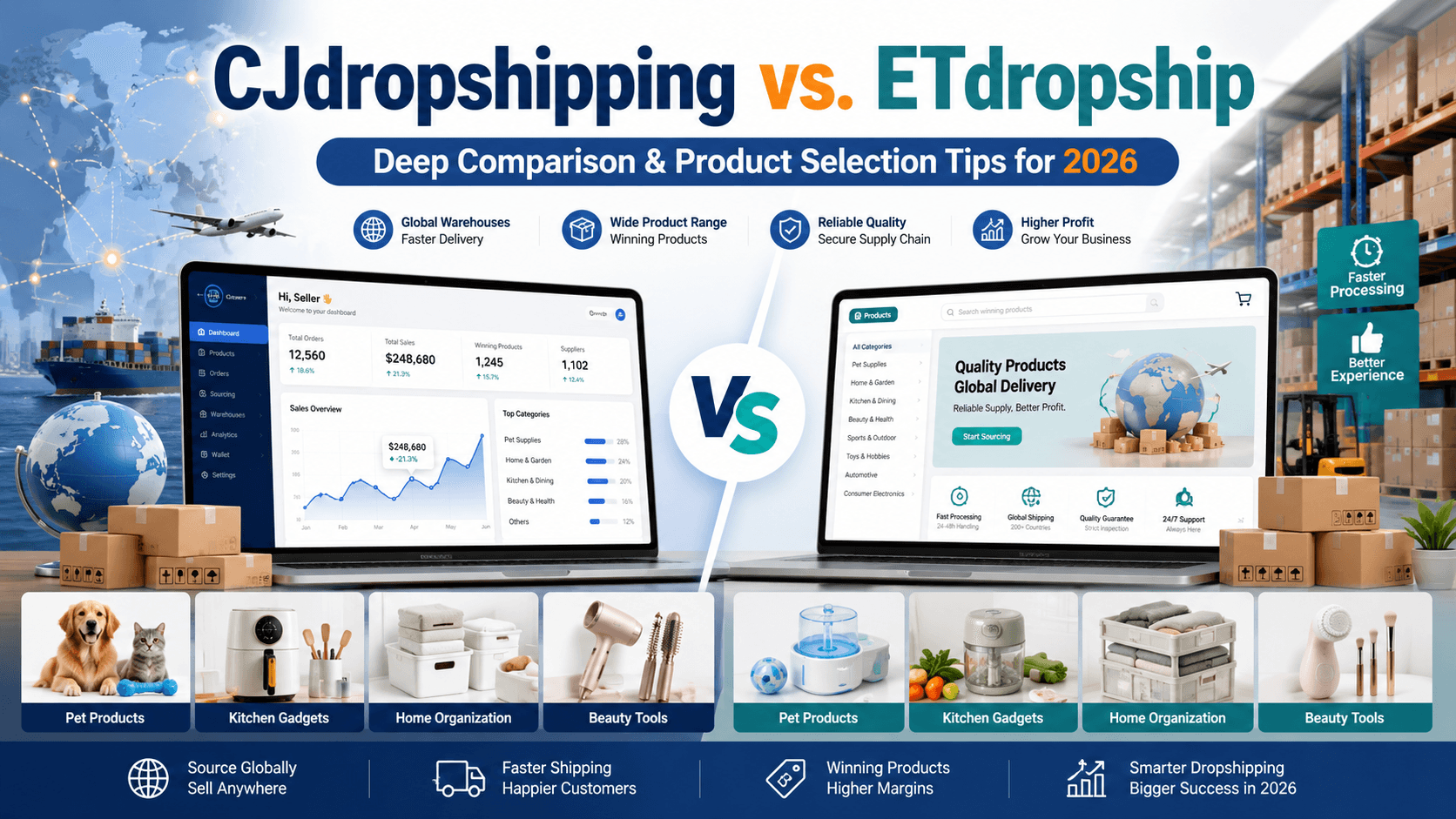
SourcinBox and Sup Dropshipping are more supply-chain-oriented platforms. Sellers can also consider service providers such as ETdropship, which support product sourcing, procurement communication, branded packaging, quality inspection, and order fulfillment. For sellers who already have product links, existing orders, or a need to move from platform-based dropshipping to a more stable supply chain, this type of provider may be more suitable for long-term cooperation.
When choosing suppliers, sellers should not only look at platform names. In the beginner stage, platform-based tools can help test products quickly. Once orders become stable, sellers should compare sourcing prices, shipping times, quality inspection, packaging customization, and after-sales response. If a SKU is already selling consistently, relying only on the most basic platform model may limit profit margins and brand experience.
Advertising Budget Should Be Based on Business Scenarios
The advertising budget for dropshipping services should not focus only on “dropshipping supplier.” This keyword is too broad and competitive. A better approach is to divide the business into specific scenarios.
One direction is Shopify order fulfillment, focusing on order processing, shipping, tracking number updates, and after-sales support. Another direction is branded packaging, showing logos, hang tags, labels, thank-you cards, packaging bags, and boxes. Another direction is product sourcing and quotation, encouraging customers to send product links for sourcing cost and shipping evaluation.
Supplier switching is also a useful content angle. Many mature sellers already have suppliers, but they are unhappy with current performance. They worry that switching may affect shipping, so they need to see a stable transition process. This can include sample testing, logistics testing, and gradually transferring a small number of SKUs first. This type of content works well on Google landing pages and in retargeting ads.
If the budget is not high, most of it can first go to Google precise keywords and Facebook case-based content. Google is used to capture active search customers. Facebook is used to test which case studies attract sellers. After website visits and engagement data accumulate, more budget can be added to retargeting.
What Dropshipping Service Providers Should Communicate in Ads
When promoting dropshipping services, it is not necessary to repeat “we are an all-in-one dropshipping supplier.” This phrase is too common and difficult for customers to remember. A better approach is to break services down into practical value that customers can understand.
For Shopify sellers, the message can focus on product sourcing, procurement communication, quality inspection, branded packaging, warehousing, shipping, and tracking number updates. Once a store is connected, orders can enter the system for processing, while the service team supports sourcing, packing, shipping, and after-sales follow-up.
For sellers building a brand, the message should focus on product logos, custom labels, hang tags, thank-you cards, packaging bags, packaging boxes, and light customization. Many sellers do not avoid branding because they dislike it. They avoid it because they do not know where to start. If a service provider can offer low-barrier, small-batch branding tests, it can reduce the customer’s decision pressure.
For sellers switching suppliers, the message should emphasize stable transition and risk control. Mature sellers worry about order disruption, shipping delays, and customer complaints. If a service provider can offer sample testing, logistics testing, SKU-by-SKU migration, and abnormal order handling, customers are more likely to trust the transition.
Promotional content does not need to explain every service at once. It is better to focus on one scenario at a time. One ad can discuss branded packaging. Another can focus on Shopify fulfillment. Another can focus on product sourcing. Another can explain supplier switching. Another can highlight after-sales support. This makes the message clearer and easier for customers to connect with their current needs.
Conclusion: Dropshipping Promotion Sells Certainty
In 2026, both Google and Facebook are valuable for promoting dropshipping services, but they play different roles. Google is better for capturing customers with clear search demand. Facebook is better for building trust through content, case studies, and visual proof.
Real data supports this difference. Google still holds about 90% of the global search engine market, making it suitable for active search demand. Global social media user identities have reached 5.79 billion, and Meta’s advertising revenue is growing quickly, showing that Facebook and Instagram remain important channels for content reach and demand education.
Effective promotion is not only about clicks or low-cost leads. Dropshipping customers often need a longer decision cycle, multiple touchpoints, several conversations, and continuous trust-building before they cooperate. Advertising is only the first step. Landing page content, case studies, quotation speed, response quality, and service details all affect final conversion.
For sellers, changing suppliers is a cautious decision. They are not only looking for someone cheaper to ship products. They want a partner who can make sourcing smoother, shipping more stable, packaging more brand-like, and after-sales support less stressful.
That is why dropshipping service providers should reduce empty claims and show more real processes and results. Customers need to see how the service reduces risk, improves fulfillment stability, strengthens brand experience, and keeps the supply chain under control as orders grow.
That is the real value behind Google and Facebook advertising for dropshipping businesses.
FAQ:
1. Is Google or Facebook better for promoting a dropshipping service?
Google is usually better for capturing customers who are already searching for suppliers, fulfillment services, sourcing agents, or branded packaging solutions. Facebook is better for building awareness and trust through visuals, case studies, and retargeting. The best strategy is often to use both platforms for different stages of the customer journey.
2. What type of dropshipping keywords should be used for Google Ads?
Dropshipping service providers should avoid relying only on broad keywords such as “dropshipping” or “dropshipping supplier.” More specific keywords usually work better, such as “Shopify dropshipping fulfillment service,” “private label dropshipping supplier,” “branded packaging dropshipping supplier,” and “China sourcing agent for Shopify.”
3. Why do Google Ads get clicks but few inquiries?
This often happens when keywords are too broad or when ads are triggered by learning-stage searches such as free courses, tutorials, or beginner guides. The landing page may also be too general. Reviewing the search term report, adding negative keywords, and creating specific landing pages can improve inquiry quality.
4. What type of Facebook content works best for dropshipping services?
Facebook content works best when it shows real scenarios. Examples include branded packaging before-and-after comparisons, product inspection videos, packing processes, warehouse handling, shipping workflows, and customer case studies. Content that shows a clear transformation usually performs better than generic company introductions.
5. Why are Facebook leads often low quality?
Facebook users are not always actively searching for a supplier. Some are only curious, some do not have a store yet, and some are only looking for the lowest price. Adding simple filtering questions, such as store URL, product category, order volume, and target market, can help improve lead quality.
6. Should dropshipping ads focus on low prices?
Low prices can attract attention, but they often bring price-sensitive customers who frequently compare and switch suppliers. A better long-term message is stable fulfillment, clear quotation, quality inspection, branded packaging, reliable shipping, and after-sales support.
7. Why is branded packaging important for dropshipping sellers?
Branded packaging helps ordinary products look more professional and improves the customer experience. For Shopify and DTC sellers, packaging can help create brand recognition and make the store feel more trustworthy. It is also easy to show visually in Facebook and Instagram ads.
8. Which dropshipping suppliers are worth considering in 2026?
Sellers can consider different suppliers based on their stage. CJdropshipping, HyperSKU, Spocket, Zendrop, Syncee, Printful, DSers, AutoDS, SourcinBox, Sup Dropshipping, and supply-chain service providers such as ETdropship all serve different needs. Beginners may prefer product catalogs and automation tools, while growing sellers may need sourcing, quality inspection, branded packaging, and more stable fulfillment.
9. How should a dropshipping service provider split ad budget between Google and Facebook?
If the website and landing pages are ready, more budget can go to Google Search Ads for high-intent keywords. If the business has strong packaging examples, warehouse videos, and case materials, Facebook and Instagram can be used for content exposure and retargeting. A practical approach is to test both platforms with small budgets and scale the one that brings better qualified inquiries.
10. What is the biggest mistake in promoting a dropshipping business?
The biggest mistake is treating ads as only a traffic problem. Dropshipping services require trust. Even if ads bring clicks, customers may not convert if the website lacks clear information, case studies, service process, quotation speed, or proof of fulfillment capability. The real goal is not just exposure, but building confidence that the provider can handle sourcing, shipping, packaging, and after-sales issues reliably.