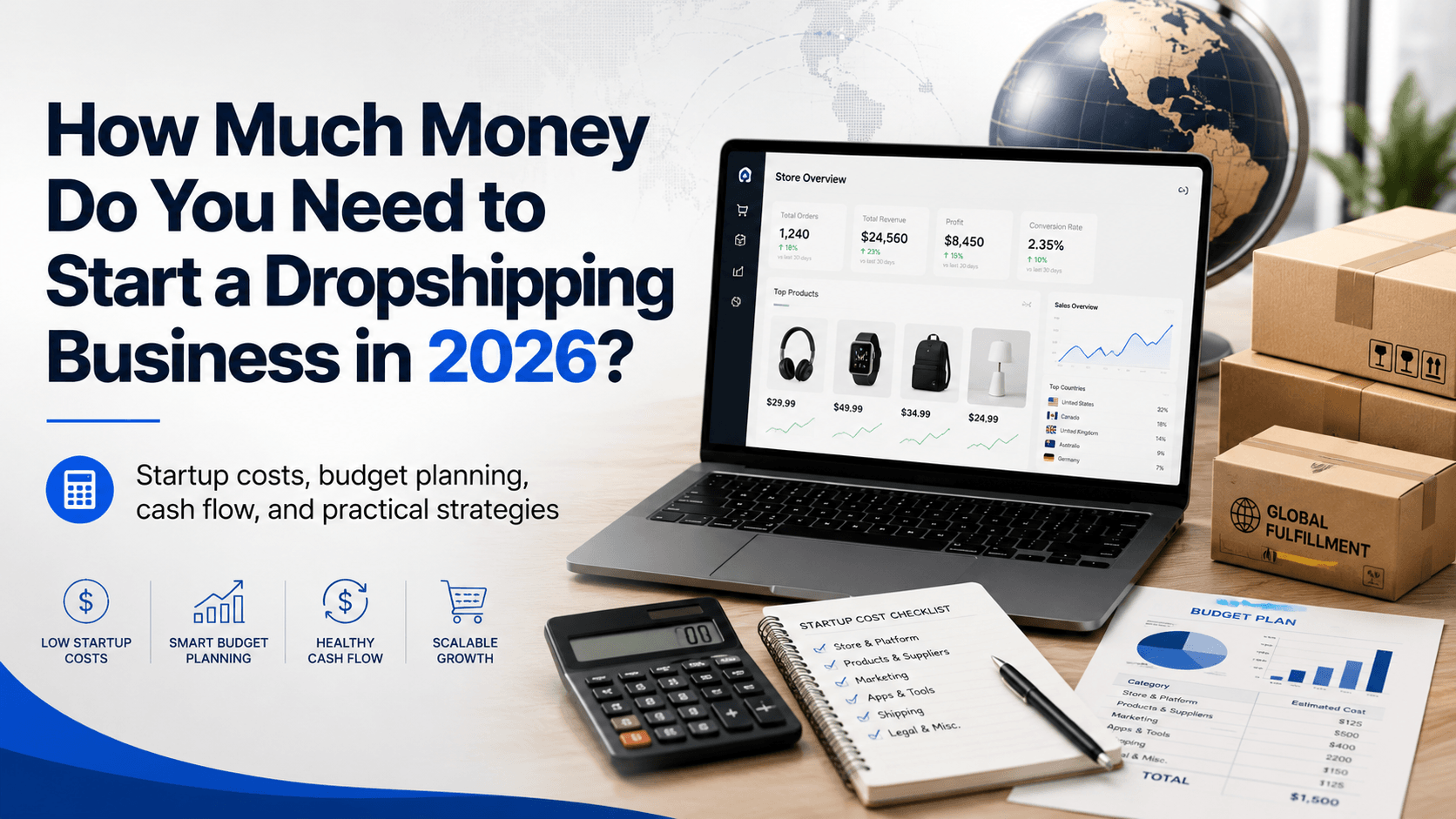
How Much Capital Do You Need to Start a Dropshipping Business in 2026?
Market Trends, Policies, Platform Selection, Consumer Behavior, and Dropshipping Model
1. Market Trends and the Rise of Dropshipping
In 2026, the global e-commerce market continues to show explosive growth. According to a report from Statista, global e-commerce sales are expected to surpass $6 trillion by 2026, with cross-border e-commerce being an important part of this growth. Against this backdrop, dropshipping, as a low-barrier e-commerce model, is gradually becoming the first choice for more and more entrepreneurs.
The advantage of the dropshipping business lies in its almost non-existent initial investment. Sellers do not need to pre-purchase inventory, nor do they need to handle complex logistics or warehousing processes. The basic dropshipping process is that the seller displays products through e-commerce platforms, and when customers place an order, the seller forwards the order to the supplier, who is responsible for directly shipping the product to the customer. For entrepreneurs who are just entering the e-commerce field, this model's low entry barriers and flexibility provide a huge attraction.
However, as more sellers adopt the dropshipping model, market competition has become increasingly fierce. Sellers must not only rely on price competition but also make more efforts in product quality, logistics timeliness, and customer service to stand out. In this competitive environment, successful dropshipping sellers are often those who can offer better customer experiences and more efficient operational processes. Sellers who rely solely on price competition may face considerable market pressure.
Real Example:
For example, AliExpress, one of the world's most famous dropshipping platforms, has thousands of sellers competing. Many beginner sellers, at the start, often rely on low prices to attract customers due to insufficient market research and lack of brand building. However, this leads them to face price war pressures. Meanwhile, some established sellers on AliExpress, through optimized advertising, improved logistics speed, and enhanced after-sales service, gradually gained a larger market share and secured a favorable position in the competition.
2. Policies and Regulations
As the dropshipping market continues to expand, governments worldwide have gradually strengthened policies regarding cross-border e-commerce. In 2026, many countries and regions introduced stricter e-commerce regulations to standardize cross-border transactions, protect consumer rights, and promote the healthy development of the market. For dropshipping sellers, complying with local policies and regulations not only avoids legal risks but also enhances customer trust.
United States:
In the United States, the government implemented new tariff policies in 2026, imposing higher import taxes and additional fees on products shipped from China and other overseas suppliers. This means that products shipped from China to the U.S. will incur higher costs, and these costs are generally borne by the seller. For dropshipping sellers, it is necessary to carefully consider these tariffs and include them in the pricing to ensure that the product price can cover the additional import fees.
European Union:
The European Union implemented the Digital Markets Act in 2026, which requires e-commerce platforms and sellers to provide more transparent and responsible services. The implementation of the act mandates that sellers provide clear return policies, accurate product descriptions, and comprehensive consumer protection measures. Sellers need to ensure that their products comply with EU safety standards, especially when selling electronics, toys, or other regulated products. Additionally, sellers must provide more consumer-friendly after-sales service to ensure product quality and protect customer rights.
China:
In China, the government has gradually improved policies supporting cross-border e-commerce, which has driven the development of the dropshipping business. The Chinese government has implemented several supportive policies for cross-border e-commerce exports, such as simplifying customs procedures and reducing cross-border logistics costs. At the same time, China has strengthened the quality control of dropshipping products to ensure that exported products meet international standards and encourages companies to improve brand building and product quality.
Real Example:
For example, the well-known cross-border e-commerce platform eBay faces legal and policy challenges globally. Particularly in the European Union, eBay has implemented stricter identity verification for sellers and requires sellers to provide detailed product information and after-sales policies. This change has not only increased compliance costs for some sellers but also led to the elimination of low-quality products from the platform.
3. Consumer Behavior Analysis
With the rapid development of the e-commerce industry, consumer shopping behavior is constantly changing. According to a survey by Nielsen, in 2026, consumers primarily focus on the following factors when choosing online shopping platforms:
Shipping Timeliness: Delivery speed has become one of the most important factors influencing consumer purchasing decisions. As consumers' demand for "next-day delivery" or "2-day delivery" increases, the logistics timeliness of dropshipping sellers directly impacts their competitiveness. According to Nielsen, approximately 60% of consumers said they are willing to pay extra for faster delivery.
Return Policies and After-Sales Service: Consumers care greatly about the transparency of return policies and the quality of after-sales services. Especially in cross-border shopping, consumers want easy returns and exchanges. Therefore, providing clear return and exchange policies and ensuring efficient after-sales service has become a key to retaining customers.
Product Reviews and Brand Trust: Although dropshipping products are usually priced lower, consumers still pay a lot of attention to product reviews and seller reputation when making purchases. Data shows that around 72% of consumers say they check product reviews before shopping, choosing sellers with high ratings and credibility. This means that dropshipping sellers need to provide high-quality products and efficient customer service to establish a strong brand image.
Real Example:
For example, a dropshipping seller optimized their product descriptions, improved logistics speed, and strengthened customer service on the Amazon platform. By building a good brand image and providing efficient after-sales service, this seller’s order volume gradually increased, and they succeeded in standing out. Other sellers who relied purely on price competition, although gaining some market share in the short term, ultimately failed to sustain their growth due to not meeting customers' expectations.
4. Dropshipping Model and Logistics Solutions
The core advantage of the dropshipping model is its low cost, but logistics remain the key factor affecting the success of dropshipping sellers. Timeliness and cost control in logistics directly impact sellers' profitability. In recent years, as e-commerce demand continues to evolve, dropshipping platforms and suppliers have continuously optimized logistics services, offering more efficient and cost-effective solutions.
Standard Shipping vs. Express Shipping: While dropshipping sellers usually use standard shipping services, such as AliExpress’s standard logistics, more and more sellers are opting for express logistics options (e.g., ePacket, DHL Express) to meet consumers' demands for fast delivery. Although express logistics is more expensive, it shortens delivery times, improves customer satisfaction, and has become a competitive advantage, especially in the U.S. and European markets.
Local Warehousing Services: In order to further improve logistics efficiency, many dropshipping platforms offer local warehousing services. By storing products in warehouses in the target market, sellers can reduce shipping times and lower logistics costs. For example, CJ Dropshipping has established multiple warehouses in the U.S. and Europe. Sellers can store products in these warehouses, and when an order is placed, the product is shipped directly from the local warehouse, shortening delivery times.
Real Example:
For instance, AliExpress launched ePacket service, providing a faster logistics option than traditional shipping. With ePacket, sellers can deliver products to European and U.S. markets within 10-20 days, greatly improving customer satisfaction. Although the cost of ePacket is higher than standard shipping, its efficient delivery times have made it the first choice for many dropshipping sellers.
Cost Analysis of Dropshipping Business
Although the operation of a dropshipping business is relatively low-cost, sellers still need to carefully manage every cost item, as each expense directly impacts profitability. From platform selection to logistics, each stage has potential costs. To help sellers better understand the breakdown of costs, here are the most common expenses in dropshipping businesses, and how optimizing management can reduce costs and increase profit margins.
1. E-commerce Platform Fees
Choosing the right e-commerce platform is crucial for dropshipping sellers. The platform's fee structure directly determines how much money the seller needs to invest in operations. Different platforms have different fee structures, so sellers need to choose a platform based on their products and market positioning.
Shopify Fees:
Shopify is one of the most popular independent e-commerce platforms, offering a comprehensive e-commerce solution that includes payment processing, website hosting, product management, marketing tools, etc. Shopify’s fee structure typically consists of a monthly subscription fee and a transaction fee.
Monthly Subscription Fee: Shopify’s monthly subscription fees range from $29 (Basic Plan) to $299 (Advanced Plan). The Basic Plan is suitable for new sellers, providing basic e-commerce functions such as unlimited product uploads and 24/7 customer support. The Professional Plan costs $79/month and is suitable for small-to-medium-sized businesses, offering more advanced reporting and analysis tools. The Advanced Plan offers even more customization options and is suited for large businesses with high traffic.
Transaction Fees: For each transaction, if the seller uses Shopify's payment gateway, they will pay a fee of 2.9% + 30 cents. If a third-party payment gateway is used, the transaction fee increases to 2.7%-3%. In addition, the platform will charge additional payment processing fees if the seller uses other payment methods.
Additional Fees: Sellers may also need to pay for additional features such as apps, reporting tools, email marketing plugins, etc. These fees usually range from $10-$50 per month, depending on the selected features and apps.
eBay and Amazon Fees:
eBay and Amazon are two of the largest e-commerce platforms globally, suitable for sellers who want quick exposure to a large customer base. Although they have a vast user base, platform fees are relatively high, and sellers need to weigh their investment carefully.
eBay Fees: eBay typically charges a sales commission ranging from 10%-15%, depending on the product category. In addition to the sales commission, sellers also need to pay a listing fee of $0.30 (eBay provides a certain number of free listings per month). eBay also charges additional fees based on the seller's sales volume and store rating.
Amazon Fees: Amazon’s fee structure is more complex. A standard seller account has a monthly fee of $39.99, which is suitable for businesses with higher sales volume. The sales commission Amazon charges is usually around 15%. Furthermore, if the seller uses Fulfillment by Amazon (FBA) to manage inventory and orders, Amazon will also charge storage fees and fulfillment fees, which vary based on product category, size, and weight.
AliExpress Fees:
AliExpress is a popular platform for dropshipping sellers, particularly those starting with a lower budget. AliExpress does not charge a monthly subscription fee but does charge a sales commission of 5%-8%. Sellers can quickly find many suppliers through AliExpress, selecting products that fit their needs.
Commission Structure: AliExpress’s commission generally ranges from 5%-8%, depending on the product category and order amount. Unlike eBay and Amazon, AliExpress does not charge additional monthly subscription or listing fees, making it more flexible and cost-effective for new sellers.
Advertising Costs: If sellers wish to increase product exposure, AliExpress also offers paid advertising services. Sellers can choose to “promote” their products, and the cost is based on the product’s exposure and click-through rate.
2. Procurement and Logistics Costs
Procurement and logistics costs are core expenses that dropshipping sellers must manage, as they directly determine profitability. Although the dropshipping model eliminates significant inventory and warehousing costs, each order’s procurement and shipping costs must be carefully managed.
Procurement Costs:
Procurement costs are the main factor influencing the profitability of a dropshipping seller. Typically, sellers purchase products through platforms like AliExpress or CJ Dropshipping. The procurement price depends on product types, supplier pricing, and market demand.
AliExpress Procurement: AliExpress is the preferred platform for many dropshipping sellers, especially in the early stages. Product prices generally range from $5-$50. For example, headphones might cost around $10-$30, while more complex products (such as smartwatches or phone accessories) might cost over $50.
CJ Dropshipping Procurement: Compared to AliExpress, CJ Dropshipping offers better product quality, but its procurement costs are relatively higher. Generally, product procurement costs range from $10-$50, and some customized or larger items may cost up to $100 or more.
Bulk Purchasing Advantages: Although one advantage of dropshipping is the lack of bulk purchasing, some sellers who establish long-term relationships with suppliers can obtain lower prices per unit. This method is especially useful for sellers looking to scale their business.
Logistics Costs:
Logistics costs typically account for a significant portion of a dropshipping seller’s total expenses. By choosing the right logistics method, sellers can effectively reduce shipping costs and improve delivery efficiency.
Standard Logistics (e.g., ePacket): ePacket is a low-cost logistics option suitable for small items. Shipping fees are typically around $5-$10, with delivery times of 10-20 days. Although shipping time is longer, its low cost makes it the first choice for many sellers.
Express Logistics (e.g., DHL, FedEx): For sellers with higher delivery time requirements, express logistics like DHL and FedEx are necessary. These logistics services typically cost between $20-$50, with shipping times ranging from 3-7 days. Although express logistics can significantly improve customer experience, sellers need to decide whether to choose it based on their product pricing.
Logistics Optimization: Using tools like ETdropship, sellers can automatically choose the most suitable logistics channels based on the market demand and order characteristics of different regions. For example, ETdropship analyzes the product's weight and destination to intelligently recommend shipping methods, helping sellers save on logistics costs.
Real Example:
Let’s say you purchase a pair of headphones from AliExpress for $30, choose ePacket for shipping, which costs $6. The total product cost is $36. Based on market demand, the seller can price the product at $50. After deducting procurement and shipping costs, the profit is $14, and after subtracting advertising and platform fees, the seller can still maintain a profitable margin.
3. Advertising and Marketing Costs
In a competitive e-commerce market, advertising and marketing are key to attracting traffic and increasing sales. Different types of advertisements and marketing strategies each come with different costs and returns.
Facebook Ads:
Facebook Ads are a commonly used promotional tool for dropshipping sellers, suitable for precise targeting and efficient traffic acquisition. The cost of Facebook Ads typically ranges from $0.5-$2 per click (CPC), depending on the competition level and audience targeting.
Ad Budget Optimization: Initially, sellers can start with a small budget (e.g., $5-$10 per day) and gradually optimize based on the ad performance. Through Facebook's advertising management tools, sellers can test different ad creatives, audience groups, and timings to improve ad performance.
Google Ads:
For sellers who want to acquire precise traffic through search engines, Google Ads is another effective advertising method. Google Ads operates on a pay-per-click basis, with CPC typically ranging from $1 to $5.
Keyword Optimization: Sellers can use Google Ads' keyword analysis tools to choose appropriate keywords, maximizing ad click-through rates and conversion rates.
ETdropship Ad Support:
ETdropship provides integration tools with Facebook and Google Ads, allowing sellers to directly manage their ad campaigns on the platform and automatically optimize advertising strategies, improving ad performance and reducing unnecessary ad waste.
Real Example:
A seller runs a $10 per day Facebook ad targeting female consumers aged 25-40 and promoting “sports headphones.” Using ETdropship’s ad optimization tools, the seller optimized the audience and creative over a week, improving the ad click-through rate by 30%, which led to significant sales growth.
4. Customer Support and After-Sales Service
Good customer support and after-sales service are crucial to maintaining customer relationships and increasing repeat purchases. Although dropshipping sellers do not handle product inventory directly, they still need to effectively manage customer returns and after-sales issues.
Customer Support Tools:
Many dropshipping sellers use third-party customer support tools (such as Zendesk, Freshdesk, etc.) to manage customer issues centrally. With these tools, sellers can efficiently handle customer inquiries and improve response time.
After-Sales Management:
Platforms like ETdropship provide automated after-sales management functions, including automatically generating return labels and processing refund requests. This effectively reduces sellers’ workload and improves customer satisfaction.
Practical Steps for Dropshipping Business
The success of a dropshipping business depends on meticulous operations, where every step requires careful planning and execution. From choosing suppliers to running ads, each stage is critical. Below is a more detailed step-by-step guide to help you build and optimize your dropshipping business.
1. Choosing Suppliers and Products
The selection of suppliers and products directly impacts the stability and profitability of a dropshipping business. A reliable supplier not only ensures product quality but also guarantees timely shipping and excellent customer service.
Step 1: Market Research and Product Selection
Market research is an essential part of the product selection process. It helps you understand consumer demand, competition, and potential market opportunities.
Market Research Tools:
Google Trends: Use Google Trends to analyze the market demand trend for a product. By entering keywords, you can see the changes in product popularity, which helps you identify hot-selling products.
AliExpress Bestsellers: The AliExpress Bestsellers list provides data on the most popular products on the platform, helping sellers find high-demand items.
Amazon Best Sellers: By viewing the Amazon Best Sellers list, sellers can learn about the current popular product categories and the level of competition.
Target Market Analysis: Understand the needs of your target market and define your target audience (e.g., young consumers, middle-aged groups, etc.) to select products suitable for them. Targeting specific groups will help you develop a more precise marketing strategy.
Step 2: Choosing a Supplier
When choosing suppliers, consider not only product prices and quality but also the following key factors:
Supplier Reputation: Check the ratings and customer feedback of suppliers on platforms like AliExpress and CJ Dropshipping. Suppliers with high ratings usually provide better product quality and are more reliable when fulfilling orders.
Product Quality and Reliability: Ask the supplier for product samples and perform quality checks. If possible, place a small trial order to ensure the product meets your standards.
Shipping Timeliness and Logistics Support: Choose suppliers who offer fast shipping options, such as ePacket or DHL, to ensure shorter delivery times. Also, verify the supplier’s warehouse locations to avoid long shipping delays.
Step 3: Filtering Products
When selecting products, in addition to focusing on market demand, make sure the chosen products offer a sufficient profit margin. Avoid selecting overly cheap products or those in highly competitive categories to avoid getting caught in price wars.
Profit Margin Evaluation: Ensure that your product has enough profit margin. Typically, the gross margin for dropshipping products is 20%-50%. For example, if the procurement cost of a pair of headphones is $15, setting the selling price at $40 gives a gross margin of about $25.
Product Diversification: To avoid the risk of depending on a single product, it’s better to choose a range of differentiated products. You can select several products in a similar category, with different prices and features, creating a product range.
Real Example:
You plan to sell Bluetooth headphones. First, you research the product demand using Google Trends and the AliExpress Bestsellers list and find that the product is in high demand and has relatively low competition. After filtering suppliers, you find one with high ratings and fast shipping. You order a few samples to check the sound quality, comfort, and design, confirming that they meet market expectations.
2. Setting Up an E-Commerce Platform
Building an efficient e-commerce platform is key to running a dropshipping business. By choosing the right e-commerce platform and optimizing it, you can increase store visibility and conversion rates.
Step 4: Choosing an E-Commerce Platform
When choosing a platform, consider the following factors:
Platform Fees: Each platform has a different fee structure. Shopify charges a monthly subscription and transaction fees, while Amazon and eBay primarily charge commissions. You need to choose based on your budget and expected sales volume.
Platform Features: Consider whether the platform offers necessary functions such as order synchronization, logistics tracking, and SEO optimization.
Platform Traffic and Target Market: If your goal is to quickly reach a large number of consumers using the platform’s traffic, Amazon and eBay are good options. However, if you are more focused on brand building, Shopify might be more suitable.
Step 5: Store Creation and Design
Once you’ve selected a platform, the next step is to create and design your store.
Register and Set Up Accounts: Create a seller account on the chosen platform and fill in store information, tax details, etc. Ensure that all account information is accurate to avoid issues with transactions and settlements.
Store Design and Theme Selection: Most e-commerce platforms provide both free and paid templates. Choose a clean, professional template and customize it to fit your brand’s style.
Logo and Brand Colors: Ensure that your logo design is simple and clear, reflecting the product’s positioning. When choosing brand colors, avoid using too many colors to maintain visual consistency.
Product Categorization: Categorize your products for easier browsing by consumers. For example, you could categorize headphone products into "Wireless Headphones,""Wired Headphones," "Sports Headphones," etc., to help customers find what they need quickly.
Step 6: Uploading and Optimizing Products
Product Image and Description Optimization: Upload high-quality, professional product images showing multiple angles and usage scenarios. Optimize product descriptions to ensure they include keywords that help with search engine optimization (SEO).
Pricing and Inventory Management: Set reasonable prices and monitor inventory levels. Use the platform’s inventory management tools to avoid running out of stock or holding excessive inventory.
SEO Optimization: Ensure that your product titles, descriptions, and tags are optimized for SEO, helping your products rank higher in search results and attract organic traffic.
Real Example:
You create a store on Shopify and choose a clean, modern template that appeals to younger consumers. You upload high-resolution images of the Bluetooth headphones and detailed descriptions, set reasonable prices, and ensure your products are optimized for SEO to increase their visibility in search engines.
3. Pricing and Marketing Strategy
Pricing and marketing strategies determine your competitiveness and profitability in the market. Proper pricing and precise marketing can help you attract more traffic and improve conversion rates.
Step 7: Pricing Strategy
Your pricing strategy should be based on the following factors:
Product Cost: Ensure your pricing covers product procurement costs, platform fees, shipping costs, and expected profit margins.
Competitor Analysis: Look at competitors’ pricing and adjust based on market conditions. You can either attract customers by lowering prices or maintain a higher price by offering better value.
Psychological Pricing: Use "psychological pricing" like $9.99 or $49.99 to make prices more appealing to customers.
Step 8: Marketing Strategy
Social Media Ads: Use Facebook, Instagram, and other platforms to run targeted ads and precisely reach your customer demographic. Set an ad budget and optimize based on ad performance.
Facebook Ads: You can target specific groups based on age, gender, interests, etc., to improve ad accuracy and conversion rates.
Instagram and Pinterest: These platforms are especially suitable for visually-oriented products such as headphones, jewelry, etc. Use attractive images and videos to grab users’ attention.
Google Ads and SEO Optimization: Use Google Ads to run keyword ads and display ads to drive traffic. Ensure your website and product pages are optimized for SEO so they rank better in search results.
Content Marketing: Increase brand exposure through blog posts, videos, customer reviews, etc. Write valuable content related to your products to attract potential customers and build trust in your products.
Real Example:
You decide to run Facebook Ads targeting consumers aged 18-35 and promote “sports headphones.” By optimizing ad creatives and audience settings, your ad’s click-through rate increases by 30%, resulting in significant sales growth.
4. Order Management and Customer Service
Effective order management and customer service are essential to improve customer satisfaction and reduce return rates. Through efficient order handling and timely customer support, you can increase customer loyalty and gain more repeat purchases and word-of-mouth referrals.
Step 9: Order Processing and Automation
Automated Order Forwarding: Use platforms like Shopify’s automatic order synchronization feature to automatically forward orders to suppliers, reducing errors caused by manual processes.
Logistics Tracking and Notifications: Use the platform’s logistics tracking function to automatically send shipping information to customers, ensuring they are informed about the status of their orders.
Step 10: Customer Service and After-Sales Support
After-Sales Support: Establish clear return and exchange policies and ensure fast processing. Use automation tools to simplify the return process and improve after-sales efficiency.
Customer Communication: Use email, social media, or customer service tools to communicate with customers and address their inquiries and issues promptly. Provide excellent customer support to improve customer satisfaction.
Real Example:
A customer receives the headphones but finds they don’t meet their needs. You quickly process the refund request and generate a return label using the automated return feature provided by the platform, ensuring a smooth return and refund process for the customer.
Conclusion
The practical steps for dropshipping involve multiple stages, from product selection and platform setup to marketing and customer service. By implementing a reasonable pricing strategy, precise marketing, automated order management, and efficient customer support, sellers can effectively increase efficiency, reduce costs, and stand out in the competitive market.