Dropshipping Profit Margin in 2026: How to Calculate Real Profit
A product costs $8 and sells for $29.99. At first glance, it looks like the seller has almost $22 in profit.
That calculation is incomplete.
The order may still need to cover international shipping, customer acquisition, payment processing, refunds, reshipments, packaging, duties, taxes, software, and other operating expenses. Once those costs are included, a product that appears highly profitable at the sourcing stage can produce a very different result.
This is why dropshipping profit margin should not be calculated as selling price minus supplier price. Sellers need to understand gross margin, contribution margin, and net margin separately, then identify which costs are consuming the profit between checkout and successful delivery.
The objective is not simply to create the highest possible markup. It is to build enough margin that the product can remain profitable when advertising, shipping, and after-sales costs fluctuate.
What Is Dropshipping Profit Margin?
Dropshipping profit margin measures how much of your revenue remains after certain costs are deducted.
The important question is which costs have been included.
A seller who deducts only product cost is measuring something very different from a seller who includes product cost, shipping, advertising, payment fees, refunds, packaging, and operating expenses.
This is why three numbers are particularly useful: gross profit margin, contribution margin, and net profit margin.
Gross margin shows whether the basic product economics have enough room. Contribution margin shows how much an additional order contributes after its variable costs. Net margin shows how much the business ultimately keeps after the broader operating structure is included.
Gross Profit Margin: Start With the Product Economics
A practical dropshipping gross profit calculation can begin with:
Gross Profit = Selling Price − Product Cost − Shipping Cost
Then:
Gross Profit Margin = Gross Profit ÷ Selling Price × 100
Suppose a product sells for $39.99. The product costs $10 and shipping costs $6.
Gross profit is:
$39.99 − $10 − $6 = $23.99
Gross profit margin is approximately:
$23.99 ÷ $39.99 × 100 = 60%
At first glance, that looks excellent.
But the store has not yet paid for advertising, payment processing, refunds, packaging, software, or other operating expenses.
A 60% gross margin is therefore not a 60% net profit margin.
Contribution Margin: Can Each Additional Order Make Money?
Contribution margin is especially useful when deciding whether a product should be scaled.
A simple per-order calculation is:
Contribution = Revenue − Variable Costs
Variable costs can include product cost, shipping, customer acquisition, payment processing, packaging, duties paid per parcel, and an allowance for refunds or reshipments.
Suppose a product sells for $49.99.
Product cost is $13, shipping is $7, customer acquisition costs $14, payment processing is $2, and expected after-sales losses average $1.50 per order.
The contribution is:
$49.99 − $13 − $7 − $14 − $2 − $1.50 = $12.49
That $12.49 is the amount available to cover fixed operating costs and eventually produce net profit.
This number becomes extremely useful when advertising volume increases because revenue can grow quickly while contribution per order quietly disappears.
Net Profit Margin: What Does the Business Actually Keep?
Net profit goes further by including the broader costs of running the store.
A simplified formula is:
Net Profit = Revenue − All Business Costs
And:
Net Profit Margin = Net Profit ÷ Revenue × 100
Imagine a store generates $50,000 in monthly revenue and has $41,000 in total costs.
Net profit is:
$9,000
Net profit margin is:
$9,000 ÷ $50,000 × 100 = 18%
This gives a much more useful picture of business performance than looking at the markup of individual products.
A product can appear extremely profitable at the supplier-price level while contributing very little to the store after customer acquisition and fulfillment costs are included.
There Is No Single “Good” Dropshipping Profit Margin
Sellers frequently search for a benchmark such as 10%, 20%, or 30%, but no single margin automatically determines whether a dropshipping business is healthy.
A store with repeat purchases can tolerate different first-order economics from a store that sells products customers buy only once. A high-ticket product has a different cost structure from a $15 accessory, while an organic-content store operates differently from one that depends heavily on paid acquisition.
The more useful question is whether the margin is resilient.
If a small increase in advertising cost or shipping immediately makes the product unprofitable, the margin structure is fragile.
If the product remains profitable after realistic changes in customer acquisition, logistics, refunds, and promotions, there is more room to scale.
Product Cost Is Only the Beginning
Supplier price creates the starting point for the margin calculation, but it should not be evaluated in isolation.
During early product testing, flexibility may be worth paying slightly more for. A seller who has not yet validated demand may prefer purchasing individual orders rather than negotiating large production quantities simply to reduce the unit price.
The calculation changes after demand becomes predictable.
If a product sells 3,000 units per month, reducing sourcing cost by $1 per unit can improve monthly contribution by $3,000 before considering any other changes.
At that stage, comparing suppliers, specifications, purchasing terms, quality consistency, and replenishment becomes financially meaningful. A more structured product sourcing process can improve unit economics without treating the lowest quotation as automatically superior.
Shipping Cost Can Destroy an Otherwise Good Product
Two products can have the same supplier price and completely different economics because of shipping.
Weight matters, but package dimensions matter too. A product can be lightweight while occupying enough space to increase chargeable weight, and fragile products may need additional protection that changes the final parcel size.
Shipping restrictions can add another variable. Products containing batteries, liquids, magnets, or unusual materials may require different logistics channels from ordinary accessories.
This is why the relevant calculation is not simply:
Product cost + cheapest shipping quote
It is the cost of using a shipping method that can realistically deliver the product to the target customer at an acceptable speed and reliability level.
Advertising Cost Is Often the Largest Unstable Variable
Supplier and shipping costs are usually relatively predictable once the product and logistics route are established.
Advertising can change much faster.
A campaign may acquire customers profitably this week and become significantly more expensive after creative fatigue, increased competition, seasonal changes, or audience saturation.
This makes break-even customer acquisition cost one of the most useful numbers in a product model.
Suppose a product sells for $59.99 and all variable costs except advertising total $31.
The theoretical break-even advertising budget is approximately $28.99 before fixed operating expenses.
That does not mean spending $28 per sale is desirable. It means the product becomes increasingly vulnerable as acquisition cost approaches that level.
Healthy economics require breathing room.
ROAS Does Not Tell You the Whole Profit Story
Return on ad spend is useful, but it does not measure the complete economics of the order.
Consider two products.
Product A has excellent advertising efficiency but high sourcing, shipping, and refund costs.
Product B requires slightly more advertising but is lightweight, stable, rarely returned, and leaves substantially more money after fulfillment.
If the seller compares only ROAS, Product A may look stronger.
If the seller compares contribution margin, Product B may be the better business.
Advertising data should therefore be combined with product economics rather than reviewed independently.
Payment Fees Need to Be Included in Every Order
Payment processing fees may look small, but they apply repeatedly.
The impact is particularly noticeable on inexpensive products because fixed transaction components consume a larger percentage of the selling price.
Chargebacks create a different problem. The business may lose revenue while also absorbing product, shipping, customer-acquisition, and administrative costs associated with the original transaction.
Payment economics should therefore be part of the product model rather than treated as an accounting detail that is reviewed only at the end of the month.
Refunds and Reshipments Are Real Product Costs
A successful sale is not necessarily a successful order.
The product may arrive damaged, the supplier may send the wrong variation, a parcel may be lost, or the customer may request a refund because the physical product does not match expectations.
These losses affect margin directly.
A reshipment can require another product and another shipping charge without generating additional revenue. A refund may also leave the seller unable to recover the original advertising cost.
This is why defect rate, wrong-item rate, damage rate, lost-parcel rate, and refund rate are not merely customer-service metrics.
They are profitability metrics.
Fulfillment Cost Should Be Evaluated Per Successful Delivery
The cheapest order-processing option does not always create the lowest final cost.
Better quality checks can reduce defective shipments. Appropriate packaging can reduce damage, reliable tracking can reduce support pressure, and consistent order processing can reduce cancellations and incorrect shipments.
These operational differences affect how much money survives after the sale.
A more integrated dropshipping fulfillment process can therefore influence margin through QC, packaging, order processing, shipping, and tracking rather than only through the shipping rate itself.
The correct comparison is the cost of a successfully completed order, not one line of the fulfillment quotation.
Duties and Customs Can Change Margin by Destination
International orders should not always be modeled as if every destination has the same cost structure.
Duties, taxes, customs clearance, shipping lanes, and refused-delivery risk can vary by country.
This becomes particularly important when deciding whether duties are handled before delivery or collected from the customer later. The economics of DDP vs DDU involve not only the amount paid for shipping but also potential rejected parcels, refunds, and customer-service friction.
A store may therefore discover that the same SKU has a healthy margin in one market and weak economics in another.
Profit should be measured by destination when those differences are meaningful.
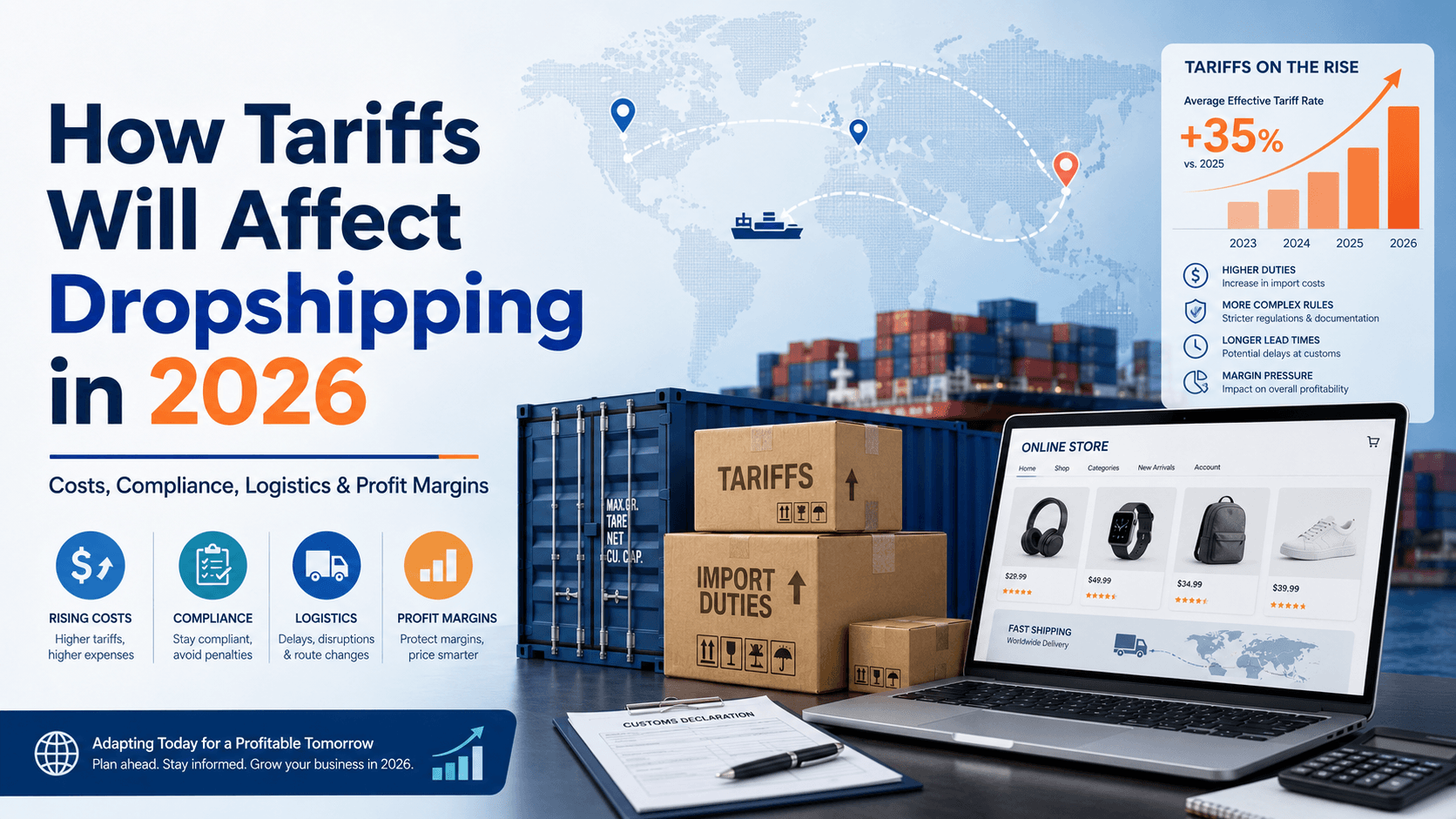
Tariffs Belong Inside the Landed-Cost Calculation
Import costs should not be treated as an unexpected expense that appears after a product has already been scaled.
If tariffs or other import charges apply to a route, they belong in the expected cost of delivering the order.
This matters especially for inexpensive products because a relatively small additional import cost can consume a large percentage of the available margin.
Changes in dropshipping tariffs and customs costs therefore affect product selection as well as logistics. Products with very little margin have less ability to absorb changes in cross-border costs.
Why Extremely Cheap Products Can Have Weak Economics
A $3 product appears attractive because the sourcing cost is low.
But suppose it sells for $14.99.
International shipping, customer acquisition, payment processing, refunds, and support still need to be paid from a relatively small amount of revenue.
The percentage markup may look enormous while the actual dollars available per order remain small.
This is why low-cost product dropshipping becomes increasingly sensitive to advertising and fulfillment costs. A $2 increase in total cost has a much greater effect on a $15 order than on a $70 order.
Low sourcing cost is valuable.
Low economic headroom is not.
Average Order Value Can Improve the Margin Structure
Improving profit does not always require finding a cheaper supplier.
Increasing average order value can sometimes produce a larger impact.
Suppose acquiring one customer costs $15. If that customer purchases one $25 item, customer acquisition consumes a large percentage of the order.
If a relevant bundle increases the order to $45 without proportionally increasing acquisition or shipping cost, the economics can improve significantly.
Bundles need to make sense from the customer's perspective.
A pet-travel product can be combined with another travel accessory. A cleaning product can become part of a complete cleaning set, while travel organizers can be sold in coordinated multi-piece kits.
Higher AOV works when the additional products create real value rather than simply inflating the cart.
Discounts Should Be Calculated Before They Are Offered
A 20% discount does not reduce profit by only 20%.
If much of the original selling price is already committed to sourcing, shipping, and advertising, discounting comes primarily from the remaining margin.
Consider a $50 product with $35 in variable costs.
The original contribution is $15.
A 20% discount reduces revenue to $40 while many costs remain unchanged.
Contribution falls to only $5.
Revenue decreased by 20%, but contribution decreased by roughly two-thirds.
This is why aggressive discounting can generate more orders while making the business less profitable.
Profitability Should Be Measured by SKU
Store-wide averages can hide weak products.
One SKU may produce a healthy margin while another generates sales but barely covers its costs.
Tracking important products separately makes those differences visible.
For each major SKU, monitor selling price after discounts, product cost, shipping, customer acquisition, payment fees, refunds, reshipments, and other meaningful variable costs.
A weak SKU can then be repriced, bundled, resourced, shipped differently, or removed.
Revenue is useful only when the economics behind that revenue are acceptable.
Profitability Should Also Be Measured by Country
The same principle applies geographically.
A product sold in the United States, France, Germany, and Australia may use different shipping routes and experience different advertising, tax, customs, and return economics.
Combining everything into one global average can hide these differences.
Country-level margin data helps determine where advertising can be increased, where pricing needs adjustment, and where logistics needs improvement.
The market producing the most revenue is not automatically the market producing the best profit.
Small Cost Improvements Become Powerful at Scale
A $0.30 improvement sounds insignificant when a product receives ten orders.
At 10,000 orders, it represents $3,000.
The same multiplication applies to sourcing, packaging, shipping, defect rates, refunds, and transaction costs.
This is why profit optimization changes as a store grows.
Early-stage sellers often gain more from improving product-market fit and customer acquisition.
Higher-volume stores can begin extracting meaningful profit from dozens of small supply-chain improvements.
There does not need to be one dramatic change.
Better supplier pricing, slightly smaller packaging, lower damage rates, stronger logistics routing, higher AOV, and fewer reshipments can collectively transform the margin.
Do Not Reduce Cost at the Expense of Customer Experience
Margin improvement does not mean minimizing every cost.
A cheaper supplier is not useful if product quality falls.
Cheaper packaging is not useful if more products arrive damaged. A slower logistics route may save money on every shipment but create more cancellations, refunds, and customer-service tickets.
Cost reduction should therefore be evaluated by its effect on the complete order, not by the amount saved at one step.
The strongest optimization reduces unnecessary cost while preserving or improving the customer's probability of receiving the correct product successfully.
A Practical Profit Check Before Scaling
Before increasing advertising substantially, calculate the product using realistic rather than best-case assumptions.
Start with the actual selling price after discounts. Deduct product cost, the shipping method you expect to use, payment processing, customer acquisition, packaging, duties where relevant, and a reasonable allowance for refunds and reshipments.
Then stress-test the result.
What happens if CAC increases by 20%? What happens if shipping rises by $1? What happens if the refund rate is slightly worse than expected?
A product that remains profitable under moderate pressure is easier to scale than one whose profit disappears whenever one variable moves.
Common Dropshipping Profit Margin Mistakes
One common mistake is confusing markup with margin. Buying a product for $10 and selling it for $30 does not mean the store has a 200% profit margin.
Another is ignoring customer acquisition. For stores dependent on paid traffic, advertising can be one of the largest costs associated with the order.
Sellers may also calculate shipping using an unrealistic quotation, ignore payment processing, forget refunds and reshipments, or assume duties and taxes will have no impact.
A final mistake is focusing excessively on revenue.
A store generating $100,000 in monthly sales with almost no remaining margin is not automatically healthier than a smaller business producing fewer sales with stronger economics.
Profitability should be measured by what remains, not by how impressive the revenue number looks.
Frequently Asked Questions
What is a good dropshipping profit margin?
There is no universal percentage that fits every store. Product category, selling price, customer acquisition, shipping, refunds, repeat purchases, taxes, and operating structure all influence the result. A healthy margin should leave enough room to remain profitable when normal costs fluctuate.
How do you calculate dropshipping profit margin?
Start by separating gross profit from net profit. Gross profit can be calculated by deducting direct product and shipping costs from revenue. Net profit requires deducting the broader costs of advertising, payments, refunds, software, operations, and other business expenses as well.
Why does my store have sales but very little profit?
Common reasons include expensive advertising, low average order value, weak pricing, high shipping costs, refunds, product defects, reshipments, discounts, payment fees, or costs that were excluded from the original product calculation.
Is markup the same as profit margin?
No. Markup measures how much the selling price is increased relative to cost. Profit margin measures how much of the final revenue remains after the relevant costs are deducted.
Should I choose products with the highest markup?
Not necessarily. A high-markup product can still produce weak profit if shipping, customer acquisition, or after-sales costs are high. Completed-order economics matter more than markup alone.
Can cheaper sourcing increase profit margins?
Yes, especially after sales volume increases. However, lower product cost should not create worse quality, stock instability, or higher refunds, because those problems can eliminate the savings.
Can faster shipping improve profit?
Sometimes. More reliable delivery can reduce cancellations, refunds, refused parcels, disputes, and customer-service workload. The correct comparison is the total cost and outcome of the order rather than shipping price alone.
Should I hold inventory to increase profit margin?
Not necessarily when a product is still being tested. Once demand becomes predictable, limited inventory may support better supplier pricing, shorter processing time, or improved stock stability. The financial benefit should be compared with the risk of holding unsold inventory.
Conclusion
Dropshipping profit margin cannot be understood by looking only at the difference between supplier price and selling price.
Gross margin shows whether the product has enough initial economic room. Contribution margin shows whether another order adds money after variable costs. Net margin shows what the business ultimately keeps.
Product cost, shipping, advertising, payments, refunds, reshipments, duties, packaging, discounts, and operational performance all influence those numbers.
As order volume increases, small improvements become increasingly valuable. Better sourcing, more suitable logistics, lower defect rates, stronger bundles, and fewer failed orders can improve profitability without requiring the store to continually raise prices.
The most useful question is therefore not how much markup a product appears to have.
It is whether each successfully delivered order still produces enough profit after realistic costs are included—and whether that margin remains healthy when the business grows.