
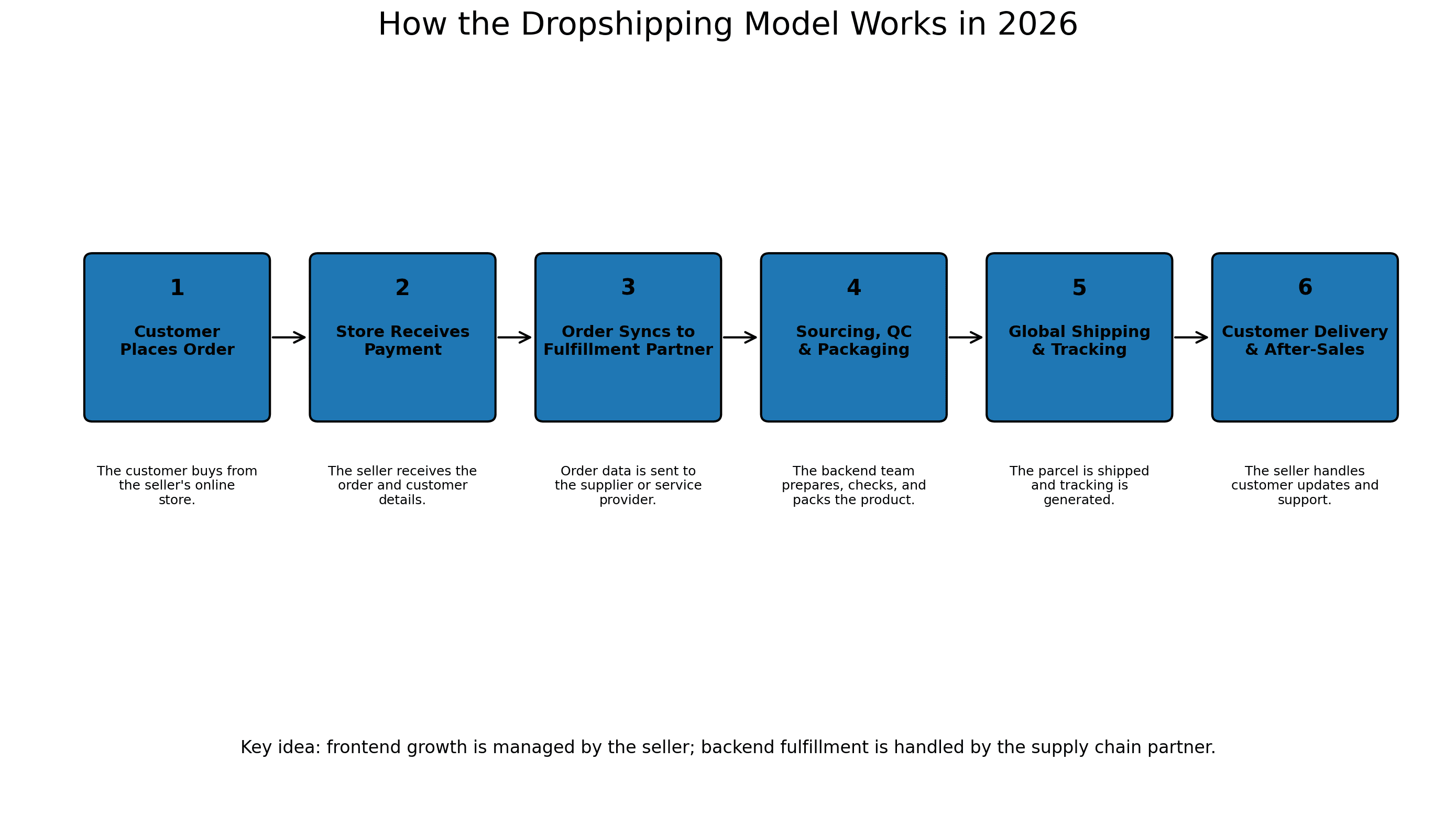
Dropshipping is a light-inventory ecommerce business model. Sellers do not need to purchase large amounts of stock before making sales, nor do they need to manage warehouses, packing, or international shipping by themselves. When a customer places an order in an online store, the order is passed to a supplier, sourcing agent, or dropshipping fulfillment provider. The backend partner then handles product procurement, quality inspection, packaging, shipping, and tracking, with the product delivered directly to the end customer.
Sources & further reading
- Shopify — What is dropshipping?
- Shopify — Global ecommerce sales outlook (cites industry forecasts)
- Grand View Research — Dropshipping market size & forecast
- European Commission — General Product Safety Regulation (GPSR)
Policies and forecasts change. Confirm dates and details on each official page before making business decisions.
Market background: why dropshipping still matters in 2026
On the surface, dropshipping reduces inventory pressure. At a deeper business level, it changes how ecommerce sellers allocate their resources. Traditional ecommerce often requires sellers to invest heavily in inventory, warehousing, and fulfillment. Dropshipping allows sellers to spend more resources on market testing, advertising, content marketing, brand positioning, and customer operations.
By 2026, dropshipping is no longer just about “finding a product, uploading it to a store, and waiting for orders.” With rising advertising costs, stricter platform fulfillment rules, and higher consumer expectations for shipping experience and brand trust, dropshipping has evolved from a low-barrier selling model into a more professional cross-border ecommerce supply chain model.
Global ecommerce growth continues to support dropshipping
The foundation of dropshipping is the continued growth of global ecommerce. According to data cited by Shopify from EMARKETER, global retail ecommerce sales are expected to reach approximately $6.88 trillion in 2026, accounting for around 21.1% of total global retail sales. By 2028, global retail ecommerce sales are expected to grow further to approximately $7.89 trillion. Consumers are shifting more purchasing online, giving cross-border sellers opportunities to enter different markets and niche categories.
Categories such as pet products, home cleaning tools, beauty accessories, fitness accessories, holiday gifts, white-label products, and personalized packaging products remain suitable for testing through independent stores, short-form video content, social media advertising, and search traffic.
The dropshipping market is becoming more professional
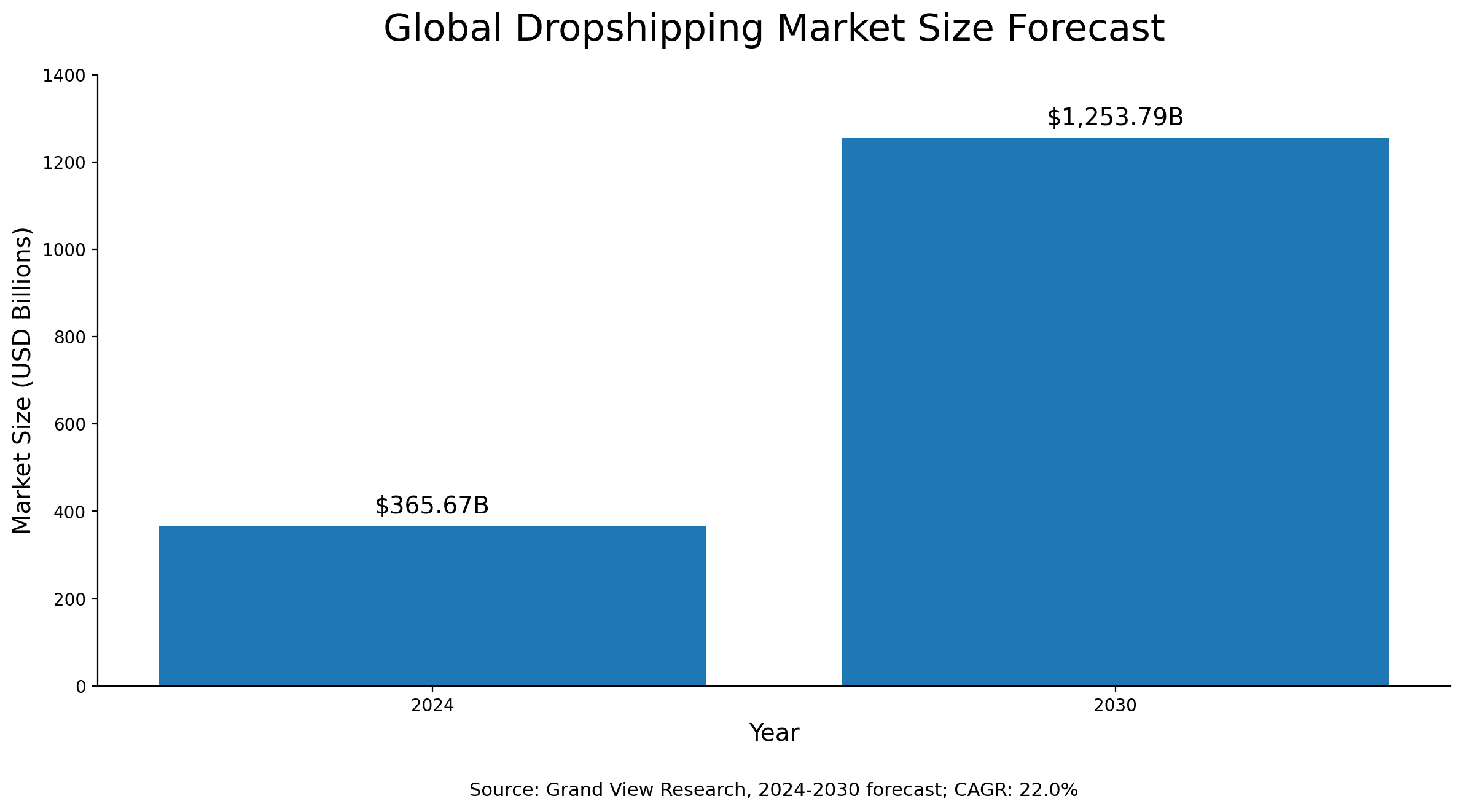
Grand View Research reported that the global dropshipping market size was approximately $365.67 billion in 2024, with an expected compound annual growth rate of 22.0% from 2025 to 2030. The market is projected to reach approximately $1.25 trillion by 2030. Key growth drivers include ecommerce adoption, mature digital payment systems, cross-border trade convenience, and sellers’ demand for low-inventory business models.
However, market growth does not mean dropshipping is becoming easier. In fact, the competitive threshold in 2026 is higher than before. In the past, many sellers could generate orders with low-cost products, simple product pages, and paid ads. Today, consumers pay close attention to tracking updates, delivery time, product packaging, customer reviews, and after-sales response. A more professional dropshipping logic in 2026 is this: use dropshipping to reduce inventory risk, validate product demand through real orders, improve the customer experience through supply chain optimization, quality inspection, packaging, and logistics management, and then gradually upgrade winning products into branded products.
What is the dropshipping model?
The basic operating logic of dropshipping
The core dropshipping process is straightforward. A seller first selects products and lists them on Shopify, WooCommerce, TikTok Shop, Amazon, eBay, or another sales channel. When a customer places an order, the seller syncs the order information to a supplier or fulfillment provider. The backend provider then prepares the product, performs quality inspection, packs the order, attaches the shipping label, and dispatches the package. Tracking is sent back to the store so the customer receives a shipping notification.
The seller does not need to hold large amounts of inventory before orders are generated. The seller mainly handles frontend operations—product selection, store pages, ad creatives, content marketing, customer communication, and data analysis. The supply chain partner handles backend fulfillment: procurement, warehousing, quality checks, packaging, shipping, and logistics tracking. Shopify describes a similar model: merchants can sell without holding inventory themselves and can outsource packaging and shipping to a third-party fulfillment provider.
Dropshipping does not mean “making money with zero inventory”
Many beginners mistakenly believe dropshipping is a zero-cost business model. Dropshipping can reduce inventory investment, but it does not remove all costs. Sellers still need to pay for store setup, ad testing, creative production, payment processing fees, after-sales costs, and time investment. A more accurate description is that dropshipping is a low-inventory startup method—suitable for testing products before committing to inventory.
Dropshipping vs. traditional ecommerce
Traditional ecommerce (buy first, sell later): Sellers usually purchase inventory first, then arrange warehousing, packaging, and shipping. Stronger control over inventory, packaging, and shipping speed—but higher upfront capital. Misjudged demand can create dead stock.
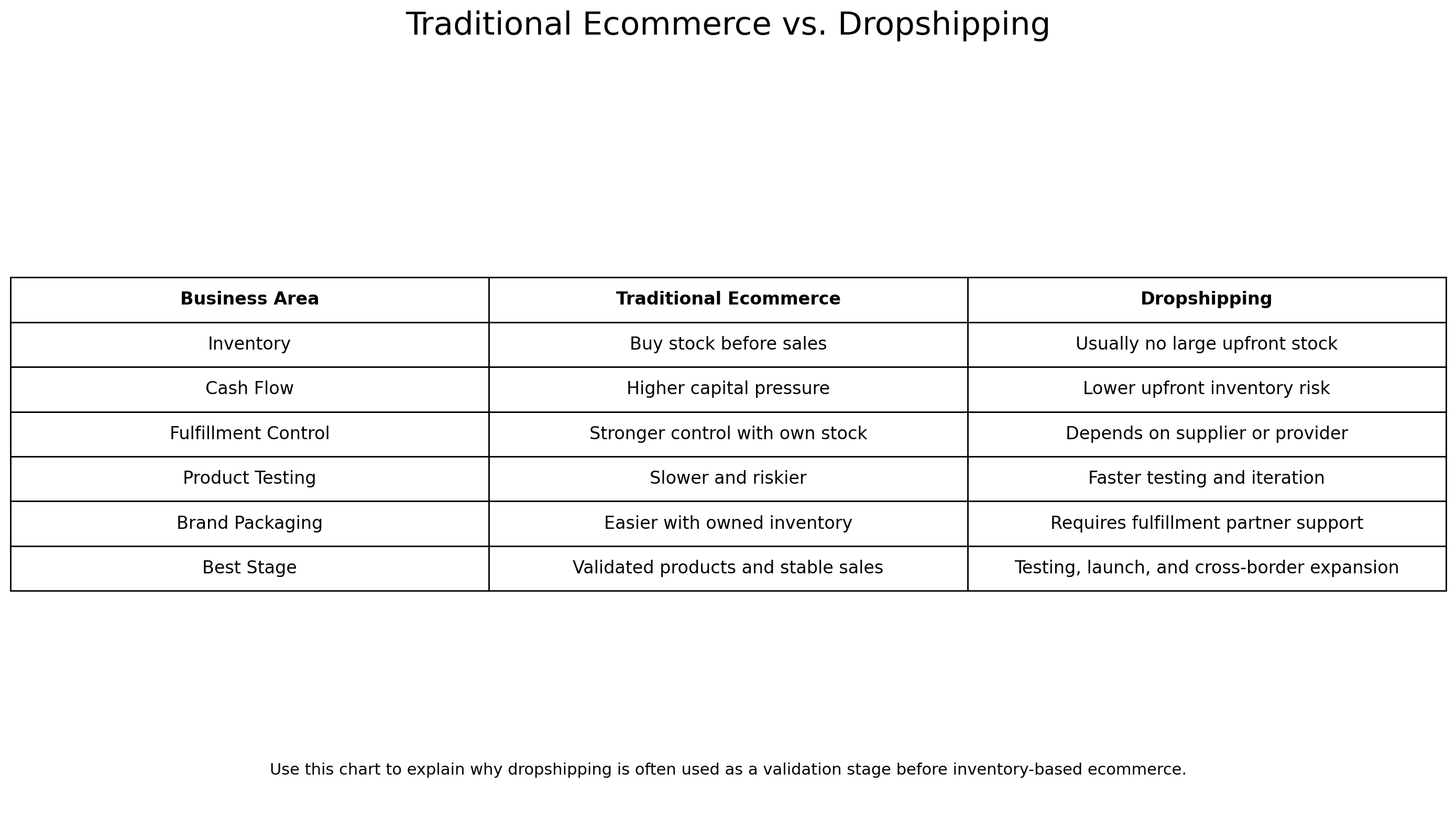
In practice, dropshipping should not be understood as a replacement for traditional ecommerce. It is better understood as a validation stage before traditional inventory-based ecommerce. A common path for mature sellers is to first test products through dropshipping, then move into small-batch stocking after demand is confirmed, followed by branded packaging, product labeling, white-label products, and customized development.
| Dimension | Traditional ecommerce | Dropshipping |
|---|---|---|
| Inventory upfront | Usually required | Minimal or none |
| Capital intensity | Higher | Lower early on |
| Control over fulfillment | Stronger | Depends on partner |
| Best use case | Validated SKUs | Testing and iteration |
Core advantages of the dropshipping model
Lower inventory risk
The most direct advantage is reduced inventory risk. With dropshipping, sellers can test multiple product directions first—then focus budget and supply chain resources on the best performers once data proves demand.
Better capital efficiency and faster product testing
Traditional ecommerce ties capital in procurement and warehousing. Dropshipping lets sellers allocate more capital to ad testing, short-form creatives, product page optimization, email marketing, and conversion—especially important for Shopify stores that must earn their own traffic.
Consumer trends move quickly in 2026. Dropshipping allows faster iteration instead of spending months on production and warehousing before launch. The same SKU can be tested across multiple angles (e.g. kitchen grease vs. bathroom scale vs. pet hair) using CTR, add-to-cart, checkout, and CPA.
Better fit for small teams and a path toward branding
Small teams and solo operators benefit when a fulfillment partner handles sourcing, QC, packaging, global shipping, and tracking updates. Early dropshipping can look similar across sellers—but it can also be the testing stage for a branded business: thank-you cards, stickers, custom bags, manuals, hang tags, labels, then white-label and OEM/ODM as volume grows.
Best sales platforms for dropshipping in 2026
Platform choice should match your traffic source, fulfillment capability, and compliance appetite. Below is a practical overview for US, UK, EU, and global sellers evaluating Shopify, WooCommerce, TikTok Shop, Amazon, eBay, and Etsy.
Shopify: independent stores and branded dropshipping
Shopify fits sellers building a long-term brand: control over pages, brand visuals, bundles, customer data, email, and repeat purchase flows. Combine with TikTok, Meta, Instagram, Google, Pinterest, or SEO depending on your niche (pet, home, cleaning, beauty tools, fitness accessories, gifts, white-label, custom packaging).
WooCommerce: SEO and WordPress operators
WooCommerce suits teams comfortable with WordPress, SEO, and content sites (e.g. pet care tips, cleaning guides, fitness recovery). Expect to own hosting, plugins, security, speed, payments, and maintenance—Shopify is usually easier for beginners.
TikTok Shop: content-driven products
Strong for products that show before/after, demos, or emotional hooks in short video. TikTok Shop US fulfillment rules require carriers to scan and move standard orders toward In transit within tight windows after Awaiting shipment—late dispatch hurts your late dispatch rate. Confirm your supply chain can meet platform SLAs before scaling.
Amazon, eBay, and Etsy
Amazon allows dropshipping but requires you to be the seller of record and to remove third-party branding from packing slips, invoices, and outer packaging—loose retail-arbitrage dropshipping is high risk.
eBay allows fulfillment from wholesale suppliers; you remain responsible for safe delivery, timelines, and satisfaction. Buying from another retailer or marketplace to fulfill eBay orders is not allowed.
Etsy centers handmade, original design, personalization, and craft supplies. Ordinary bulk factory goods without design or personalization are generally a poor fit; check Etsy’s current policies on production partners and print-on-demand.
Recommended dropshipping service providers in 2026
Evaluate partners on sourcing, QC, branded packaging, automation, tracking sync, logistics stability, after-sales—not only catalog size or headline price.
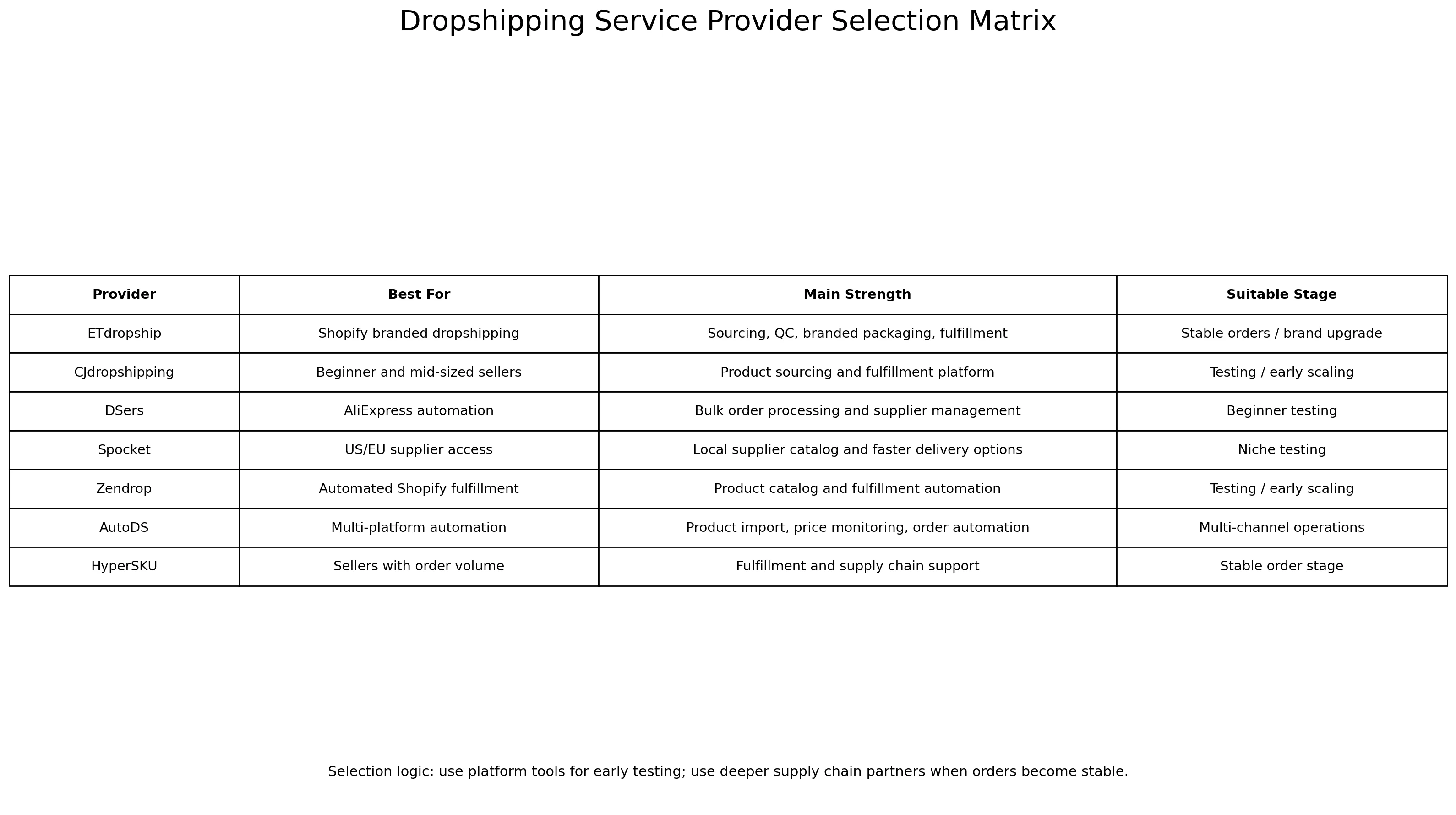
- ETdropship: Strong fit for serious Shopify sellers upgrading from generic dropshipping to branded fulfillment—sourcing, quotes, QC, packaging, warehousing, global shipping, and tracking sync.
- CJdropshipping: Broad catalog and one-stop flow for beginners and SMBs testing categories.
- DSers: AliExpress automation for early testing; quality and speed still depend on each supplier.
- Spocket: US/EU supplier focus—useful when delivery time matters; recheck unit economics vs. China sourcing.
- Zendrop / AutoDS: Automation and multi-channel ops—efficiency without replacing supply-chain judgment.
- HyperSKU: Fulfillment-oriented for sellers with existing volume comparing backend stability.
How to choose a dropshipping provider at different business stages
Beginner testing stage
Focus on learning the loop: list, sell, fulfill, measure. Tools such as DSers, CJdropshipping, Zendrop, or AutoDS can help. Avoid uploading hundreds of SKUs—test 10–30 products in one niche and watch CTR, add-to-cart, checkout, ad spend, and refund rate.
Stable order stage and brand upgrade stage
With stable orders, shift attention to procurement cost, logistics speed, packaging experience, and after-sales. ETdropship, HyperSKU, or CJdropshipping may fit depending on whether you need deep branding and exception handling. When a SKU proves durable, invest in thank-you cards, stickers, custom bags, labels, small-batch stock, then white-label or OEM/ODM.
Real cases: successful dropshipping is about positioning, not copying
Case one: Subtle Asian Treats (Shopify)
In a Shopify case study, Tze Hing Chan co-founded Subtle Asian Treats, selling bubble-tea-themed plush toys and curated cute products—about $19,000 profit within two months. The lesson: the product connected with culture, identity, and gifting—not only “plush toys.” Emotional and shareable angles convert better on social.
Case two: from general testing to focused positioning
Many successful sellers started with broad testing, then doubled down on winners with better pages, creatives, and supply chains. In 2026, use data—not gut feel alone—to validate demand before scaling inventory.
How to start a dropshipping business from zero in 2026
Use this as an operational checklist from niche to brand.
- Choose a niche market with a clear audience and use case (pet travel vs. cleaning vs. small-dog accessories, etc.).
- Build product selection standards: size/weight, breakage risk, visual demo potential, margin for ads, path to branded packaging.
- Calculate real landed cost: product, international shipping, packaging, platform fees, payments, ads, refunds, and support time—not supplier list price alone.
- Confirm supply chain capability: transit times to US/UK/DE/FR, processing SLAs, tracking quality, branding options, lost/damage policy, inventory sync, and automation.
- Build the sales channel (often Shopify first) with 10–30 focused SKUs and trust-rich product pages.
- Test the full fulfillment path with a real test order before scaling ads.
- Test ads and creatives on a small budget, then scale the angles that win on efficiency metrics.
- Upgrade to branding after repeatable sales—packaging, inserts, labels, then inventory and customization.
ETdropship’s role in the dropshipping supply chain
For Shopify sellers, the hardest part is often not the storefront—it is the backend: consistent sourcing, QC before dispatch, accurate weights, timely tracking, and fast resolution of exceptions. ETdropship is aimed at sellers who want to move from generic dropshipping to branded, repeatable fulfillment with sourcing, quotes, inspection, packaging, warehousing, global shipping, and tracking synchronization.
Conclusion: dropshipping in 2026 is a professional light-inventory model
Dropshipping in 2026 should not be sold as “zero-cost” or “quick money.” It is a low-inventory, fast-testing, supply-chain-driven model. Strengths: lower inventory risk, faster validation, flexible cross-border entry. Challenges: similarity of offers, ad costs, logistics expectations, after-sales, and platform rules.
A sustainable path: validate demand with dropshipping, stabilize fulfillment with a professional partner, then invest in brand packaging, small batches, white-label, and custom development—using content and ads on the frontend and reliable sourcing and fulfillment on the backend.
Frequently asked questions
- What is dropshipping?
Dropshipping is a light-inventory ecommerce model. Sellers do not purchase large inventory in advance. After a customer orders, a supplier, sourcing agent, or dropshipping service provider handles procurement, packaging, and shipping. The seller focuses on selection, store operations, ads, customer communication, and after-sales.
- Is dropshipping still worth doing in 2026?
Yes—but it is more professional. Sellers need product quality, shipping speed, experience, branded packaging, and supply chain stability—not only cheap products and simple ads. A strong long-term path is to test with dropshipping, then upgrade into branded packaging, small-batch inventory, and customized products.
- What is the best sales platform for beginners?
For independent stores, Shopify remains a strong default for control and branding. Content- and SEO-strong teams may prefer WooCommerce. Products that demo well on short video can add TikTok Shop once fulfillment SLAs are achievable.
- What type of dropshipping service provider should beginners choose?
Beginners often start with DSers, CJdropshipping, Zendrop, or AutoDS to learn listing and order flow. With stable orders and branding goals, consider a supply chain partner such as ETdropship for sourcing, QC, packaging, and global fulfillment.
- What type of sellers is ETdropship suitable for?
ETdropship fits Shopify sellers—especially those upgrading from standard dropshipping to branded dropshipping—with needs across sourcing, quotes, QC, branded packaging, warehousing, fulfillment, global shipping, and tracking sync.
- What is the difference between dropshipping and traditional ecommerce?
Traditional ecommerce usually buys inventory before selling. Dropshipping tests the market first and fulfills through partners after orders. Traditional offers more control but needs more upfront capital; dropshipping is more flexible with lower early inventory risk.
- Do dropshipping sellers need to hold inventory in advance?
Usually not at the early stage. After consistent sales, consider small-batch stock, custom packaging, labels, or white-label work to improve margins and experience.
- Why do many dropshipping sellers lose money?
Common causes: ignoring total cost (ads, shipping, refunds), pricing too low, slow suppliers, unstable quality, weak trust, and poor after-sales. Professional sellers model full economics before scaling spend.
- Can dropshipping be branded?
Yes. Many brands begin with dropshipping tests, then layer packaging, inserts, manuals, labels, boxes, white-label, and OEM/ODM as data supports investment.
- How should sellers choose a dropshipping service provider?
Look beyond price: sourcing depth, QC, stable logistics, tracking sync, branded packaging, after-sales, and communication. Tools help beginners test; stable brands need end-to-end supply chain partners.

Author
Simon
Simon is a content strategist at ETdropship with extensive professional experience. He has been working in the industry for 13 years and possesses deep knowledge of the eCommerce sector and logistics systems. Passionate about his work, he creates practical and easy-to-understand content that helps sellers successfully run and grow their dropshipping businesses.
Get in touch
Have a question?
Leave your name, WhatsApp and message. We'll get back to you soon.
Ready to professionalize your Shopify fulfillment?
Move from ad-hoc supplier links to sourcing, QC, branded packaging, and reliable global shipping—with a team built for independent brands.
