
By 2026, dropshipping is no longer just listing low-cost products and waiting for suppliers to ship. As Shopify, TikTok Shop, Amazon, Temu, SHEIN, and other platforms accelerate global competition, consumers expect faster delivery, better quality, reliable packaging, and professional after-sales support. For cross-border sellers, long-term profitability depends on supply chain stability, fulfillment reliability, branding support, and fast resolution when orders go wrong. Grand View Research estimates the global dropshipping market at approximately USD 365.67 billion in 2024, growing at 22.0% CAGR from 2025 to 2030 toward roughly USD 1.25 trillion by 2030—driven by ecommerce infrastructure, digital payments, social marketing, and low-inventory selling. This guide explains policy context, how to pick partners by stage, and ten suppliers worth comparing in 2026.
Sources & further reading
- Grand View Research — Dropshipping market size & forecast
- European Commission — General Product Safety Regulation (GPSR)
- European Commission — Environment & packaging (PPWR context)
- U.S. CBP — Internet purchases / ecommerce imports (basics)
- Shopify — Global ecommerce sales outlook
Policies and forecasts change. Confirm dates and details on each official page before making business decisions.
1. Dropshipping market background in 2026: why supplier selection matters
Dropshipping lowers the barrier to entry: sellers can test demand with ads, social, SEO, or influencers before buying inventory. That flexibility still matters for Shopify and independent stores—but the environment has changed.
- Delivery expectations: Amazon, Temu, and SHEIN have trained buyers to expect faster shipping. If an indie store routinely takes 20–30 days, complaints, refunds, and payment disputes rise. Evaluate real routes, destination performance, tracking stability, and after-sales speed.
- Product homogeneity: Trending SKUs get copied fast across TikTok, Meta, and spy tools. Without packaging, bundling, content, CX, or brand differentiation, sellers slide into price wars.
- Compliance cost: Major markets focus on product safety, sustainable packaging, declarations, and tax. Reliable suppliers should help with product information, packaging rules, QC, declaration support, and after-sales—not only "ship the box."
2. Policy changes affecting dropshipping sellers in 2026
2.1 United States: low-value import and landed cost
Many sellers relied on low-cost small parcels from China to the U.S. In 2025, the U.S. ended de minimis duty-free treatment for certain low-value goods from China and Hong Kong, affecting tax, clearance, and logistics economics for some direct-shipping models.
In 2026, model full landed cost: product, freight, duties/fees, platform fees, ads, refunds, and after-sales—not only supplier list price.
2.2 EU GPSR: product safety obligations
The EU General Product Safety Regulation (GPSR) tightens obligations for many non-food consumer products sold to EU consumers—safety information, economic operators, risk assessment, recalls, and consumer protection.
Before scaling toys, kids products, electronics accessories, home goods, fitness, or beauty tools to the EU, verify documentation, instructions, labels, and warnings. Ask suppliers for materials, certificates, QC photos, and pre-shipment checks—not only MOQ and shipping days.
2.3 EU PPWR: packaging compliance and sustainability
The Packaging and Packaging Waste Regulation (PPWR) sets clearer expectations for recyclability, reduction, labeling, and waste management—especially relevant if you use branded packaging.
Balance brand experience, protection, cost, and compliance: boxes, cards, manuals, stickers, hang tags, and inserts should be intentional—not decorative waste.
3. Advantages of the dropshipping business model
3.1 Lower startup cost and faster market testing
Traditional ecommerce ties cash in inventory, warehousing, and labor. Dropshipping lets you list first, collect payment, then have the partner purchase, pack, and ship—reducing trial-and-error cost when testing pet toys, kitchen gadgets, or fitness accessories with real CTR, ATC, conversion, and refund signals.
3.2 Flexible testing and global expansion
Adjust for seasons, holidays, trends, and ad data. Many partners offer international lanes, regional warehouses, or global fulfillment so you can test the U.S., U.K., Germany, France, Canada, and Australia without building local warehouses on day one.
3.3 Small teams, automation, and a path to branding
One- to three-person teams drown if they manually source, pack, ship, and update tracking. Integrations that sync Shopify orders and return tracking save ops hours. Mature dropshipping also supports branded packaging, labels, inserts, manuals, small-batch customization, and OEM/ODM as winners emerge.
4. Dropshipping vs. traditional inventory
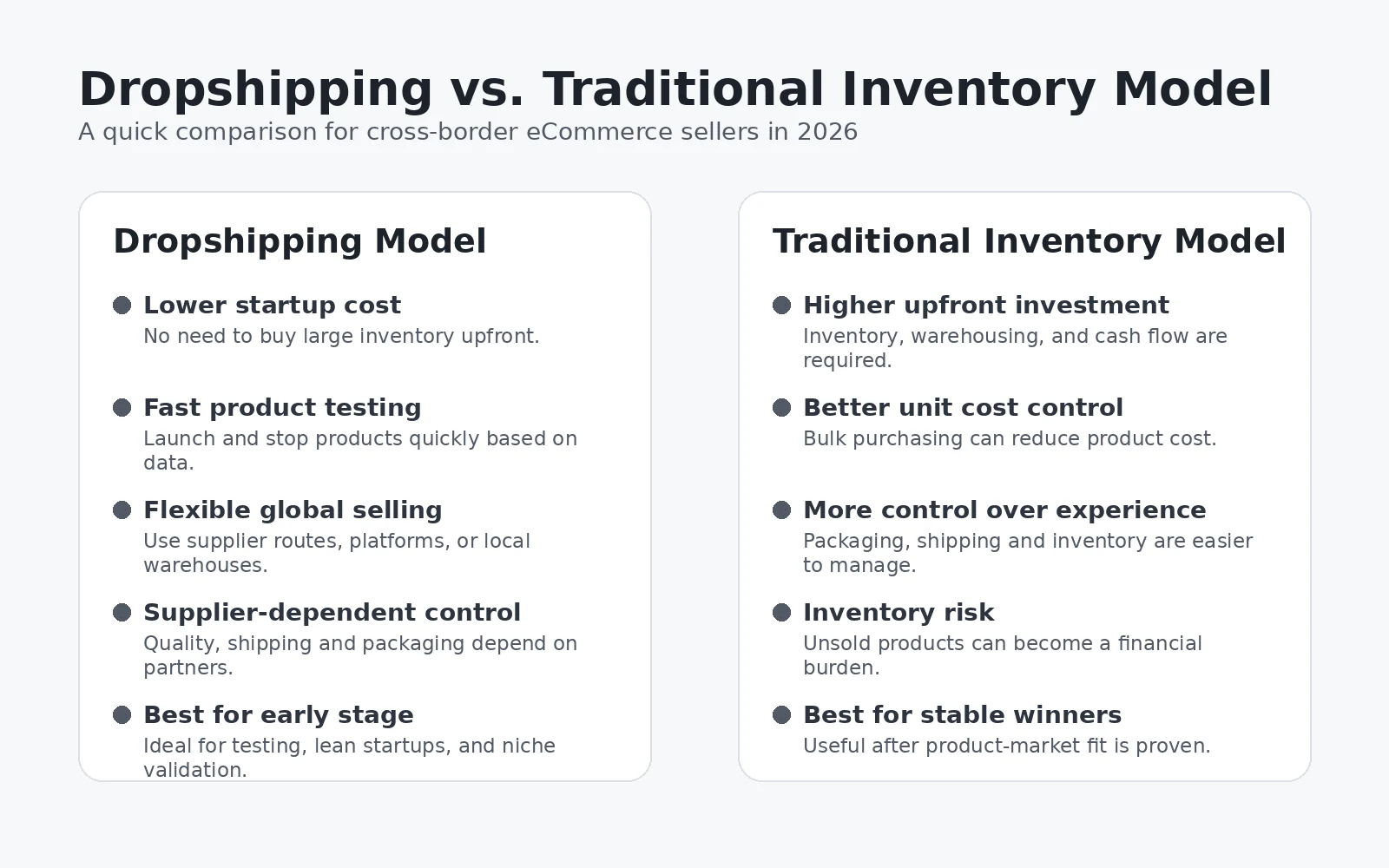
In real operations, dropshipping and traditional inventory are not completely opposite models. A more mature approach is to use dropshipping for early product testing, work with supply chain agents to optimize cost and shipping during the growth stage, and then use small-batch inventory or overseas warehouses for stable bestsellers.
5. Top 10 best dropshipping suppliers in 2026
Below is a practical shortlist—not a ranking of "best for everyone", but best fit by stage, channel, and geography. Always place sample orders and measure landed cost, SLA, and after-sales on your own SKUs.
1. ETdropship — branding and deep supply chain (Shopify-first)
Best when you are moving past catalog dropshipping into QC, branded packaging, warehousing, global shipping, and after-sales. Strong fit for Shopify sellers optimizing logos, custom boxes, stickers, manuals, thank-you cards, inserts, hang tags, and small-batch / private label upgrades—especially if you are outgrowing AliExpress-style variability.
2. CJdropshipping — beginners and SMB testing at scale
Broad catalog, sourcing requests, warehousing, fulfillment, and integrations across Shopify, eBay, WooCommerce, Etsy, TikTok Shop, Temu, AliExpress, plus regional warehouses and options like CJPacket. Great for category tests—sample first; popular SKUs attract copycats.
3. HyperSKU — growing DTC and brand sellers
Fulfillment-oriented platform for teams with volume moving from basic dropshipping to stable ops across Shopify/WooCommerce—pet, home, electronics accessories, beauty tools, TikTok-style SKUs, and light customization. You still own merchandising, ads, and positioning.
4. Zendrop — fast Shopify launch and automation
Beginner-friendly Shopify flows: discovery, import, pricing, automated fulfillment, and shipping options—plus AI store tooling. Good for home, pet, beauty, gifts, and POD-style tests. Re-check unit economics once orders stabilize.
5. Spocket — U.S. and EU supplier focus
Emphasizes US/EU suppliers for speed and experience—home decor, beauty, pet, fashion accessories, gifts. Expect higher product cost vs. China sourcing; model margins with AOV and CAC in mind.
6. DSers — low-cost testing via AliExpress-style supply
Automation across AliExpress, 1688, Alibaba, TikTok workflows: import, bulk orders, tracking, supplier optimization. Excellent testing layer—less ideal as a long-term brand backbone unless you tighten supplier QC and SLAs.
7. AutoDS — multi-channel automation
Research, import, fulfillment, branding helpers, and AI tooling across Shopify, eBay, Facebook Marketplace, etc. Treat it as ops software—still validate real sources, logistics, and after-sales quality.
8. Syncee — local brands and wholesale-style relationships
Marketplace connecting retailers with US, CA, UK, EU, AU and global suppliers; AI search, pricing, auto updates, sync. Strong for mid-ticket and formal supplier relationships in home, fashion, beauty, gifts, baby, pet, lifestyle—watch COGS vs. ad spend.
9. Trendsi — women’s fashion and boutiques
Vertical fashion supply with dropshipping, branding, and quality positioning. Plan for sizing, returns, fabric copy, model info, and refresh cadence—apparel returns can erode margin if the funnel is weak.
10. Gelato — print-on-demand and local production
Global POD with local production to cut cross-border distance for apparel, drinkware, wall art, phone cases, etc. Moat is design + audience + story, not generic uploads.
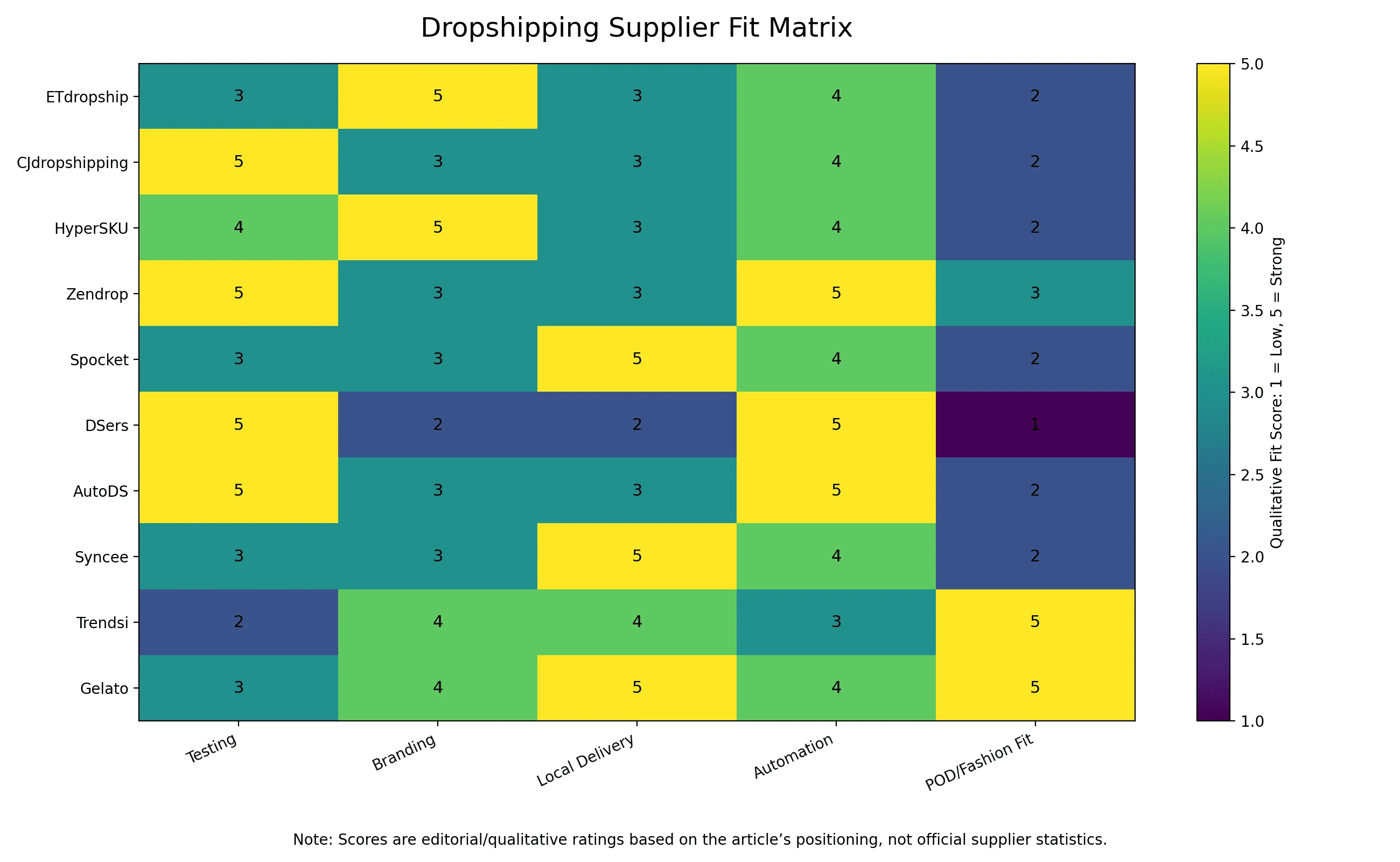
6. Practical workflow: from product selection to stable fulfillment
- Define market and segment (e.g. U.S. pet owners vs. EU home buyers)—compliance, shipping, returns, and CAC differ.
- Select SKUs beyond "trending"—size/weight/fragility, demo clarity, margin headroom, after-sales risk.
- Compare suppliers on landed cost—product, domestic/international freight, packaging, platform/payment fees, ads, refunds, duties.
- Order samples—materials, color drift, packaging, weight/dimensions, unboxing for content.
- Build high-trust Shopify PDPs—use cases, specs, shipping/returns, FAQs; avoid copy-paste supplier text.
- Test creatives with small budgets—TikTok/Meta/Google/Pinterest; diagnose CTR vs. ATC vs. checkout drop-offs.
- Sync orders and SLAs—inventory signals, tracking back to Shopify, exception rules.
- Operationalize after-sales—delays, bad tracking, damage, disputes; pick partners who respond fast.
- Optimize after 7–14 stable days—routes, packaging, bundles, small-batch buys, related SKUs.
- Graduate winners—white label, private label, custom packaging, overseas stock as volume justifies it.
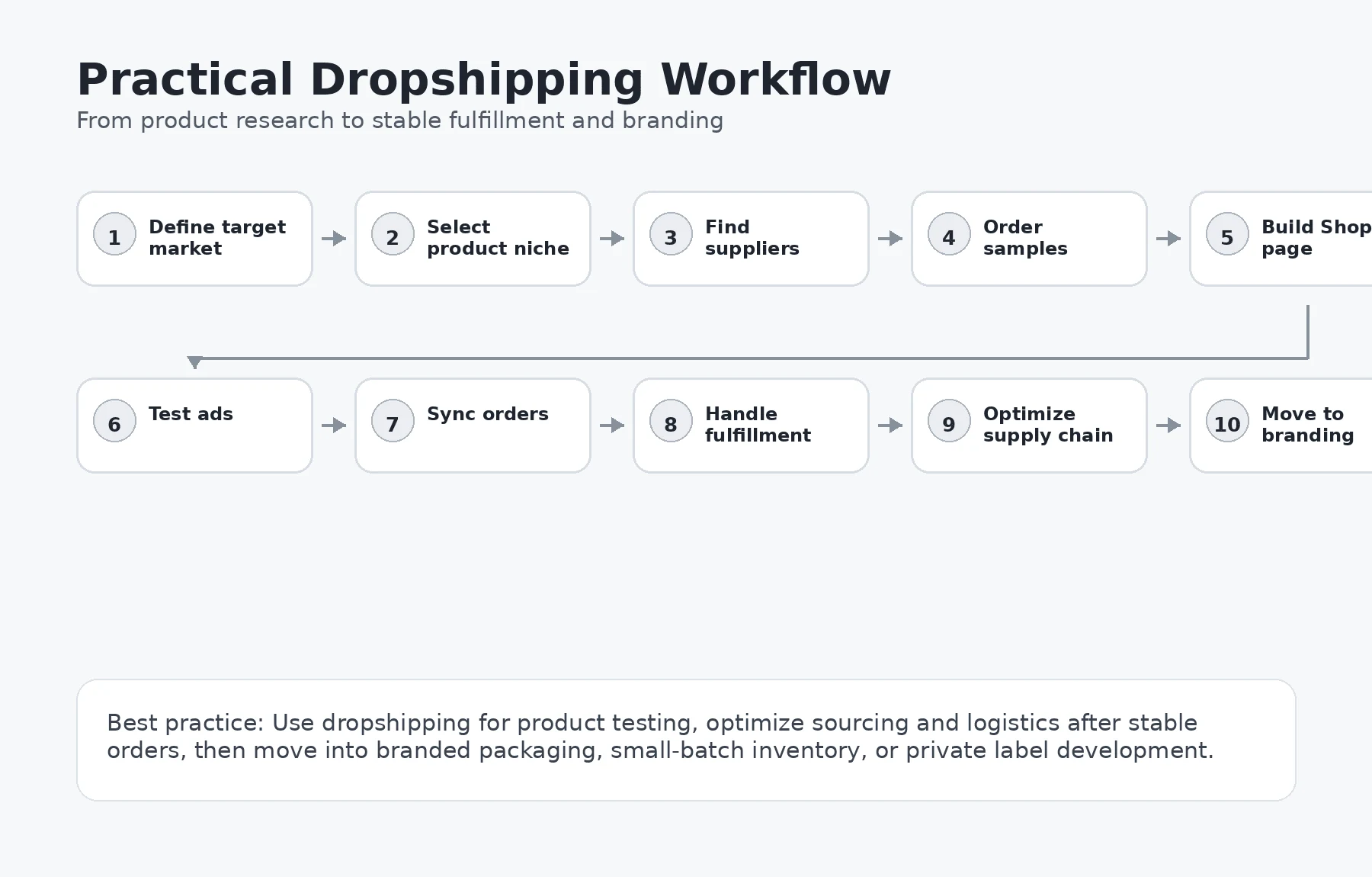
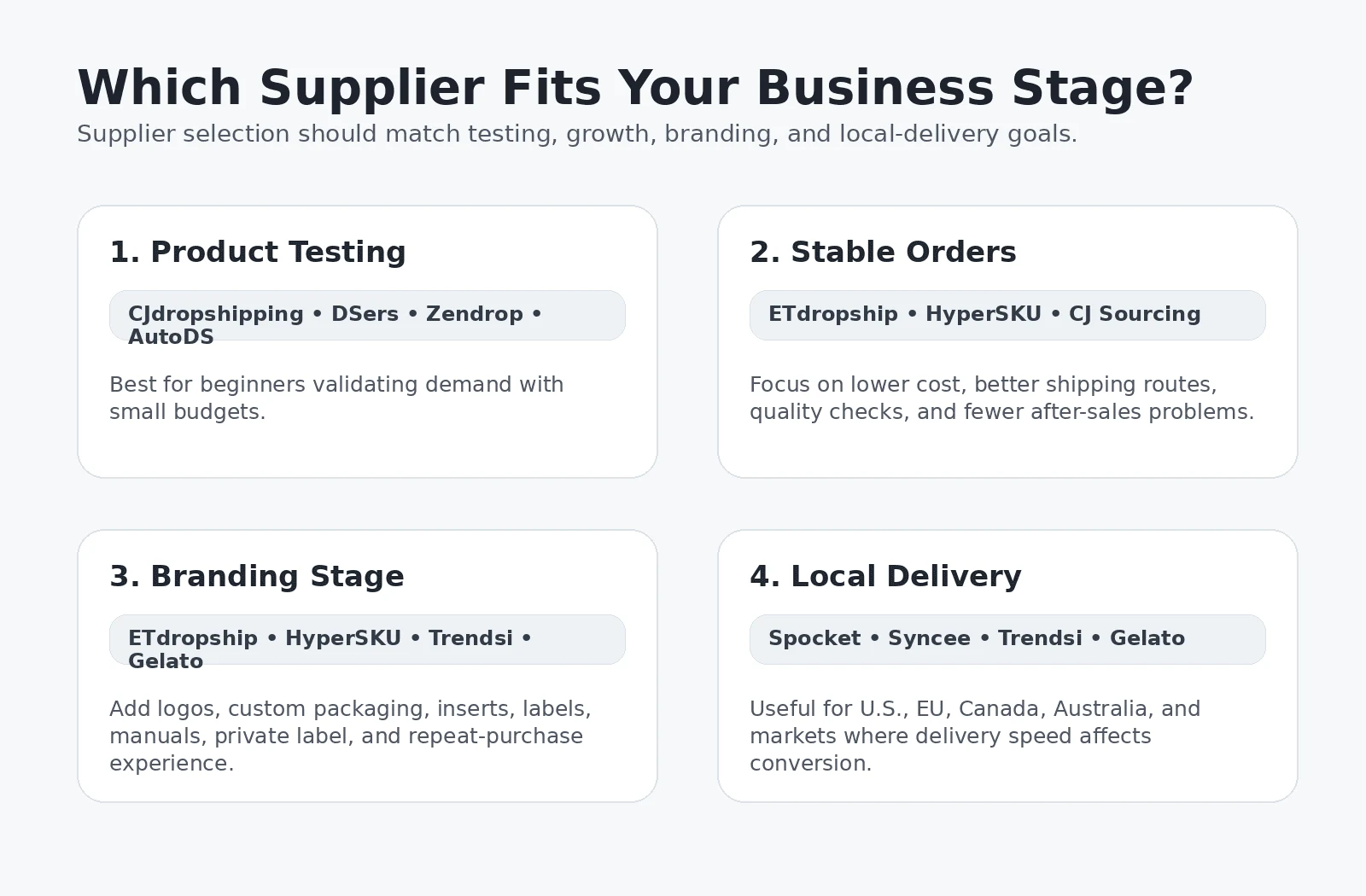
7. How to choose suppliers based on business stage
Beginner testing
Prioritize speed of learning: CJdropshipping, DSers, Zendrop, AutoDS. Keep catalogs tight; measure data before investing in custom packaging.
Stable order volume
Prioritize cost stability, QC, fewer defects: ETdropship, HyperSKU, and deeper CJ sourcing workflows. Document SKU mapping, packaging standards, and exception SLAs.
Branding and differentiation
Prioritize packaging, labeling, and product story: ETdropship, HyperSKU, Trendsi, Gelato depending on category (general vs. fashion vs. POD).
US/EU local delivery experience
Prioritize local or regional fulfillment: Spocket, Syncee, Trendsi, Gelato—trade higher COGS for speed and trust where the brand promises it.
8. Conclusion: the best supplier depends on your stage
In 2026, catalog size and headline price are weak predictors of fit. Match partners to store stage, target markets, category, and brand plan: beginners lean on CJ / DSers / Zendrop / AutoDS for tests; US/EU experience may favor Spocket, Syncee, Trendsi, Gelato; scaling Shopify brands often graduate toward ETdropship and HyperSKU for deeper fulfillment and branding.
The mature path: dropship to derisk, optimize supply chain in growth, then compound with QC, packaging, inventory, and customization—escaping pure price competition with margin, repeats, and real brand equity.
Frequently asked questions
- Is dropshipping still worth doing in 2026?
Yes—but not as blind copy-paste of trending SKUs with slow shipping. Winners focus on niches, fulfillment reliability, compliance-aware sourcing, and content-driven acquisition.
- Which dropshipping supplier should beginners choose first?
Most teams start with CJdropshipping, DSers, Zendrop, or AutoDS for fast tests. Keep SKU count small, sample everything that matters, and graduate once data proves repeatability.
- Is ETdropship suitable for Shopify sellers?
If you need QC, branded packaging, customization, global shipping, and responsive after-sales beyond basic listing tools, ETdropship is built for long-term Shopify operations—especially after you have a clear product direction.
- Is dropshipping better than traditional wholesale?
Neither is universally better. Dropshipping reduces early inventory risk; wholesale and warehousing improve control and speed for proven SKUs. Mature sellers combine both over time.
- China suppliers vs. local US/EU suppliers?
China routes often win on selection and COGS; local suppliers can win on speed and perceived trust. Many brands mix: test from Asia, fulfill winners closer to customers.
- Do suppliers need to support branded packaging?
Not mandatory for short tests—but high leverage for LTV, trust, and differentiation once you scale. Even light branding (inserts, stickers, mailers) moves conversion and reviews.
- How can sellers judge whether a supplier is reliable?
Sample orders, track record on your lanes, tracking quality, QC evidence, and how exceptions are handled. Claims are cheap—data from your own SKUs is expensive and worth it.
- What should sellers prioritize most in 2026?
True profit after all-in costs, logistics stability, and compliance risk (product + packaging + declarations). If any pillar is weak, ads only accelerate losses.

Author
Simon
Simon is a content strategist at ETdropship with extensive professional experience. He has been working in the industry for 13 years and possesses deep knowledge of the eCommerce sector and logistics systems. Passionate about his work, he creates practical and easy-to-understand content that helps sellers successfully run and grow their dropshipping businesses.
Get in touch
Have a question?
Leave your name, WhatsApp and message. We'll get back to you soon.
Ready to upgrade fulfillment and branding?
ETdropship helps Shopify sellers move from basic dropshipping to QC, branded packaging, and dependable global shipping—talk to us about your SKUs and target markets.
