Shopify Dropshipping vs Amazon FBA: Which is Better for New Sellers in 2026?
As the global e-commerce market continues to grow at a rapid pace, more and more new sellers are entering the industry. Choosing the right platform and fulfillment model is one of the biggest challenges they face. Shopify Dropshipping and Amazon FBA (Fulfillment by Amazon) are two of the most popular e-commerce models. For new sellers, making the right choice between the two is crucial.
In this article, we’ll dive deep into the current state of the e-commerce market in 2026, compare Shopify Dropshipping and Amazon FBA, and provide practical guidance, successful case studies, and insights to help new sellers make the best decision.
1. What is Shopify Dropshipping?
Shopify Dropshipping is a low-entry e-commerce sales model where sellers create an online store using the Shopify platform, select products from third-party suppliers, and forward the orders to the suppliers who directly ship the products to the customers. Sellers do not need to purchase inventory or manage logistics and can focus on product marketing and customer service.
1.1 Advantages of Shopify Dropshipping
Low Startup Costs: One of the biggest advantages of Shopify Dropshipping is its low startup costs. Sellers do not need to buy inventory or worry about warehousing and logistics. According to Shopify, about 20% of new sellers start with an initial investment of $500 or less, making it ideal for those with limited budgets.
High Flexibility: Shopify Dropshipping offers high flexibility. Sellers can adjust their product line based on market demand, select multiple suppliers, and customize their store’s design and marketing strategies. This level of freedom is not available on many other platforms.
Global Market Opportunities: Shopify supports selling in multiple languages and currencies, which makes it easy for sellers to reach a global audience. This gives sellers the ability to tap into international markets.
Automation Tools: Shopify offers several automation tools, such as order management, customer support, and marketing features, that help sellers save time and effort.
1.2 Challenges of Shopify Dropshipping
High Competition: Due to the low entry barriers, the competition in Shopify Dropshipping is extremely fierce. New sellers may find it difficult to stand out in the crowded market, especially when it comes to driving traffic and building a brand.
Quality Control Issues: Since the seller relies on third-party suppliers to fulfill the orders, they have no direct control over the product quality. If the supplier’s products are of poor quality, it could affect the seller’s reputation.
Logistics and Delivery Problems: Even though the supplier handles shipping, delays or issues with the logistics process are sometimes unavoidable, which can negatively impact the customer experience.
Customer Service Challenges: Since the seller doesn’t directly manage order fulfillment, customer service can be more challenging. Issues such as returns, refunds, and other customer inquiries often require coordination with the supplier.
1.3 Successful Case Study
For example, FitTrack, a Shopify Dropshipping store that specializes in smart health scales, quickly scaled up by leveraging social media marketing and influencer partnerships. They reached over $2 million in annual sales in 2019. FitTrack collaborated with Instagram health influencers to increase brand exposure, while optimizing SEO and running Google ads to drive store traffic.
2. What is Amazon FBA?
Amazon FBA (Fulfillment by Amazon) is a service provided by Amazon where sellers ship their products to Amazon's fulfillment centers, and Amazon takes care of storage, packaging, shipping, and customer service. Sellers can leverage Amazon's large customer base and efficient logistics system to sell products globally.
2.1 Advantages of Amazon FBA
Global Shipping Network: Amazon FBA provides sellers with a powerful global shipping service, allowing products to be delivered to customers quickly. According to the 2019 Amazon Global Logistics Report, Amazon Prime's average delivery time in the U.S. is just 2 days, making it one of the fastest delivery services in the world.
Platform Traffic and Brand Effect: Amazon has one of the largest active customer bases globally. Sellers can benefit from the platform’s traffic to quickly acquire customers. According to Jungle Scout, Prime members tend to buy more frequently and spend more compared to non-members, making FBA a great way to tap into this loyal, high-value customer base.
Advertising and Promotional Tools: Amazon offers powerful advertising tools, such as Sponsored Products and Sponsored Brands, to help sellers increase product visibility. By 2026, Amazon’s advertising revenue is projected to exceed $10 billion, giving sellers the chance to leverage these advertising platforms to boost sales.
Customer Service Support: Amazon FBA handles all aspects of customer service, including returns, refunds, and customer inquiries. This greatly reduces the operational burden on sellers.
2.2 Challenges of Amazon FBA
High Fees: Amazon FBA fees can be quite high, including storage fees, shipping fees, and other service-related costs. Sellers who have low sales volumes or large, bulky products may face significant costs, impacting their profitability.
Inventory Management Complexity: Sellers need to maintain a certain level of inventory in Amazon’s warehouses to avoid stockouts. Overordering inventory can lead to higher storage fees, so inventory management is a critical part of using Amazon FBA.
Platform Rule Restrictions: Amazon has strict rules and regulations that sellers must follow. Sellers need to adhere to pricing policies, product listings guidelines, and other platform rules. Failing to comply with these rules can result in account suspensions or bans.
2.3 Successful Case Study
Anker, a company specializing in smart electronics, leveraged Amazon FBA to scale rapidly. Anker's products reached global markets, and with the help of Amazon ads, they grew their annual sales to over $1 billion by 2020. Anker optimized their product listings, regularly ran promotions, and carefully targeted keywords to expand their brand presence on Amazon.
3. E-commerce Market Trends and Insights for 2026
3.1 Global E-commerce Growth Trends
According to Statista and eMarketer, the global e-commerce market is expected to surpass $6.3 trillion in sales by 2026, showing a 30% growth compared to 2023. This growth is not only driven by traditional e-commerce platforms but also by the rise of social commerce and emerging markets. For sellers choosing between Shopify Dropshipping and Amazon FBA, understanding these market trends is crucial.
Emerging Markets' Growth: Asia-Pacific, particularly China, India, and Southeast Asia, are projected to account for 60% of global e-commerce sales by 2026. With increasing internet penetration and growing middle classes, these regions present huge opportunities for sellers. Shopify Dropshipping is ideal for entering these emerging markets due to its flexibility and ease of operation.
The Rise of Social Commerce: Social commerce is booming, with platforms like Instagram, TikTok, and Facebook increasingly integrating shopping features. By 2026, social commerce is expected to account for 10% of the global e-commerce market. Sellers can utilize these platforms for product promotion, influencer marketing, and short video marketing to quickly gain exposure.
Personalized and Customized Products: Consumers are increasingly drawn to personalized and customized products. According to a Nielsen survey, around 66% of global consumers prefer to buy products that align with their personal preferences and lifestyle. For sellers aiming to differentiate their brand, offering unique and customized products is a powerful way to gain market share.
3.2 Amazon FBA and Shopify Dropshipping Market Trends
3.2.1 Amazon FBA’s Market Dominance
The Power of Amazon Prime: As of 2026, Amazon Prime is expected to surpass 200 million members, giving sellers access to a highly loyal and high-spending customer base. Amazon Prime members typically purchase more frequently and have higher annual spending, which is a major benefit for FBA sellers.
Global Expansion Opportunities: Amazon’s vast fulfillment network allows sellers to easily ship products to international markets. With Amazon FBA, sellers can reach customers not only in North America and Europe but also in emerging markets such as Latin America, Asia, and Africa.
3.2.2 Shopify Dropshipping’s Growing Market
Multi-channel Selling: Shopify has become the platform of choice for many sellers looking to expand their reach across multiple sales channels. Sellers can connect their Shopify store with platforms like Amazon, eBay, Facebook, and Instagram, allowing them to tap into various customer segments and increase sales.
Social Media Integration: Shopify integrates seamlessly with social media platforms, enabling sellers to sell directly through Instagram and Facebook stores. Sellers can use social media to run targeted ads, reach a larger audience, and increase brand visibility.
Eco-Friendly Products: Sustainability is a growing trend, with consumers increasingly preferring eco-friendly products. Sellers can choose to work with sustainable suppliers and offer environmentally-friendly products that cater to the growing demand for green products.
4. How to Choose Between Shopify Dropshipping and Amazon FBA?
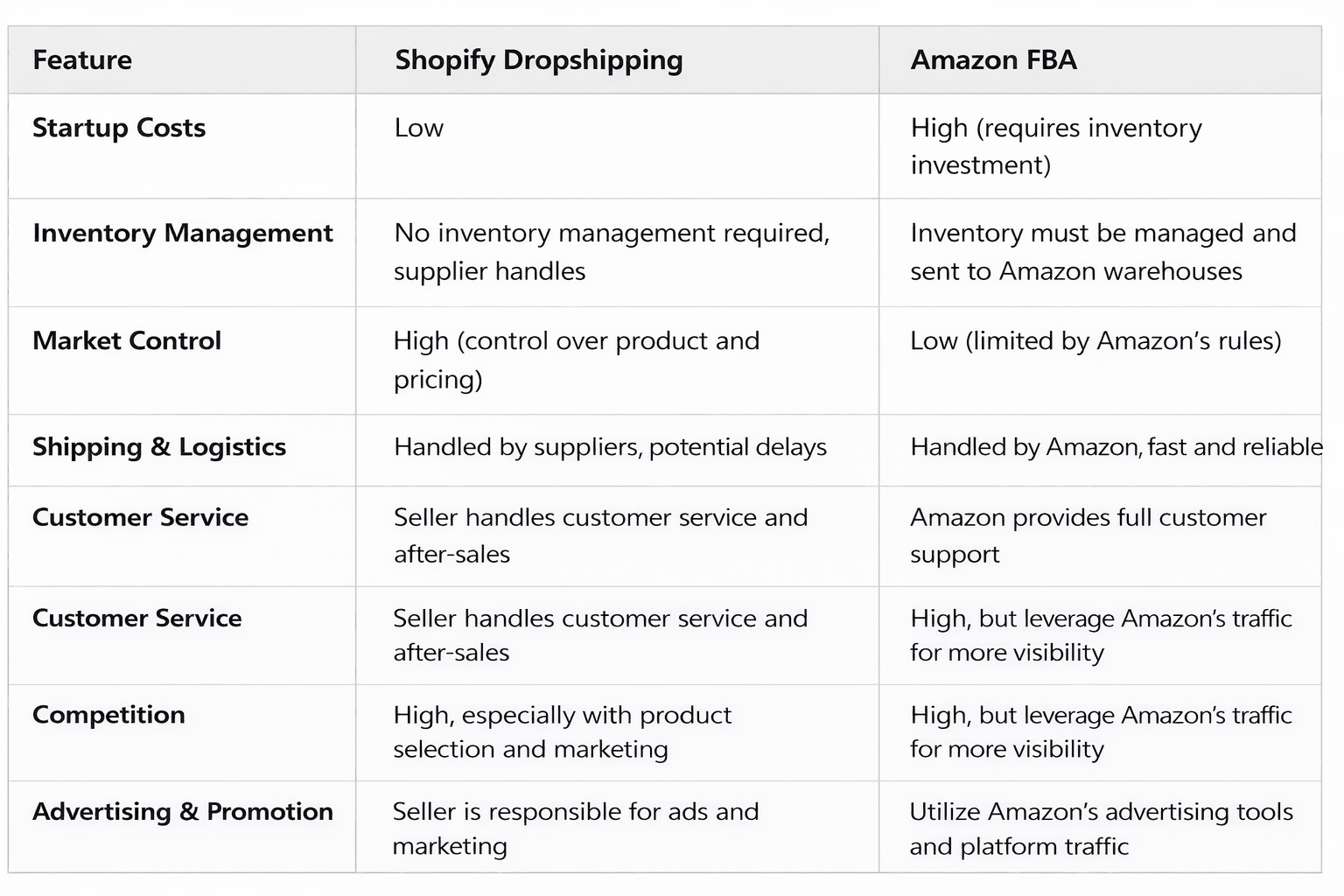
5. Conclusion: Making the Right Choice for 2026
Choosing the right model depends on your budget, brand strategy, product type, and operational capabilities. Whether you choose Shopify Dropshipping or Amazon FBA, it’s important to understand both the advantages and challenges each model presents.
Choose Shopify Dropshipping: If you have limited funds, want to operate with more flexibility, and are focused on building a unique brand, Shopify Dropshipping is an ideal choice. You can leverage social media platforms, SEO optimization, and multi-channel selling to gain exposure and grow your business.
Choose Amazon FBA: If you have a bigger budget and want to tap into Amazon’s massive traffic quickly, Amazon FBA is the way to go. With powerful advertising tools, global reach, and a solid customer base, you can scale rapidly on this platform.
Whatever model you choose, remember to stay flexible, continuously optimize your operations, and adapt to the changing market demands.
6. Global E-commerce Market Trends and Insights for 2026
6.1 Global E-commerce Growth Trends
As 2026 approaches, the global e-commerce market has entered a new phase of development. According to reports from Statista and eMarketer, global e-commerce sales are expected to exceed $6.3 trillion by 2026, with significant growth occurring in emerging markets and specific market segments. For example, as internet penetration increases in countries like China, India, and Southeast Asia, the potential for e-commerce growth in these regions is immense.
6.1.1 Rise of the Asian Market
According to eMarketer, the Asia-Pacific region will account for more than 60% of global e-commerce sales by 2026. Particularly in Southeast Asia, the rise of the middle class and the widespread adoption of digital payment methods will accelerate e-commerce growth. Therefore, Shopify Dropshipping is particularly well-suited for entering these emerging markets due to its flexibility, enabling sellers to quickly adapt to local demands.
6.1.2 The Rise of Social Commerce
In recent years, social commerce has become mainstream, with platforms like Instagram, TikTok, and Facebook increasingly enhancing their shopping features. By 2026, social commerce is expected to account for over 10% of the global e-commerce market. Selling products through social platforms has become an essential channel for many e-commerce sellers. Especially with influencer marketing and short-form video promotions, sellers can quickly reach more customers and drive sales.
6.1.3 Growth in Demand for Personalized and Customized Products
Consumers are increasingly demanding personalized and customized products. For instance, consumers are more inclined to buy unique products that match their personalities and needs, presenting a significant opportunity for sellers seeking to establish a strong, differentiated brand. Shopify Dropshipping is particularly suitable for creating customized and personalized products, helping sellers build a distinct brand image in the market.
6.2 Market Trends for Amazon FBA vs Shopify Dropshipping
6.2.1 Amazon FBA Market Outlook
Amazon FBA continues to dominate the global e-commerce market, especially in mature markets like North America, Europe, and Japan. According to Statista and Jungle Scout, Amazon FBA sellers’ sales have steadily increased over the years, and by 2026, Amazon’s global sales are projected to surpass $500 billion, with FBA contributing a significant portion.
Amazon Prime’s Value-Add Effect: With the growing number of Amazon Prime members (expected to surpass 200 million by 2026), FBA sellers will benefit from increased exposure and higher sales. Prime members not only purchase more frequently but are also more willing to pay a premium for convenient delivery. Amazon’s efficient membership system has fueled the success of FBA, enabling sellers to leverage the platform's traffic for rapid growth.
Global Expansion Opportunities: Amazon's global logistics network enables sellers to easily implement cross-border e-commerce. With FBA, sellers can distribute products across multiple international markets. FBA allows sellers to reach customers in the US, Europe, Latin America, Asia, and even Africa, providing excellent opportunities for global business expansion.
6.2.2 Shopify Dropshipping Market Outlook
With the trend of global e-commerce and multi-channel selling, Shopify Dropshipping continues to experience strong growth into 2026. Especially in emerging markets and niche segments, Shopify Dropshipping provides entrepreneurs with a more flexible operational model. According to Shopify data, by 2026, the platform’s total sales will continue to rise, and the number of sellers will increase by approximately 15%.
The Rise of Multi-Channel E-commerce: As sellers become more aware of the limitations of single-platform selling, more and more merchants are opting for multi-platform and multi-channel strategies. Shopify supports seamless integration with platforms such as Amazon, eBay, Facebook, and Instagram, allowing sellers to sell across multiple channels and enhance their sales performance.
Shopify’s Integration with Social Media: Shopify’s close integration with social media platforms, particularly Instagram and Facebook, enables sellers to sell products directly on social platforms. Through the use of short-form videos and images, sellers can attract traffic and increase exposure. Additionally, Shopify provides built-in marketing tools that help sellers execute targeted ads and manage customer relationships more efficiently.
The Trend Toward Sustainability: Over recent years, eco-friendly and sustainable products have gained popularity. Consumers are increasingly favoring brands and products that are environmentally friendly, presenting a significant market opportunity for sellers. Shopify Dropshipping sellers can collaborate with environmentally conscious suppliers to offer green products that meet market demand, attracting more eco-conscious consumers.
7. E-commerce Seller’s Guide to Success in 2026
7.1 How to Succeed with Shopify Dropshipping
If you choose to sell through Shopify Dropshipping, here are some practical tips to help you succeed in 2026:
7.1.1 Selecting the Right Products and Suppliers
Product Selection: Choosing the right products is critical in the Shopify Dropshipping model. You need to identify products with strong market demand and moderate competition, preferably products that stand out through differentiation and uniqueness. Tools like Google Trends and Jungle Scout can help you analyze product trends and select those with growth potential in the market.
Supplier Selection: Supplier selection directly impacts product quality and customer experience. Work with reputable suppliers to ensure consistent product quality, and try to choose suppliers who support fast shipping and international delivery. Platforms like Oberlo and Spocket can help you find high-quality suppliers and automate the order fulfillment process.
7.1.2 Sales Channels and Marketing
Multi-Channel Sales: In addition to your Shopify store, you can also sell on social media platforms like Instagram and Facebook, using their advertising and influencer marketing features to drive traffic. Multi-channel selling helps you reach a broader customer base and expand your brand presence.
Search Engine Optimization (SEO): Shopify allows you to customize your store’s SEO settings, optimize keywords, page titles, and product descriptions to improve your store’s search engine ranking. By optimizing your SEO, you can drive free organic traffic to your store.
Paid Advertising: Utilize platforms like Google Ads and Facebook Ads to target your specific customer demographic, improving conversion rates. Continuously optimizing your ads and marketing strategies will increase your store’s exposure and drive more sales.
7.1.3 Customer Service and After-Sales
Customer Experience: In the dropshipping model, providing excellent customer service is crucial. Ensure timely responses to customer inquiries and handle refunds and returns promptly to maintain customer satisfaction. You can also add value with services like customized packaging or personalized thank-you notes to enhance customer loyalty.
After-Sales Service: Offer great after-sales services, including easy returns, exchanges, and handling customer complaints. Maintaining close communication with your suppliers ensures that any logistics or quality issues are resolved quickly, guaranteeing a good customer experience.
7.2 How to Scale with Amazon FBA
If you decide to use Amazon FBA, here are some specific operational steps:
7.2.1 Selecting High-Demand Products and Optimizing Listings
Product Selection: Use tools like Jungle Scout, Helium 10, and AMZScout to analyze hot-selling products on Amazon. Choosing high-demand, low-competition products can help you stand out on Amazon’s platform.
Optimizing Product Pages: Amazon’s search ranking is heavily influenced by the optimization of product listings. Ensure that your product titles, descriptions, images, and keywords are optimized to improve search rankings. High-quality images and well-written product descriptions can significantly increase your conversion rate and boost sales.
7.2.2 Inventory Management and Logistics
Inventory Management: Use Amazon’s inventory management tools to ensure your product stock is sufficient and avoid stockouts. Additionally, you should avoid overstocking to minimize unnecessary storage fees. Amazon FBA provides powerful tools to help sellers monitor inventory and predict demand more accurately.
Amazon Advertising: Utilize Sponsored Products and Sponsored Brands ads to increase product visibility and drive more sales. Through precise ad targeting, you can present your products to a wider pool of potential customers.
8. Conclusion: How to Choose the Right E-commerce Model for 2026?
In 2026, the right e-commerce model for you will depend on your budget, brand strategy, product type, and operational capacity. Whether you choose Shopify Dropshipping or Amazon FBA, it's important to align your decision with your business goals and available resources.
Choose Shopify Dropshipping: If you have limited funds, want flexibility, and aim to build a unique brand, Shopify Dropshipping is an ideal choice. Leveraging social commerce platforms, SEO, and multi-channel sales, you can quickly access a global customer base.
Choose Amazon FBA: If you have a larger budget and wish to leverage platform traffic for rapid growth, Amazon FBA is a better option. By optimizing ads, managing inventory, and enhancing customer experience, you can scale your business within Amazon's massive marketplace.
Regardless of the model you choose, stay adaptable, continuously optimize your operations and marketing strategies, and respond to the ever-changing market demands.