Netherlands Dropshipping in 2026: Trends and a Complete Beginner-to-Advanced Guide
1. Why the Dutch Market Is Redefining the Value of Dropshipping
Within the broader European eCommerce landscape, the Netherlands has long occupied a position that is often underestimated yet highly representative. In terms of sheer size, it is not the largest market, but structurally, it is one of the closest to what a “mature eCommerce end state” looks like. According to long-term data from Statistics Netherlands (CBS) and Statista, the Dutch eCommerce market has consistently remained at the scale of tens of billions of euros, while online shopping penetration has exceeded 90% for years. This means that for most consumers, online purchasing is no longer a novelty—it is part of everyday infrastructure.
However, this maturity often leads to a common misjudgment among new entrants: the assumption that a mature market is easier to operate in. In reality, the opposite is true. Maturity implies that consumers already have clearly defined expectations. They expect fast delivery, familiar payment methods, high levels of trust on product pages, and transparent return processes. If any of these elements fall below expectations, users typically do not attempt to rationalize the issue—they simply leave.
In such an environment, traditional models that rely on low pricing and information asymmetry gradually lose effectiveness. What continues to work are models that can adapt quickly. This is precisely why dropshipping regains strategic importance in 2026. It is no longer just a low-barrier entry method, but a system that enables continuous adjustment in an otherwise stable yet demanding market. When consumer habits are stable but preferences shift rapidly, the ability to test, iterate, and optimize becomes more valuable than getting everything right the first time.
2. The Core Advantage of Dropshipping: Not Cost, but Iteration
When comparing traditional inventory models with dropshipping, the real difference is not simply the level of capital investment—it is the structure of risk. Inventory-based models are fundamentally built on prediction. Sellers must decide in advance what to stock, how much to order, and at what price to sell, all before having full validation from the market. If that judgment is wrong, the consequences—unsold inventory and cash flow pressure—can escalate quickly.
Dropshipping changes this dynamic. It transforms prediction into testing. Products can be listed and sold without holding inventory, allowing real demand to be validated through actual orders before scaling decisions are made.
This capability is particularly critical in the Dutch market. Consumers do not frequently chase novelty, but they constantly raise their expectations for existing products—better design, more sustainable materials, improved usability. As a result, product life cycles become shorter, while demand becomes more segmented. Without a flexible supply chain, it is difficult to keep up with this pace.
The true advantage of dropshipping, therefore, is not that it is “cheap to start,” but that it allows businesses to make many small mistakes instead of one large, costly one. This distributed risk model enables sellers to explore multiple directions simultaneously, gradually identifying products that genuinely fit the market rather than relying on a single breakout item.
3. Supply Chain Evolution: From Single Channel to Layered Systems
In practical operations, long-term stability is determined less by product selection and more by supply chain structure. Many beginners interpret dropshipping simply as shipping from China to Europe, but this is only the most basic layer.
In mature markets, a single supply chain rarely satisfies both testing speed and customer experience. As a result, operations naturally evolve into layered systems.
At the early stage, Chinese suppliers remain essential. Platforms like AliExpress or CJdropshipping allow sellers to launch products quickly with minimal cost and test demand through advertising or organic traffic. At this stage, the goal is not profit but data—identifying which products receive clicks, conversions, and potential repeat purchases.
Once certain products begin to show consistent demand, the supply chain must evolve. European warehouses become critical at this point. Whether located in the Netherlands, Germany, or Poland, their role is not primarily cost reduction, but conversion optimization. Dutch consumers expect delivery within two to three days. If this expectation is not met, sellers are often forced to compensate with lower prices, reducing margins.
The resulting structure is a hybrid system: China-based shipping for testing, EU warehouses for scaling, and cross-border fulfillment for long-tail products. Each layer serves a different purpose, balancing flexibility and performance.
4. Logistics and Payment: Underrated Drivers of Conversion
In many markets, logistics and payment are treated as background infrastructure. In the Netherlands, they directly determine whether a transaction happens.
Delivery expectations are clear. Next-day delivery is ideal, two to three days is acceptable, and anything beyond five days significantly reduces conversion rates. This expectation is not created by a single platform, but by years of ecosystem-wide competition.
For dropshipping sellers, logistics is therefore not just an operational cost—it is a conversion lever. Faster delivery leads to higher conversion rates, lower customer acquisition costs, and better reviews.
Payment is equally critical. iDEAL dominates the Dutch market, functioning as the default payment method for a large portion of transactions. Without iDEAL, a significant share of potential orders is lost at checkout. Meanwhile, services like Klarna, which offer buy-now-pay-later options, are increasingly influencing average order value, particularly in home and lifestyle categories.
5. SEO as a Long-Term Multiplier
If advertising amplifies traffic, SEO stabilizes it. In the Dutch market, consumers frequently rely on search to gather information before making purchasing decisions. This behavior makes SEO a fundamental component of long-term strategy.
Compared to inventory-based models, dropshipping offers a structural advantage in SEO: scalability. Sellers can rapidly expand product pages and content pages, covering a wide range of keywords and building a consistent traffic base over time.
A typical structure includes category pages targeting core keywords, product pages focused on conversion, and content pages capturing long-tail search intent. Over time, this creates a feedback loop: content generates traffic, traffic generates data, and data refines both product selection and page optimization.
As this system matures, reliance on paid advertising gradually decreases, and organic traffic becomes the primary driver.
6. Profit Logic: Beyond Per-Order Margins
A common misconception is that dropshipping offers low profit margins. This perception often comes from evaluating individual transactions in isolation. For example, a product sold at €60 may yield only €10–15 in profit after accounting for costs, shipping, VAT, and advertising.
However, true profitability emerges at the system level. Customer acquisition costs decrease as SEO gains traction, repeat purchases increase lifetime value, and product bundling raises average order value. Profit is not driven by single transactions, but by the efficiency of the overall system.
7. Competitive Landscape: Platform Dominance and Independent Opportunities
Major platforms such as bol.com and Amazon Netherlands dominate in logistics and trust. However, they are also characterized by product commoditization and limited brand differentiation.
Independent stores, supported by dropshipping, can compete by building stronger brand identity, richer content, and more cohesive product ecosystems. This flexibility allows sellers to differentiate without being constrained by platform limitations.
8. A Realistic Growth Path
In practice, most successful projects follow a gradual trajectory rather than explosive growth. The initial phase focuses on testing products, often operating at break-even or slight loss. The middle phase introduces optimization—improving pages, upgrading supply chains, and stabilizing conversion rates. After six to twelve months, the business typically reaches a more predictable and scalable state.
A common example can be found in home organization products. Sellers test multiple variations, retain a small set of high-performing SKUs, transition them to EU warehouses, and gradually expand related product lines. Over time, conversion rates improve, advertising costs decrease, and repeat purchases contribute to revenue.
9. The Shift in User Behavior: Harder Conversions, Higher Value
Conversion rates may appear to decline, but this reflects a deeper shift in consumer behavior. Users now spend more time validating decisions—revisiting pages, comparing options, and searching for additional information. As a result, initial conversion becomes more difficult, but each successful conversion carries greater long-term value.
Dropshipping aligns well with this behavior by enabling multi-touchpoint strategies. Sellers can create content layers—reviews, comparisons, and use cases—that guide users through the decision process.
10. Product Strategy: Why “Ordinary” Products Win
Highly differentiated or novel products often underperform in mature markets like the Netherlands. Consumers prefer familiar product categories, but expect incremental improvements in quality, design, and usability.
This creates an opportunity for “ordinary” products that are executed exceptionally well. Dropshipping enables horizontal testing across multiple variations, allowing sellers to identify the most effective combination without committing to large inventory risks.
11. Advertising Reality: Structural Issues Over Tactical Mistakes
Most sellers understand how to run ads, but struggle because of structural misalignment. Treating ads as direct conversion tools often leads to inefficiency. In reality, ads should function as entry points into a broader information ecosystem.
More effective strategies guide users from ads to content, and then to product pages. While this increases the number of steps, it significantly improves trust and overall return on investment.
12. Page Optimization: The Hidden Profit Driver
As traffic costs rise, page efficiency becomes critical. High-performing pages in the Dutch market share several characteristics: complete information, clear structure, and strong trust signals.
Language plays a crucial role. While English is widely understood, localized language significantly improves confidence at the checkout stage. Page optimization is therefore not just about design, but about reducing user uncertainty at every step.
13. Long-Term Growth: From Products to Systems
Sustainable growth no longer depends on single products, but on integrated systems. These systems combine diversified product portfolios, multiple traffic sources, and user retention strategies.
Dropshipping supports this model by providing flexibility. Sellers can continuously introduce new products, remove underperforming ones, and maintain overall stability through constant iteration.
14. A More Realistic Case Perspective
Instead of dramatic success stories, most projects follow steady growth patterns. Early months focus on testing, followed by gradual optimization and eventual stabilization. Profit emerges from cumulative improvements rather than sudden breakthroughs.
15. Final Perspective: The Evolution of Dropshipping
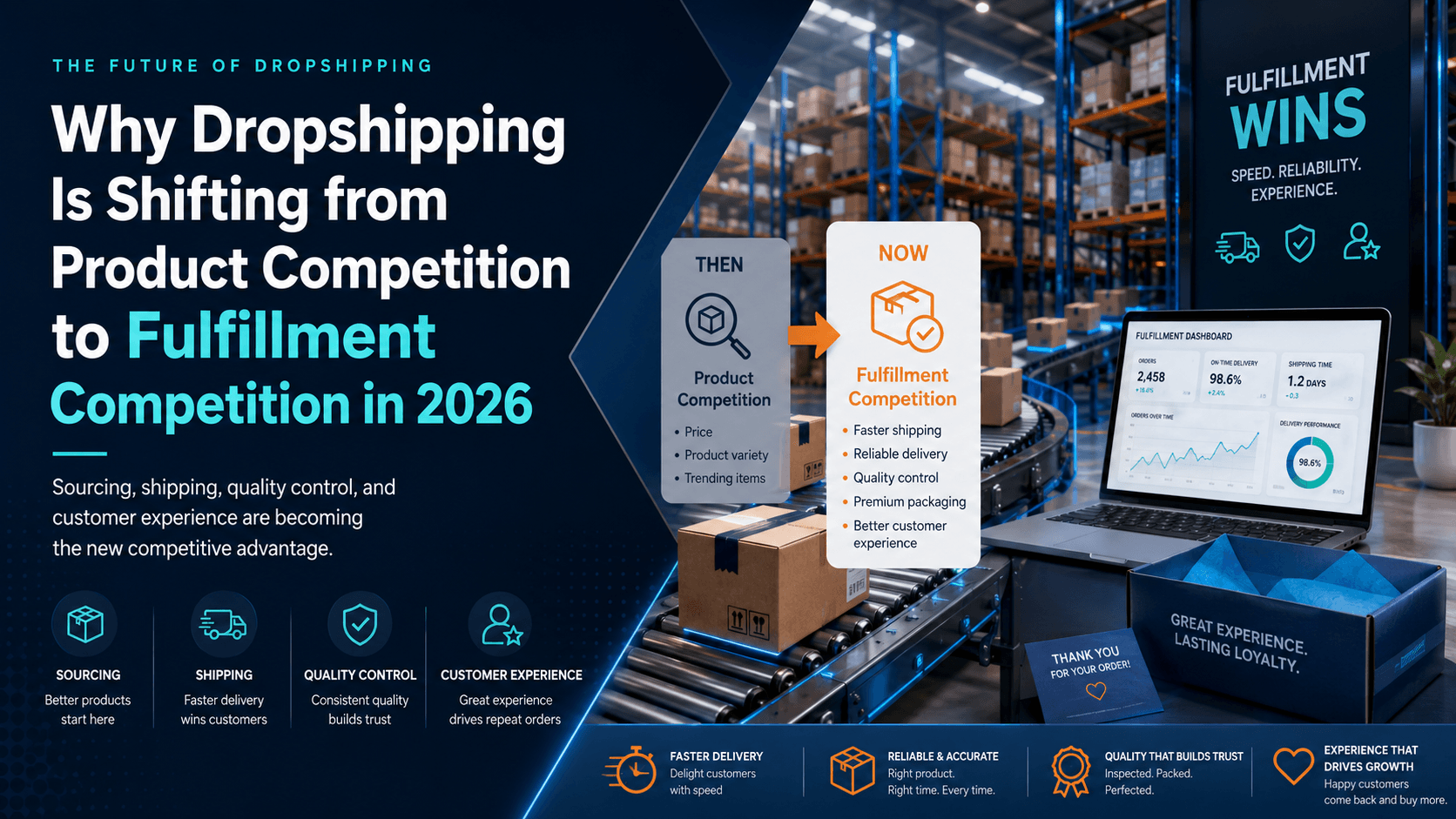
Dropshipping is no longer defined by its lack of inventory. Its true value lies in its adaptability. It enables businesses to operate within uncertainty, refine strategies continuously, and scale with confidence once patterns emerge.
In a mature market like the Netherlands, where consumer expectations are high and competition is structured, this adaptability becomes a decisive advantage.
Final Conclusion
The essence of dropshipping has shifted. It is no longer simply about low cost entry, but about building a system capable of continuous optimization in a complex market environment.