
For cross-border beginners, dropshipping is one of the easiest models to understand: no large inventory buys, no warehouse lease, no fulfillment team, and no pile of unsold stock. You test demand first and only source after orders. "Zero upfront cost" does not mean spending nothing forever—it means no inventory commitment, no bulk buys, no heavy ad spend on day one, and no complex hiring. Use free research, cheap store builds, organic content, and pay-per-order fulfillment to cap trial cost. By 2026, success depends as much on shipping, quality, packaging, after-sales, and compliance as on finding a cheap SKU.
Sources & further reading
- Shopify — What is dropshipping?
- U.S. CBP — Internet purchases / ecommerce imports (basics)
- European Commission — General Product Safety Regulation (GPSR)
- Amazon — Dropshipping overview (seller of record & basics)
- Shopify — Global ecommerce sales outlook
Policies and forecasts change. Confirm dates and details on each official page before making business decisions.
The dropshipping market background in 2026
Global ecommerce is structural, not a fad: Shopify’s e-commerce sales outlook cites roughly $6.88 trillion in global online revenue in 2026 (~21.1% of retail). That tailwind does not guarantee beginner profits—buyers compare prices across Temu, SHEIN, Amazon, TikTok Shop, expect clearer delivery and returns, and reward trust on the page.
- Price pressure: Competing only on “cheap” from an indie store is fragile.
- Logistics & tax: US/EU rules around low-value parcels are tightening—model landed cost, not supplier list price.
- Experience: Packaging, tracking clarity, CS speed, and “does it match the page?” decide reviews and repeats.
Better than uploading hundreds of random SKUs: small, focused tests backed by data, then a calmer upgrade path on supply chain and presentation.
Relevant policies and compliance trends
US: low-value parcel policy and landed cost
Many sellers historically relied on de minimis-style economics for small direct parcels from China. Rules have tightened materially; in 2026 you must plan for ad valorem duties, brokerage, and clearer declared value paths—not only product + postage.
Landed cost includes product, international shipping, duties/VAT where applicable, platform and payment fees, packaging, ads, refunds, and disputes. Orders that look “profitable” on a spreadsheet without taxes/logistics often aren’t.
EU: ecommerce import supervision
The EU is moving away from treating low-value ecommerce parcels as friction-free: expect tighter treatment of ≤€150 style flows, more disciplined VAT/IOSS, declarations, and evidence. Multi-country Shopify traffic needs serious tax/shipping configuration—not ad‑hoc defaults.
Platforms: Amazon, TikTok Shop, and beyond
Amazon dropshipping: you must be the seller of record; invoices, packing slips, outer pack, and buyer-facing branding must not pass another retailer/supplier off as the merchant. Retail-arbitrage fulfillment is high-risk.
TikTok Shop: read prohibited/restricted categories and import rules (e.g. alcohol/tobacco/vape constraints in US materials). Avoid exaggerated health/medical claims and gray-import positioning.
Trending is not enough—check certification, materials, IP, importability, and ad-policy fit before you build creatives.
Dropshipping vs. traditional retail
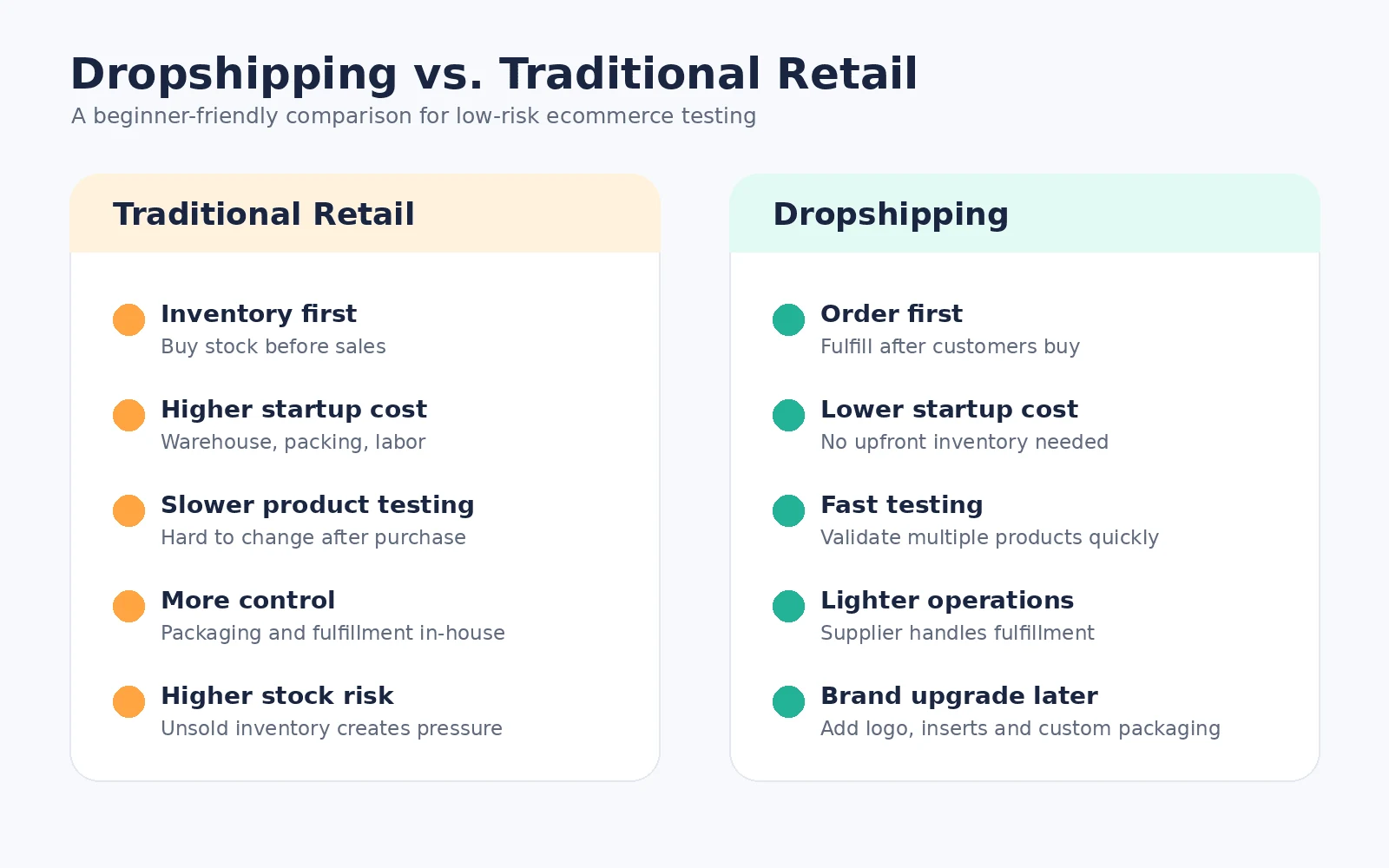
For beginners, the advantage of dropshipping is “test first, invest later.” You do not need to predict with certainty that a product will become a bestseller. Instead, you can use data to see whether customers are interested. Once a product has stable clicks, add-to-carts, and orders, you can then consider purchasing samples, improving packaging, upgrading branding, or even holding a small amount of inventory.
Traditional retail buys first: stronger control and unit economics when you guess right—but wrong guesses become dead stock.
Dropshipping is list first, fulfill after order: lower early cash pressure and faster pivots when clicks/ATC/orders say “not this angle.” Tradeoffs: slower shipping than local stock, supplier-dependent quality, harder early packaging control, and you own CX when the chain wobbles.
Dropshipping is a low-financial-risk learning loop, not a “free money” cheat code.
Core advantages for beginners
Low cash burn and friendly tests
Budget goes to samples, page quality, and content before inventory. Pay for fulfillment only when customers pay you.
Faster pivots
Within a niche (e.g. pet travel), double down on the SKUs that earn engagement and starve the weak ones—without months of warehouse regret.
Lighter ops → path to brand
Outsource pick-pack-ship so the founder focuses on research, PDPs, creative, and CS. As orders stabilize, add logos, labels, mailers, thank-you cards, inserts, then light ODM/OEM where margin supports it.
Dropshipping products suitable for beginners in 2026
Prefer light, demo-friendly, lower-liability items with clear use cases and reasonable shipping physics—not every buzzword “winner.”
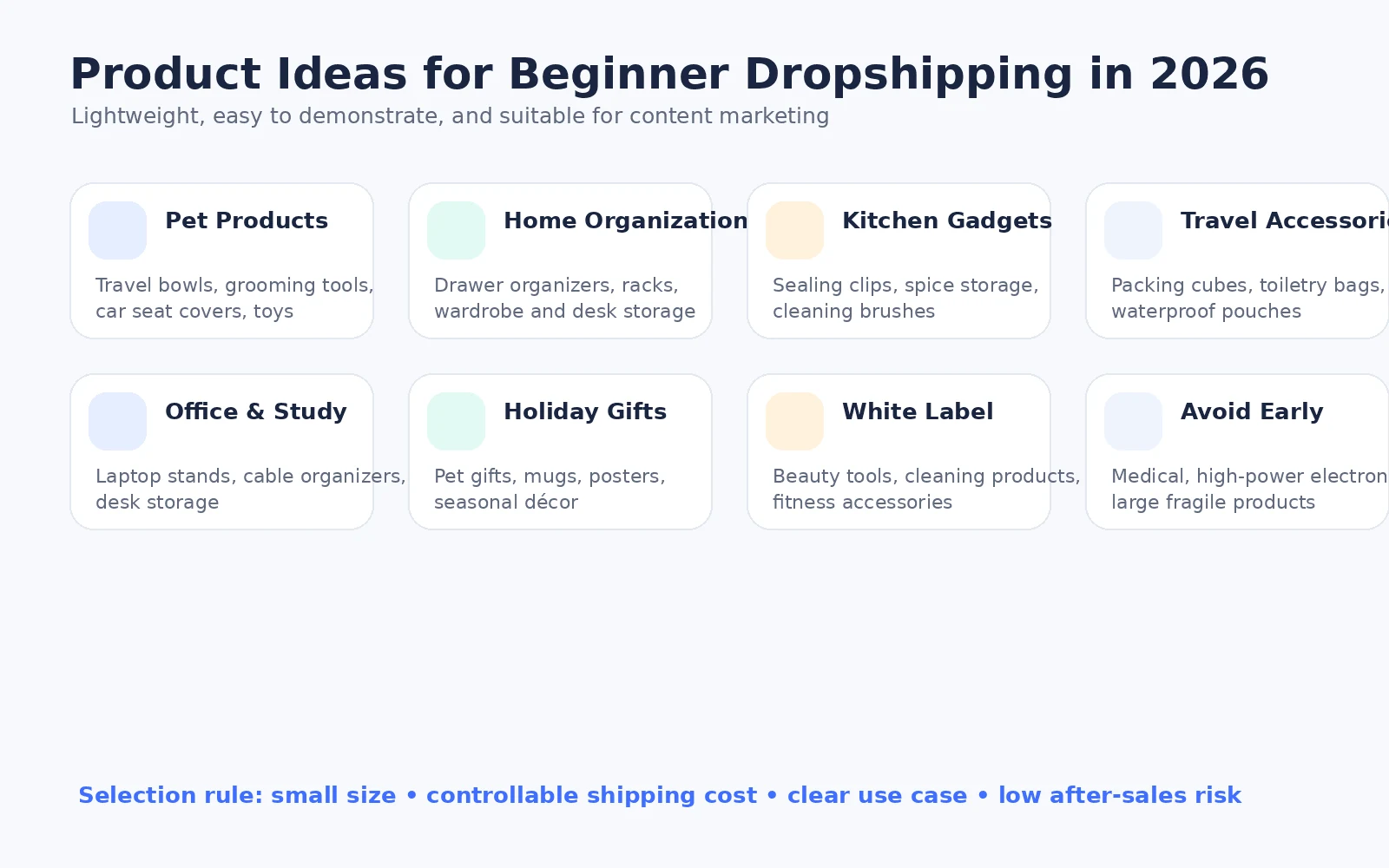
Pet, home org, kitchen, travel, desk, seasonal gifts
- Pet: travel bowls, seat covers, compact grooming—avoid food/meds/medical claims early.
- Home org / kitchen: obvious before/after on Shorts/Reels/Pinterest.
- Travel/office: packing cubes, toiletry bags, cable tidies—seasonal hooks (summer trips, back-to-school).
- Gifts: strong intent windows—ship-time math 4–8 weeks ahead, not “list Monday for Friday.”
- Light white-label: logos/cards only after repeat orders justify MOQs.
Products beginners should avoid at the start
Steer clear of medical devices, pharma-style claims, kid safety‑critical SKUs, aggressive skincare promises, heavy/large or ultra‑fragile goods, messy batteries, climbing/safety gear, and anything that dies on returns. Heavy “cheap” items often lose margin to freight.
Recommended platforms
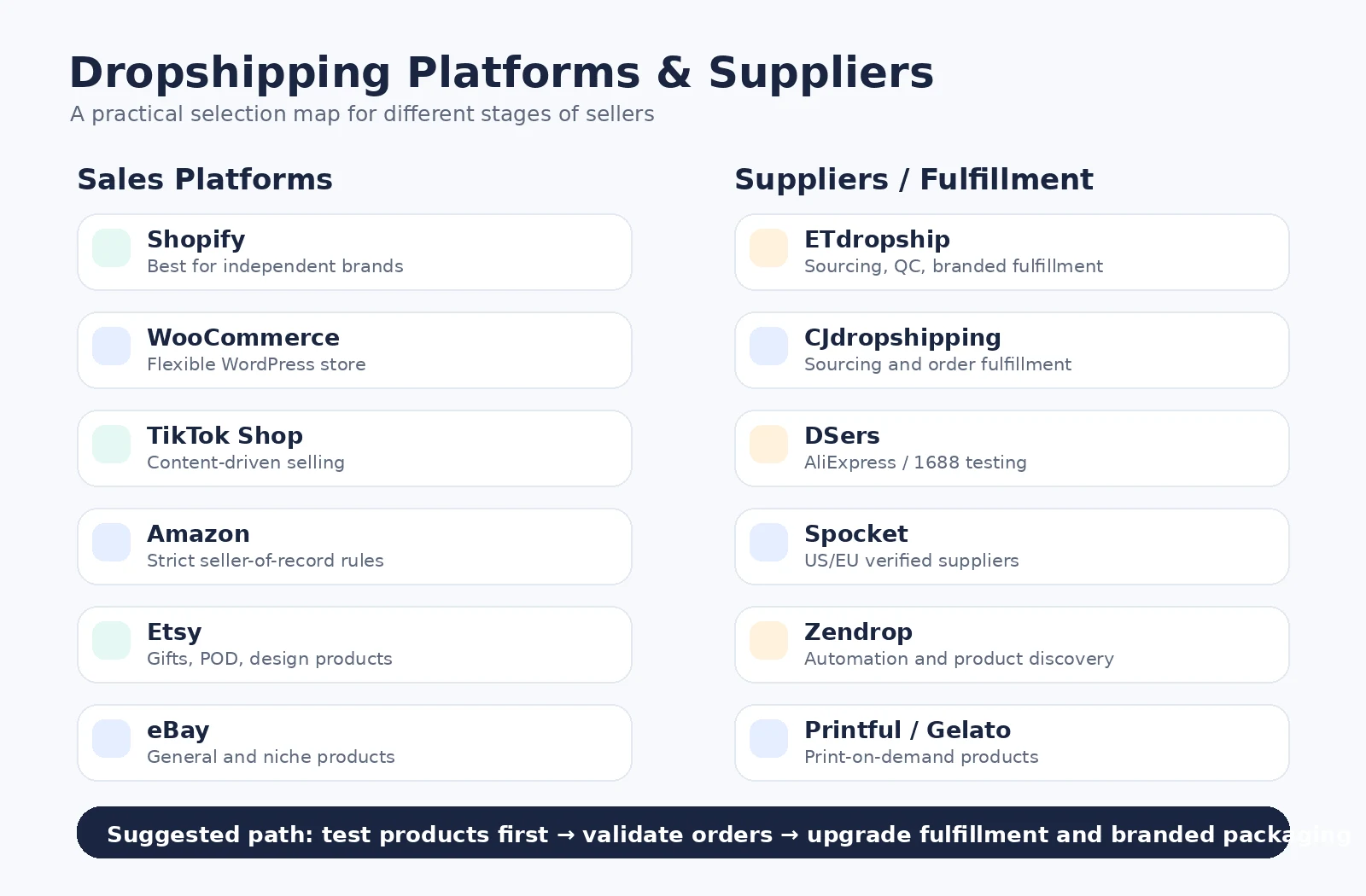
Shopify
Best default for owned audience, themes, apps, email/pixels, SEO, and branded fulfillment. You bring traffic—plan organic + paid + partnerships, not “build and wait.”
WooCommerce
Great if you already live in WordPress: maximum control, SEO depth, and hosting economics—more moving parts (plugins, security, speed) than Shopify.
TikTok Shop, Amazon, Etsy, eBay
TikTok Shop: strongest when you can show the product; respect category and SLA rules. Amazon: strict seller-of-record hygiene—beginners without controllable packaging/suppliers should pause. Etsy: design/personalization/POD positioning—not bulk wholesale clones. eBay: viable tests with real stock + trackable lanes; protect account health.
Recommended suppliers and fulfillment partners
Match the partner to stage, lane, and brand ambition—price alone mis-ranks suppliers.
ETdropship
Shopify-centric upgrade from generic dropship: sourcing, procurement, QC, branded packs, warehousing, global ship, after-sales. Best when you are exiting “random Ali quality” and need repeatable back-office.
CJdropshipping, DSers, Spocket, Zendrop, Printful, Gelato
CJ for wide-catalog tests + automation; DSers for low-cost Ali/1688 workflows (watch variance); Spocket for US/EU supplier emphasis (higher COGS, faster perception); Zendrop for Shopify automation—premium branding tiers often assume volume/eligibility; Printful / Gelato for POD with localized production on posters/apparel/mugs when design + niche are the moat.
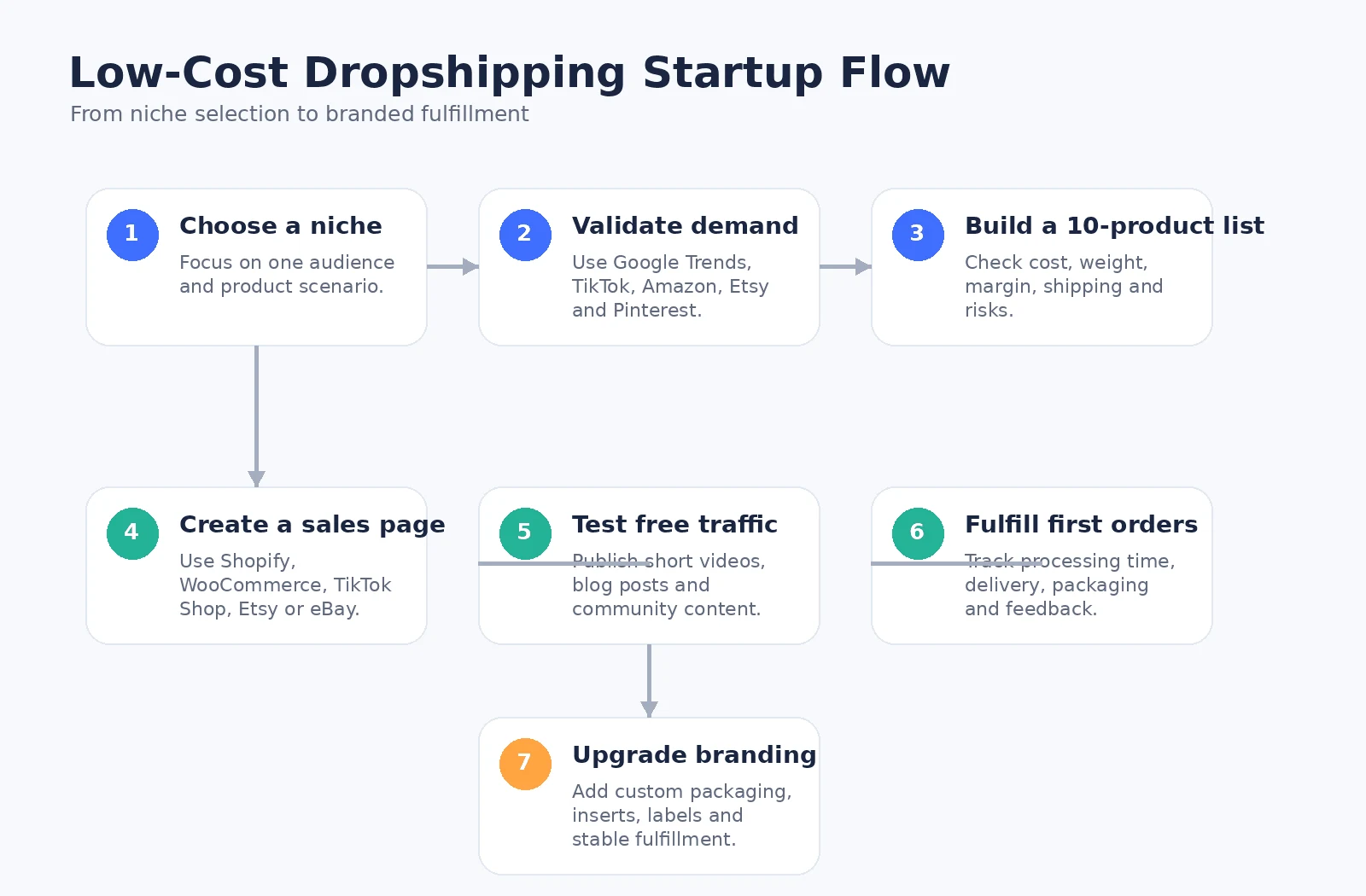
Practical steps for beginners to start dropshipping with low cost
- Pick ONE niche first (pet travel, kitchen tidy, desk glow-up, etc.)—not a general store.
- Validate with free signals: Trends, TikTok search, bestseller lists, Reels/Pinterest mood, competitor negative reviews = your differentiation brief.
- Build a ~10 SKU test matrix: note weight, size, COGS, shipping band, target price, margin, claims risk, content angles.
- Minimum viable PDP: honest visuals, scenario copy, dimensions/materials, delivery/returns/FAQ—trust beats gimmicks.
- Earn traffic before big ad $: short video, SEO posts, communities—10–20 posts per hero SKU before writing off a concept.
- Treat first orders as QA: timestamps, processing SLA, tracking cadence, damage, mismatch—fix chain before scaling spend.
- Upgrade with proof: logos, mailers, inserts, better lane—often with ETdropship-style partners once repeat orders exist.
Conclusion: zero upfront cost is only the starting point
You can still start lean in 2026, but not with 2019-style “copy + undercut + pray.” Stage 1: low-cost tests. Stage 2: stable fulfillment and honest economics. Stage 3: branded experience and defensible SKUs. Tools like DSers, CJ, Spocket, Zendrop, Printful, and Gelato help you learn; ETdropship fits when Shopify ops need sourcing, QC, custom packaging, warehousing, global shipping, tracking sync, and after-sales done professionally.
Frequently asked questions
- Can you really start dropshipping with zero upfront cost?
You can start very lean: no stock, no warehouse, free/low-cost discovery, organic traffic tests. You will still pay for domains/apps/samples/tools/ads over time—just not on day zero like traditional retail.
- What dropshipping products are best for beginners?
Usually pet accessories, home organization, kitchen helpers, travel/office, holiday gifts, and later light private label—easy to demo, moderate risk, shippable economics.
- Shopify or TikTok Shop first?
Shopify if you want owned data and a long-term brand. TikTok Shop if you can feed compliant, high-frequency video—and accept stricter category/fulfillment rules.
- How should beginners choose suppliers?
Beyond price: SLAs, consistency, QC, pack options, exceptions, branding roadmap. Start with DSers/CJ/Spocket for learning cohorts; graduate to ETdropship when branding + reliability matter.
- When should I add branded packaging?
After stable orders + happy customers—not on SKU zero. Add logos/cards/inserts in small steps matched to margin.
- What is the biggest risk in 2026?
Unstable chains (slow/opaque tracking), rule violations, mis-modeled duties/VAT, and weak PDP trust—ads only accelerate broken economics.
- Who is ETdropship for?
Shopify/cross-border teams moving from generic dropship to sourced, inspected, branded fulfillment with global shipping and accountable after-sales.

Author
Simon
Simon is a content strategist at ETdropship with extensive professional experience. He has been working in the industry for 13 years and possesses deep knowledge of the eCommerce sector and logistics systems. Passionate about his work, he creates practical and easy-to-understand content that helps sellers successfully run and grow their dropshipping businesses.
Get in touch
Have a question?
Leave your name, WhatsApp and message. We'll get back to you soon.
Launch lean. Scale with a real fulfillment partner.
ETdropship helps Shopify sellers keep early tests light—then upgrade sourcing, QC, custom packaging, and shipping with predictable ops.
