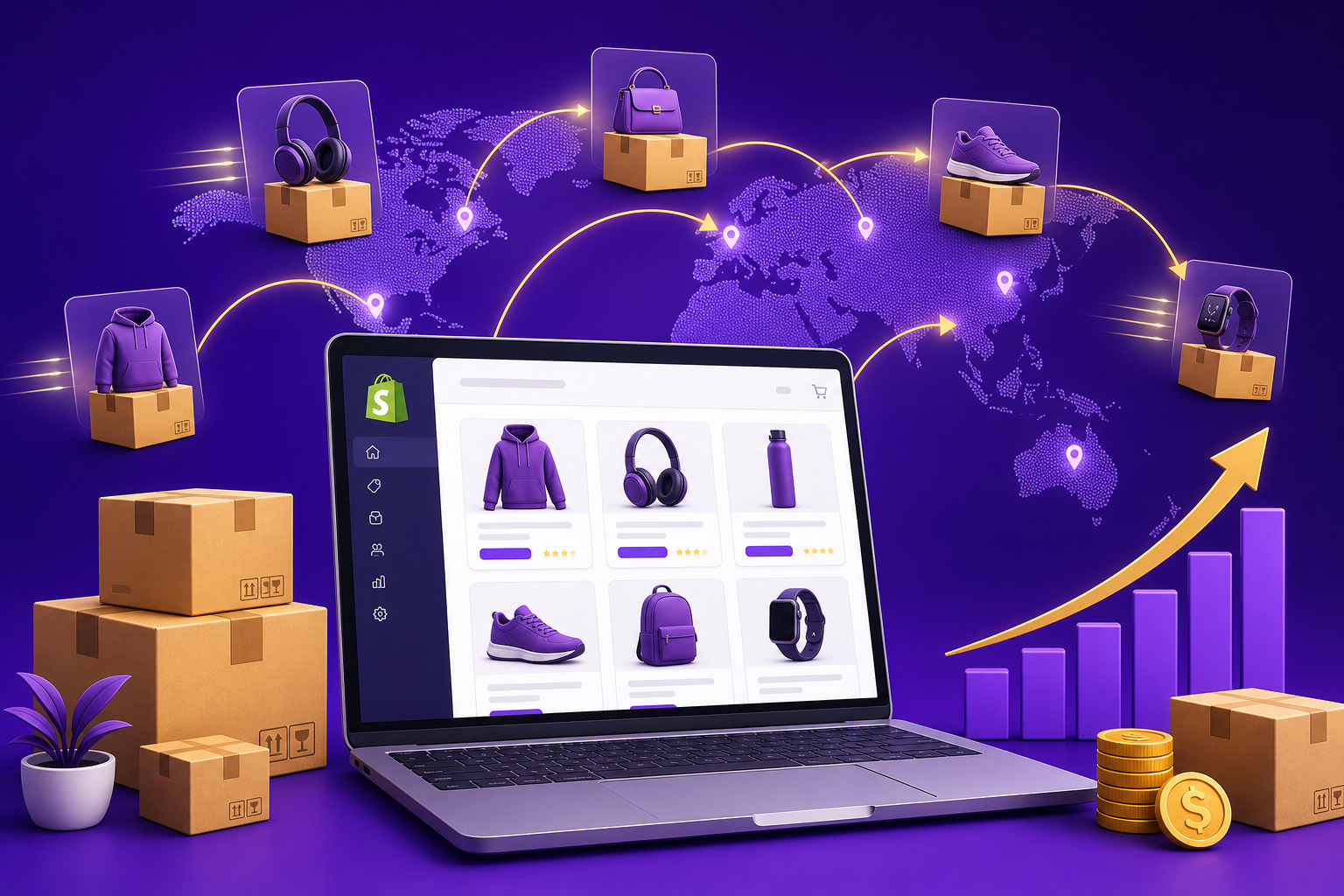
Dropshipping is still one of the lowest-barrier ways to start an e-commerce business — no inventory, no warehouse, no upfront bulk orders. But "low barrier" doesn't mean "no strategy." The sellers who survive past 90 days are the ones who treat it like a real business from day one. This guide covers every step: choosing a niche, vetting suppliers, building your store, driving traffic, and scaling efficiently with a professional sourcing agent.
What Is Dropshipping?
Dropshipping is a retail fulfilment model where you sell products you never physically hold. When a customer places an order, you forward it to a supplier or agent who ships directly to the customer under your brand.
Quick Answer
Start dropshipping in 2026 with $500–1,500: (1) choose a niche with repeat purchase potential (pet, beauty, home, health, baby), (2) test products via AliExpress, (3) build on Shopify with DSers, (4) run Meta or TikTok ads targeting 2.5–3.5× ROAS, (5) switch to a professional sourcing agent at 15–20 orders/day. Most sellers find their first profitable product within 30–90 days.
The model in 30 seconds
Customer orders from your store → you forward the order to your supplier → supplier ships to the customer → you keep the difference between your retail price and the supplier cost.
You handle marketing, customer service, and brand experience. Your supplier handles manufacturing and logistics. The margin sits between what you charge and what you pay. Typical healthy net margins — after ads, platform fees, and returns — range from 25% to 45% depending on niche and sourcing quality.
- No inventory risk: You only pay for a product after a customer pays you.
- Low startup cost: A Shopify store, a domain, and a small ad budget is all you need to test.
- Location independent: Your "warehouse" is your supplier's warehouse — anywhere in the world.
- Scalable: Adding new products or markets doesn't require physical infrastructure.
The trade-off: you have less control over packaging, shipping speed, and product quality compared to holding inventory. That's why choosing the right partner — especially as you scale — matters enormously.
Step 1: Choose Your Niche and Winning Products
Niche selection is the highest-leverage decision you make. A great product in a weak niche underperforms. A mediocre product in a strong niche can still win. Here's how to pick strategically.
What makes a winning dropshipping niche? High perceived value (so you can price with margin), repeat purchase potential (pet food, skincare, supplements), visual appeal for social ads, and a customer pain point that's clearly solvable by the product.
| Niche | Avg Order Value | Why It Works | Competition Level |
|---|---|---|---|
| Pet Supplies | $35–55 | Repeat purchases, emotional buyers, gift-friendly | Medium |
| Beauty & Skincare | $40–65 | Visual ads, high margins, subscription upsell | High |
| Home & Kitchen | $45–80 | Broad appeal, evergreen demand, easy to brand | Medium |
| Health & Wellness | $50–70 | Strong pain points, high AOV, loyal buyers | Medium |
| Baby & Kids | $40–60 | Safety-conscious buyers pay premium, low returns | Low-Med |
| Outdoor & Sports | $55–90 | Seasonal spikes + year-round core demand | Medium |
Top-performing dropshipping niches in 2026
Product research tools to use: Minea, AdSpy, or TikTok's own Creative Center show you ads currently spending money — a direct signal that someone's already profitable. Facebook Ad Library lets you filter by e-commerce brands in your niche. AliExpress "Choice" and "1000+ orders" filters show proven demand.
Avoid these product traps
Fragile items (high damage/return rates), branded goods (legal risk), very heavy products ($15+ shipping kills margins), and anything with a 2–3 week delivery time from AliExpress standard shipping.
Step 2: Find a Reliable Supplier or Sourcing Agent
Your supplier relationship determines your product quality, shipping speed, and ultimately your customer reviews. The difference between AliExpress and a professional agent is the difference between 18-day delivery and 7-day delivery — and often $3–5 per unit in cost savings.
AliExpress is fine for testing. You can launch a product with zero MOQ, validate demand, and get real customer feedback before committing. But once you're above 15–20 orders per day, the cracks show: inconsistent quality, slow restocks, no custom packaging, and shipping times that generate WISMO (Where Is My Order) tickets.
| Factor | AliExpress Direct | Sourcing Agent (e.g. ETdropship) | Your Benefit |
|---|---|---|---|
| Shipping time | 14–25 days | 5–10 days | Fewer refund requests |
| Product cost | Retail price | 30–50% lower | Higher margin |
| Custom packaging | Not available | Yes, your branding | Brand equity |
| Quality control | None | Pre-shipment QC | Fewer returns |
| MOQ to start | 1 unit | 1 unit | Same flexibility |
| Dedicated support | None | 1-on-1 manager | Faster problem solving |
When to switch to an agent: The moment you have consistent daily orders (even 10–15/day), an agent negotiation makes economic sense. At 20 orders/day, saving $3/unit = $1,800/month straight to your bottom line.
- ETdropship: End-to-end China sourcing + fulfillment + custom packaging. One-on-one account manager. No MOQ, no upfront payment until orders come in.
- CJ Dropshipping: Good for breadth of catalog, automated Shopify/WooCommerce integration.
- Zendrop: US-based warehousing option for faster domestic shipping.
Step 3: Build Your Online Store
Shopify is the de facto standard for dropshipping. It connects natively to every major dropshipping app, has the cleanest checkout flow, and offers reliable uptime. Here's how to set it up in a weekend.
- Sign up for Shopify (14-day free trial, then $39/month Basic). Use a custom domain ($10–15/year via Namecheap or Shopify Domains) — never launch on a myshopify.com address.
- Choose a clean, fast theme. Dawn (free) or Debutify (free tier) are both conversion-tested. Avoid bloated themes with 50+ features you won't use.
- Install DSers or AutoDS to connect your AliExpress/agent products. These apps auto-import listings and fulfil orders with one click.
- Write real product copy. Don't copy-paste AliExpress descriptions. Answer: Who is this for? What problem does it solve? What makes it better than alternatives? Add trust signals: guarantee, return policy, real photos.
- Set up payment processing. Shopify Payments (if available in your country) or Stripe. Also add PayPal — some customer segments won't buy without it.
- Configure a post-purchase upsell. Reconvert or ReConvert Upsell & Cross Sell app. A single upsell offer can increase AOV by 15–25%.
- Install Klaviyo for email. Set up a welcome sequence, abandoned cart flow (3 emails), and post-purchase sequence. Email is free traffic that converts at 3–5×.
Store must-haves before going live
Clear shipping policy with realistic timelines. Return/refund policy (even "no questions asked 30 days" dramatically lifts conversions). About page with a real story. Contact page with a real email. Trust badges on the cart/checkout page.
Step 4: Drive Traffic and Acquire Customers
Traffic is the oxygen of your dropshipping business. No traffic = no sales, regardless of how good your product is. Here's how to think about each channel.
Facebook/Instagram Ads remain the highest-volume channel for dropshipping. The targeting depth and visual ad formats match the impulse-purchase nature of the model. Start with a $20–30/day test budget. Create 3–5 ad creatives per product (UGC-style video performs best in 2026). Use Campaign Budget Optimisation (CBO) and let the algorithm find your buyer.
TikTok Ads have become the go-to for fashion, beauty, and anything with a "wow factor." CPMs are still lower than Meta on average, and organic TikTok content can go viral without spending. Create short, entertaining product demos (15–30 seconds) with a strong hook in the first 2 seconds.
| Channel | Best For | Avg CPC | Learning Curve |
|---|---|---|---|
| Facebook Ads | Most niches, broad audiences | $0.50–1.50 | Medium |
| TikTok Ads | Youth-oriented, visual products | $0.20–0.80 | Low–Med |
| Google Shopping | Branded or high-intent searches | $0.30–2.00 | High |
| Instagram Influencers | Beauty, fashion, lifestyle | Flat fee | Low |
| Home decor, fashion, food | $0.10–0.30 | Low | |
| SEO / Blog | Long-term organic traffic | Free | High (6–12 months) |
Channel comparison for dropshipping traffic
Key metrics to watch: ROAS (Return on Ad Spend) target 2.5–3.5× minimum. CPA (Cost Per Acquisition) should stay below 30% of your selling price. CTR above 1.5% signals your creative is resonating. If CTR is high but conversions are low, the issue is your landing page, not the ad.
Step 5: Scale to a Sustainable Business
Getting to $1K/day is a validation milestone. Getting past it requires systematizing what's working and building defensible advantages — primarily brand and supplier relationships.
Switch to a professional agent at 20+ daily orders. Negotiate product cost, request custom packaging with your logo, and ask for a dedicated account manager. Your agent becomes a supply chain partner, not just a transaction processor.
- Build a brand, not just a store. Custom packaging, inserts, and a consistent visual identity turn first-time buyers into repeat customers. Repeat buyers cost 5× less to acquire than new customers.
- Expand the product line. Once you have a winning product, find 3–5 complementary products for bundles and upsells. This increases LTV (lifetime value) without increasing ad spend.
- Hire a VA for customer service. Once you're over 30 orders/day, customer emails will eat your time. Outsource it early.
- Test new ad creatives weekly. Creative fatigue kills profitable campaigns. Allocate 20% of your ad budget to testing new hooks, angles, and formats.
- Diversify traffic. Never rely on a single ad platform. Platform policy changes, bans, and CPM spikes happen. Build email, SMS, and ideally organic channels in parallel.
The $10K/month formula
Average order value $55 × 6 orders/day × 30 days = $9,900 gross. Net at 35% margin = $3,465. To hit $10K net: increase AOV (bundles), increase daily orders (scale ads), or improve margin (agent sourcing). All three together compound quickly.
Common Mistakes That Kill New Dropshipping Stores
Most dropshipping failures aren't due to bad luck — they're predictable mistakes. Here's what to watch for.
- Testing too many products at once. Focus on one winning product at a time. Scattering budget across 10 products means you never get enough data on any of them.
- Ignoring shipping times. AliExpress standard shipping (18–25 days) generates chargebacks. Always use ePacket or agent fulfilment for sub-12-day delivery.
- Underpricing to compete on price. Dropshipping is not a price war business. Premium presentation + faster shipping justifies a $15–20 premium over the AliExpress price.
- No email list from day one. Every visitor who doesn't buy is wasted. Capture emails via exit-intent popups + offer a 10% discount. This is your retargeting asset.
- Skipping the legal basics. Register your business, collect sales tax where required, and don't sell trademarked products. The fines are not worth the shortcut.
- Giving up after the first failed product. On average, it takes 3–5 products tested before finding a winner. Treat each test as data, not failure.
Frequently Asked Questions
How much money do I need to start dropshipping?
A realistic starting budget is $500–1,000. This covers your Shopify subscription ($39/month), a domain ($15), basic apps ($20–30/month), and a $300–500 ad testing budget for your first product. You can technically start with less, but under-funding your ad tests leads to inconclusive data.
Is dropshipping still profitable in 2026?
Yes — but the era of slapping an AliExpress product on a generic store and printing money is over. Profitable dropshipping in 2026 requires fast shipping (agent fulfilment), brand presentation, and proper paid traffic strategy. Sellers who operate professionally continue to build significant businesses.
How long does it take to make money dropshipping?
Most successful sellers see their first profitable weeks within 30–60 days of launching, assuming they run ads consistently. However, building a sustainably profitable store typically takes 3–6 months of iteration — testing products, optimising ads, and improving conversion rates.
Do I need a business licence to start dropshipping?
Requirements vary by country. In the US, most states require a business licence and a sales tax permit if you sell to in-state customers. In the EU, VAT registration applies once you exceed certain thresholds. Consult a local accountant. Most people start as a sole proprietor and form an LLC/Ltd as revenue grows.
What is the best platform for dropshipping?
Shopify is the industry standard for good reason — native integrations with DSers, AutoDS, CJ Dropshipping, and ETdropship, a polished checkout, and strong app ecosystem. WooCommerce is a solid free alternative if you're already on WordPress. TikTok Shop is growing fast for in-app dropshipping.

Author
Simon
Simon is a content strategist at ETdropship with extensive professional experience. He has been working in the industry for 13 years and possesses deep knowledge of the eCommerce sector and logistics systems. Passionate about his work, he creates practical and easy-to-understand content that helps sellers successfully run and grow their dropshipping businesses.
Get in touch
Have a question?
Leave your name, WhatsApp and message. We'll get back to you soon.
Ready to launch your first dropshipping store?
ETdropship handles sourcing, QC, custom packaging, and fast global fulfilment — so you can focus on sales.
