How Much Money Do You Need to Start a Dropshipping Business in 2026?
For many new sellers entering cross-border e-commerce, one of the most practical questions is: **How much money do I actually need to start a dropshipping business?**
At first glance, dropshipping seems like a low-barrier business model. You do not need to purchase large amounts of inventory in advance, rent a warehouse, or hire a team from day one. In theory, with a store, a product, and a fulfillment partner, you can start testing the market.
However, from a real business perspective, dropshipping is not a “zero-cost business.” It simply converts the heavy inventory cost of traditional e-commerce into more flexible testing costs, advertising costs, content costs, fulfillment costs, and cash flow requirements.
Therefore, when discussing how much money you need to start dropshipping in 2026, you should not only look at the cost of opening a store. You need to look at whether your budget can support a complete business cycle: product research, store setup, sample testing, advertising, order fulfillment, after-sales support, and cash flow management.
1. Why Dropshipping Still Matters in 2026
Cross-border e-commerce is still growing. Global online shopping has become a long-term consumer habit, not just a temporary trend. Consumers are increasingly comfortable buying pet products, home goods, fashion accessories, smart toys, personalized gifts, beauty products, and niche lifestyle products online.
At the same time, the dropshipping market itself continues to expand. Different market research reports may use different calculation methods, but most forecasts point in the same direction: the global dropshipping market is expected to keep growing strongly over the next several years.
This shows that dropshipping is not outdated. What is outdated is the old way of doing dropshipping: randomly finding products, copying supplier photos, selling at low prices, and relying only on basic ads.
In 2026, dropshipping is more like a light-inventory cross-border e-commerce model. Sellers use a lower upfront budget to test the market, rely on fulfillment partners to handle sourcing and shipping, and then gradually upgrade products, packaging, branding, and customer experience based on real data.
2. Why Traditional E-Commerce Requires More Capital
To understand the financial advantage of dropshipping, it is important to first understand the cost structure of traditional e-commerce.
In a traditional e-commerce model, sellers usually purchase products first, then store them, photograph them, list them online, promote them, and finally sell them. This means the seller has already paid for inventory, packaging, warehousing, labor, and logistics before confirming whether the product can actually sell.
For example, if a seller wants to sell pet toys using a traditional model, they may need to purchase 1,000 units in advance. If each unit costs $3, the product cost alone is already $3,000. After adding international shipping, warehousing, packaging, product photography, advertising, and after-sales costs, the initial investment can easily reach $5,000 or more.
If the product sells well, inventory can help reduce unit costs. But if the product is wrong, the ads do not perform, or the trend fades quickly, inventory becomes a burden. Capital gets trapped in unsold stock, and the seller has less money to test new products.
This is the biggest issue with the traditional model: it is not that traditional e-commerce cannot make money, but that the cost of trial and error is much higher.
For beginners, the biggest uncertainty in the early stage is not whether they can ship products. The real uncertainty is whether the product has market demand. Buying large amounts of inventory before validating demand means using inventory to carry market risk.
3. The Real Advantage of Dropshipping
The core value of dropshipping is not that sellers spend no money. The real value is that sellers do not need to take on large inventory risk from the beginning.
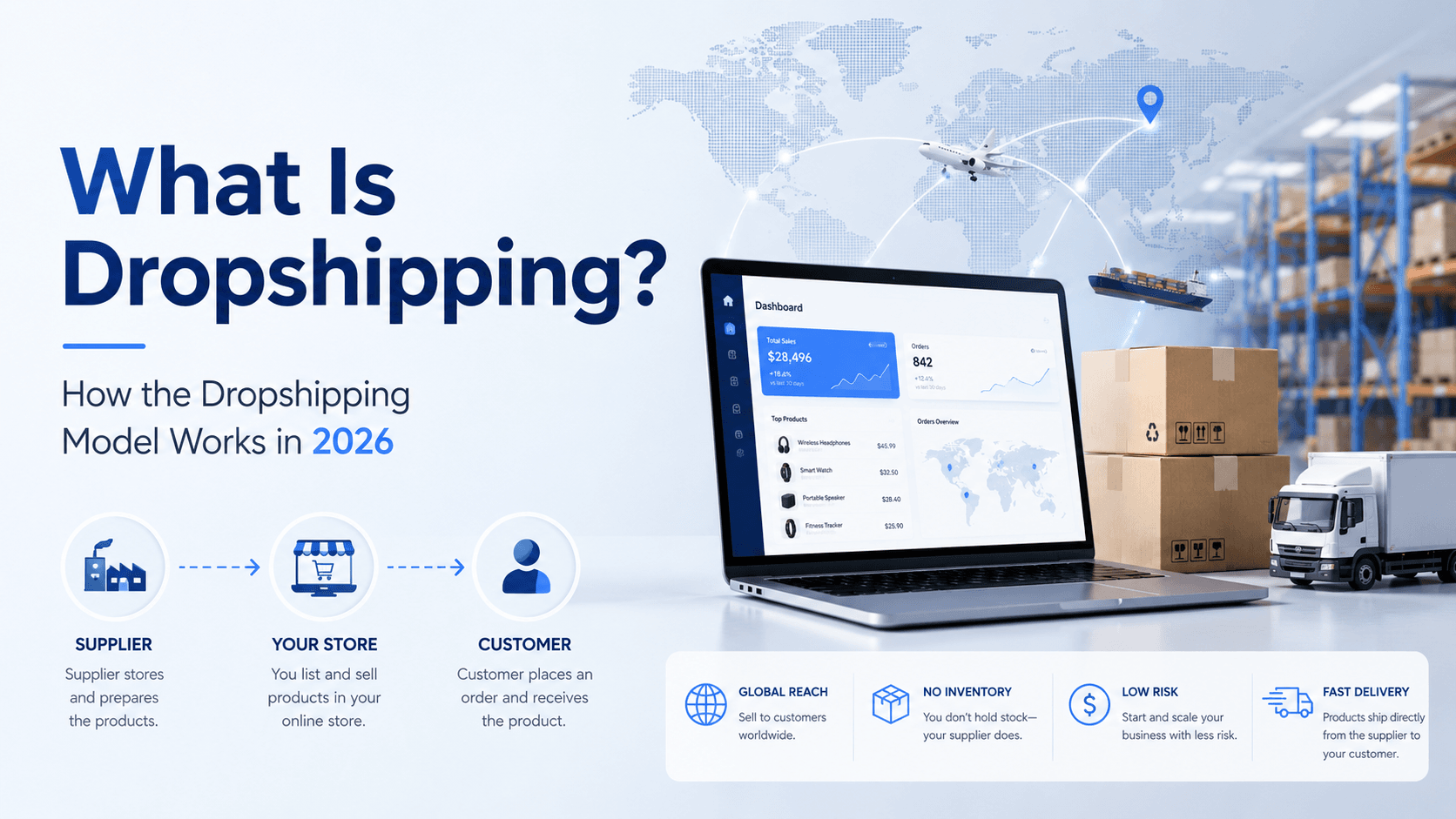
A seller can list products on a Shopify store, TikTok Shop, Etsy, WooCommerce, or another sales channel. When a customer places an order, a fulfillment partner or supplier handles sourcing, quality inspection, packaging, shipping, and tracking number updates.
Compared with the traditional model, dropshipping has several major advantages.
First, the startup cost is lower. Sellers do not need to purchase hundreds or thousands of units in advance. They can use a smaller budget to test whether a product has real demand.
Second, the trial-and-error cost is lower. If a product does not perform well in advertising or conversion, the seller can quickly switch products instead of being stuck with unsold inventory.
Third, cash flow is more flexible. Traditional e-commerce usually requires sellers to buy products first and wait for sales later. In dropshipping, customers usually pay first, and the seller then pays for product and fulfillment costs. Although working capital is still needed, the pressure is much lower than in a stock-based model.
Fourth, product testing is faster. Sellers can test different niches such as pet products, home organization, seasonal gifts, smart toys, fashion accessories, and more. Then they can use click-through rate, add-to-cart rate, conversion rate, and gross margin to decide which product deserves more investment.
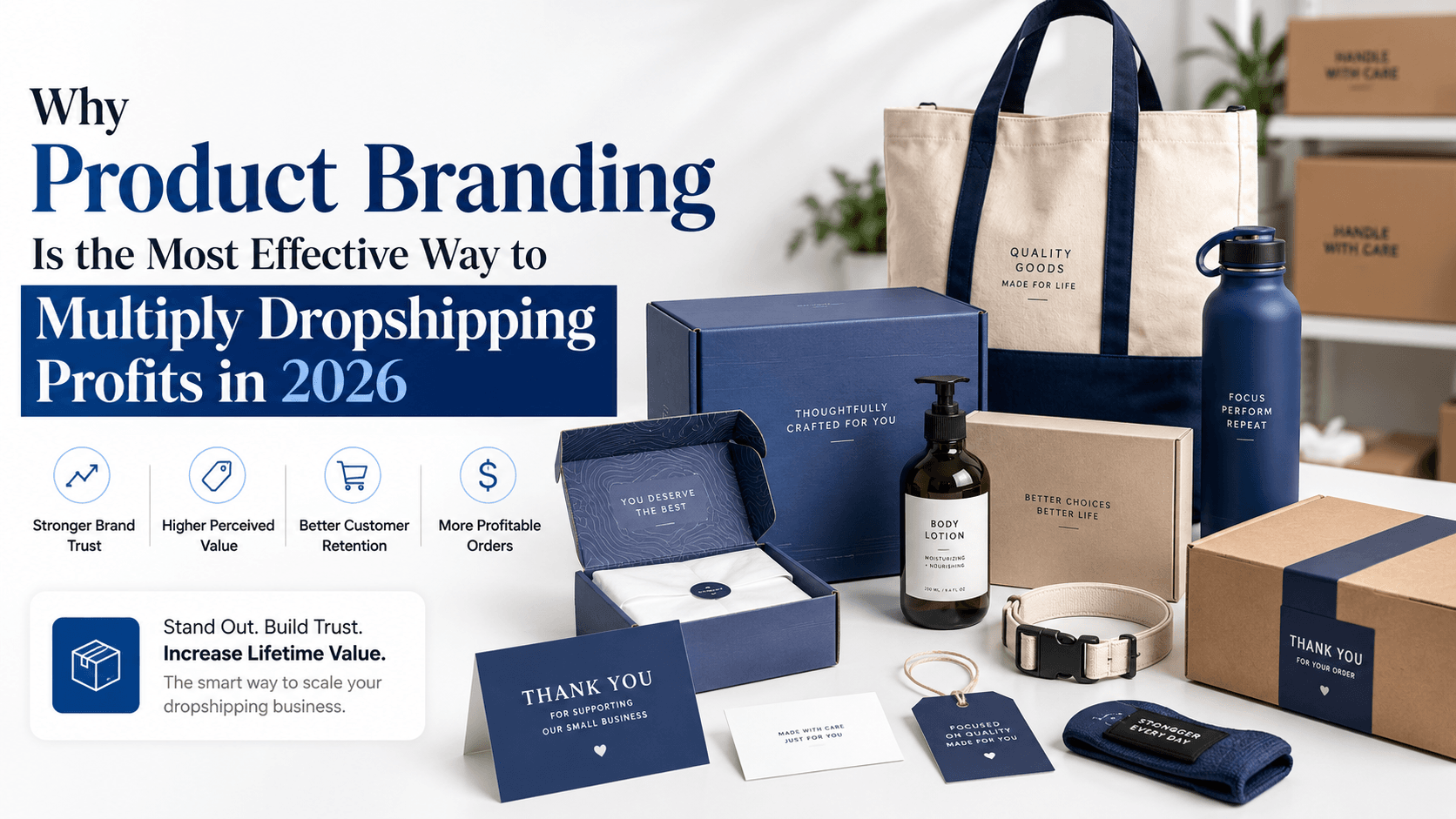
Fifth, dropshipping is suitable for brand development. Modern dropshipping is no longer limited to generic, unbranded fulfillment. Many fulfillment partners now support branded stickers, custom packaging, thank-you cards, product labels, instruction cards, bundle sets, light customization, and even OEM or ODM support. This allows sellers to test the market first and gradually upgrade into a branded business.
In other words, dropshipping in 2026 is not just about selling cheap products. It is a lower-inventory, lower-risk, faster-testing e-commerce model for small and medium-sized sellers.
4. How Much Money Do You Need to Start Dropshipping in 2026?
From a practical business perspective, dropshipping budgets can be divided into four levels.
If you only want to learn the process and test a small idea, **$300 to $800** can be enough to start.
If you want to properly test a Shopify dropshipping store, **$1,000 to $3,000** is more realistic.
If you want to build a more branded dropshipping business, including better product content, packaging, creative assets, and stable ad testing, **$5,000 to $10,000** is a stronger starting range.
If you want to test multiple markets, product lines, and advertising channels at the same time, you may need **more than $10,000**.
These numbers are not fixed rules. They are practical reference points.
A few hundred dollars can help you understand the process, but it usually cannot support serious product testing for long. A budget of $1,000 to $3,000 gives you more room to build a store, order samples, create content, test ads, and handle initial fulfillment. A budget of $5,000 or more allows you to work on better branding, better creative assets, stronger supplier testing, and more stable customer experience.
5. A Professional Cost Breakdown for Dropshipping
To plan a dropshipping budget properly, you should not only ask, “How much does it cost to open a store?”
A professional dropshipping budget should include six main types of costs.
The first is the basic setup cost. This includes Shopify fees, domain name, basic apps, email setup, payment configuration, and basic store design. This part should not take up too much of your budget. In the early stage, your store does not need to be perfect. It needs to be clear, trustworthy, and able to process orders smoothly.
The second is sample testing cost. This is one of the most important costs, but beginners often try to avoid it. You need to check the real product quality, size, color, material, packaging, smell, user experience, and supplier reliability. This is especially important for pet products, baby products, fashion accessories, and home goods, where the difference between supplier photos and real products can be significant.
The third is content and creative cost. In 2026, consumers are much more sensitive to generic supplier images. If your product photos look like they came from a wholesale catalog, customers are less likely to trust your store. Good-performing content usually includes real product photos, usage scenarios, unboxing videos, before-and-after comparisons, UGC-style videos, and short-form product demonstrations.
The fourth is advertising testing cost. Advertising is not simply about spending money. It is about buying data. You need to use click-through rate, cost per click, add-to-cart rate, checkout rate, and conversion rate to judge whether a product has potential. If your ad budget is too small, you may not get enough data to make a reliable decision.
The fifth is working capital for fulfillment. Even though dropshipping usually means the customer pays first, payment platforms may have settlement delays, and new stores may face temporary fund holds. At the same time, suppliers usually require you to pay product and shipping costs before they fulfill the order. This means you must keep some cash available for order fulfillment.
The sixth is after-sales reserve. Refunds, reshipments, shipping delays, wrong addresses, damaged packages, and unhappy customers can all create additional costs. Beginners should reserve at least around 10% of their budget as a buffer for after-sales issues.
A professional dropshipping budget is not something you spend all at once. It should be invested in stages: first validate the product, then improve ads, then optimize the landing page, and only later invest more into branding, packaging, and supply chain improvements.
6. Cash Flow Matters More Than Startup Cost
Many beginners only calculate how much money they need to open a store. But in real operations, cash flow is what determines whether the business can continue.
For example, suppose you sell a pet toy for $29.99.
The product cost is $4.
The shipping cost is $6.
The packaging and handling cost is $1.
The payment processing fee is about $1.20.
Before advertising cost, the gross profit is around $17.79 per order.
This means that if your customer acquisition cost is below $17.79, there may still be room for profit. If your advertising cost per purchase is higher than $17.79, the product may become unprofitable.
However, in real operations, you also need to consider refunds, reshipments, discounts, app fees, and your own operating time. A more conservative approach is to keep your target customer acquisition cost within 60% to 70% of your gross profit, instead of spending all the gross profit on ads.
The basic profit formula is:
**Selling Price - Product Cost - Shipping Cost - Packaging and Handling Cost - Payment Fees - Refund and Reshipment Cost - Advertising Cost = Net Profit**
If this formula remains positive over time, the product has potential for scaling. If it stays negative, the product or marketing strategy needs to be adjusted.
7. $300 to $800 Budget: Suitable Only for Light Validation
If your budget is only $300 to $800, you can still start dropshipping, but you must be very focused.
This stage is not suitable for building a large general store or testing too many products at once. A better approach is to choose one niche, such as cat toys, home organization, seasonal gifts, fitness accessories, or educational toys, and test only a small number of products.
The goal at this stage is not to build a profitable business immediately. The goal is to understand the process and collect early signals.
You should build a basic store, order one to three samples, check whether the supplier is reliable, create simple product content, and run a small advertising test or use short-form content to get traffic.
If your budget is low, you should not spend money on complex branding, custom packaging, expensive themes, or too many apps. The key questions are: Does the product attract clicks? Do people add it to cart? Is the price acceptable? Can the supplier ship reliably?
The biggest mistake at this stage is spreading the budget too thin. Testing ten products with $500 usually gives you no useful conclusion. A more professional approach is to test one product direction and use every dollar to validate the most important assumptions.
8. $1,000 to $3,000 Budget: The Most Practical Starting Range for Beginners
For most beginners, $1,000 to $3,000 is a more realistic starting range.
This budget can support a more complete testing cycle: store setup, sample orders, content creation, advertising, initial fulfillment, and after-sales handling.
At this stage, your main goal is not to make a large profit immediately. Your goal is to find a product with scaling potential. You need to track not only the number of orders, but also click-through rate, add-to-cart rate, checkout rate, conversion rate, average order value, gross margin, and refund rate.
For example, if you have a $2,000 budget, a reasonable plan could be: keep store setup within $200 to $300, use $300 to $500 for samples and supplier testing, use $200 to $400 for content creation, allocate $800 to $1,200 for ad testing, and keep the rest for fulfillment and after-sales reserve.
This budget level usually fails for two reasons.
The first mistake is spending too much on surface-level store design. The store looks good, but there is not enough budget left to test products properly.
The second mistake is testing ads without structure. One day the seller tests pet products, the next day kitchen tools, and the next day fashion accessories. Each product receives only a tiny budget, so there is no reliable data.
A more professional method is to test multiple angles within one niche. For example, in the pet niche, you can test angles such as dental care, indoor exercise, pet boredom relief, natural materials, and gift bundles. This helps you understand whether the product itself is weak or whether the marketing angle needs improvement.
9. $5,000 to $10,000 Budget: Suitable for Branded Dropshipping
If your budget reaches $5,000 to $10,000, you should not think only about basic product testing. You can start building a more branded dropshipping operation.
The difference between regular dropshipping and branded dropshipping is not just whether you have a logo. The real difference is whether the customer feels they are buying from a trustworthy brand.
At this stage, more money should go into real product content, product pages, packaging experience, after-sales process, and supply chain stability.
For example, two sellers may both sell pet products. A basic dropshipping seller may use supplier images and plain packaging. A branded dropshipping seller will order samples, shoot real product photos, create usage videos, design branded stickers, add thank-you cards or instruction cards, and possibly sell products as a bundle.
Branded dropshipping does not mean you must buy a large amount of inventory from the beginning. A safer approach is to start with small-batch packaging materials such as branded stickers, thank-you cards, inserts, and packaging bags. The product can still be fulfilled through dropshipping, but the customer experience becomes much more professional.
For sellers who want to build a long-term Shopify store, this stage is important. Advertising brings orders, but brand experience drives reviews, trust, repeat purchases, and long-term profit.
10. Practical Startup Case: Starting a Dropshipping Store with $2,000
The following case is written based on real operating logic and can be used as a practical reference. If it is used as a customer story for a brand or service provider, it should be adjusted with real product data, order data, and advertising data.
A beginner seller prepared $2,000 to test a Shopify dropshipping store. Instead of building a general store, he chose the pet products niche because pet products are easy to demonstrate with short videos and can create emotional buying motivation.
First, he shortlisted ten products but did not list all of them. After comparing product cost, size, shipping difficulty, selling price potential, and content potential, he selected only three products for sample testing.
Second, he ordered samples and compared suppliers. After receiving the samples, he found that one product looked good in supplier photos but had poor material quality in real life. Another product had acceptable quality, but the packaging was easily damaged. In the end, only one cat interactive toy was suitable for further testing. This sample testing process cost a few hundred dollars, but it helped him avoid listing poor-quality products that could have caused refunds and complaints later.
Third, he created real product content using his phone. At first, he used supplier images in ads, but the click-through rate was poor. Later, he changed the ad angle from “cheap cat toy” to “help your cat burn energy indoors” and added real usage scenes. The click-through rate improved.
Fourth, he optimized the product page. The first version of the page only showed basic product images and price. It did not explain the use case clearly. Later, he improved the first screen of the product page, added usage scenarios, material details, suitable cat types, shipping time, return policy, and common questions. This improved customer trust and add-to-cart performance.
Fifth, he controlled his advertising test. He did not test too many products at once. Instead, he tested different creatives and angles around the same product. After two weeks, he found that the angles “indoor exercise” and “boredom relief” performed better, so he focused more budget on the winning creatives.
The key lesson from this case is not that $2,000 can immediately create a large profit. The real lesson is that $2,000 can support a complete validation cycle: product research, sample testing, content creation, advertising, landing page optimization, supply chain testing, and after-sales preparation.
Compared with buying inventory in advance, this approach is much safer and more flexible.
11. How a Fulfillment Partner Improves Budget Efficiency
Many beginners focus heavily on ads and store design but underestimate how much the supply chain affects profitability.
An unstable supply chain creates hidden costs. Slow shipping leads to customer complaints and refunds. Poor packaging causes negative reviews. Tracking delays reduce customer trust. Unstable product quality increases reshipments and after-sales pressure.
This is why professional sellers do not only look at product cost. They look at total landed cost and fulfillment reliability.
A product with a very low purchase price may not be the best choice if shipping is slow, packaging is weak, and after-sales issues are frequent. A slightly more expensive product with better quality and more stable fulfillment may be more profitable in the long run.
For Shopify sellers, a dropshipping fulfillment partner such as ETdropship can help with product sourcing, procurement coordination, quality inspection, branded packaging, global shipping, and tracking number updates. After connecting a store, orders can automatically sync to the fulfillment system, and the service provider can assist with sourcing, warehousing, packaging, shipping, and after-sales issues.
The value of this type of service is not just “shipping products.” The real value is reducing supply chain trial-and-error costs, improving fulfillment stability, and allowing sellers to focus more on product selection, advertising, content, conversion rate optimization, and customer operation.
For sellers who want to build a brand, a fulfillment partner can also support branded stickers, thank-you cards, product labels, custom packaging bags, custom boxes, bundle sets, and some light customization needs. This allows sellers to gradually build brand experience without holding large amounts of inventory from the start.
12. Three Costs Beginners Often Underestimate
The first underestimated cost is advertising learning cost. In the early stage, ads may not be profitable immediately, but they generate valuable data. If the data helps you understand product demand, creative performance, and page problems, the money is not wasted.
The second underestimated cost is after-sales cost. Every cross-border e-commerce business will face shipping delays, lost packages, unhappy customers, refund requests, or reshipments. Without a buffer, a few refunds can quickly hurt cash flow.
The third underestimated cost is time. Dropshipping is light in inventory, but it is not light in operation. Product selection, product pages, content, ads, customer service, logistics, and after-sales support all affect profitability. Beginners who only look at product price differences often underestimate the real difficulty of operating a store.
13. Final Conclusion: How Much Should Different Sellers Prepare?
If you only want to learn the dropshipping process,**$300 to $800** can be enough for light validation.
If you want to seriously test a Shopify dropshipping store,**$1,000 to $3,000** is a more practical starting range. This can cover store setup, samples, content, ads, and early fulfillment.
If you want to build a branded dropshipping business,**$5,000 to $10,000** is more suitable. This gives you more room for real content, packaging, supplier testing, ad scaling, and customer experience improvements.
If you already have experience and want to test multiple markets, multiple product lines, and multiple ad channels, then **more than $10,000** is safer.
However, the most important factor is not how much money you have at the beginning. The real question is whether you spend it in the right order.
A professional dropshipping strategy does not start by spending heavily. It starts with staged validation: validate the product, validate the ads, validate the product page, validate the supply chain, and only then increase budget and build branding.
Dropshipping in 2026 still has opportunities. But those opportunities do not belong to sellers who only want to copy cheap products. They belong to sellers who understand data, supply chain reliability, customer experience, and long-term optimization.
FAQ:
1. Can I start dropshipping with no money in 2026?
Not realistically. You can learn dropshipping with free resources, but running a real store usually requires money for a domain, store platform, samples, content, advertising, fulfillment, and after-sales support. Dropshipping reduces inventory cost, but it does not remove all business costs.
2. What is the minimum budget to start dropshipping?
A very basic test can start with around $300 to $800. However, this budget is only suitable for learning and light product validation. If you want to seriously test a Shopify store,$1,000 to $3,000 is a more realistic starting range.
3. Is $500 enough to start dropshipping?
Yes, but only for a very focused test. With $500, you should choose one niche, test a small number of products, order limited samples, and avoid spending too much on themes, apps, or branding. It is not enough for aggressive advertising or large-scale testing.
4. What is the biggest cost in dropshipping?
For most sellers, the biggest cost is advertising and product testing. Other important costs include sample orders, content creation, fulfillment working capital, refunds, reshipments, and after-sales support.
5. Do I need to buy inventory for dropshipping?
No, not at the beginning. The main advantage of dropshipping is that you can sell products without purchasing large amounts of inventory upfront. Once a product is proven to sell consistently, you may consider small-batch inventory, custom packaging, or overseas warehousing to improve customer experience.
6. How much money do I need for branded dropshipping?
For branded dropshipping, a budget of $5,000 to $10,000 is more suitable. This allows you to invest in better product content, sample testing, packaging materials, branded inserts, advertising, supplier comparison, and after-sales support.
7. Should beginners spend money on custom packaging from the start?
Not always. Beginners should first validate the product. Once a product shows strong demand and stable conversion, then it makes sense to invest in branded stickers, thank-you cards, packaging bags, instruction cards, or custom boxes.
8. Why is working capital important in dropshipping?
Even though customers usually pay first, payment platforms may delay payouts, especially for new stores. At the same time, you may need to pay suppliers before the order is shipped. Working capital helps you fulfill orders smoothly and avoid cash flow problems.
9. How do I know whether a dropshipping product is profitable?
You need to calculate the full cost, not just product cost. The basic formula is:
**Selling Price - Product Cost - Shipping Cost - Packaging and Handling Cost - Payment Fees - Refund and Reshipment Cost - Advertising Cost = Net Profit**
If this number stays positive after enough testing, the product may be worth scaling.
10. When should I move from dropshipping to bulk inventory?
You should only consider bulk inventory when a product has stable sales, healthy profit margins, low refund rates, reliable suppliers, and consistent customer demand. Moving to inventory too early can create unnecessary risk.