How E-commerce Sellers Can Find High-Quality Suppliers in 2026: Does Dropshipping Still Have a Future?
As we enter 2026, global e-commerce competition is becoming increasingly intense. Advertising costs continue to rise, while consumers demand faster shipping, better customer service, and improved shopping experiences. Traditional low-cost bulk stocking strategies are no longer sufficient to guarantee long-term profitability. More and more independent store owners are focusing on supply chain efficiency and fulfillment capabilities. But does dropshipping still have a future? The answer is yes—but success now depends on high-quality supply chains and strategic operations.
According to GII Research, the global dropshipping market reached $445 billion in 2025 and is expected to surpass $1.25 trillion in the next few years. In the U.S. and European markets, approximately 27% of independent store sellers use dropshipping as their primary fulfillment method. This trend shows that supply chain capabilities and fulfillment efficiency have become the core of e-commerce success, not just products and traffic. Consumer expectations are rising: over 65% of U.S. and European consumers state that if the expected delivery time exceeds five days, they may abandon the purchase. Logistics transparency, after-sales service, and packaging quality directly affect conversion rates and repurchase rates, making supply chain optimization an essential focus for sellers.
Comparing Traditional Stocking and Dropshipping Models
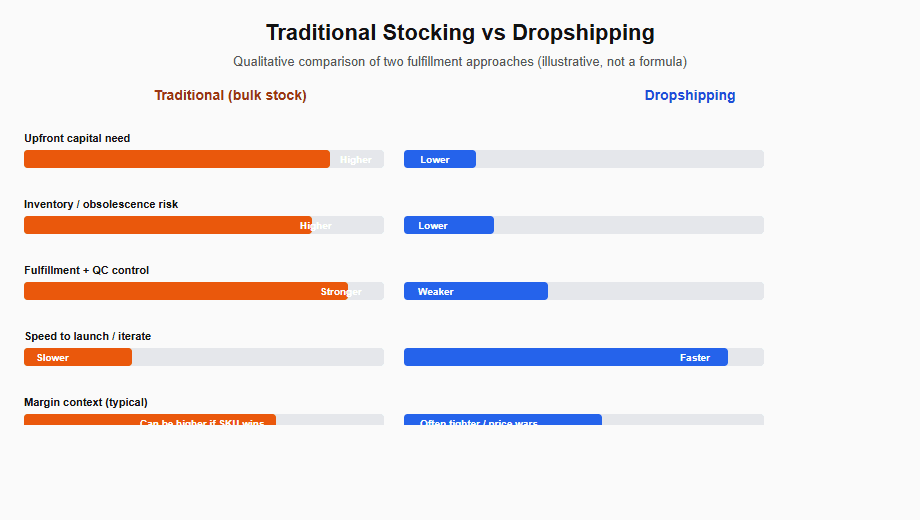
When running an online store, sellers generally face two main options: traditional bulk stocking or dropshipping. These models differ significantly in terms of capital requirements, inventory risk, operational flexibility, and supply chain control.
Traditional Stocking Model
The traditional model relies on purchasing inventory in advance. Sellers predict sales and buy products in bulk, storing them in warehouses. The advantages include full inventory control, fast shipping, and higher profit margins, especially for hot-selling products. For example, a U.S.-based sports equipment seller achieved over 200 orders per day during peak seasons, with a stable profit margin of 20%. Bulk purchasing also reduces per-unit costs, providing economies of scale.
However, the traditional model carries risks. Large capital investment is required, and inaccurate sales forecasts can result in overstock or obsolete inventory. Warehouse management demands additional labor and costs. According to statistics, roughly 35% of traditional independent store sellers struggle with inventory management and cash flow, limiting business expansion.
Dropshipping Model
Dropshipping operates on a zero-inventory, on-demand fulfillment model. Orders are sent directly from suppliers to customers. Its main advantages include low startup costs and minimal capital requirements, making it ideal for testing markets and iterating products quickly. For instance, a home gadget store processed only 3 orders per day initially using dropshipping to validate demand. After confirming product popularity, they gradually introduced local warehouses, increasing fulfillment efficiency. Within three months, their daily orders stabilized at 50.
However, dropshipping has limitations: shipping speed depends on suppliers and logistics, which can lead to delays; profit margins are typically lower than traditional stocking; and sellers have less control over product quality and after-sales service. Industry data shows that approximately 80% of pure dropshipping stores have profit margins below 10%, and only about 15% maintain long-term profitability.
In summary, traditional stocking suits sellers with sufficient capital, strong supply chain management, and validated products, while dropshipping suits low-cost, fast-launch, and flexible operations. Many independent store sellers adopt a hybrid approach: testing products via dropshipping first, then transitioning to stocked inventory or local warehouses for proven bestsellers to balance risk and maximize profit.
Why High-Quality Suppliers Matter
In 2026, finding a high-quality supplier is not just about low costs—it’s about overall supply chain stability, fulfillment efficiency, and customer experience. Low-quality supply chains may result in stock shortages, shipping delays, frequent returns, and negative brand perception, directly impacting profitability.
First, competition and product similarity compress margins. Many sellers source from the same suppliers, making price wars inevitable. Most traditional dropshipping stores have net profit margins below 10%, with only 10–20% achieving sustained profitability.
Second, logistics experience is a major competitive factor. In the U.S. and Europe, consumers expect delivery within 2–5 days. Slow shipping or opaque tracking can lead to lost orders.
Finally, supply disruptions remain a key risk. About 30% of cross-border orders may experience delayed shipping or stockouts, especially during peak seasons. High-quality supply chains ensure product availability, better user satisfaction, higher conversion rates, and repeat purchases.
Real-World Case Studies: Supply Chain Optimization Drives Growth
Case 1: Home Gadget Store
Initially, this store processed fewer than 3 orders per day, with frequent customer complaints. By introducing local warehouses overseas, implementing automated order systems, and switching to more reliable suppliers, daily orders stabilized at 50 within three months. Advertising conversion costs dropped by 20%, and overall conversion rates improved by 15%.
Case 2: Sports & Outdoor Store
This seller focused on niche products in the sports and outdoor category. By optimizing supplier relationships and fulfillment efficiency while running targeted ads, the store achieved over $2 million in total sales in a single quarter, with cumulative profits of approximately $250,000. These examples highlight how supply chain improvements reduce operational risk and increase conversion, laying the foundation for long-term profitability.
Dropshipping Operational Workflow and High-Quality Supply Chain Strategy
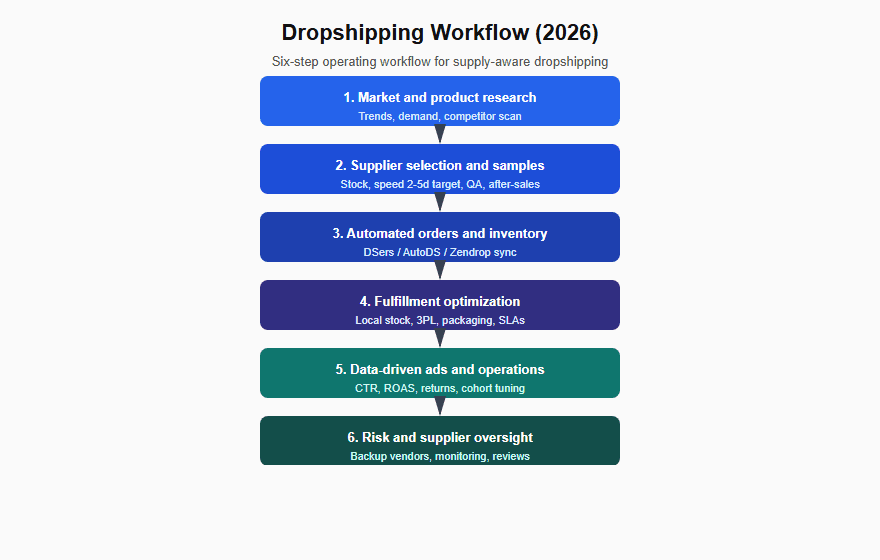
In 2026, dropshipping is no longer just a low-risk startup strategy. It must integrate supply chain optimization, data analytics, and customer experience. Below is a detailed operational workflow:
1. Market & Product Research
Use tools like Google Trends, Ahrefs, Jungle Scout, and TikTok trend data to identify market demand and product potential. Metrics include search volume, trend trajectory, and social media engagement. For instance, in 2025, home gadgets and sports accessories in the U.S. and Europe saw sustained growth, with short-video engagement up 120% YoY—ideal for testing via dropshipping.
Analyze competitors’ pricing, reviews, and advertising strategies to select high-potential, moderately competitive products for initial testing.
2. Supplier Selection & Sample Verification
Key criteria for suppliers:
Stock stability: consistent supply to prevent stockouts.
Shipping speed: ideally 2–5 days for U.S./EU markets, using local warehouses or 3PL.
Product consistency: high-quality and well-packaged items.
After-sales support: timely handling of returns or order issues.
Practical step: place small sample orders with multiple suppliers to verify logistics, packaging, and product quality. For example, a sports accessory store tested three suppliers with 10 sample items each, ultimately selecting the best-performing supplier for long-term partnership.
3. Automated Order & Inventory Management
Use tools like DSers, AutoDS, or Zendrop to sync Shopify/WooCommerce orders automatically with suppliers, reducing human error. Real-time inventory synchronization prevents overselling. Sellers with multi-channel sales can integrate Amazon, eBay, and independent store orders for centralized management.
Case: a home gadget store increased daily orders from 20 to 80 after integrating DSers, reducing error rates by 90%.
4. Fulfillment Strategy Optimization
Enhance delivery performance through:
Local warehouse placement: reduce shipping times and improve control.
3PL logistics partnerships: handle peak season surges effectively.
Pre-stock high-converting products: anticipate demand.
Packaging & user experience: enhance unboxing, reduce returns.
Example: a sports store with local warehouses in California and Texas reduced average shipping from 12 days to 3–5 days, increasing positive reviews by 35% and repeat purchase rate by 20%.
5. Data-Driven Advertising & Operations
Continuously monitor ad and order data, including CTR, ROAS, conversion, and return rates. Build core customer profiles to improve ad targeting. Monthly analysis allows quick elimination of low-performing products and campaigns.
Example: a home gadget store optimized based on analytics, increasing daily orders from 50 to 150, boosting ad ROI by 40%, and raising overall profit margin from 8% to 15%.
6. Risk Management & Supply Chain Oversight
Mitigate risks by:
Maintaining backup suppliers
Real-time inventory and order monitoring
Regular supplier performance evaluations
Seasonal forecasting and logistics coordination
Routine quality checks and streamlined returns handling
Operational Takeaways:
Data-driven product research and market testing
Verified, high-quality suppliers with sample testing
Automated order and inventory systems
Local warehouses and 3PL logistics for faster delivery
Analytics-driven advertising and operations
Comprehensive risk and supply chain management
This workflow allows dropshipping to evolve from a startup tool into a sustainable, profitable business model.
Conclusion & Future Outlook
The 2026 e-commerce landscape confirms that dropshipping still has potential, but only with high-quality supply chains and strategic operations. Low-cost bulk purchasing is no longer enough for long-term success. Profitable sellers typically exhibit:
Stable and reliable supply chains
Precise product selection
Data-driven advertising and operations
High-quality user experience and after-sales support
The hybrid model is increasingly popular: test products via dropshipping, then stock inventory or build local warehouses for validated bestsellers, ensuring growth and profitability. Sellers who excel in supply chain efficiency, fulfillment speed, customer experience, and data analysis will stand out in the independent store market.
References
SellersCommerce – Dropshipping Statistics & Trends
https://www.sellerscommerce.com/blog/dropshipping-statistics/
Dropship Lifestyle – Success Rate Statistics
https://wifitalents.com/dropshipping-industry-statistics/
Shopify Blog – Dropshipping Success Stories
https://www.shopify.com/blog/dropshipping-success