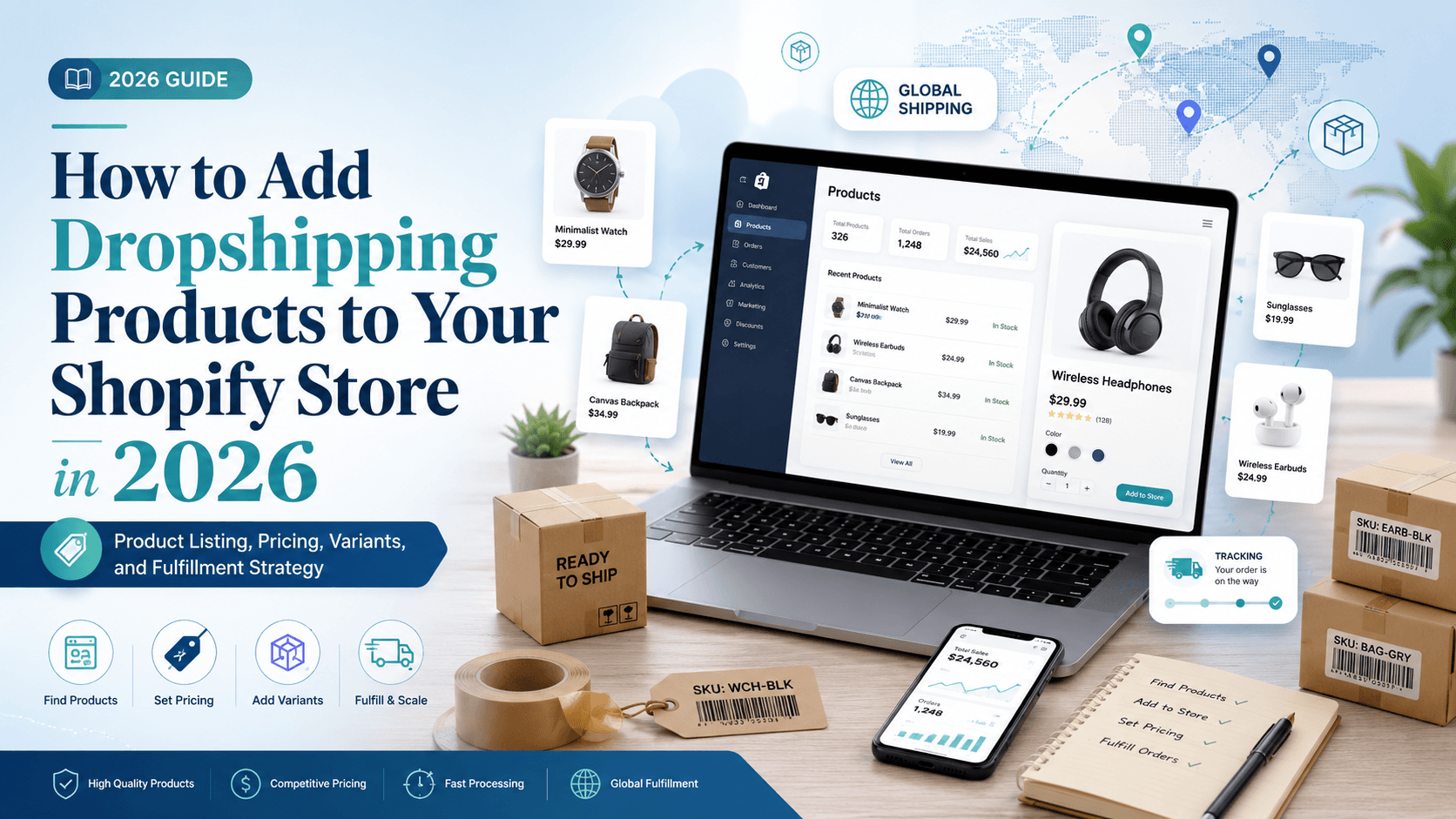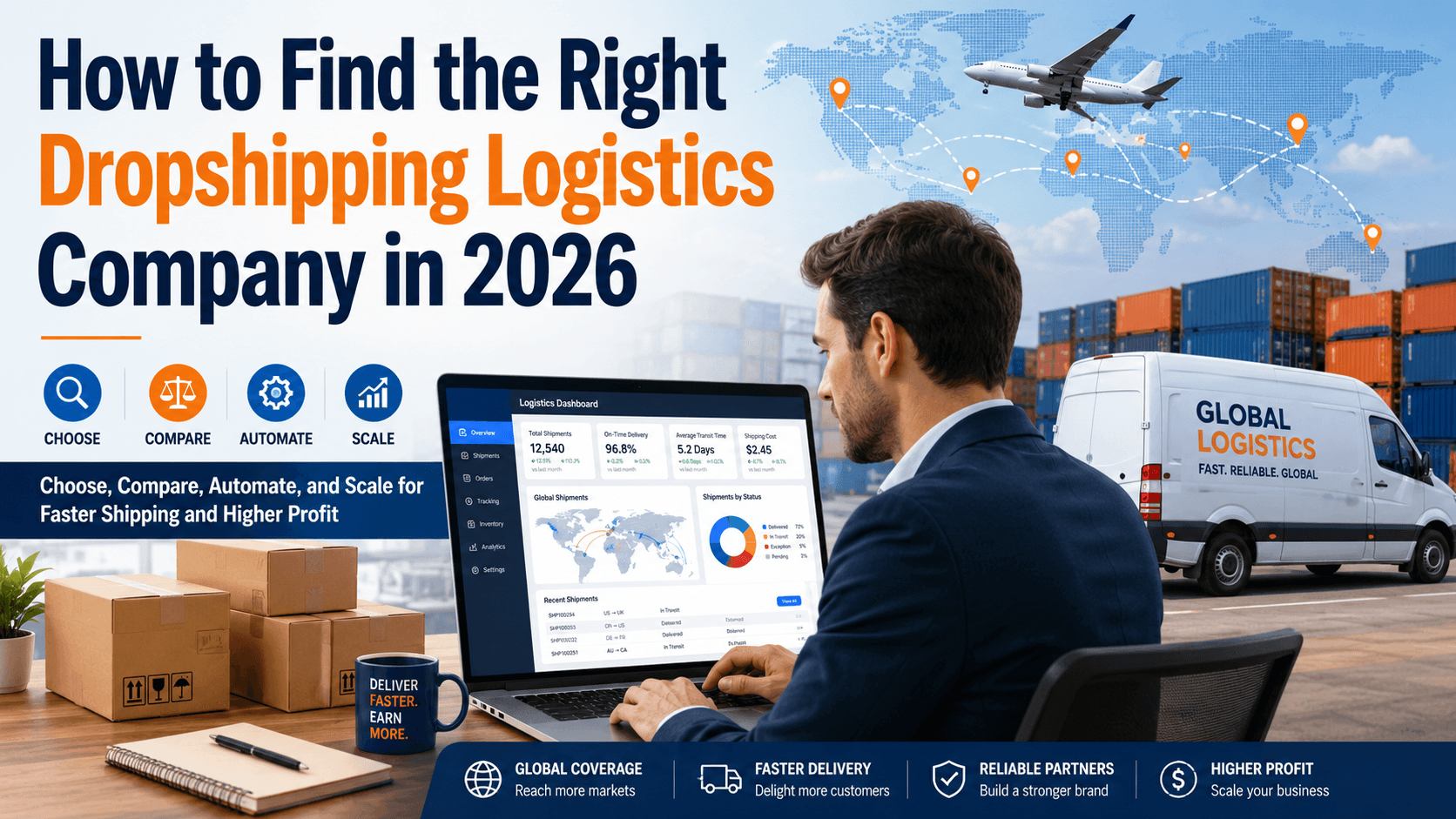
Best Shopify Dropshipping Apps for Beginners in 2026: From Store Setup to Scalable Fulfillment
1. The Real Transformation of Global E-commerce in 2026: Shopify as the Core Infrastructure for Independent Stores
By 2026, global e-commerce has entered a clear phase of structural transformation. On the surface, the industry continues to grow, but the real drivers behind that growth have changed significantly.
Shopify is one of the clearest examples of this shift. Its 2025 financial reports no longer focus only on merchant growth. Instead, they increasingly highlight ecosystem expansion, merchant quality, and the broader role Shopify plays in global commerce. This reflects a deeper market change: Shopify is no longer just a website builder. It is becoming a core operating system for independent e-commerce brands.
In the past, most online commerce traffic was concentrated on marketplaces such as Amazon and eBay. Sellers depended heavily on platform traffic, platform rules, and platform-controlled customer relationships.
By 2026, that structure has changed.
Traffic is now mainly distributed across three major channels:
* TikTok recommendation-driven content traffic
* Meta advertising systems, including Facebook and Instagram
* Google Shopping and search-based purchase-intent traffic
In this new environment, Shopify plays a different role. It is no longer simply a tool for creating an online store. It has become the central system that connects external traffic sources, manages customer journeys, and completes the full transaction loop.
According to global DTC market trends, independent stores in North America and Europe continue to grow faster than traditional marketplace-based e-commerce. This confirms a clear direction: independent stores are becoming primary brand infrastructure, not just secondary sales channels.
The deeper logic behind this shift: competition has moved from traffic access to control power
The core change is not that e-commerce has simply become harder. The real change is that the nature of competition has evolved.
In traditional marketplace systems, sellers operate within a fixed structure. Traffic is controlled by the platform. Rules are defined by the platform. Customer data also belongs to the platform.
In the Shopify-based model, the situation is different. Traffic comes from external advertising and content platforms, but the seller controls the storefront, customer data, conversion path, and post-purchase experience.
This means competition is no longer only about who can acquire cheaper traffic. It is about who can control the full customer journey from first impression to final conversion.
Rising advertising costs are reshaping profitability
Over the past two years, the advertising landscape has changed rapidly.
According to WordStream’s 2025 advertising industry data, Meta Ads CPMs have increased across multiple industries, with some verticals experiencing even sharper growth. TikTok advertising competition has also intensified as more sellers enter the same content-driven traffic environment.
The result is straightforward: the era of relying on cheap traffic to generate easy profits is disappearing.
In 2026, the key question for Shopify sellers is no longer whether traffic exists. The real question is whether their conversion rate, fulfillment experience, and profit margin are strong enough to support paid acquisition costs.
Within this structure, one factor that many beginners underestimate becomes critical: fulfillment experience. Shipping speed, delivery reliability, tracking accuracy, and refund control are no longer backend details. They directly influence customer trust, ad performance, and the ability to scale.
2. What Are Dropshipping Apps? They Are Not Just Tools, but the Execution Layer of the Supply Chain
Many beginners think of dropshipping apps as simple product sourcing tools or Shopify plugins. In the real business environment of 2026, however, their role is much more important.
Dropshipping apps function as the execution layer between a Shopify store and the supply chain. Their job is to turn customer orders into actual fulfillment actions.
In other words, they are not just support tools. They are order execution systems.
Their position in the full e-commerce structure
A complete Shopify dropshipping system consists of several connected layers.
Trafifc comes from TikTok, Meta, Google, or other channels. Visitors enter the Shopify store and decide whether to purchase. Once an order is placed, it flows into the dropshipping app. From there, suppliers process the order, logistics providers complete delivery, and tracking information is sent back to the customer.
Within this structure, the dropshipping app acts as a coordination layer. It is responsible for order routing, supplier matching, inventory synchronization, tracking updates, and fulfillment control.
If this layer becomes unstable, the entire business chain is affected.
Why this layer is critical in 2026
As customer expectations for delivery experience continue to rise, fulfillment quality has a direct impact on conversion rates and customer retention.
In real operations, the impact is even more obvious.
Slow shipping can lead to abandoned purchases. Unstable logistics can increase refund rates. High refund rates can damage customer satisfaction and ad account performance. Once advertising performance declines, acquisition costs rise and scaling becomes more difficult.
In 2026, fulfillment is no longer a backend issue. It has become part of the advertising system itself.
Real example: how the same product performs differently under different systems
Take a typical TikTok viral product, such as a portable massage device.
A seller using basic AliExpress direct fulfillment may experience shipping times of 12 to 20 days, refund rates above 15%, and ROAS between 1.2 and 1.6. Under these conditions, scaling becomes difficult even if the product has demand.
In contrast, a seller using a more structured fulfillment system such as CJ, Zendrop, or a managed supply chain partner may reduce shipping times to 5 to 9 days, lower refund rates to 5% to 8%, and achieve a stronger ROAS range.
The product itself has not changed. What changes is the system behind it.
3. The Advantages and Structural Limits of Dropshipping in 2026
Dropshipping still exists in 2026, but it is no longer the simple low-cost business model many beginners imagine. It has evolved into a more structured commercial system.
The advantages remain, but they are no longer enough
From a cost perspective, dropshipping still has a relatively low entry barrier. A beginner can usually launch a test with only a few hundred dollars.
However, low entry cost is no longer a strong competitive advantage. The number of sellers entering similar markets has increased significantly, and many products become saturated quickly once they gain attention on TikTok, Meta, or Amazon.
Fast validation, but equally fast failure cycles
One of the biggest advantages of dropshipping is rapid market validation. A product can often be tested within 3 to 7 days to determine whether it has conversion potential.
But in 2026, this speed also means faster failure cycles. Poor product selection, weak product pages, unstable fulfillment, or ineffective advertising creatives can quickly drain an advertising budget.
Dropshipping allows sellers to test faster, but it also exposes weak systems faster.
The market has become clearly segmented
By 2026, the dropshipping market has naturally divided into several types of sellers.
Some sellers focus mainly on rapid product testing. Their goal is to validate demand as quickly as possible.
Some sellers move into operational stability. They use systems like CJ or Zendrop to improve fulfillment reliability after finding products that show potential.
More advanced sellers build system-level operations using automation tools, supply chain partners, or platforms such as AutoDS and ETdropship to support scaling.
This means the Shopify dropshipping ecosystem has become much more structured. The core competition is no longer only product selection. It is supply chain capability, fulfillment stability, and system scalability.
Dropshipping apps are no longer simple plugins. They are the execution core of the entire commercial system.
Why Choosing a Dropshipping App in 2026 Means Choosing a Supply Chain System
1. The real difference is not the interface, but the supply chain behind it
In the Shopify ecosystem of 2026, choosing a dropshipping app is no longer just about comparing dashboards, automation features, or product catalogs.
The real difference lies in the supply chain structure behind each app.
Most beginners evaluate tools based on surface-level factors such as ease of use, product availability, or whether the app can import products with one click. These factors matter, but they do not determine long-term performance.
What truly determines success is whether the system can maintain stable fulfillment under advertising pressure, handle scaling demand, reduce refund risk, and support consistent customer experience.
In other words, the competition is not only between tools. It is between supply chain architectures.
2. CJ Dropshipping: A Mid-Layer Supply Chain Infrastructure
CJ Dropshipping is often one of the first structured options for sellers moving away from basic AliExpress fulfillment.
It should not be viewed simply as a product sourcing tool. It is closer to a hybrid supply chain system that introduces partial standardization into fulfillment operations.
Operational strength: moving from uncontrolled to semi-controlled fulfillment
One of CJ’s main advantages is that it reduces the randomness often found in direct supplier models.
Compared with AliExpress, where fulfillment depends heavily on individual sellers and suppliers, CJ introduces a more centralized workflow, more standardized logistics routes, and partial warehouse support.
This improves shipping predictability, which becomes increasingly important once paid advertising is involved.
Another advantage is that order processing becomes more automated. Orders can be routed through the system without requiring manual intervention at every step, reducing operational friction as sales volume increases.
However, CJ is still a semi-structured system rather than a fully controlled supply chain.
Key limitation: supply chain consistency is not always stable
Despite its advantages, CJ still has structural limitations.
Product quality may vary depending on suppliers. Fulfillment performance during peak demand periods may not always be consistent. Customer support responsiveness can also differ across regions, suppliers, and product categories.
As order volume increases, these inconsistencies become more visible and may directly affect customer satisfaction.
Best fit
CJ is best suited for sellers who have already validated product demand and are transitioning from basic testing to more stable operations.
It is less ideal for sellers who need fully customized supply chain management or high-level scaling control, but it can be a useful bridge between unstable sourcing and structured fulfillment.
3. Zendrop: A Simplified Fulfillment System for Beginners
Zendrop follows a different philosophy from supply chain-heavy platforms.
Instead of focusing on maximum flexibility or deep supplier control, it focuses on simplifying the fulfillment process for beginners.
Core advantage: reducing operational barriers
The main value of Zendrop is that it makes dropshipping easier to start.
Rather than requiring complex supplier management, manual order handling, or advanced logistics configuration, Zendrop allows users to automate many basic fulfillment processes through a simplified interface.
This makes it easier for beginners to launch their first Shopify store without being overwhelmed by technical or logistical complexity.
In some cases, Zendrop also offers access to US-based inventory, which can significantly reduce shipping times compared with traditional overseas fulfillment models.
Structural limitation: limited supply chain depth
The simplicity of Zendrop also comes with trade-offs.
Product selection may be more limited than broader sourcing ecosystems. Pricing flexibility may also be lower, which can make margin optimization more difficult.
Zendrop is not designed for highly complex scaling strategies, multi-supplier optimization, or deep supply chain customization.
Best fit
Zendrop is most suitable for beginners who want to launch quickly, validate their first product, and avoid building a complicated operational structure from the beginning.
4. AutoDS: An Automation Layer for Scalable Operations
AutoDS operates at a different level from entry-level dropshipping tools or traditional sourcing platforms.
It is not primarily a sourcing system. It is an automation layer designed to help sellers scale operations.
Core function: reducing manual workload
The main value of AutoDS is reducing repetitive manual work across multiple operational areas.
It can monitor product price changes, synchronize inventory data, automate order placement, manage product listings, and support multi-store operations from a centralized system.
This becomes especially important when a seller starts managing multiple products, running multiple advertising campaigns, or operating more than one store.
Without automation, manual workload quickly becomes a bottleneck.
Structural challenge: higher setup complexity
Although AutoDS is powerful, it also introduces a higher level of operational complexity.
The initial setup requires users to understand automation rules, integration flows, product monitoring logic, and supplier connections.
For beginners, this can create a learning curve that slows down early execution.
Best fit
AutoDS is most suitable for sellers who have already gained some operational experience and are entering the scaling phase.
It is especially useful for sellers managing multiple products, multiple suppliers, or multiple Shopify stores.
5. Spocket: A Localized Supply Chain Model for Western Markets
Spocket represents another direction in the dropshipping ecosystem. Instead of focusing on broad global sourcing, it focuses more on localized supply chains.
Core strength: faster delivery through local suppliers
Spocket mainly connects sellers with suppliers based in the US and Europe.
This can significantly reduce shipping times compared with traditional cross-border fulfillment models. Depending on the supplier, products may arrive within 2 to 7 days.
This level of delivery speed creates a customer experience closer to mainstream e-commerce platforms such as Amazon.
Structural limitation: higher cost pressure
The trade-off for faster delivery is higher product cost.
Margins are usually lower than overseas sourcing models, which makes Spocket less suitable for aggressive pricing strategies or high-volume, low-margin scaling.
Product selection is also more limited compared with broader global sourcing networks.
Best fit
Spocket is generally better for sellers targeting higher-end positioning, where customer experience and delivery speed matter more than the lowest possible product cost.
6. ETdropship: A System-Level Supply Chain Architecture
ETdropship operates at a more structural level than many traditional dropshipping tools.
Instead of focusing only on individual features, it emphasizes supply chain orchestration.
Core concept: moving from tools to system architecture
The key difference with ETdropship is that it is not designed only to help sellers find products. Its purpose is to manage supply chain structures as a unified system.
This includes supplier coordination, fulfillment routing, inventory risk reduction, order handling, and logistics management across multiple sources.
The goal is not just convenience. The goal is system stability under scaling conditions.
Why this matters in scaling environments
Once advertising volume increases, the main constraint is no longer product selection. It becomes supply chain stability.
Problems such as stockouts, delayed fulfillment, inconsistent shipping times, and weak supplier coordination can directly affect advertising performance.
Systems like ETdropship are designed to reduce these risks by helping sellers stabilize fulfillment across multiple suppliers and routes.
For sellers who are moving beyond basic product testing and want to build a more reliable fulfillment structure, this type of system-level supply chain support becomes increasingly important.
7. Comparative Logic: Choose by Stage, Not by Features
When these tools are viewed together, their differences become clearer.
Zendrop focuses on lowering entry barriers.
CJ supports sellers moving into a more structured fulfillment stage.
AutoDS helps sellers automate operations at scale.
Spocket focuses on localized delivery and faster customer experience in Western markets.
ETdropship provides system-level supply chain stability for sellers who need more control and scalability.
Each tool represents a different operational stage. The question is not simply which app is “best.” The better question is: which supply chain structure matches your current business stage?
By 2026, choosing a Shopify dropshipping app is no longer about picking the tool with the most features. It is about matching your fulfillment system to your growth stage, advertising pressure, and operational needs.
2026 Shopify Dropshipping Execution Workflow: From Zero to First Sale and Scaling
1. Pre-Launch Mindset: You Are Not Building a Store, You Are Running a Validation System
Before starting any technical setup, beginners need to understand what a Shopify dropshipping business actually is in 2026.
A Shopify store is not the final product. It is a testing environment where multiple variables are continuously validated.
The workflow is not a simple sequence of “set up, launch, and profit.” Instead, it operates through repeated cycles:
* traffic injection
* behavior observation
* product validation
* fulfillment adjustment
* advertising optimization
Each cycle produces data. Decisions are then made based on how that data behaves under real paid traffic conditions.
2. Shopify Store Setup: Structure Matters More Than Design
During the setup stage, many beginners spend too much time on visual design.
But in real advertising environments, design is secondary to structural clarity.
A store that converts paid traffic must help users quickly understand three things:
* what the product is
* what problem it solves
* why they should buy it now
If these points are not clear within the first few seconds, better colors, fonts, or animations will not significantly improve conversion performance.
Information hierarchy inside a high-converting store
Most stores that perform well under paid traffic follow a similar structure.
The first section usually focuses on visual demonstration, often through short-form video. This reduces cognitive load and helps visitors understand the product quickly.
The next section shows how the product is used in real-life situations, allowing users to mentally imagine owning and using it.
Functional descriptions come later, but they should be framed around problem-solving rather than technical specifications.
Trust elements such as reviews, shipping policies, guarantees, and FAQs are placed strategically to reduce hesitation.
3. Choosing a Dropshipping App: A Supply Chain Decision, Not a Tool Decision
Within a dropshipping system, apps are not just plugins. They represent different levels of supply chain architecture.
Each tool corresponds to a different operational stage.
Testing stage: validating demand with minimal complexity
At the beginning, the goal is not optimization. The goal is validation.
Tools like Zendrop are often used because they reduce operational friction and allow orders to flow from store to supplier without complex configuration.
The primary requirement at this stage is not advanced efficiency. It is stable basic order execution.
Transition stage: when fulfillment starts affecting performance
Once orders become more consistent, the focus shifts from validation to reliability.
At this stage, systems like CJ Dropshipping are commonly used because they provide more structured fulfillment routes and partial warehouse support.
Fulfillment is no longer just a backend process. It begins to influence advertising performance directly.
Scaling stage: automation becomes the limiting factor
When advertising volume increases, manual processing becomes unsustainable.
Systems like AutoDS help automate repetitive work such as order processing, inventory synchronization, product monitoring, and multi-store management.
More advanced supply chain partners such as ETdropship can extend this further by turning fulfillment into a unified supply chain management layer.
At this stage, the focus shifts from simply handling orders to maintaining system stability under higher volume.
4. Product Validation: Filter for Ad Compatibility, Not Just Market Trends
In 2026, product selection is no longer only about chasing trends.
The key question is whether a product can survive paid advertising conditions.
Where product ideas actually come from
Most experienced sellers do not rely on a single product research source. Instead, they cross-check signals from multiple environments.
TikTok provides behavioral signals by showing what types of content naturally attract attention.
Meta Ads Library provides competitive density insights by revealing which products are actively being advertised.
Amazon reviews help sellers understand demand patterns, customer complaints, and emotional triggers.
The goal is not simply to find a popular product. The goal is to find a product that can be clearly demonstrated, profitably advertised, and reliably fulfilled.
Filtering logic used in real operations
A product is usually evaluated based on whether it can be understood visually in a few seconds.
If a product requires too much explanation instead of demonstration, it often performs poorly in paid advertising environments.
Pricing also matters. Mid-range products often perform better in early testing because they create lower decision friction while still allowing room for profit.
Logistics complexity is another important factor. Products with unstable fulfillment structures may fail during scaling even if they perform well in early tests.
5. Product Page Optimization: Conversion Speed Matters More Than Design Quality
In paid traffic environments, users rarely read product pages in detail. They scan quickly and make fast decisions.
The purpose of a product page is not to provide every possible detail. Its purpose is to reduce decision time.
Video content often performs better than static images because it demonstrates real-world usage more effectively.
Problem framing usually works better than feature listing because customers respond more strongly to pain points than technical specifications.
Reviews function mainly as risk-reduction signals. Their role is not only to persuade, but to reduce hesitation before purchase.
6. Advertising Testing: A Filtering Mechanism, Not a Growth Engine
On platforms like Meta, most products do not become profitable in their first advertising cycle.
Advertising should not be treated as an instant growth engine. In the early stage, it is mainly a filtering mechanism.
The goal is to eliminate weak products, weak creatives, and weak offers quickly.
Multiple creatives are usually tested for each product because user response varies significantly across different angles and formats.
Early evaluation often starts with engagement signals such as click-through rate. Then sellers look at behavioral signals such as add-to-cart activity. Only after enough data is collected should conversion-level performance be judged more seriously.
7. Fulfillment Execution: The Stage That Determines Whether Scaling Is Possible
Once orders begin flowing through the system, fulfillment becomes one of the most important factors in overall performance.
The process starts when an order is placed in Shopify. It then passes through the dropshipping app, moves to the supplier or fulfillment partner, and finally enters the logistics system for delivery.
Although this structure appears simple, its impact on advertising performance is significant.
Unstable fulfillment can increase refund rates, delay delivery, hurt customer satisfaction, and create negative feedback loops that eventually limit ad scaling.
This is why fulfillment should not be treated as a secondary operation. In 2026, fulfillment quality is part of the growth system.
8. Scaling Phase: Structure Replaces Individual Execution Ability
Once a product reaches stable performance, operational priorities change.
Increasing the advertising budget alone is not enough. The system must be able to support larger traffic and order volume without breaking down.
This requires continuous creative iteration, reliable supply chain performance, stable inventory management, and expansion into related product categories.
Many sellers gradually move from single-product testing into multi-product stores or niche-focused brand structures.
By 2026, Shopify dropshipping operates as a structured system rather than a simple selling model.
The outcome of a business is no longer determined by one product or one advertising campaign. It is determined by the interaction between validation speed, fulfillment stability, and scaling capacity.
Dropshipping apps exist to support this structure. Their real value is not just importing products or automating orders. Their value is helping the business continue operating under real advertising pressure.
Final Summary
Across the entire 2026 Shopify dropshipping ecosystem, success is shaped less by individual products and more by how different system layers interact under real advertising pressure.
A Shopify store is no longer just a traditional online shop. It functions as a controlled environment where demand signals are tested through paid traffic, customer behavior, and fulfillment feedback.
Traffic may come from Meta, TikTok, Google, or other channels. But what happens after the click determines whether the business can survive and scale.
At the center of this structure are dropshipping apps. They are not simply supporting tools. They function as the execution layer between the storefront and the supply chain.
Their role is to translate demand into fulfillment under conditions where timing, consistency, delivery reliability, and customer experience directly influence advertising performance.
Different apps represent different levels of operational maturity. Some are designed to simplify entry. Others stabilize mid-stage operations. A smaller group is built for scaling environments where automation, supplier coordination, and supply chain reliability become essential.
In the early stage, product performance is mainly evaluated through advertising behavior. Clicks, engagement, add-to-cart activity, and early purchase intent act as filtering signals rather than final success indicators.
As the business evolves, fulfillment stability becomes increasingly important. Delivery delays, refund rates, tracking issues, and operational inconsistencies all feed back into ad performance and customer trust.
At later stages, scaling is no longer driven only by finding new products. It depends on maintaining system consistency under increasing order volume.
Seen as a whole, modern dropshipping operates as a continuous loop rather than a linear process. Product selection, advertising, fulfillment, customer experience, and automation all influence each other in real time.
The dropshipping model in 2026 is therefore not just about launching products quickly. It is about whether the entire system can remain stable while operating under sustained advertising pressure.
FAQ:
1. What is the best Shopify dropshipping app for beginners in 2026?
The best Shopify dropshipping app depends on your business stage. For beginners, Zendrop is often easier to start with because it simplifies product importing and order fulfillment. CJ Dropshipping is better for sellers who want more structured sourcing and fulfillment. If you are planning to scale with automation, AutoDS or a more supply-chain-focused solution like ETdropship may be more suitable.
2. Are dropshipping apps still worth using in 2026?
Yes, dropshipping apps are still worth using in 2026, but their role has changed. They are no longer just simple product-importing tools. A good dropshipping app now acts as the execution layer between your Shopify store and your supply chain, helping manage orders, suppliers, inventory, tracking, and fulfillment reliability.
3. What should beginners look for in a Shopify dropshipping app?
Beginners should focus on fulfillment stability, shipping speed, ease of use, product quality, supplier reliability, and order automation. Many new sellers only compare product catalogs or app interfaces, but the real long-term difference comes from how stable the fulfillment system is once orders start coming in.
4. Is Shopify dropshipping still profitable in 2026?
Shopify dropshipping can still be profitable in 2026, but it is more competitive than before. Profitability now depends on product selection, ad creatives, conversion rate, fulfillment speed, refund control, and supply chain stability. Sellers can no longer rely only on cheap traffic or trending products.